Primarosa Cesarini Sforza, Ines Fontenla, Thorsten Kirchhoff, Daniela Monaci, Luana Perilli at Galleria Emmeotto, from October 3 to November 27, 2026
https://www.estateromana.com/en/rome/trip-planner/primarosa-cesarini-sforza-ines-fontenla-thorsten-kirchhoff-daniela-monaci-luana/
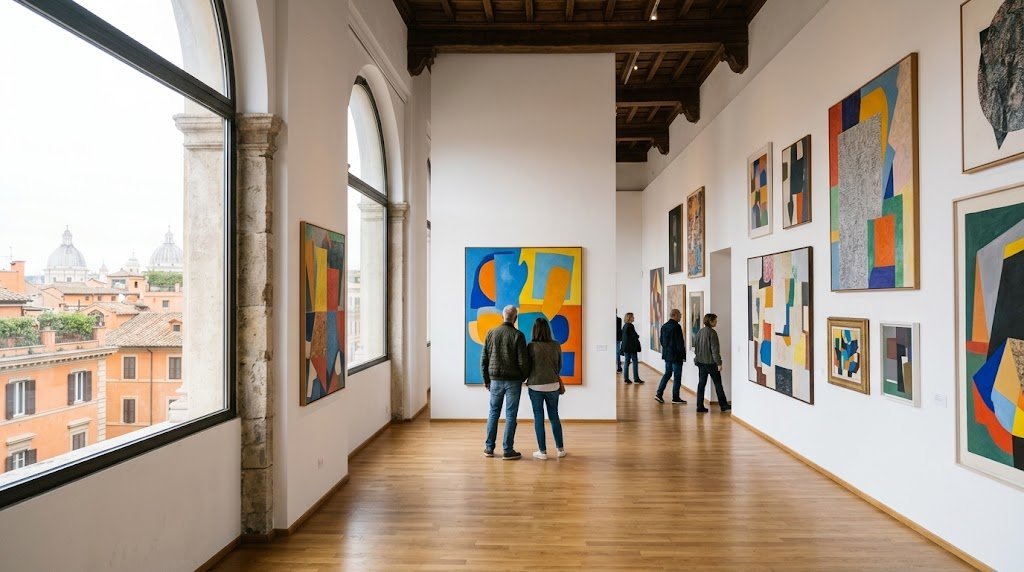
The exhibition with works by Primarosa Cesarini Sforza, Ines Fontenla, Thorsten Kirchhoff, Daniela Monaci and Luana Perilli, curated by Ada Lombardi, is open at Galleria Emmeotto Arte, at via di San Pantaleo 66, in the Parione district, from October 3 to November 27, 2026. The opening is on Saturday, October 3, 2026 from 17:00 to 20:00, then from October 5 to November 27 Monday to Friday, from 15:00 to 19:00. Admission is free. The gallery is a few steps from Piazza Navona and Palazzo Braschi. The closest bus stops are on corso Vittorio Emanuele II (C.so Vittorio Emanuele/Navona) and on corso del Rinascimento, about 100 meters away. The closest tram stops in Piazza Benedetto Cairoli (Arenula/Cairoli), about half a kilometer away. There are no tickets to buy: just show up during opening hours.
The Cesarini Sforza, Fontenla, Kirchhoff, Monaci and Perilli exhibition in brief
Five artists who live and work in Rome, one curator, an ancient question: what do we call home? Galleria Emmeotto exhibition is the Roman section, hosted in a private space in the historic center, of a broader international project, States of Uncertain Domesticities, which from September 19 to November 8, 2026 also occupies Museo Carlo Bilotti, in the Aranciera of Villa Borghese.
Dates and hours
Public opening is Saturday, October 3, 2026, with the opening reception from 17:00 to 20:00. From October 5 to November 27 the gallery is open Monday to Friday, from 15:00 to 19:00. On Saturday and Sunday, after the opening day, the gallery doesn't appear in the published hours: whoever comes from outside Rome for a weekend has to take that into account.
The price
Admission is free, as is usual in private galleries. There is no ticket office and no need to book for an individual visit. For a large group it's a courtesy to notify the gallery first, because the rooms are sized for a few people at a time.
Who is behind the exhibition
The curatorship is by Ada Lombardi, who also curates, together with Alba D'Urbano, the exhibition at Museo Carlo Bilotti. The curator's text accompanies the catalog, whose presentation is announced for October.
States of Uncertain Domesticities: the project Galleria Emmeotto exhibition comes from
The via di San Pantaleo section is better understood if you know the parent project. States of Uncertain Domesticities is an international traveling exhibition that, before Rome, stopped in Berlin and Brno. In Rome it arrives with a new installation, devoted to the theme of home and dwelling, approached from an openly feminist, political and social perspective.
The exhibition at Museo Carlo Bilotti
At the Museo Carlo Bilotti, in the Aranciera of Villa Borghese, the curators Alba D'Urbano and Ada Lombardi selected about 30 works among videos, paintings, sculptures and environmental installations, by international artists of different generations. The opening took place on Friday, September 18. The exhibition is open until November 8, 2026, Tuesday to Friday from 10:00 to 16:00, Saturday and Sunday from 10:00 to 19:00, closed Monday. The entrance is at viale dell'Aranciera 4, with a second access from viale Fiorello La Guardia 6.
Who sponsors and who organizes
The Roman project is sponsored by Roma Capitale, Department of Culture, and by the Sovrintendenza Capitolina ai Beni Culturali. The organization is by the Comitato Roma Radici, in collaboration with the Institut für Auslandsbeziehungen (ifa). Among the partners are Accademia di Belle Arti di Roma, Casa Internazionale delle Donne and House of Arts. Technical and logistical support comes from Galleria Emmeotto, from Haus. Kunst. Mitte. and from the Residenze di Artisti Qwatz. The patronage is by the Embassy of the Federal Republic of Germany and the association Altritalia Ambiente.
Why two venues
The choice to split the project between a civic museum inside a park and a private gallery in the historic center has a precise logic. At the Bilotti is the international picture. At the Emmeotto is the focus on a group of artists who live and work in the host city. Two of them, Luana Perilli and Thorsten Kirchhoff, appear at both venues, and the works answer each other at a distance: Perilli's series Regeneration, for example, is shown at the Bilotti and continues in the gallery with the ceramic nests.
What the exhibition is about: home as a place
The exhibition reflects on the contemporary meaning of dwelling in an era marked by migration, environmental crises and social transformations, and proposes a dialogue between contemporary artistic research and Roman cultural heritage. The starting point, in the words of the curatorial text, is the archetype of the home and its many transformations.
Care as the central theme
The thread the curator identifies among the works is that of care: many women artists point to it as a fundamental element of the home and as a factor of identity, while in capitalist society care remains a marginalized activity, often invisible and unrecognized. It's a sharp reading, and the exhibition supports it with works very different from one another, from pencil drawing to ceramics, from installation to painting with electric lights.
Rome as material
The curatorial text insists on a point that whoever knows the city recognizes at once: in Rome the layers of the past are visible in the very matter of urban space. In a city made like this, awareness of the ecological crisis takes a particular form, which the curator calls eco-anxiety. It's not an isolated case: several works in the exhibition look at ancient painting, frescoes, Roman and Pompeian houses as a repertoire of images of friendly nature.
Our opinion
The exhibition works because it doesn't claim to answer. Five different languages, in rooms of domestic size, do what a large museum can't: they put the visitor in the position of someone entering another person's home. It's the right format for this theme.
The works on show at Galleria Emmeotto, artist by artist
The presentation text describes the works one by one. Here is what you see, in the order in which the curator tells them.
Daniela Monaci, Fragments of a Lover's Discourse
Daniela Monaci's installation shows parts of the body, hands, thighs, a shoulder, treated as rooms in which emotion, eros and desire dwell. Mind and body fuse, in open contrast with the mechanical conception of the body elaborated by Descartes and Hobbes. The title brings to mind Roland Barthes's A Lover's Discourse: Fragments: the home, here, is the body itself.
Primarosa Cesarini Sforza, two oils and two artist's books
Primarosa Cesarini Sforza shows two oil paintings and two artist's books that refer to the frescoes of the House of Livia on the Palatine and those of the House of the Golden Bracelet in Pompeii. Nature appears there as a maternal space, safe and familiar, part of the very idea of home and protected by the ancient Lares. In her works this memory resurfaces as a happy time, far from the unease of the present.
Ines Fontenla, the tree and the chairs
On the main wall of the room Ines Fontenla made a large pencil drawing: a tree under whose branches chairs find a place. The idea, stated in the curatorial text, is that humanity's first home was trees, and that the sense of belonging to the natural world is engraved in us. The curator evokes Odysseus and the longing to return.
Luana Perilli, Regeneration and the ceramic nests
Luana Perilli develops the idea of the natural home. The series Regeneration, already shown in the Bilotti section, is made of prints taken from entomology books and tells the world of ants: the ability to build a common home, feed, protect themselves and act as a single organism. In the gallery the reflection continues with ceramic nests suspended in space.
Thorsten Kirchhoff, Cistite Intercontinentale
The itinerary closes with Thorsten Kirchhoff, a Danish artist who chose Rome as his home, the only man among the artists of the two exhibitions. His work Cistite Intercontinentale tackles with irony the way the identity of the housewife was turned into a sweetened and desirable image, and explicitly recalls Richard Hamilton's 1956 collage Just what is it that makes today's homes so different, so appealing? In the painting are inserted real, working electric lights.
Thorsten Kirchhoff: biography and career
Thorsten Kirchhoff was born in Copenhagen in 1960 and lives and works in Rome. His research crosses painting, objects, installations and video, and he often works on images taken from cinema, reworked into multimedia works, paintings and sound works.
The Biennials
Kirchhoff took part twice in the Venice Biennale: in 1990 in the Aperto '90 section of the 44th edition, and in 1993 at the 45th edition, in the exhibition La coesistenza dell'arte curated by Lorand Hegyi and Luisa Somaini. In 2001 he was at the first Valencia Biennial. Later he also exhibited at the Beijing International Art Biennale.
Solo shows
The curriculum published by his Turin gallery lists solo shows at Galleria Gian Enzo Sperone in Rome, Galleria Massimo De Carlo in Milan, Galleria Alberto Peola in Turin, the Lucas Schoormans Gallery in New York, the MAN in Nuoro, Fondazione Bevilacqua La Masa in Venice and Fondazione Merz in Turin. In Rome he exhibited at the Danish Academy, with Una serata con il Dottor Hoffmann curated by Cristiana Perrella, and at the Quadriennale, with Retrovisione curated by Lucilla Meloni.
Group shows in museums
Among the group shows are the Neue Galerie am Landesmuseum Joanneum in Graz, the Musée d'Art Contemporain in Lyon, the Arken Museum for Modern Kunst in Copenhagen, the Vietnam National Museum of Fine Arts in Hanoi, the Center of Contemporary Art in Tel Aviv, the Triennale di Milano and, in Rome, Palazzo Barberini, with Cose mai viste curated by Achille Bonito Oliva, and Palazzo delle Esposizioni, with WelcHome.
A thread leading to the home
It's not the first time Kirchhoff has worked on the theme of domestic space. His curriculum includes La Casa, at the Magazzino d'Arte Moderna in Rome, curated by Alessandra Galletta, and Ironia Domestica, a curious look across Italian private collections, at the MUSEION in Bolzano, curated by Letizia Ragaglia. The title of the latter could serve as a subtitle to his work on via di San Pantaleo.
Primarosa Cesarini Sforza: biography and career
Primarosa Cesarini Sforza comes from a family of artists, the Cascella Cesarini Sforza family network, and has said she understood very early that her world would be art. Raised in Rome, in a house in Piazza del Collegio Romano, at 20, in 1966, she moved to the United States to join her father.
The American years
Her first commission was a large mosaic in front of an Italian pastry shop in New York, in 1967. From 1969 she began making the Boxes, accumulations of objects that seem to push outward, shown by Allan Stone in 1971. Between 1971 and 1972 she moved to Wisconsin, where she taught a ceramics course at the university: from that period come the white drawings, born, as she herself has told, from watching the snow from the window.
Morocco, Paris, Spain
At the end of the 1980s the candor of those works was swept away by the colors of Morocco, where the artist returned for 20 years in a row. From there comes the dense weave of colored threads that frames her drawings. Then there is a Paris period, with dark works enclosed in frames, and the diary books made during her travels, in particular in Spain.
The retrospective at Villa Torlonia
In 2023 the Casino dei Principi, in the park of Villa Torlonia, devoted to her the retrospective La materia e il perimetro, curated by Michela Becchis, open from April 5 to July 2: five decades of drawings, paintings, installations, ceramics and artist's books, with the most recent works, colorful and full of flowers, threads and birds, born in her house in the woods in Umbria, and with the use of lead to forge leaves applied to the canvases.
A curiosity about Primarosa Cesarini Sforza, Ines Fontenla, Thorsten Kirchhoff, Daniela Monaci, Luana Perilli at Galleria Emmeotto, from October 3 to November 27, 2026
The exhibition's best curiosity is a quotation hidden in plain sight. Thorsten Kirchhoff's Cistite Intercontinentale recalls a work that many textbooks cite as one of the starting points of Pop Art: Just what is it that makes today's homes so different, so appealing?, the small collage made by Richard Hamilton in 1956. That collage was, already 70 years ago, an ironic portrait of the modern home, full of appliances, advertising and magazine bodies.
Kirchhoff takes up its spirit and shifts it to the role of the housewife, turned by the imagery of advertising into a sweetened and desirable image. Then he adds an element that gets lost in a photographic reproduction: real, working electric lights, inserted into the painting. In front of the work the question changes nature. You are no longer looking at a painting that represents a home, but at an object that, like a home, lights up.
The curatorial text describes the effect as a disorientation that forces you to ask if the reality we live in is authentic or a complicated dream. It's a question that often returns in Kirchhoff's work: his research has long started from the images of cinema to build situations suspended between narrative and perception. His curriculum even includes a group show with an eloquent title, Ironia Domestica, at the MUSEION in Bolzano.
There is also a second curious detail, a statistical one. Among all the artists of the two venues of the project, at the Bilotti and in the gallery, Kirchhoff is the only man. In an exhibition that approaches the home from a feminist perspective, the presence of a single male gaze, moreover an ironic one aimed precisely at stereotypes about women, is a precise curatorial choice. The text says it clearly: his work closes the itinerary, but in reality opens it.
Galleria Emmeotto: from via Margutta to via di San Pantaleo
Galleria Emmeotto is a private Roman contemporary art gallery that for this exhibition welcomes the public at via di San Pantaleo 66, in the Parione district. Its recent history is a story of moves, and each venue left a mark on the way of understanding the exhibition space.
The via Margutta years
Emmeotto was born on via Margutta, the street of artists' studios between Piazza del Popolo and Piazza di Spagna. In May 2012 it left that venue for a new adventure, described at the time by the specialized press as a change of course toward a cross-disciplinary project.
Palazzo Taverna season
In 2012 the gallery moved to Palazzo Taverna, seat of the Incontri Internazionali d'Arte and the Modigliani Institut. The spaces were three large rooms overlooking the inner courtyard and a seventeenth-century fountain. The opening was set for May 23, 2012.
The living gallery idea
The project of those years, called Emmeotto Living Gallery, wanted rooms designed like a living room, animated by the dialogue among artists, critics and collectors. It provided for a GuestArtist Room, with the function of studio and residence for guest artists, and a KitchenArt Room, an informal and convivial space. The program connected painting, photography, music, performance and art design.
Why this story matters for the exhibition
A gallery that for years defined itself as a living room, a home inhabited by art, today hosts an exhibition about home and dwelling. It's a coincidence worth noting, and it also explains the Emmeotto's role in the project: besides hosting the Roman section, the gallery appears among the technical and logistical supporters of the exhibition at the Bilotti.
One thing nobody tells you about Primarosa Cesarini Sforza, Ines Fontenla, Thorsten Kirchhoff, Daniela Monaci, Luana Perilli at Galleria Emmeotto, from October 3 to November 27, 2026
What nobody says, because it's in the fine print of the hours, is that this exhibition can't be visited on the weekend. After the opening on Saturday, October 3, the gallery is open only Monday to Friday, from 15:00 to 19:00. Four hours a day, five days a week, for eight weeks: whoever plans to drop by on a Sunday morning, after a stroll around Piazza Navona, will find the door closed.
The second thing nobody says concerns the other venue. Museo Carlo Bilotti is closed on Monday and ends its exhibition on November 8, almost three weeks before the gallery. If you want to see the complete project, the useful days are Tuesday to Friday, between October 6 and November 6, plus Saturday and Sunday at the Bilotti alone. After November 8 only the via di San Pantaleo section remains.
The third thing is about method. A private gallery is not a museum: there is no large gallery staff, no audio guides, no long wall panels. Whoever comes in can, and should, ask questions. The best way to visit an exhibition like this is to ask whoever is in the gallery to tell you about the works, the materials, the installation choices. Galleries are generally happy to do it, especially in the quiet hours of early afternoon.
The advice I give you for visiting Primarosa Cesarini Sforza, Ines Fontenla, Thorsten Kirchhoff, Daniela Monaci, Luana Perilli at Galleria Emmeotto, from October 3 to November 27, 2026
The advice is simple and a bit demanding: do the two exhibitions on the same day, the Bilotti first and then the gallery. Museo Carlo Bilotti opens at 10:00 Tuesday to Friday. The Emmeotto opens at 15:00. The sequence comes naturally: morning at Villa Borghese, lunch, afternoon in the historic center.
At the Bilotti you'll see the international picture, about 30 works among video, painting, sculpture and installations. On via di San Pantaleo you'll see how five artists who live in Rome respond to the same theme. Perilli and Kirchhoff are at both venues: looking first at the Regeneration series at the museum and then at the ceramic nests in the gallery is the clearest way to understand the dialogue between the two exhibitions.
Between the two venues there are about 3 kilometers. You can do them on foot, going down from Villa Borghese toward Piazza del Popolo and then through via di Ripetta or via del Corso, or by public transport to corso Vittorio Emanuele II or corso del Rinascimento. It's best to walk: it's a stroll that crosses exactly the Rome of palaces and houses that the exhibition evokes.
For the gallery allow between half an hour and an hour. Arrive around 15:30, when the gallery has only just opened and it's calm. After the visit, come out onto Piazza di Pasquino and take the time to cross Piazza Navona in the late afternoon light. If you have energy left, a few meters away is Palazzo Braschi with the Keith Haring exhibition, from October 6. Two ways of thinking about the space we live in, 100 meters apart.
The Parione district and via di San Pantaleo
Via di San Pantaleo is a short street in the Parione district, the 6th rione of Rome, between Piazza di San Pantaleo, which opens onto corso Vittorio Emanuele II, and Piazza Navona. It's one of the densest areas of the historic center, where every facade has a story and at every corner you run into a museum, a church, a statue.
Palazzo Braschi
Next to the gallery is Palazzo Braschi, home of the Museo di Roma. It's an eighteenth-century palace designed by Cosimo Morelli. Giuseppe Valadier also worked on the monumental staircase, the building's most characteristic element. The palace has two fronts, on Piazza di San Pantaleo and on Piazza Navona, and acts as a hinge between the traffic of the corso and the open space of the square.
Piazza Navona and Pasquino
Piazza Navona is a few steps away, with the Fountain of the Four Rivers and the church of Sant'Agnese in Agone. On the small square behind Palazzo Braschi is Pasquino, the most famous of the talking statues, where for centuries Romans posted satirical verses against those in power.
Campo de' Fiori and the Cancelleria
Crossing corso Vittorio Emanuele II you reach in a few minutes Campo de' Fiori and the Palazzo della Cancelleria. At the corner between the corso and via dei Baullari is the Museo Barracco, with its collection of ancient sculpture.
Another well-known fact, yet rarely cited
That Piazza Navona has the shape of a stadium almost everyone knows: the square follows the perimeter of the Stadium of Domitian, built for athletic competitions in the 1st century AD. What is cited much less is that the stadium hasn't disappeared: it's still there, under the feet of those who stroll, and you can visit its remains in the underground spaces on the north side of the square.
The fact has a direct link with this exhibition. The curator's text insists on a characteristic of Rome: the layers of the past are visible in the very matter of urban space. Parione is the perfect example. The houses facing Piazza Navona were built on the stadium's stands, and the curve of the square is the curve of the ancient track. Here, literally, people live inside a monument.
The same goes for many of the streets around the gallery. Romans built for centuries on top of and inside earlier buildings, reusing walls, foundations, columns. The idea of home as stratification, as a place that carries with it the memory of those who lived there before, is not an abstraction from a critical text: it's the daily condition of those who live in the historic center.
The right photo to take at Primarosa Cesarini Sforza, Ines Fontenla, Thorsten Kirchhoff, Daniela Monaci, Luana Perilli at Galleria Emmeotto, from October 3 to November 27, 2026
The right photo, inside the gallery, is the one of Ines Fontenla's large drawing on the main wall: the tree with chairs under its branches. It's an image that works even in a photograph taken with a phone, because it's graphic, readable, and because the scale of the drawing relative to the room tells the meaning of the work by itself. The advice is to include a piece of floor and ceiling, to show that the drawing occupies the wall the way a landscape occupies a window.
Before shooting, ask. In private galleries the rules on photographs vary, and almost always the answer is yes, without flash and without a tripod. If they say no, respect the choice.
The second shot is Kirchhoff's work with the lights on. Here the challenge is technical: the real bulbs inside the painting create a strong contrast. Expose for the lights and let the rest fall a little into shadow, or take two shots and choose later. The disorientation effect the curator speaks of is better captured in a slightly dark photo.
Outside the gallery, the classic photo of the district is Pasquino: the worn bust, with the sheets stuck on the base. If you pass at sunset, the raking light of Piazza Navona on the curved facades on the south side is the best portrait of a square built on top of an ancient stadium. Avoid the center of the square, crowded. Move toward the sides, where the curve reads better.
How to get to Galleria Emmeotto for the exhibition
Galleria Emmeotto is at via di San Pantaleo 66, between corso Vittorio Emanuele II and Piazza Navona. The best way to get there is on foot from the historic center or by bus to corso Vittorio Emanuele II.
On foot
From Piazza Navona it's a couple of minutes. From Campo de' Fiori you cross corso Vittorio Emanuele II and you're there. From the Pantheon it's less than 10 minutes, going by via della Dogana Vecchia or corso del Rinascimento.
By bus
The closest stops are C.so Vittorio Emanuele/Navona and C.so Vittorio Emanuele/S. A. della Valle, on corso Vittorio Emanuele II, and the Rinascimento stops, on corso del Rinascimento. In the historic center line routes can change because of roadwork and events: it's best to check lines and hours on the public transport company's information service before leaving.
By tram
The closest tram stop is Arenula/Cairoli, in Piazza Benedetto Cairoli, about half a kilometer away. From there you go north, through Campo de' Fiori, in about 10 minutes.
By metro
No metro station is close. The Spagna station on line A is more than a kilometer away: from there you continue on foot through the center or by bus.
By taxi or car
A taxi is the most convenient solution for those who have difficulty walking: have it drop you in Piazza di San Pantaleo. A private car in the historic center is not advisable: parking is rare and access to the limited traffic zone needs to be checked before leaving.
Where to eat near Galleria Emmeotto
Parione is full of places to eat, and for that very reason you need a bit of method. The rule is the same: avoid the tables with a direct view of Piazza Navona, where you mostly pay for the view, and move one or two streets toward the inside of the district.
Before the exhibition
Since the gallery opens at 15:00, lunch comes first. Between Campo de' Fiori and corso Vittorio Emanuele II there are bakeries, pizza-by-the-slice places and small spots where you eat standing. A pizza bianca and a supplì are enough, if you want to walk in the afternoon.
After the exhibition
The gallery closes at 19:00, the right time for an aperitivo. The streets between Piazza Navona and via del Governo Vecchio offer wine bars and bars where you can sit. For dinner, look for trattorias with a short menu, written in Italian and changed with the season: they are more reliable clues than any sign.
Some important events that happened here in history
The history of the place where the gallery stands is the history of Parione, one of the historic districts of the center. Here are some moments that marked the area around via di San Pantaleo.
The first is the construction of the Stadium of Domitian, in the 1st century AD. The emperor wanted a stadium here for athletic competitions in the Greek manner. Its perimeter survives in the shape of Piazza Navona, and the remains can be visited under the north side of the square.
The second is the birth of Pasquino's satire. The ancient torso you see today on the little square behind Palazzo Braschi became the bulletin board of Roman satire. For centuries, on its base, Romans hung anonymous verses against popes, cardinals and the powerful: a form of free speech in a city that didn't grant much of it.
The third is the construction of Palazzo Braschi in the eighteenth century, designed by Cosimo Morelli, with the staircase Giuseppe Valadier worked on. The palace, today Museo di Roma, filled the block between Piazza di San Pantaleo and Piazza Navona and fixed the current appearance of the area around the gallery.
The fourth is recent and concerns contemporary art. From October 6, 2026 Palazzo Braschi hosts the exhibition devoted to Keith Haring, while the Emmeotto welcomes the Roman section of States of Uncertain Domesticities. For a few weeks, the same block brings together a great name of American street culture and five artists who made Rome their home. It's a good summary of what Parione has always been: a place where the city argues with itself.
Who has passed through the Primarosa Cesarini Sforza, Ines Fontenla, Thorsten Kirchhoff, Daniela Monaci, Luana Perilli exhibition at Galleria Emmeotto, from October 3 to November 27, 2026
Through Galleria Emmeotto, in its different venues, have passed artists, critics and collectors: the living gallery project was built precisely on the idea of a place where these figures meet. With this exhibition, the list grows by five names with very different stories.
Primarosa Cesarini Sforza brings to the gallery a life of travel: New York in the 1960s, with the Boxes shown by Allan Stone in 1971. Wisconsin, where she taught ceramics at the university. Morocco, where she returned for 20 years. Paris and Spain. In 2023 the Casino dei Principi of Villa Torlonia devoted a retrospective to her.
Thorsten Kirchhoff, born in Copenhagen in 1960, has taken his work to two Venice Biennials, to Valencia, to Beijing, and to museums from Graz to Lyon, from Copenhagen to Hanoi and Tel Aviv. In Rome he exhibited at the Danish Academy, the Quadriennale, Palazzo Barberini, Palazzo delle Esposizioni, and in Gian Enzo Sperone's galleries.
With them pass through via di San Pantaleo Ines Fontenla, Daniela Monaci and Luana Perilli, with works ranging from mural drawing to installation to ceramics, and the curator Ada Lombardi, who curates the entire Roman project with Alba D'Urbano.
And above all the project itself passes through, States of Uncertain Domesticities, which before Rome crossed Berlin and Brno. For eight weeks the gallery becomes a stop on a European itinerary, with the support of the Institut für Auslandsbeziehungen and the patronage of the Embassy of Germany.
Accessibility and visiting with children
Accessibility
The information published on the exhibition does not specify the access conditions for people with mobility disabilities. Many historic buildings in the center have steps at the entrance or small elevators: whoever uses a wheelchair does well to contact the gallery before the visit to find out how the entrance is organized. The streets of Parione are paved with sampietrini, uncomfortable but passable with care.
With children
The exhibition also lends itself well to a visit with school-age children. The big tree drawn in pencil, the suspended ceramic nests, the ants of the Regeneration series, the lightbulbs lit inside a painting: these are images children understand right away and on which a conversation can be built. The exhibition's question, what is a home, is one children love. The visit is short, and Piazza Navona, a couple of steps away, is the final reward.
Groups
For groups and schools it's best to contact the gallery in advance. The rooms of a private gallery are not designed for 40 people together: better to split the group into shifts. For those who organize private guided visits in the historic center, with itineraries that combine contemporary art and the history of the district, there is the editorial team of Tour Leader Pro.
Fall in Rome: the time of the exhibition
The exhibition occupies the full fall, from the beginning of October to the end of November. For me it's the best period for walking in the historic center: the days are still long at the start, the light is soft, the summer heat has passed.
The other nearby exhibitions
In the same period, 100 meters from the gallery, Palazzo Braschi opens on October 6 the exhibition devoted to Keith Haring. At Museo Carlo Bilotti the main section of States of Uncertain Domesticities stays open until November 8. Whoever comes to Rome for a few days can put together a small contemporary art itinerary between Villa Borghese and Parione.
Frequently asked questions about the exhibition at Galleria Emmeotto
When is the exhibition at Galleria Emmeotto open?
The exhibition at Galleria Emmeotto opens on Saturday, October 3, 2026 from 17:00 to 20:00. From October 5 to November 27, 2026 it is open Monday to Friday, from 15:00 to 19:00. On the weekend, after the opening, the gallery doesn't appear as open in the published hours.
How much is admission to the exhibition?
Admission to Galleria Emmeotto exhibition is free. There are no tickets and no required reservations for an individual visit. For groups and schools it's best to contact the gallery before showing up, because the rooms are of domestic size and hold a few people at a time.
Where is Galleria Emmeotto?
Galleria Emmeotto is at via di San Pantaleo 66, in the Parione district, between corso Vittorio Emanuele II and Piazza Navona, a few steps from Palazzo Braschi. The closest bus stops are on corso Vittorio Emanuele II and on corso del Rinascimento, about 100 meters away.
Which artists are exhibiting at Galleria Emmeotto?
Primarosa Cesarini Sforza, Ines Fontenla, Thorsten Kirchhoff, Daniela Monaci and Luana Perilli are exhibiting at Galleria Emmeotto, all artists who live and work in Rome. The exhibition is curated by Ada Lombardi and is the Roman section of the project States of Uncertain Domesticities.
What is the relationship with the exhibition at Museo Carlo Bilotti?
Galleria Emmeotto exhibition runs at the same time as, and in dialogue with, States of Uncertain Domesticities at Museo Carlo Bilotti, Aranciera of Villa Borghese, open until November 8, 2026. The traveling project arrived in Rome after Berlin and Brno. Perilli and Kirchhoff exhibit at both venues.
How much time do you need to visit the exhibition?
For the exhibition at Galleria Emmeotto, between half an hour and an hour is enough, depending on the time you give each work and the conversation with the gallery. If you combine the visit with Museo Carlo Bilotti, allow half a day more, with the morning at Villa Borghese and the afternoon at the gallery.
Can you take photographs in the gallery?
At Galleria Emmeotto, as in every private gallery, the gallery decides the rules on photographs: ask before shooting. Usually photos without flash and for personal use are allowed. The most photogenic works are Ines Fontenla's mural drawing and Thorsten Kirchhoff's painting with lights.
The final advice
Best is a weekday in mid-October, with the Bilotti in the morning and the Emmeotto in the afternoon. This is not an exhibition to glance at in passing: it's an exhibition to listen to, made of works that each ask for a few minutes of attention. In return, it gives back a question that goes home with you, your own.
Article written by the editorial team of Tour Leader Pro, contact them for Private/Corporate/V.I.P. Tours and Experiences.
Planning a trip to Rome? The English-language guides for visiting the city are on ItalyPlanner.com.