Pinguini Tattici Nucleari at Stadio Olimpico in Rome, Tour Stadi 2027
https://www.estateromana.com/en/rome/trip-planner/pinguini-tattici-nucleari-at-stadio-olimpico-in-rome-tour-stadi-2027/
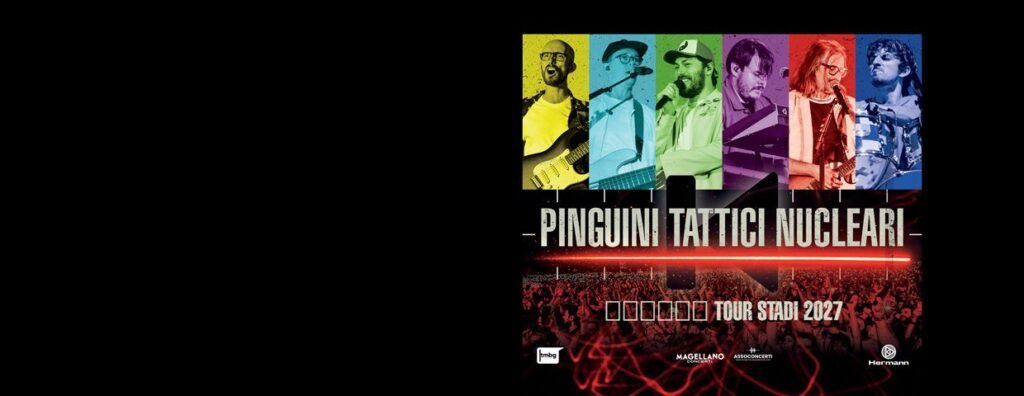
On Thursday, July 8, 2027, at 21:00, Pinguini Tattici Nucleari play Stadio Olimpico in Rome, inside the Foro Italico complex, for one of the dates of their Tour Stadi 2027. Six musicians born and raised between Alzano Lombardo, Pedrengo, Seriate, Treviglio and the city of Bergamo, who 15 years ago played joke metal in the clubs of the Bergamo province and who now fill the biggest venue in the capital on a July night.
As I put these lines together, the date is 10 months away. That means the set list doesn't exist, any guests don't exist, the shape of the stage doesn't exist and the final section prices don't exist: anyone describing them now is imagining them, and I'll write this only once because there's no need to repeat it. What already exists, though, and can be known today, is everything around it: who the six people taking that stage are and where their popularity comes from, what that stadium really is when there's no match on, what surrounds it, how to get there and how to get back, and why that piece of Rome deserves an hour of attention before the lights go down.
On Foro Italico I have a firm belief: it's the most visited and least looked-at architectural complex in the city. Tens of thousands of people pass through it every time there's a match, a tennis tournament or a concert, they walk along an avenue covered entirely in mosaics, pass by a Carrara marble obelisk almost 18 meters tall, skirt buildings designed by some of the most debated Italian architects of the 20th century, and almost nobody looks up. A concert night, if you arrive with an hour to spare, is the perfect chance to make up for it without paying for an extra ticket and without missing a minute of music.
Thursday, July 8, 2027: what kind of evening it is
July 8, a Thursday. The combination matters more than it seems, and it's worth taking it apart piece by piece because it concretely changes how you plan the day.
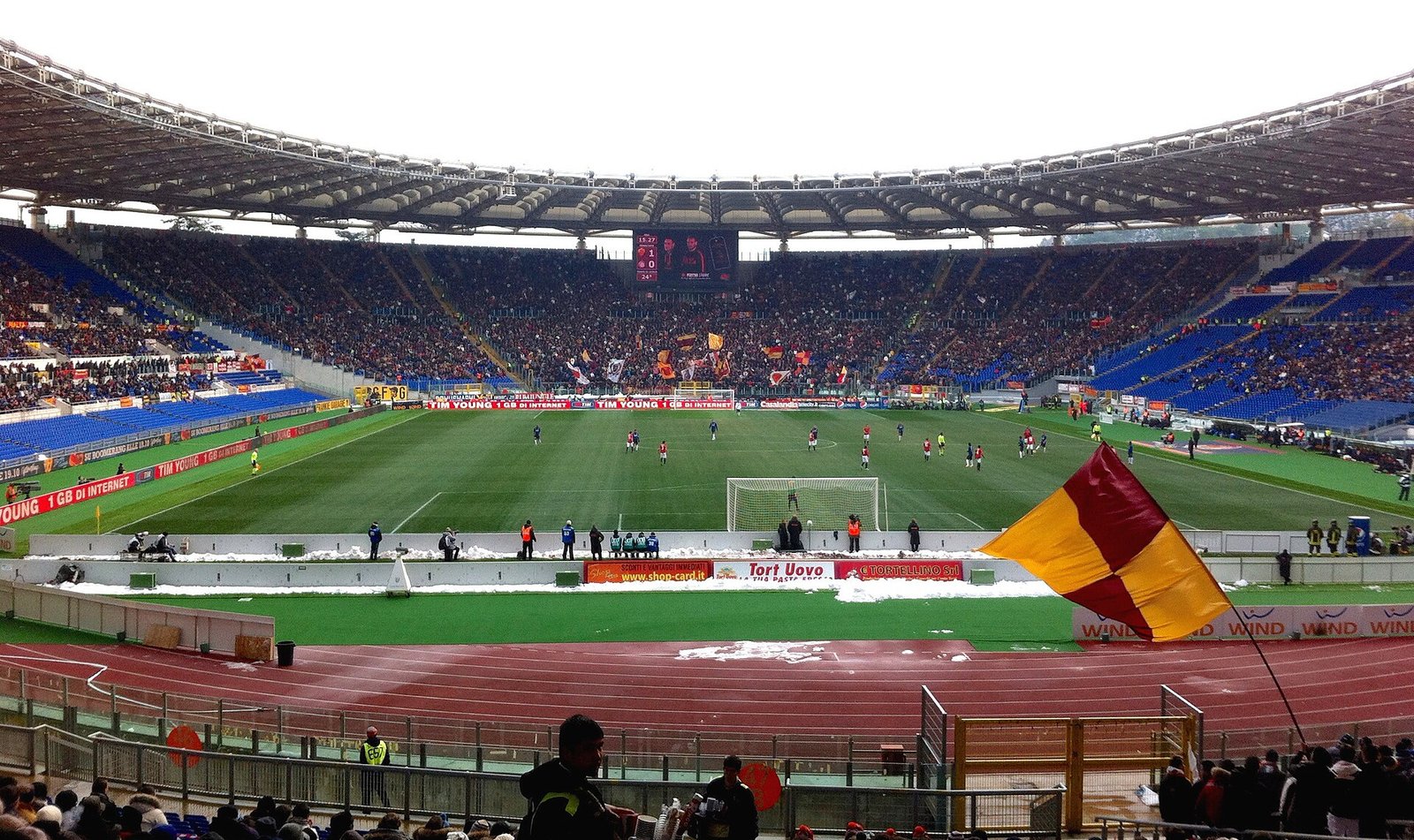
Thursday is the weekday that in Rome looks most like the weekend without being one. Offices are working, schools have been closed since mid-June, bars and restaurants in the central neighborhoods have already switched to late hours, and evening traffic still carries the tail of the commute home. If you head toward Foro Italico between 18:30 and 20:00 on a Thursday in July, you'll find on the right-bank Lungotevere roads and around Milvian Bridge a density of vehicles that isn't there on Saturday. On the other hand, at the end of the show, the city returns the favor: at 23:30 on a Thursday the streets clear much faster than they would on a Saturday, and the bars have no line at the door.
Then there's the light. On July 8 in Rome the sun sets shortly after 20:40 and the sky stays readable until almost 21:30. A concert starting at 21:00 in that seasonal window has a feature you can't get indoors in any way: the first part takes place under a still-bright sky, the stadium's Teflon roof is backlit, and full darkness arrives when the show has already been going for half an hour. If you go to the stadium in winter for soccer, you never see that transition, because in December at 21:00 it's been dark for a while.
The heat, which must be taken seriously
The rule is simple: water before, water during, and no alcohol in the afternoon. Heatstroke in line at a summer concert is the most trivial and most frequent cause of ruined evenings, and it doesn't only affect 80-year-olds: it mostly affects 20-year-olds who've spent six hours on the asphalt without eating. If someone in your group has blood pressure problems or doesn't handle heat well, the reasonable choice isn't the field under the stage: it's a numbered section, in the shade of the roof, where you arrive at 20:30 and sit down.
Who Pinguini Tattici Nucleari are
The story of this band is longer and less linear than the one told by people who discovered them at Sanremo. It's worth starting from the beginning, because it helps you understand what kind of audience you'll find at Stadio Olimpico that night.
The group was formed at the end of 2010 in the province of Bergamo, initially around two people: Lorenzo Pasini and Riccardo Zanotti. They met at school. The name, one of the most told stories of their biography, comes from a Scottish beer called Tactical Nuclear Penguin, produced since 2009 by the BrewDog brewery: a detail that says a lot about the tone the band took in its early days, when the genre they played was joke metal and nobody imagined stadiums.
The first self-produced EP, five tracks, is titled Cartoni animali and came out in 2012. Then came years of clubs: first only in the Bergamo area, then all over northern Italy, with the stated goal of building a loyal audience so they could promote themselves. For years they worked without a press office, without a booking agency and without a record label, handling every aspect themselves, that is, embracing the do-it-yourself ethic out of necessity even before ideological choice. It's the part of the story that the fans in the front row know by heart and that people who met them 10 years later usually ignore completely.
The lineup, and why six people aren't one
The current lineup is this: Riccardo Zanotti, born in Alzano Lombardo on September 16, 1994, vocals and guitar. Nicola Buttafuoco, born in Pedrengo on October 24, 1994, guitar. Lorenzo Pasini, also from Alzano Lombardo, born on May 28, 1994, guitar. Simone Pagani, born in Bergamo on July 4, 1991, bass, double bass and vocals. Matteo Locati, born in Treviglio on February 26, 1991, drums. Elio Biffi, born in Seriate on May 8, 1994, keyboards, accordion and vocals.
There were intermediate steps: with the arrival of drummer Marco Sonzogni, Zanotti became frontman and sole singer as well as songwriter. In 2015 Elio Biffi joined and Matteo Locati came in on drums. In 2016 the group took its final shape with Nicola Buttafuoco on guitar and Simone Pagani on bass, replacing Cristiano Marchesi. Former members also include Francesco Bernuzzi on vocals and Claudio Cuter on guitar.
This list of names isn't an encyclopedia exercise: it's the thing that most changes the evening compared with the other concerts passing through the same stadium this summer. Six people on stage means six positions, six monitor mixes, a real drum kit in the center, keyboards and accordion on one side, three guitars to manage without overlapping. A solo singer with a backing band takes the center of the stage and everything else works behind him. A real band fills the stage across its width, and anyone who buys a side ticket on a night like this still sees something happening near them.
From the albums to the Festival
The first studio album, Il re è nudo, came out in 2014: seven tracks plus an intro, with songs like Cancelleria and Test d'ingresso di medicina. The second, Diamo un calcio all'aldilà, arrived on December 18, 2015 with a sound closer to alternative rock. The third, Gioventù brucata, came out on April 17, 2017: 11 tracks and an intro, with the ballad Irene, the pop rock of Tetris and more complex pieces like Gigi Cinque Ottavi. In August of the same year the group took part in the 25th edition of the Sziget Festival in Budapest, performing on the Light Stage.
On April 5, 2019 came Fuori dall'hype, the first album released with Sony Music, preceded by the singles Verdura, out on January 18, Sashimi and the title track. Three weeks later, on April 26, Faber nostrum came out, a tribute album to Fabrizio De André, with the group's version of Fiume Sand Creek. On May 1, 2019 Pinguini took the stage of the Concerto del Primo Maggio in Piazza San Giovanni in Laterano, in Rome, with Verdura and Irene: it was their first big exposure in Rome, and their first time in front of a big outdoor crowd.
In February 2020 they took part in the 70th edition of the Sanremo Festival with Ringo Starr, finishing third overall on the final night. On the third night, the covers night, they performed a medley titled Settanta volte. On February 7, 2020 the album was reissued as Fuori dall'hype - Ringo Starr, which also includes the previously unreleased Ridere and Bergamo.
The hard years and the climb back
They filled those years with records. On August 28, 2020 La storia infinita came out. On November 13 Scooby Doo, which preceded the EP Ahia!, released on December 4, 2020. In 2021 came collaborations with artists from different backgrounds, and the singles from the EP, including Scrivile scemo and Pastello bianco, kept circulating for months. In that same window they returned to Teatro Ariston, on the covers night of the 2021 Sanremo Festival, joining Bugo on Lucio Battisti's Un'avventura.
The return to live shows came in 2022 with the Dove eravamo rimasti tour, their first real arena tour, replacing the one postponed for more than two years. In May of the same year Giovani Wannabe came out, becoming one of the best-selling and most-played songs on the radio that season. In August came Dentista Croazia, which looks back at the group's early days, and on September 23 Ricordi, also at the top of the FIMI chart. On November 13, 2022 the band won the MTV Europe Music Award for best Italian act, and on December 2 released its fifth studio album, Fake News.
The stadiums, and the numbers that made them possible
On October 17, 2022 a concert at San Siro Stadium was announced for July 11, 2023: it sold out in 12 hours. A few days later, on October 25, a second date was added right here at Stadio Olimpico in Rome, also sold out. On November 11, 2022 the first stadium tour was confirmed: 10 dates in seven Italian venues between July 7 and August 13, 2023, with a final concert on September 9, 2023 at the RCF Arena in Reggio Emilia.
That Reggio Emilia date holds the record for paying spectators at a single concert by an Italian band: over 80,000 people. The stadium tour as a whole topped half a million tickets sold over 11 dates, making it the best-selling tour of 2023 in Italy along with Marco Mengoni's. On September 9, 2023 the Fake News Indoor Tour in arenas was announced for 2024, selling 100,000 tickets in the first 24 hours of presale. Taken in its two parts, the Fake News live cycle totaled about 1 million tickets between 2023 and 2024, coming to represent on its own around four percent of the Italian live concert market in 2023. The American magazine Pollstar placed it eighth among the most successful tours at the box office worldwide that year.
We've all seen the last few months: on May 15, 2026 Sorry scusa lo siento came out, on August 21 came Fabri Fibra's Goya, on which the band collaborated, and on September 1, 2026 Pinguini won the 10th edition of Power Hits Estate with Sorry scusa lo siento. Overall the group has passed 8 million certified copies: one of the most solid Italian cases of record success in the streaming era, with the peculiarity that it involves a band and not a solo artist.
A curious fact about Pinguini Tattici Nucleari at Stadio Olimpico in Rome, Tour Stadi 2027
July 8. That date, in that stadium, already has a meaning that none of the six on stage was old enough to remember live: three of them had been born less than a year before, the other three weren't born yet.
On July 8, 1990, on that field, the World Cup final was played between West Germany and Argentina. In front of 73,603 spectators, the Germans won 1-0 with a penalty scored by Andreas Brehme six minutes from the end. It was a match that went into the record books for unhappy reasons: Olimpico became the first stadium in history to see a player sent off in a World Cup final, and two of them at that, the Argentinians Pedro Monzón and Gustavo Dezotti.
Between July 8, 1990 and July 8, 2027 exactly 37 years go by. Same date, same field, same Teflon roof overhead, and one difference that says everything about how the use of that venue has changed: in 1990 the stadium had just been handed back after an almost total rebuild and was returned to international soccer in front of a crowd of 70,000 people. In 2027 the same bowl is filled to hear six musicians from Bergamo who in 1990 didn't exist even as an idea.
Then there's a curious detail. In July 1991, just over a year after that final, the stadium hosted its very first concert: a joint event by Miles Davis and Pat Metheny, on a stage built in front of the Curva Sud, in front of about 20,000 people. The Teflon roof installed for the World Cup had made the venue suitable for music, and the year after Italy's most watched final someone realized that the container could be used for something else. In 36 years it went from 20,000 people for jazz to a full stadium for an Italian pop group, in the very same perimeter.
The stadium as a built object: the part almost nobody tells
When people talk about Olimpico they almost always talk about matches. I'll try to describe it for what it is, a building, because on the concert night that building determines what you hear and what you see.
The current stadium is the result of an almost complete rebuild, following a demolition in 1989 that left practically nothing standing of the 1953 venue. This is the point almost everyone gets wrong: Olimpico you enter today isn't Stadio dei Centomila with a few additions, it's another stadium built in the same place. The travertine, the postwar reinforced concrete, the low, continuous shape of Annibale Vitellozzi's tiers: none of that is there anymore.
The roof is what strikes first-time visitors most. Above the tiers runs a ring of steel cables, and from those cables hang metal structures supporting the actual cover, made of Teflon, that is, polytetrafluoroethylene, combined with fiberglass. The engineering design of the roof was supplied by the Majowecki firm of Bologna. The choice of material wasn't aesthetic: Teflon combined with glass is light, lets some daylight through and above all doesn't impose on the structure the loads of a rigid roof. The result, at 21:00 on a Thursday in July, is that the sky above the bowl stays visible and slightly milky, and the light fades gradually instead of being cut off by an opaque slab.
The entrances and the four pillars
The stands are reached through 33 entrances: two for each section of the distinti, four for each curva, seven for the Tribuna Tevere and 10 for the Tribuna Monte Mario. The highest level of the tiers, the upper distinti on the Tevere side and on the Monte Mario side, is reached through four large reinforced concrete pillars containing the stairs.
Those four pillars, with the stairs built inside them, weren't in the original renovation project. They're the direct consequence of a legal affair that deserves a section of its own, which I'll get to shortly.
A note on the seats, useful if you have memories of the 1990s: in the round of work before the 2009 Champions League final the seats were widened, to 48 centimeters in the curve and distinti, 50 in the Tribuna Tevere and 54 in the VIP stand. The operation cost about 5,000 seats in total, but made the stadium much more livable for a three-hour evening. At the same time the locker rooms were doubled and a third was built, for the visiting club only: in the concert years those spaces serve a very different purpose, and anyone working backstage at Olimpico knows well that a tour's logistics go right through there.
Foro Italico: what's around the stadium
The complex the stadium sits in is much larger than the stadium itself, and almost everything in it is accessible on foot on the concert night, without a ticket and without detours. I'll try to take an orderly tour, because here general websites just mention two or three things and move on.
Foro Italico was conceived and built by Enrico Del Debbio between 1927 and 1933, and completed after the war between 1956 and 1968. The political initiator of the operation was Renato Ricci, undersecretary of National Education and founder of the Opera nazionale Balilla. The area, 85 hectares at the foot of Monte Mario, wasn't in engineer Edmondo Sanjust di Teulada's 1909 master plan: it was meant for railway use, and was converted into a sports complex with a general variant in 1926.
The buildings you can look at
Palazzo H, by Del Debbio between 1928 and 1932, housed the Fascist men's academy of physical education and since 1951 has been the headquarters of CONI. It's the building you see on the right when you arrive from the bridge, and its facade is one of the most readable documents of that period's architecture in the city.
Palazzo delle Terme, by Costantino Costantini between 1930 and 1936, contains the indoor pools and two institutions that have changed names twice: the GIL music academy, which in 1995 became Auditorium Rai del Foro Italico, and the Istituto superiore di educazione fisica, the old ISEF, which in 2008 became the Università degli Studi di Roma Foro Italico. This is the detail that surprises people most: inside a complex that almost everyone considers just a sports park, there's a Rai concert hall and a full-fledged public university, with students, classes and exam sessions.
The avenue, the obelisk and the statues
The main entrance to the Foro opens to the southeast, in line with Ponte Duca d'Aosta. In front of a wide avenue covered entirely in black and white mosaic tiles, originally called Piazzale dell'Impero and today Viale del Foro Italico, rises a Carrara marble obelisk 17.5 meters tall not counting the base, dedicated to Mussolini. In April 2015 the then president of the Chamber of Deputies Laura Boldrini proposed removing the inscriptions from the stele: the proposal met objections from architectural experts and historians and went nowhere. The debate hasn't closed, and in 2026 the historian Hannes Obermair raised the issue again in different terms, suggesting not removal but recontextualization, on the model of what was done in Bolzano, because an aesthetic of that kind, left without comment, keeps occupying public space on its own.
People walking along that avenue on the concert night pass over it without looking, and I understand why: underfoot there are hundreds of square meters of mosaic, and at that hour the flow of people makes it impossible to stop. Arriving an hour early, though, you see everything: the scenes, the inscriptions, the panels. It's a complicated historical document, and looking at it carefully doesn't mean approving of it. It means stopping ignoring it.
The Walk of Fame, which almost nobody notices
On May 7, 2015, on Viale delle Olimpiadi, a path dedicated to the legends of Italian sport was inaugurated: 100 plaques set into the pavement with the names of athletes chosen by the CONI Athletes' Commission. The ceremony was presided over by the then CONI president Giovanni Malagò, and in the following years more plaques were added.
If you're looking for something to do in the 40 minutes of waiting outside the gates, this is the best answer I know: you walk along the avenue, read the names, and realize how many Italian sports you know only through a handful of people. It's free, it takes up exactly the time you have left over, and it keeps you moving instead of standing in line in the sun.
Something nobody tells you about Pinguini Tattici Nucleari at Stadio Olimpico in Rome, Tour Stadi 2027
The shape of the roof you'll be under that night is the result of an appeal to the TAR, the regional administrative court, filed by three environmental associations. It's not a joke: it's the documented account of how that object came about.
Let's go back to 1987. Italy had to renovate Olimpico for the 1990 World Cup. CONI, which managed the venue and commissioned the work, had already appointed the CO.GE.FAR. consortium as general contractor. The project called for 40-meter-high pylons to support the tensile roof structure. In November 1987 Italia Nostra, Legambiente and WWF Italia filed a joint appeal to the TAR of Lazio, denouncing the environmental and landscape damage those pylons would cause in that setting, at the foot of Monte Mario, right by the Tiber, inside a protected complex.
In January 1988 the TAR upheld the appeal and stopped the project. CONI, fearing more appeals, halted all work as a precaution, even work the order didn't touch. Meanwhile more seizure and stop orders came for the Curva Sud building sites, suspected of not meeting workplace safety standards. At that point the Ministry of Cultural Heritage ordered a new project, taking into account the protections invoked. The solution found is the one you see today: lowering the height of the pylons and building into them the stairs up to the highest tiers. Faced with these changes, the environmental associations withdrew their appeal.
So: the four large pillars that today contain the stairs and take spectators to the upper levels of the stadium exist in that form because three environmental associations sued the State and won. The roof is lower and less intrusive on the profile of Monte Mario than it would have been, and the compromise produced an architectural feature that has since become recognizable. Anyone climbing those stairs on the evening of July 8, 2027 walks inside the technical solution to a 1988 administrative dispute.
My tip for Pinguini Tattici Nucleari at Stadio Olimpico in Rome, Tour Stadi 2027
There's only one tip and I'll put it plainly: treat July 8, 2027 as a whole day in Rome and not as a transfer to a gate. Everything else follows from that.
In practice, the recommended plan for evenings like this is this. Afternoon away from Foro Italico, somewhere with shade and water, so not in line on the asphalt. Around 18:30 you move, arriving from the Tiber side or from the Della Vittoria district depending on where you spent the day. Between 18:45 and 19:45 you walk around the complex: Viale del Foro Italico with the mosaic, the obelisk, the facade of Palazzo H, the perimeter of Stadio dei Marmi, the Walk of Fame on Viale delle Olimpiadi. It's 40 minutes of slow walking, never too far from your entrance. At 20:00 you go in, calmly, when the line is on its way down. You find your seat, buy a drink, sit down. At 21:00 the show starts and you're not already dead tired.
If you choose the field, you have to think differently, and I'll say it bluntly: the field under the stage, at a summer concert of this size, is a physical commitment. It means arriving early, standing for many hours, not being able to step away without losing your spot, and going through the afternoon heat peak in a space with no shade. It's worth it if you're 20, you're with friends and you accept the effort. It's not worth it if you're coming from outside Rome for a single day and would also like to see something of the city.
The tip within the tip: choosing your section
If I had to name just one position for an evening like this, I'd name the lower side distinti. Reasons: the sound arrives more clearly, the roof protects you from the leftover sun at 21:00, the distance from the stage stays reasonable, you see the staging as a whole instead of squashed from below, and above all you get out faster at the end of the night because those sections empty onto short stairways. The Tribuna Monte Mario has the advantage of build quality and the overall view, but it's the side that faces the stage head-on from far away. The upper curve are the cheapest and the most compromised on every front.
How to get to Foro Italico, and how to get back
This is the part people from out of town underestimate most, because Olimpico doesn't have a metro stop in front of the entrance. It doesn't, and it never has.
The most used solution is still the combination of metro and tram. You take metro line A to one of the stations in the northwest quadrant, and from there you continue above ground. The tram serving the area crosses the Flaminio district and reaches Piazza Mancini, the reference terminus for Foro Italico: from Piazza Mancini to the stadium you walk across Ponte Duca d'Aosta, arriving straight onto the mosaic avenue. It's about a 10-minute walk, on the flat, with the Tiber on your right and the complex ahead: in terms of visual impact it's by far the best arrival, and I recommend it even if you have alternatives.
Surface lines in the area are reinforced on big event nights, and in some cases dedicated services are added. The arrangements change from event to event and are announced in the preceding days by the transit company and the organizers: the sensible thing is to check them in the week of the date, because a setup decided 10 months ahead doesn't exist.
By car: you can, but you need to know how
Driving all the way to the stadium on the night of a concert with tens of thousands of people is the worst possible choice. The right-bank Lungotevere roads are closed or restricted, the area inside Foro Italico is closed to private traffic, and parking is in any case at distances that cancel out the advantage of the car.
The strategy that works is different: leave the car far away, at a point served by public transportation, and do the last stretch by rail or on foot. The neighborhoods north of Foro Italico and the Piazzale Clodio area offer more options than the area right next to the stadium, and above all let you leave without getting stuck in the outflow.
The outflow, which is the worst part
Leaving a full stadium is always slower than entering it, because everyone leaves at the same moment. At Olimpico the outflow empties onto a limited number of routes: the bridges over the Tiber, the avenue toward the Della Vittoria district and the climb toward Monte Mario. In the first 20 minutes after the end of the concert the bridges are jammed.
The countermove that always works, and applies in any stadium in Europe, is the same: don't leave right away. Stay seated for 20 minutes, let the bulk of the crowd clear, and leave when the square has started breathing again. You lose half an hour and gain one. Alternatively, you leave while the music is still playing, but with this band I doubt anyone wants to miss the finale.
Another well-known fact, yet one that's rarely mentioned
Of the whole stadium inaugurated in 1953, the one Romans called Stadio dei Centomila, only one piece survived the 1989 demolition: part of the outer facade of the Tribuna Tevere.
It's a fact known to anyone who has read two pages on the history of the venue, and practically ignored by everyone who goes in. It means that the side of the stadium facing the river preserves a fragment of Annibale Vitellozzi's construction, reinforced concrete clad in travertine, and that everything else, curve, distinti, Monte Mario, roof, entrances, tiers, was built between 1989 and 1990. When you walk along the outer perimeter on the Tiber side you pass the only surviving scrap of a building that had hosted the 1953 inauguration, the 1960 Olympic Games and the 1987 World Athletics Championships.
Why I find it important to point out: because it changes the way you look at Olimpico. It isn't a historic stadium with some updates, it's a stadium from 37 years ago built inside the perimeter of a historic stadium, with a piece of wall left standing. All the rhetoric about that field having seen Wilma Rudolph, Livio Berruti and Stefka Kostadinova is true for the place and false for the building: the place is the same, the tiers aren't.
The same thing said the other way around
Flipping the sentence makes it even clearer. Anyone entering the stadium on July 8, 2027 enters a building that is almost exactly the same age as the youngest members of the band playing in it. The renovation was handed over in May 1990. Riccardo Zanotti, Nicola Buttafuoco, Lorenzo Pasini and Elio Biffi were all born in 1994. Stadium and musicians basically belong to the same generation, and it's one of those coincidences that mean nothing but that, once you've noticed them, change the way you look at the evening.
Tickets, sections and access
On this point I'll be brief and cautious, because 10 months from the date any detailed information would be invented.
What can be said with certainty is the structure of the venue, which doesn't change. The sections available in a concert setup are the field, usually split between an area under the stage and a zone further back, the north and south distinti, the Tribuna Tevere and the Tribuna Monte Mario, which is laid out on several levels and includes the best positions for an overall view. The Curva Sud and Curva Nord, depending on where the stage is placed, may be partly or entirely excluded from sale.
Entry conditions, gate opening times, rules on backpacks, bags, bottles and cameras, how tickets are put in a name and any name-change procedures are announced by the organizers in the preceding weeks, and should be read then. A rule published 10 months ahead would have a very good chance of being outdated by the event date.
One recommendation that always applies, though: go to the entrance for your section and not to just any entrance. The stadium's 33 entrances serve different sections and don't connect with each other from outside. Picking the wrong gate, on the night of a full concert, means walking half the perimeter again against the crowd. It's the most common mistake I see people make, and it costs 20 minutes on average.
Accessibility, children and those who need a different pace
Stadio Olimpico has dedicated spaces for spectators with disabilities and their companions, and access routes separate from the main flows. How to request them, the documents needed and the booking channels are set by the organizer for each event: the right move is to contact them directly as soon as sales open, because those places are limited in number and sell out quickly.
On children there's a specific point to make. A stadium concert starting at 21:00 ends between 23:00 and midnight, and getting home easily takes you past 01:00. For a small child it's a long, loud evening, with sound levels that require hearing protection. This band's audience includes many families and many very young kids, so it isn't a question of if the repertoire is suitable: it's a question of hours and decibels. If you bring a child, the right place is a numbered section up high, far from the speakers, with ear protection, and with the advance acceptance that you may leave before the end.
The right photo to take at Pinguini Tattici Nucleari at Stadio Olimpico in Rome, Tour Stadi 2027
The right photo isn't inside the stadium. Inside the stadium, with a phone, 100 meters from the stage, in difficult light and with thousands of raised arms in front of you, you take home images that don't hold up the next day. The right photo is taken before you go in, and from one specific spot.
The spot is Ponte Duca d'Aosta, looking toward Foro Italico, between 20:15 and 20:45. At that hour on July 8 the sun is low behind Monte Mario and the light skims the mosaic avenue. Into the frame come, in order: the water of the Tiber in the foreground, the perspective of the avenue, the white marble obelisk catching the warm light, the outline of the complex and, in the background, the hill. If you wait for the moment when the flow of people toward the gates is already dense, you also get the thing that makes the photo a photograph and not a postcard: the crowd moving toward a point out of frame.
Variations that work
Second option, if you feel like walking: the climb toward Monte Mario. Going up from Foro Italico toward the higher area you gain height quickly and get a view from above in which the white ring of the stadium roof reads in full against the green. At sunset in July that roof takes on a warm tone you don't see in daylight. It should be said that it's a real climb, to be done calmly and before the crowd thickens.
A technical recommendation: inside a stadium with constantly changing lights, night mode produces blurry images, so it's better to accept a bit of grain and use fast shutter speeds. And better still, for long stretches, keep your phone in your pocket.
Some important events that happened here in history
The history of this piece of the city is so dense that listing it all would take a whole book. I'll try to line it up by choosing the episodes that explain something, not the ones that fill lists.
1932: Stadio dei Cipressi
On October 28, 1932, among the venues completed for the regime's 10th anniversary, was Stadio dei Cipressi, designed for 100,000 spectators and built entirely with terracing on the Monte Mario side and earth fill on the other sides. It was a venue designed more for rallies than for sport: the field measured about 20,000 square meters, roughly 200 meters by 100. From 1933 Luigi Moretti, with Angelo Frisia and engineer Achille Pintonello, reworked its shape, adding masonry stands on the Tiber side too. On May 9, 1937, the first anniversary of the Empire, the renovated venue was inaugurated, holding 60,000 spectators, with raised sections already planned that were supposed to bring it to 100,000.
In the following years Stadio dei Cipressi worked essentially as the stage for the regime's events. In 1938 a military display was held there for Hitler's visit to Rome. In September 1941, in the middle of the war, it hosted paramilitary celebrations at the same time as Berlin and Tokyo. When the war reached Rome in 1943 the development plans stopped, and after the liberation of the capital in 1944 the stadium was used by the Allied military as a logistics base and a venue for inter-Allied sports competitions.
1953: the inauguration, and two goals by Puskás
After the war the stadium passed to CONI, which under the presidency of Giulio Onesti announced it would be completed in phases. When Roccatelli died, in 1951, the work went to Annibale Vitellozzi. The new venue, entirely in reinforced concrete clad in travertine, was inaugurated on May 17, 1953 at 16:30 with the return match of the International Cup between Italy and Hungary. It ended 0-3: Nándor Hidegkuti scored in the 41st minute, the new venue's first official scorer, and Ferenc Puskás added the second and third in the second half. After the match the crowd watched the finish of the sixth stage of the Giro d'Italia, Naples-Rome, won in a sprint by Giuseppe Minardi.
The following Sunday the first club match was played, Lazio-Juventus, won 1-0 by Juventus with a goal by Pasquale Vivolo, curiously the same player who had come on a week earlier against Hungary in place of Boniperti. On the last matchday of that season it was Roma's turn to debut in the new stadium, with a 0-0 draw against SPAL. Since then Olimpico has been the home ground of the capital's two teams, and has been continuously for over 70 years.
1960: the Olympic Games
In 1955 the IOC awarded Rome the 1960 Games. For Stadio dei Centomila, which by then everyone called Olimpico, the work involved only the press box, whose capacity went from 572 to 1,126 seats. On August 25, 1960 the venue hosted the opening ceremony, and in the following days it saw a series of athletics records.
On that track the American Wilma Rudolph won the 100 meters in exactly 11 seconds and then the 200, after setting the Olympic record for the distance in a heat. Livio Berruti won Italy's first gold medal in sprinting, equaling the 200-meter world record in both the semifinal and the final with a time of 20.5 seconds. Giuseppina Leone, third in the 100 behind Rudolph, was the first Italian woman to win a sprint medal.
1974 and 1987: the two busiest days
On May 12, 1974, in the 29th round of the league, Lazio and Foggia played in front of 78,886 paying spectators: it's still the highest attendance recorded at Olimpico for a sports event. Lazio won 1-0 and took its first league title with a round to spare.
In 1987, 13 years later, the stadium hosted the World Athletics Championships. Carl Lewis ran the 100 meters in 9.93 seconds, a new world record. But the record that really went down in history that year was another: Bulgarian Stefka Kostadinova's 2.09 meters in the high jump, which stood as the world record for 37 years and was beaten only in 2024 by Yaroslava Mahuchikh. When Pinguini take the stage, the women's high jump world record will have been broken just three years earlier, after being set on that runway. They're two facts living in the same perimeter that nobody ever puts side by side.
The dark side
It would be wrong to tell the story of this stadium only through records. In 1979, before a derby, a flare fired from the curva hit Vincenzo Paparelli, who died before reaching Santo Spirito hospital. The court case ended at the Court of Cassation in May 1987, and it started both a legislative and a cultural discussion on safety at sports venues and entrance controls, whose effects can still be seen today in every line at the turnstiles.
On January 23, 1994, before Roma-Udinese, a Lancia Thema packed with dynamite and parked along Viale dei Gladiatori was supposed to explode near some Carabinieri vans on public order duty. A fault in the remote control prevented the explosion, and the bombers removed the car. The story came out only years later, through statements by some state witnesses, and was placed within the bombing strategy of that period. Anyone walking along Viale dei Gladiatori on the evening of July 8, 2027 passes over a spot where, because of a malfunction, something enormous didn't happen.
From 1990 to today
After the 1990 World Cup final the stadium kept collecting big events: the 1996 Champions League final between Juventus and Ajax, decided on penalties, the one on May 27, 2009 between Barcelona and Manchester United, won 2-0 by the Spaniards with goals by Eto'o and Messi in front of 62,467 spectators, and the Coppa Italia final, which since 2008 has been held here permanently with a single exception in 2020.
In June 2021 the stadium hosted the opening ceremony of the European Championship, postponed by a year because of the pandemic, with a crowd reduced to about 16,000 people for health reasons. On March 22, 2023, for a Women's Champions League quarterfinal between Roma and Barcelona, it set the Italian attendance record for a women's soccer match: 39,454 spectators. In 2024 it hosted the European Athletics Championships. Meanwhile ownership changed: with a decree of February 3, 2004 the Ministry transferred Foro Italico, stadium included, to Coni Servizi, a company renamed Sport e Salute in 2019, the current owner of the venue.
One last event that repeats every year and that almost nobody associates with this stadium: the Golden Gala, an athletics meeting held here regularly since the early 1980s, which since 2010 has been the Rome stop of the Diamond League and since 2013 has been named after Pietro Mennea. People who go to Olimpico only for soccer and concerts don't imagine that on that track, every year, athletes race at the highest level in the world.
Who has passed through Pinguini Tattici Nucleari at Stadio Olimpico in Rome, Tour Stadi 2027
The musical history of this stadium starts late compared with its sports history, and it starts for a technical reason: before the 1990 rebuild and the installation of the Teflon roof, the venue wasn't considered suitable for concerts.
The very first artists to perform here were Miles Davis and Pat Metheny, in a joint event in July 1991, on a stage built in front of the Curva Sud, in front of about 20,000 spectators. The first Italian was Zucchero, in June 1993, during the Urlo tour, with 10,000 people. Numbers that today, for a stadium, seem small: those were the years when nobody yet knew how much that container could deliver.
The 1998 record
The jump in scale came on June 6, 1998, with Claudio Baglioni's concert on the Da me a te tour. For that evening 82,000 tickets were sold, plus about 8,000 complimentary spectators, for a total of around 90,000: the highest attendance ever recorded in Italy for a concert.
The record was possible because of a specific circumstance. The then CONI president, Mario Pescante, exceptionally authorized the installation inside the stadium of a huge star-shaped stage, 112 meters long and 72 wide, because the field was going to be replaced that very summer and so damage to the pitch wasn't a problem. It's the clearest way to put it: the history of concerts at Olimpico has always been a history of negotiations with those who then have to give the field back to the soccer teams, and it's also the reason why concerts at this stadium are all concentrated between June and July.
The regulars
Among Italians, the most frequent visitor is Luciano Ligabue, who has played here 13 times between 1996 and 2023. Among foreign acts the record belongs to the British band Depeche Mode, five times between 2006 and 2023, most recently with the Global Spirit Tour and the Memento Mori World Tour. Behind them, with four shows, the Irish band U2, between 2005 and their most recent date as part of the Joshua Tree Tour 2017.
Among the other notable evenings in the venue's musical history are the performances by David Bowie and Tina Turner at the 1996 Live Rock Festival and R.E.M.'s in 2005, during the Around the Sun Tour.
2027, and the context this date fits into
Summer 2027 brings to Olimpico a concentration of music events worth keeping in mind if you're planning a trip. On the same stage, in the nearby weeks, Olly, Achille Lauro, Laura Pausini and the long residency of Vasco Rossi have been announced. If you're coming from outside Rome and have some flexibility on dates, fitting two evenings into the same trip is really possible, and it changes a lot the ratio between the cost of the trip and what you get out of it.
Where to eat, where to drink and where to wait
The area right around Foro Italico doesn't have a density of bars and restaurants comparable to the central neighborhoods, and on big event nights what little there is fills up quickly. It's worth knowing this and planning differently.
The most sensible direction is the Della Vittoria district, behind the stadium to the southeast, across the bridge. It's a residential neighborhood with a decent range of trattorias, pizza-by-the-slice places and bars, frequented mostly by the people who live there, and on concert nights it absorbs part of the crowd without going into crisis. From there to Foro Italico it's a good quarter of an hour on foot. The other direction is the Flaminio district, to the south, which offers more variety and has the advantage of being on the tram route: you eat there, take the tram, reach Piazza Mancini and cross the bridge.
If you stay closer, you'll find the kiosks on the squares, which on event nights work at full capacity and with long lines. The solution is obvious but it works: eat early and light somewhere else, and treat the food inside the stadium as an extra and not as dinner.
The neighborhood, and the people who live there
Foro Italico sits inside an inhabited part of the city. It isn't an isolated venue on the outskirts: around it there are apartment buildings, schools, stores, people who go to work the next morning. An evening with tens of thousands of people, with amplified music until 23:00 and beyond and the outflow lasting until 01:00, has a real impact on the people who live there.
This applies above all to those coming from out of town. Residents of that area have lived for 70 years with two soccer teams, an international tennis tournament, an athletics meeting and, in recent summers, a growing concentration of stadium concerts. Living together works when people who come for the event behave like guests: keeping noise down in residential streets after the concert, trash in the bins and not on the sidewalks, cars parked where it's allowed and not in front of driveways. These are obvious things, but they're also the difference between a neighborhood that tolerates events and one that starts filing complaints.
What you can see in the area
If you have half a day free before the concert and want to stay in the area instead of crossing the city, you have a few serious options. To the south, in the Flaminio district, is MAXXI, the national museum of 21st-century arts, and a little further Auditorium Parco della Musica, which in summer has its own open-air program in the cavea. Going further down you reach Piazza del Popolo and the north entrance of Villa Borghese, which in the July heat offers the only serious shade on that side of the city.
To the north, past Foro Italico, there's Milvian Bridge, one of the oldest bridges in Rome still in use, and going up the hill you reach the Monte Mario Nature Reserve and the Monte Mario Observatory, which has the highest view over the city. They're all things you can do on foot or with a short stretch of public transportation, and they turn an evening into a full day.
The most common questions
What time should I arrive?
For a numbered section, between 19:30 and 20:00 at your entrance: you go in calmly, find your seat, buy a drink and get to 21:00 rested. For the field, much earlier, and knowing you'll face the hottest afternoon of the day standing and without shade.
Is the view good from the curve?
It depends on where the stage is placed, information that doesn't exist 10 months from the date. In general, in a setup with the stage on a short side, one of the two curve is partly or entirely excluded. The advice stays the same: for the same price, a lower side section is better than an upper central one.
Is it worth coming from outside Rome?
If you listen to this band, yes, and not only for the concert. Rome in July has very long days and bearable evenings, and Foro Italico alone justifies an afternoon. The condition is the one I've been repeating from the start: two nights and not one, and a day built around the evening instead of squeezed onto it.
Frequently asked questions about Pinguini Tattici Nucleari at Stadio Olimpico in Rome, Tour Stadi 2027
When is the Pinguini Tattici Nucleari concert at Olimpico?
The Pinguini Tattici Nucleari concert at Stadio Olimpico in Rome takes place on Thursday, July 8, 2027. Thursday is the weekday that in Rome looks most like the weekend without being one: offices are working but schools have been closed since mid-June and bars and restaurants in the central neighborhoods have already switched to late hours.
Where is the concert held?
The concert is held at Stadio Olimpico in Rome, inside the Foro Italico complex conceived and built by Enrico Del Debbio between 1927 and 1933. The current stadium is the result of an almost complete rebuild following a demolition in 1989, which left almost nothing standing of the original 1953 venue.
What time should I arrive?
For a numbered section, it's best to arrive at your entrance between 19:30 and 20:00, so you can go in calmly, find your seat, buy a drink and be rested for the start. For the field, it's best to arrive much earlier, accepting that you'll spend the hottest afternoon of the day standing and without shade.
How do I get to Stadio Olimpico, given there's no metro underneath?
Stadio Olimpico doesn't have a metro stop in front of the entrance, and never has. The most used solution is the combination of the metro, line A to one of the stations in the northwest quadrant, and a tram that continues above ground to the Foro Italico area.
How much do tickets cost?
10 months from the date any precise figure would be invented, so it's only worth knowing the structure of the venue, which doesn't change: the sections available in a concert setup are the field, the north and south distinti, the Tribuna Tevere and the Tribuna Monte Mario. For actual prices, check the official sales channels.
Is the stadium accessible for people with disabilities?
Yes, Stadio Olimpico has dedicated spaces for spectators with disabilities and their companions, with access routes separate from the main flows. How to request them and the booking channels are set by the organizer for each event, so it's best to contact them as soon as sales open, because those places are limited.
Why does the July 8 date have a special meaning for the stadium?
Because on July 8, 1990, exactly 37 years earlier, the World Cup final between West Germany and Argentina was played on that same field, in front of 73,603 spectators, won 1-0 by the Germans with a penalty. None of the band members was old enough to remember it live.
Why this date deserves more attention than it gets
To close, a part that usually doesn't find room on event pages.
And inside all of this, on the evening of July 8, 2027, six people from the province of Bergamo who started out playing a parody of metal in clubs and who now make an entire stadium sing. Exactly 37 years earlier, to the day, on the same field, a German defender scored a penalty that decided a World Cup. None of these things was put there to create atmosphere, and that's exactly why the atmosphere works.
Article written by the editorial team of TourLeaderPro, contact them for Private, Corporate and V.I.P. Tours and Experiences. If you'd like to turn the afternoon before the concert into a real guided walk through Foro Italico and the Flaminio district, between 1930s architecture and contemporary architecture, with a licensed guide who explains what's under your feet and over your head, you can write from the TourLeaderPro contact page. Agencies and operators building evening and music programs in Rome will find a dedicated consulting service in the area reserved for tour operators.
If you're planning a trip to Italy and think in English, you'll find the guides on ItalyPlanner.com. To plan your Rome days around a date like this, the starting point is the page on the best things to do in Rome, while if you have three full days you'll find a ready-made plan in the three-day Rome itinerary.