Pietro Giannini, La costanza della mia vita at Teatro del Lido di Ostia, November 20, 2026
https://www.estateromana.com/en/rome/trip-planner/pietro-giannini-la-costanza-della-mia-vita-at-teatro-del-lido-di-ostia-november/
On Friday, November 20, 2026, at 19:00, Teatro del Lido di Ostia hosts La costanza della mia vita, the monologue written and performed by Pietro Giannini and produced by Teatro Metastasio in Prato: the story of a family falling apart told through the fragile, imaginative eyes of a child. The show received a special mention at the Premio Scenario 2023, and the performer won the 2025 Ubu Award for best actor or performer under 35. The theater is at Via delle Sirene 22 (00121 Rome), in Ostia, and is one of the venues of Teatri in Comune, the network of Roma Capitale's public theaters in the municipalities. From Rome you get there on the Roma Lido railway, which leaves from Porta San Paolo next to the Piramide stop on metro B, to Lido Centro station, about a kilometer from the theater. Prices are published on the official Teatri in Comune website, which leads to the presale circuit authorized by the theater. To book, Teatro del Lido answers at 06 5646962.
Language: performed in Italian. No English version or English surtitles are announced.
La costanza della mia vita at Teatro del Lido: the date, the time and the tickets
La costanza della mia vita is on Friday, November 20, 2026, at 19:00 at Teatro del Lido di Ostia, in the Teatri in Comune season. It's a single date: the theater's page lists no other performances.
The time
The start is at 19:00, an early evening time that lets you leave the theater in time for dinner. If you're coming from central Rome, that means leaving in the late afternoon, allowing for the train times or Friday traffic. The theater doesn't list the length. Since it's a monologue without an intermission, be in the hall a few minutes before the start.
Tickets and bookings
Tickets are sold online from the dedicated section of the Teatri in Comune website, which links to the authorized presale circuit, or by booking by phone at 06 5646962. Prices are those published by the theater. For information there's also the address promozione@teatrodellido.it.
Who presents the show
The theater's listing says the show is presented by Teatro Metastasio in Prato, which handles its production. The work was developed in residency at Teatro Due Mondi.
La costanza della mia vita: what the show is about
La costanza della mia vita is the story of a constant process of family separation, filtered through eyes and ears still used to fairy tales. The show's presentation calls it a tender and painful monologue about growing up too fast, between fairy tale, memory and the need to protect oneself from the adult world.
The characters
There's a family slowly falling apart. There are two parents, both changed, a sister who has left, the Play-Doh Lady with her secret-catching little men, Paolo, who loves to sleep. And then there's a son, who is also a brother and a child, and who tells a seemingly simple story. He's the voice of the monologue.
A child who watches
The protagonist, the presentation explains, helplessly witnesses the events that strike him and those around him, and that force him to enter the complex world of grown-ups too early. He isn't a child who acts, but one who watches, listens and tries to understand.
A stream of consciousness
On stage a stream of consciousness unfolds that the presentation text describes in three ways: a clumsy attempt at understanding, a desperate and childish denial of what has been, a protection against the outside and its ugliness. They're three movements that, in our opinion, tell how a child reacts to a family crisis better than any adult explanation.
The title
The title plays on the word costanza, constancy. The presentation speaks of a constant process of family separation: what stays constant in the protagonist's life isn't the family but its slow division. It's a bitter irony the audience catches from the show's name, and that the childlike narration makes even more evident.
A seemingly simple story
The listing insists on one expression: a seemingly simple story. It's the key to the monologue, in our opinion: a child's simple words, his funny figures, his secrets kept by the Play-Doh men, let you glimpse behind them an adult reality the protagonist can't yet name.
The tone
Tender and painful at once: it's the organizers' definition, and it says the show doesn't give up the lightness of the child's gaze, even while telling of a wound. If you go to the theater expecting a gloomy drama, you'll find instead the language of fairy tales, with its funny characters and its secrets.
Pietro Giannini: biography of the actor and author
Pietro Giannini was born in Genoa in 2000, and that's where he took his first steps in theater. He's an actor and the author of his own shows, and in 2025 he won the Ubu Award for best actor or performer under 35.
Training in Genoa
In 2016, at 16, he began his artistic path in the theater workshop coordinated by Enrico Campanati, in Genoa.
The Accademia Silvio d'Amico
In 2019 he was admitted to the Accademia Nazionale d'Arte Drammatica Silvio d'Amico in Rome, where he worked with some of the most important figures in contemporary theater: Massimiliano Civica, Arturo Cirillo, Andrea Baracco, Monica Demuru, Liv Ferracchiati, Michele Monetta. The productions he took part in include Noi, gli eroi, directed by Valentino Villa, Spettacolino futile, directed by Massimiliano Civica, and Roberto Zucco, supervised by Arturo Cirillo.
Author of his own shows
In 2022 he began working as author and actor of his own shows. The first is La costanza della mia vita, which in 2023 received a special mention at the Premio Scenario.
La traiettoria calante and Romaeuropa
His second work, La traiettoria calante, is devoted to the Ponte Morandi tragedy in Genoa, his city. In 2023 it was staged at Romaeuropa Festival, in the Anni Luce series devoted to the new generations.
With Antonio Latella
At the same time, Pietro Giannini continues his training under the guidance of Antonio Latella.
The 2025 Ubu Award
In 2025 the Ubu Award named him best actor or performer under 35. It's the award the Teatri in Comune listing highlights alongside the Premio Scenario mention.
The production: Metastasio of Prato and Teatro Due Mondi
La costanza della mia vita is a production of Teatro Metastasio in Prato, developed in residency at Teatro Due Mondi. The show's listing also publishes the names of the team working behind the scenes.
The team
Technical coordination of the staging is by Marco Serafino Cecchi, with Giulia Giardi as staging assistant. Production is handled by Francesca Bettalli and Elena Tedde Piras, press office by Cristina Roncucci, communications by Francesco Marini. Photo and video documentation is by Ivan D'Alì, graphics by Veronica Franchi.
Documentation
The photographs and videos of the show are by Ivan D'Alì, and the graphics by Veronica Franchi: they're the images with which Teatro Metastasio in Prato presents the monologue, and the ones the audience finds in the communication materials of the theaters that host it, including the Teatri in Comune season. The production's press office, for anyone writing about the show, is Cristina Roncucci's.
Why it matters
A debut monologue arriving at a public theater in Rome with the production of a Tuscan repertory theater and the support of an artist residency is the typical path of young authors on the Italian scene: an award that flags the work, a production that helps it grow, a tour that takes it to the theaters of the public network.
A curious fact about Pietro Giannini and La costanza della mia vita at Teatro del Lido in Ostia on November 20, 2026
The most interesting curious fact is that Pietro Giannini and Francesca Astrei, two of the performers who won the 2025 Ubu in the under-35 category, both pass through Teatro del Lido within a week: she on November 14 with Io sono verticale, he on November 20 with La costanza della mia vita. Both bring a monologue written and performed by themselves, and both trained at the Accademia Silvio d'Amico. If you follow the new Italian scene, in a few days the Lido offers a small portrait of a generation.
The second curious fact concerns the characters. Among the figures who populate the monologue is the Play-Doh Lady, with her secret-catching little men: a character who seems to step out of a fairy tale, and who says a lot about the way a child turns real people into fantastic figures in order to bear them.
The third concerns age. Pietro Giannini was born in 2000, wrote his first show at 22 and received the Ubu Award at 25. The monologue he brings to Ostia is therefore the debut work of an author who, in three years, went from the Accademia to the best-known prize in Italian theater.
Teatro del Lido di Ostia, the venue
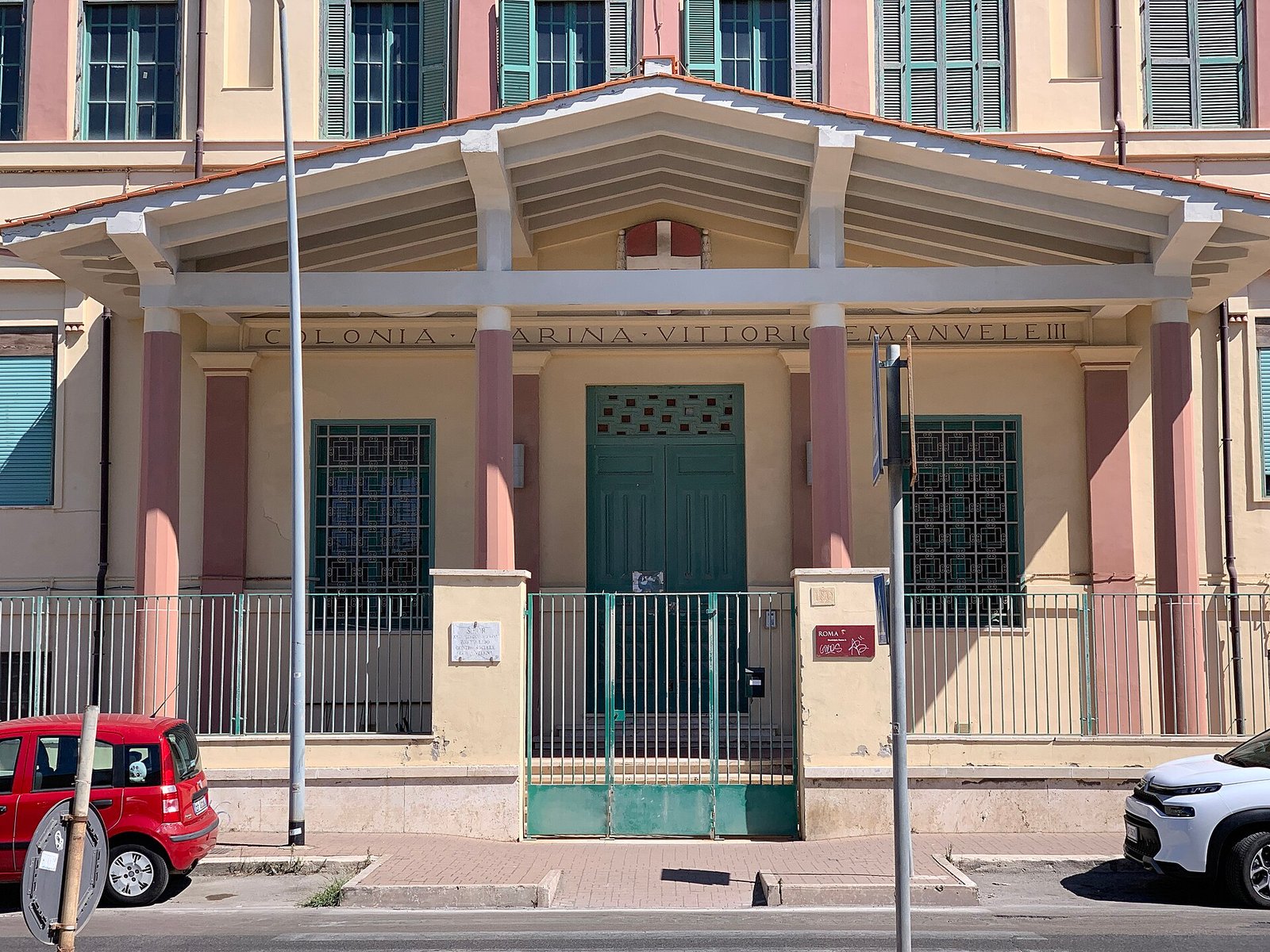
Teatro del Lido di Ostia occupies part of the former Vittorio Emanuele III seaside colony, at Via delle Sirene 22, and opened in February 2003 as Rome's first public, participatory theater on the city's outskirts.
A building for children
The complex was born as a seaside colony, a facility for children's stays by the sea. The same building today also houses the Elsa Morante municipal library and the Almayer bookstore, as well as social reception services. That a monologue told by a child is staged in a building made for children is a coincidence that, in our opinion, adds something to the evening.
From abandonment to theater
After different uses, the spaces remained unused for over 25 years. In 1997 local artists and young people occupied them and started theater and workshop activities there. The City of Rome renovated the building between 1999 and 2003, with a consortium of associations involved in the programming, and in February 2003 the theater opened.
The hall
The hall is rectangular, with an orchestra and rising tiers, for 202 seats. For a monologue it's the right size: the voice carries effortlessly, expressions can be read even from the back rows, and the audience shares the performer's breath.
Teatri in Comune
Teatro del Lido is part of Teatri in Comune, the system of Roma Capitale's public theaters in the municipalities, together with Teatro Biblioteca Quarticciolo, Teatro Tor Bella Monaca and Teatro Villa Pamphilj. The program alternates drama, music, dance and youth theater, like the family series Teatri d'Arrembaggio.
Something nobody tells you about Pietro Giannini and La costanza della mia vita at Teatro del Lido in Ostia on November 20, 2026
What's rarely said is that Teatro del Lido exists because a community demanded it twice. The first time in 1997, when artists and young people from Ostia occupied the abandoned spaces of the colony. The second on February 26, 2010, when, after its closure in June 2008, a committee of artists, students, residents and former workers occupied it again. Three years of mobilization followed, until an agreement that restored its function and started bringing it up to code.
The second rarely mentioned thing concerns the theme. The show is about a family splitting up, seen by a child: an experience many spectators know closely, as children or as parents. The lightness of fairy tales makes the story accessible, but it's worth knowing in advance what it's about, especially if you're thinking of going with a young person.
The third is practical. Ostia is Rome, administratively, but it's more than 20 kilometers from the center. With a 19:00 start on a Friday evening, if you're coming from the center allow for traffic or train times: better to leave early.
My advice for attending Pietro Giannini and La costanza della mia vita at Teatro del Lido in Ostia on November 20, 2026
My advice is to get to Ostia at least an hour early and allow yourself a walk on the seafront before going in. In late November the sun sets over the Tyrrhenian well before 19:00, and the off-season sea puts you in the mood for a monologue that asks for attention.
The second piece of advice concerns your seat. In a 202-seat hall with an orchestra and tiers, the first rows of the tiers offer the best balance between closeness and overall view. If you want to read every expression of the performer, choose the center of the orchestra.
Third piece of advice: if possible, pair the two evenings. If you've seen or want to see Io sono verticale by Francesca Astrei on November 14, you can come back on the 20th for Pietro Giannini: two monologues by two performers who won the 2025 Ubu in the same hall, six days apart.
Last piece of advice, a practical one: book early. A small hall, a single date, an award-winning performer: seats may run out sooner than expected.
How to get to Teatro del Lido
From central Rome, Teatro del Lido can be reached on the Roma Lido railway to Lido Centro station, about a kilometer east of the theater, at Via delle Sirene 22.
The Roma Lido railway
The Roma Lido leaves from Porta San Paolo station, next to the Piramide stop on metro B and the Pyramid of Cestius. The most convenient stop is Lido Centro. From there you walk toward the sea for about a kilometer. For times and connections, the reference is the ATAC journey planner.
By car
From Rome you reach Ostia via Via del Mare, Via Ostiense or Via Cristoforo Colombo. In November parking near the theater is much less complicated than in summer. If you live in the southern parts of the city, a car is often the most practical choice.
From Ostia and the coast
If you live in Ostia, Acilia, Casal Palocco or Infernetto, the theater is a neighborhood outing. To choose the right bus, check the ATAC journey planner.
Getting back
With a 19:00 start, the show ends early. If you're going back by train, check the time of the last runs toward Porta San Paolo anyway, especially if you plan to stop for dinner.
Another well-known fact, yet rarely mentioned
It's well known that the Ubu Award is one of the best-known honors in Italian theater. It's less remembered that among its categories is one for performers under 35, which flags new voices before they become known to the general public. Seeing an actor who won in that category at a 200-seat public theater in Ostia is exactly the kind of opportunity the award aims to create.
A second rarely mentioned fact concerns the Premio Scenario, which gave its special mention to La costanza della mia vita in 2023. The mention came a year after Pietro Giannini began working as an author, in 2022: his first text was recognized almost immediately.
And a third fact: the network of outskirts theaters, of which Teatro del Lido was the first, is governed by a 2005 regional law of Lazio. Behind an evening of theater in Ostia there's a precise idea of cultural policy: not leaving the contemporary scene only to the central neighborhoods.
The right photo to take at Pietro Giannini and La costanza della mia vita at Teatro del Lido in Ostia on November 20, 2026
The right photo of this evening is taken outside, before the show. The facade of the former Vittorio Emanuele III seaside colony, with its entrance portico, is a building that tells a century of Ostia's social history: the children's colonies, the abandonment, the occupations, the public theater. In late November, around 18:30, the light is already the blue after sunset and the lit streetlamps give depth to the image.
The second photo is on the seafront, a few steps from Via delle Sirene: the empty off-season beach, with the dark sea and the lights of the coast, is the image of Ostia you don't see in summer.
The third, inside, is taken only before the start or during the applause. In a 202-seat hall a lit screen during a monologue can be seen from the stage and disturbs the performer. During the applause, instead, a photo of the actor standing before the audience rounds off the story of the evening.
Ostia and the area around Teatro del Lido
Teatro del Lido is in Ostia, in Municipio X, a few steps from Lungomare Paolo Toscanelli: a seaside neighborhood with its own history, near the excavations of Ostia Antica and the Castel Fusano pine forest.
The off-season seafront
In late November the seafront is a quiet walk, with the beach open to all and the pace of a seaside town out of season. Before the show it's the best way to arrive at the theater.
Ostia Antica
A few kilometers away is the archaeological site of Ostia Antica: if you have the day free, you can spend the morning at the excavations and the afternoon on the seafront.
The pine forest
To the south stretches the Castel Fusano pine forest, one of the coast's large green spaces, good for a walk in daylight hours.
The same theater, other nights
During the season Teatro del Lido also hosts concerts like I Magnifici Anni '80, musical shows like Cumme Marie, storie di donne and drama like Still Alive.
Some important events that happened here in history
The history of Teatro del Lido begins with the Vittorio Emanuele III seaside colony, built in Ostia for children's stays by the sea. Sources disagree on the construction date: some give 1916 and a design attributed to Marcello Piacentini, while Rome's tourism portal speaks of the 1920s. After different uses, the spaces remained abandoned for over a quarter of a century.
In 1997 local artists and young people occupied the premises on Via delle Sirene and started theater and workshop activities there. Between 1999 and 2003 the City of Rome renovated the building. In February 2003 the theater opened as Rome's first outskirts theater. For five years its management involved the Department of Cultural Policies, the Culture Department, Municipio Roma XIII, then responsible for Ostia, and the Associazione di Associazioni Le Sirene. On September 15, 2005, Lazio regional law number 16 regulated the outskirts theaters.
In June 2008 the theater closed. On February 26, 2010, a committee of artists, students, residents and former workers occupied it again. After three years of mobilization an agreement restored its function and started bringing it up to code. Today the theater is part of Teatri in Comune, in Municipio X.
Who has passed through Pietro Giannini and La costanza della mia vita at Teatro del Lido in Ostia on November 20, 2026
The history of Teatro del Lido is made more of communities than of famous names. The first to pass through these buildings were the children of the seaside colonies, brought to Ostia for decades to breathe the sea air. Then, from 1997, the local artists and young people who occupied the abandoned spaces. After 2003 the associations of the Le Sirene consortium, the companies of the new scene, the schools of the coast. In 2010 the occupiers again, who kept the hall open for three years.
In autumn 2026 the hall welcomes music, storytelling theater and family theater, and a week before Pietro Giannini it hosts Francesca Astrei, who also won the 2025 Ubu in the under-35 category.
Pietro Giannini's path includes the teachers he met at the Accademia, from Massimiliano Civica to Arturo Cirillo, from Andrea Baracco to Monica Demuru, Liv Ferracchiati and Michele Monetta, the directors Valentino Villa and Antonio Latella, his first Genoese teacher Enrico Campanati. On November 20 they all pass, ideally, through a public hall in Ostia, together with the characters of the monologue: two parents, a sister who has left, the Play-Doh Lady, Paolo who loves to sleep and a child who tells the story.
How to plan the evening in Ostia
A 19:00 show on a Friday, in Ostia, lends itself to a half day at the off-season seaside, with the theater at its center.
The afternoon
If you have the afternoon free, you can leave Rome after lunch, visit the excavations of Ostia Antica, reach the Lido around sunset and walk along the seafront before going into the theater. In late November it gets dark early: do outdoor visits in the early afternoon.
The evening
With a 19:00 start the show leaves dinner free: a table booked on the seafront or in the center of the Lido rounds off the evening. If you're going back by train, check the last Roma Lido run before sitting down to eat.
From outside Rome
If you're arriving from Fiumicino airport or the northern coast, Ostia is closer than central Rome: the theater can become the first or last evening of a stay, paired with the sea and the excavations of Ostia Antica.
With family or friends
The monologue touches on a theme many people know closely. Going to the theater as a couple or in a small group, and stopping afterward to talk about it, is in our opinion the best way to experience it: the questions it raises are easier to untangle at the table than on the train.
Where to eat in Ostia before or after the show
Ostia is the right place for a seafood dinner after a show that starts at 19:00, with trattorias and seafood restaurants on the seafront and on the streets of the Lido center. The cooking of the Roman coast is simple and direct: fried fish, pasta with seafood, grilled fish. On Friday evening, even in November, booking is wise. If you're in a hurry, you'll find bars, bakeries and pizza-by-the-slice shops in the Lido center, toward Lido Centro station.
Accessibility, age and practical information
Teatro del Lido has a hall with an orchestra and rising tiers for 202 seats. For accessibility needs, the reference is the theater, at 06 5646962 or promozione@teatrodellido.it.
Orchestra and tiers
The tiers improve visibility but involve steps: if you have difficulty walking, ask for an orchestra seat when booking.
Audience age
The theater doesn't list age limits. The monologue uses a child's point of view, but it tells of a family separation and of growing up too fast: in our opinion it's suitable for an adult audience and older teens, ideally with an adult to talk it over with afterward.
Late November in Ostia
In late November Ostia is a seaside town in the depths of the off-season. Evenings on the coast are damp and windy: a heavy jacket and an umbrella are wise, especially if you're walking from the station to the theater.
Frequently asked questions about La costanza della mia vita in Ostia
When is La costanza della mia vita on at Teatro del Lido?
La costanza della mia vita by Pietro Giannini is on at Teatro del Lido di Ostia on Friday, November 20, 2026, at 19:00, in the Teatri in Comune season. It's a single date.
What is La costanza della mia vita about?
La costanza della mia vita is a monologue that tells of a family falling apart through the eyes of a child, forced to enter the adult world too early. The text alternates fairy tale, memory and the need to protect oneself.
Who is Pietro Giannini?
Pietro Giannini is an actor and author born in Genoa in 2000, trained at the Accademia Nazionale d'Arte Drammatica Silvio d'Amico. In 2025 he won the Ubu Award for best actor or performer under 35.
How do you buy tickets for Teatro del Lido?
Tickets for Teatro del Lido di Ostia are sold online on the Teatri in Comune website, which links to the authorized presale circuit, or by booking at 06 5646962. Prices are published by the theater.
How do you get to Teatro del Lido di Ostia?
Teatro del Lido, at Via delle Sirene 22, can be reached on the Roma Lido railway from Porta San Paolo, next to the metro B Piramide stop, to Lido Centro, and then on foot for about a kilometer. By car you arrive via Via del Mare, the Ostiense or the Colombo.
Who produces the show?
La costanza della mia vita is a production of Teatro Metastasio in Prato, developed in residency at Teatro Due Mondi. In 2023 it received a special mention at the Premio Scenario.
Is the show suitable for teens?
Teatro del Lido lists no age limits for La costanza della mia vita. The monologue talks about family separation in the language of fairy tales: it may interest older teens, ideally together with an adult to talk it over with.
How long is La costanza della mia vita?
The length of La costanza della mia vita at Teatro del Lido isn't given in the Teatri in Comune listing. The show is a monologue and starts at 19:00: be in the hall a few minutes early.
What other shows are on at Teatro del Lido in November?
In the same Teatri in Comune season Teatro del Lido di Ostia also hosts Io sono verticale by Francesca Astrei, on Saturday, November 14, 2026, at 19:00, another monologue by a performer who won the 2025 Ubu under 35.
Final advice on La costanza della mia vita at Teatro del Lido, in Ostia
A debut monologue recognized at Scenario, a performer who two years later won the Ubu under 35, a 202-seat public hall born in a building made for children: in our opinion it's one of the most interesting drama events of the Teatri in Comune season. Book early, get to Ostia an hour ahead for the seafront, sit in the first rows of the tiers and, if possible, pair the evening with Francesca Astrei's on November 14.
Article written by the editorial team of Tour Leader Pro, contact them for Private/Corporate/V.I.P. Tours and Experiences.
Planning a trip to Rome? English guides to visiting the city are on ItalyPlanner.com.