63rd Nuova Consonanza Festival in Rome, November 6 to December 20, 2026
https://www.estateromana.com/en/rome/trip-planner/nuova-consonanza-festival-2026/
The 63rd Nuova Consonanza Festival, the contemporary music series that the Rome association of the same name has organized every year since 1963, runs from November 6 to December 20, 2026. The concerts announced so far are at the Auditorium Parco della Musica Ennio Morricone, at viale Pietro de Coubertin 30, starting at 8:00 p.m.: on November 6 the tribute to the centenary of Mauro Bortolotti and Franco Evangelisti, on November 20 Ars Ludi 40 with Steve Reich's ninetieth birthday, on November 25 D'improvviso with the International Contemporary Ensemble, on December 5 a concert devoted to Philippe Manoury. On November 23 and 24, at 4 p.m., Villa Aurelia hosts the conference On Improvisation: Sound, Space, Thought, organized by the American Academy in Rome. You reach the Auditorium by tram 2 from Flaminio station on Metro A, stops Flaminia/Reni or Apollodoro, or by bus 910 from Termini. Ticket prices and purchase methods are published by the organization on Nuova Consonanza's official website, which also flags the concerts still to be announced.
Language: performed in Italian. No English version or English surtitles are announced.
The 63rd Nuova Consonanza Festival: dates and program
The 63rd Nuova Consonanza Festival runs from November 6 to December 20, 2026. The association has published four concerts and a conference in advance, the rest of the program is announced as coming.
Friday, November 6: the centenary of Bortolotti and Evangelisti
The festival opens on November 6 at 8:00 p.m. at the Auditorium Parco della Musica with a concert devoted to the centenary of Mauro Bortolotti and Franco Evangelisti, two of the composers who founded the association. On stage the soprano Felicita Brusoni, the Evo ensemble, Blow Up Percussion and the PMCE, Parco della Musica Contemporanea Ensemble.
Friday, November 20: Ars Ludi 40
On November 20 at 8:00 p.m., again at the Auditorium, Ars Ludi 40 is scheduled, which the festival presents with two anniversaries: Steve Reich's 90 years and the 40 years of Ars Ludi, the Roman percussion ensemble.
Monday, November 23 and Tuesday, November 24: the conference at Villa Aurelia
On November 23 and 24, from 4:00 p.m., Villa Aurelia hosts the conference On Improvisation: Sound, Space, Thought, organized by the American Academy in Rome, devoted to improvisation in sound, space and thought.
Wednesday, November 25: D'improvviso
On November 25 at 8:00 p.m. at the Auditorium there is D'improvviso, a concert that brings together the International Contemporary Ensemble and Nuova Consonanza.
Saturday, December 5: Philippe Manoury
On December 5 at 8:00 p.m. at the Auditorium the festival devotes an evening to Philippe Manoury, with the voices of Ljuba Bergamelli and Livia Rado and the PMCE.
Through December 20
The festival closes on December 20, 2026. The events after December 5 have not yet been published: the association's website is the reference for the full calendar.
Tickets and practical information
The prices of the 63rd Nuova Consonanza Festival concerts are not yet published on the festival's page. The organization indicates on its website the purchase methods and updates to the program.
Where to buy
For the concerts at the Auditorium Parco della Musica tickets are bought through the circuit indicated by the organization. For the Villa Aurelia conference, organized by the American Academy, the access conditions should be checked with the Academy, which normally asks for an ID at the entrance.
The radio
The concerts of the Nuova Consonanza Festival are usually broadcast, live or delayed, on Rai Radio3, the association explains. Those who can't be in the hall thus have a second chance to listen.
Contacts
Nuova Consonanza is based at viale Mazzini 134, in Rome, and publishes on its website a phone number and an email address for information.
The opening concert: the centenary of Bortolotti and Evangelisti
The November 6 concert celebrates two composers born in the same year, 1926, and united by the same adventure: Mauro Bortolotti, born in Narni on November 26, 1926, and Franco Evangelisti, born in Rome on January 21, 1926. Both were among the founders of Nuova Consonanza.
Mauro Bortolotti
Bortolotti studied at the Santa Cecilia Conservatory, graduating in composition with Goffredo Petrassi, in piano with Rodolfo Caporali and in organ with Fernando Germani. From 1957 to 1968 he attended the Darmstadt summer courses for new music and specialized in Pietro Grossi's Florentine electronic music studio. He also investigated the relationship between music and new technologies at the CNUCE of the University of Pisa. He taught composition at the Frosinone and Santa Cecilia conservatories, was twice president of Nuova Consonanza, in 1983-1985 and in 1995-1996, and directed the Orchestra Regionale di Roma e del Lazio from 1994 to 2000. He died in Rome on November 14, 2007.
Poetry and students
In his output the relationship with poetry has particular weight: Bortolotti set to music texts by Scotellaro, Éluard, Cummings, Berryman, Martial, Pasolini, Giuliani, Pessoa, Mayakovsky and Rilke. Among his students are Paolo Rotili, Lucio Gregoretti and Fabrizio De Rossi Re. His archive is kept in the library of the Accademia di Santa Cecilia, which is right at the Auditorium Parco della Musica: the concert for his centenary takes place a few yards from his papers.
Franco Evangelisti
Evangelisti left his engineering studies for composition. He was a student of Daniele Paris in Rome and Harald Genzmer in Freiburg, from 1952 to 1960 he took part in the Darmstadt courses, where meeting Werner Meyer-Eppler brought him close to electronic music and the concept of chance. In 1956 he worked in the electronic studio of Cologne radio, in 1957 in the experimental electroacoustic studio in Gravesano at the invitation of Hermann Scherchen, in 1958 he inaugurated with Karlheinz Stockhausen and Luigi Nono the experimental studio of Polish radio in Warsaw. In 1959 he was among the promoters of the Palermo International New Music Week.
Improvisation
From Nuova Consonanza was born in 1964 the Gruppo di Improvvisazione Nuova Consonanza, which Evangelisti presented as the first and only ensemble made up of composer-performers, considered among the first experimental collectives of composers. From 1974 until his death, on January 28, 1980, Evangelisti taught electronic music at the Santa Cecilia Conservatory.
The performers
The opening concert fields the soprano Felicita Brusoni, the Evo ensemble, Blow Up Percussion and the PMCE, Parco della Musica Contemporanea Ensemble, whose name recalls the Auditorium itself. The detailed program of the pieces is not yet published.
Ars Ludi 40 and Steve Reich's 90 years
Ars Ludi is a variable-lineup percussion ensemble founded in Rome in 1987, awarded the Silver Lion at the 2022 Venice Biennale Musica, the November 20 concert celebrates its 40 years together with Steve Reich's 90.
The ensemble's history
Ars Ludi was founded by Antonio Caggiano and Gianluca Ruggeri, in 1988 Alessandro Tomassetti joined and in 1989 Rodolfo Rossi. The ensemble has collaborated with composers such as Giorgio Battistelli, Louis Andriessen, Jacob TV, Alvin Curran and Francesco Filidei, giving their premieres, and has commissioned pieces from many Italian and foreign authors.
Seasons and festivals
The ensemble has performed in the seasons of the Istituzione Universitaria dei Concerti, the Ravenna Festival, the Accademia Filarmonica Romana, Musica per Roma, Nuova Consonanza itself and the Concerti del Quirinale, and in festivals such as RomaEuropa, the Maggio Musicale Fiorentino and the Sagra Musicale Malatestiana. The discography counts seven CDs, three of them devoted to John Cage and one to Battistelli.
Ars Ludi and Reich
The tie to Steve Reich is not occasional: among the ensemble's projects are Reich's Drumming, Electric Counterpoint and Tehillim. The evening's program is not yet published, but the pairing of the two anniversaries says clearly what repertoire the concert will start from.
Beyond music
Ars Ludi is characterized by work that integrates the musical language with cinema, theater and the figurative arts. Its members also carry out intense teaching activity: Caggiano at the Accademia Chigiana in Siena, Rossi and Ruggeri at the international courses in San Marino.
D'improvviso and the Manoury evening
Two concerts of the 63rd Nuova Consonanza Festival look at two poles of today's music: improvisation, with D'improvviso on November 25, and real-time electronic music, with the December 5 evening devoted to Philippe Manoury.
D'improvviso
On November 25 the International Contemporary Ensemble and Nuova Consonanza are together in concert. The title recalls improvisation, a theme running through the whole festival: the Villa Aurelia conference, two days earlier, is devoted precisely to improvisation, and the association's history is tied to the Gruppo di Improvvisazione Nuova Consonanza, born in 1964.
Philippe Manoury
Philippe Manoury, born in Tulle on June 19, 1952, is a French composer and teacher. He studied at the École Normale de Musique and the Paris Conservatoire, in 1980 he joined IRCAM as a composer and electronic music researcher, and from 2004 to 2012 he taught composition at the University of California, San Diego. Today he lives in Strasbourg.
The real-time pioneer
From the 1980s Manoury worked with the American researcher Miller Puckette, first at IRCAM and then in San Diego. The series Sonus ex machina is among the first works to use real-time audio signal processing, and Pluton, from 1988, is the first composition made with Puckette's Max software.
Manoury and Nuova Consonanza
The tie with the Roman association is old: in 2011 Manoury was the guest composer of De Musica, Nuova Consonanza's workshop for young composers from Italian and European conservatories. On December 5 the voices of Ljuba Bergamelli and Livia Rado with the PMCE perform him.
A curiosity about the 63rd Nuova Consonanza Festival in Rome, November 6 to December 20, 2026
The curiosity is that the opening concert celebrates the founders in the place that keeps their memory. Mauro Bortolotti's archive, with manuscripts, scores, sheet music, records, books and letters, is kept in the library of the Accademia di Santa Cecilia, which is based at the Auditorium Parco della Musica. On November 6 Bortolotti's music sounds again a few steps from his papers, in the centenary of his birth.
The second curiosity concerns the number. The 2026 festival is the 60-third: the association has organized it regularly since 1963, and the numbers add up. But Nuova Consonanza is older than the festival. Founded at the end of the 1950s by nine composers, Mario Bertoncini, Mauro Bortolotti, Aldo Clementi, Antonio De Blasio, Franco Evangelisti, Domenico Guaccero, Egisto Macchi, Daniele Paris and Francesco Pennisi, it was born as an association and only a few years later established the annual autumn event.
The third concerns teaching. Among the composers hosted by the De Musica workshop, the association recalls in 2003 Ennio Morricone, today the namesake of the Auditorium where the festival's concerts are held. On that occasion Morricone led the workshop for Nuova Consonanza's young composers.
Nuova Consonanza, 60 years of new music in Rome
Nuova Consonanza is a non-profit musical cultural association whose purpose is the dissemination of Italian and foreign contemporary music, since 1963 it has regularly organized its annual festival.
The numbers
According to the association, after over 50 years of activity Nuova Consonanza has 49 members among composers, performers, musicologists and critics, and has given 750 concerts, with more than 800 authors performed and about 3,000 compositions, very many in world, European or Italian premiere. It has published 14 monographic volumes and organized conferences, seminars and study meetings.
The avant-gardes of the 1960s
Its activity starts from the debate of the avant-gardes of the 1950s and 1960s, with a predilection for chance, theatrical aspects, the integration of music, visual arts and poetry and new electronic technologies. In those years the association presented music by Nono, Berio, Maderna, Stockhausen, Kagel, Schnebel, Ligeti, Castiglioni, Donatoni and Bussotti, the first public electronic music concerts, performances by interpreters such as David Tudor and Frederic Rzewski.
The 1970s and 1980s
In the 1970s the association also devoted itself to popularizing historical 20th-century music in schools and in the Rome province, and distinguished a decentralized season from the autumn festival. In the 1980s the historic festivals devoted to Evangelisti (1980), Petrassi (1983) and Guaccero (1984) alternated with thematic ones on contemporary vocality, the piano, the myth of the primitive. The festival Intorno alla seconda scuola di Vienna won the Premio Abbiati in 1990.
The archive
In 2014 Nuova Consonanza's archive was declared of particularly important historical interest by the Archival Superintendency of Lazio. It holds about 2,400 recordings of contemporary works, often absent from the record catalog, hundreds of scores and a rich tape library documenting Italian and international musical life from 1962 to today.
The Franco Evangelisti competition
The association also organizes the Franco Evangelisti International Composition Competition, which chooses the winning score after the live public performance of the finalist compositions, the winning scores are broadcast on Rai Radio3.
Something nobody tells you about the 63rd Nuova Consonanza Festival in Rome, November 6 to December 20, 2026
What is rarely said is that the Nuova Consonanza Festival is a festival to follow in full, not to sample. The program is built like a path: the founders' centenary, the relationship between a Roman ensemble and an American master of minimalism, a conference on improvisation, an improvised concert, real-time electronic music. Whoever goes to a single evening hears a concert, whoever follows three or four understands why this association has existed for 60 years.
The second thing rarely said is that the program is not complete. The association has published the concerts in advance, up to December 5, but the festival lasts until December 20: more events will come. It's worth signing up for Nuova Consonanza's newsletter, which the association offers on its website, to receive the full program as soon as it's published.
The third concerns the Villa Aurelia conference. It's organized by the American Academy in Rome, which is based on the Gianicolo and applies its own access rules: photo ID at the entrance, no bulky luggage, no storage. Those planning to go should know this beforehand, so as not to miss the start of the sessions.
My advice for seeing the 63rd Nuova Consonanza Festival in Rome, November 6 to December 20, 2026
The advice is to choose at least two evenings that speak to each other. The most natural pair is November 6 and November 25: the centenary of Evangelisti, the composer who in Rome theorized free improvisation, and D'improvviso, which brings improvisation to the Auditorium stage with the International Contemporary Ensemble. In between, for those with time, the Villa Aurelia conference on the same theme.
For those who prefer more immediate listening, the November 20 concert is, in our view, the best doorway to contemporary music: Ars Ludi's percussion and Steve Reich's repertoire, with its repetitive structures and rhythmic energy, are an experience accessible even to those who don't frequent this repertoire.
One last tip: the concerts are at 8:00 p.m., on weekdays. It's best to arrive at the Auditorium half an hour early, dine after the concert in the Ponte Milvio or Flaminio area, and check the association's website in the preceding days for the exact hall and the program of pieces.
The Auditorium Parco della Musica Ennio Morricone
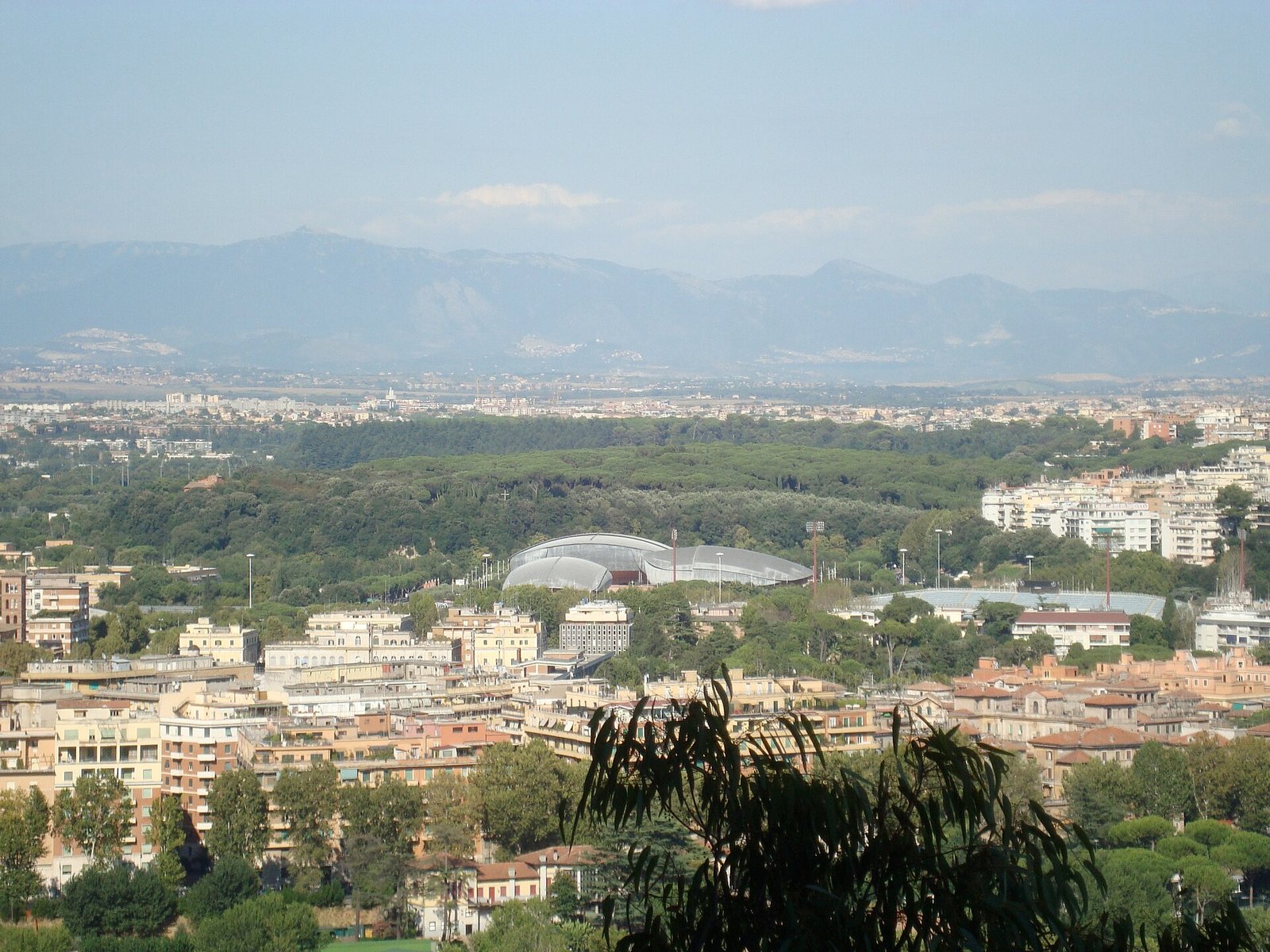
The Auditorium Parco della Musica Ennio Morricone, at viale Pietro de Coubertin 30, is the complex designed by Renzo Piano that hosts most of the 63rd Nuova Consonanza Festival's concerts.
The three halls
From outside the three halls look like three big scarabs, covered in lead panels on a brick base and arranged radially around the open-air cavea, named after Luciano Berio. Renzo Piano won the 1993 invitational competition and worked with the acoustician Jürgen Reinhold of the Müller-BBM studio in Munich and with the landscape architect Franco Zagari.
The Roman villa under the halls
During construction the remains of a Roman villa emerged, built in the 3rd century BC on the site of an archaic farm of the 6th century BC. The discovery forced Piano to modify the design: two of the three scarabs were moved west, almost to the corso di Francia viaduct. The finds are displayed in a small museum under the cavea.
A place for contemporary music
On April 21, 2002 the first hall opened, on December 21, 2002 the rest of the complex was inaugurated. Since 2003 the Auditorium has been the permanent home of the Accademia Nazionale di Santa Cecilia, in 2020 it was named after Ennio Morricone. The PMCE, the ensemble playing in two of the festival's concerts, carries the Parco della Musica in its name.
Getting to the Auditorium and Villa Aurelia
The Auditorium Parco della Musica is reached by tram 2, stops Flaminia/Reni or Apollodoro, and by buses 910, 982, 168 and 53, the nearest metro station is Flaminio, on line A.
Metro A and tram 2
From Flaminio station you exit onto piazzale Flaminio and take tram 2 along via Flaminia. Get off at Flaminia/Reni or Apollodoro and walk a few minutes toward viale Pietro de Coubertin, crossing the Villaggio Olimpico.
Bus 910 from Termini
The 910 leaves from piazza dei Cinquecento, in front of Termini station, and takes you to the Auditorium without changes. The 168, which arrives from Tiburtina station, is a weekday line: it's best to check its evening schedules.
By car
The complex has paid internal parking, with limited spaces. Viale Pietro de Coubertin is closed to traffic along the Auditorium stretch.
Villa Aurelia
Villa Aurelia is one of the sites of the American Academy in Rome, on the Gianicolo, near Porta San Pancrazio, the Academy's main site is at via Angelo Masina 5. The public transport route to Porta San Pancrazio is calculated with the ATAC planner.
Another well-known fact, yet rarely cited
It's well known that Nuova Consonanza was born from the debate of the avant-gardes of the 1950s and 1960s. Less often remembered is how much of that Roman season passed through its concerts. According to the association, the first public electronic music concerts, the performances of David Tudor and Frederic Rzewski and the birth of the Gruppo di Improvvisazione Nuova Consonanza belong to those years. And the improvisation ensemble came into contact with the American composer Larry Austin during his residency at the American Academy in Rome.
The second fact ties this episode to the 2026 festival. The November 23 and 24 conference on improvisation is organized precisely by the American Academy, at Villa Aurelia. 60 years later, the same institution that hosted Austin and put him in contact with Evangelisti returns to talking about improvisation in the festival Evangelisti helped found.
The third fact concerns Rai Radio3: the festival's concerts are usually broadcast by public radio, and the winning scores of the Franco Evangelisti competition are also aired on Radio3. For a contemporary music festival it's a rare sounding board, which takes these concerts well beyond the Roman halls.
The right photo to take at the 63rd Nuova Consonanza Festival in Rome, November 6 to December 20, 2026
The right photo is taken outside the halls, before the concert. From the top of the cavea, just as it gets dark, you frame Renzo Piano's three scarabs with the lead cladding reflecting the lights. In November darkness comes early: by 7:30 p.m. the light is already evening light, and the lit Auditorium is the most photogenic subject in the neighborhood.
Inside the hall the phone goes in your pocket. In contemporary music silence is part of the composition, and every noise, every lit screen, interferes with listening. For the November 20 concert, before the start, the stage full of Ars Ludi's percussion instruments is in any case an image worth a shot, if the hall staff allow it.
For the Villa Aurelia conference, the right photo is the panorama from the Gianicolo, a few steps from the American Academy: after an afternoon session, the late-November sunset over the city is the best way to end the day.
Around the Auditorium
The Auditorium occupies an area bounded by Villa Glori, the Villaggio Olimpico, the corso di Francia viaduct and viale Maresciallo Pilsudski, in the northern quadrant of Rome.
MAXXI
Near the Flaminia/Reni stop of tram 2 is MAXXI, the national museum of 21st-century arts: with the Auditorium it forms the city's most important pair of contemporary architectures. For those following the festival, it's a coherent way to spend the afternoon before the concert.
The Ponte della Musica and Ponte Milvio
From the Auditorium you go down toward the Tiber and the Ponte della Musica, the pedestrian and cycle footbridge that links Flaminio to the Foro Italico. Farther north, beyond piazza Mancini, is Milvian Bridge, the ancient bridge that in the evening is one of the meeting points of northern Rome.
The Gianicolo
For those going to the Villa Aurelia conference, the Janiculum Hill offers one of the widest views over Rome, a few minutes' walk from the American Academy.
Some important events that happened here in history
The history of the Nuova Consonanza Festival begins with a few Roman composers. At the end of the 1950s Mario Bertoncini, Mauro Bortolotti, Aldo Clementi, Antonio De Blasio, Franco Evangelisti, Domenico Guaccero, Egisto Macchi, Daniele Paris and Francesco Pennisi founded the association. Since 1963 the festival has been held every year, since 1964 the association has had stable access to ministry funding. In 1964 the Gruppo di Improvvisazione Nuova Consonanza was born, performing for the first time in 1965, at the third festival.
The following years are marked by monographic and thematic festivals: Evangelisti in 1980, the year of his death, Petrassi in 1983, Guaccero in 1984, contemporary vocality in 1982, the piano in 1987, the myth of the primitive in 1989. In 1990 the festival Intorno alla seconda scuola di Vienna wins the Premio Abbiati. Between 1998 and 2000 the association gains access as lead partner to European funds with the festivals Elettroshock, on 50 years of electronic music, Da York a New York and Terror vocis.
In 2001 the festival stages chamber music-theater works by Evangelisti, Guaccero, Pennisi, Donatoni and De Rossi Re, in 2005 it is devoted to Giacinto Scelsi. In 2014 the association's archive is declared of historic interest, and Roma Capitale recognizes the festival as of particular interest for the city's cultural life. In 2026, with the centenary of Bortolotti and Evangelisti, the festival returns to its origins.
Who has come through the 63rd Nuova Consonanza Festival in Rome, November 6 to December 20, 2026
A good part of second-half-20th-century music has passed through the Nuova Consonanza Festival. According to the association, in the 1960s music by Luigi Nono, Luciano Berio, Bruno Maderna, Karlheinz Stockhausen, Mauricio Kagel, Dieter Schnebel, György Ligeti, Niccolò Castiglioni, Franco Donatoni and Sylvano Bussotti was performed, and interpreters such as David Tudor, Frederic Rzewski, the Kontarsky brothers and the La Salle Quartet played.
Through the De Musica workshop have passed as teachers David Lang in 1999, Louis Andriessen in 2000, Pascal Dusapin in 2001, Ivan Fedele in 2002 and 2015, Ennio Morricone in 2003, Helmut Lachenmann and Brice Pauset in 2004, Gavin Bryars in 2007, Salvatore Sciarrino in 2009, Beat Furrer in 2010, Philippe Manoury in 2011, Mark Andre in 2012. Among the scholars who have written and spoken for the association are Pierre Boulez, Massimo Cacciari, Diego Carpitella and Stockhausen himself.
In 2026 the festival is joined by the soprano Felicita Brusoni, the Evo ensemble, Blow Up Percussion, the PMCE, Ars Ludi, the International Contemporary Ensemble, the voices of Ljuba Bergamelli and Livia Rado, and again, 15 years after the De Musica workshop, the music of Philippe Manoury.
Where to eat before or after the concerts
Inside the Auditorium there are a bar and a café in the foyer and a restaurant bar with street access too: the most convenient solution for those arriving straight from work to an 8:00 p.m. concert.
In the neighborhood
Between the Villaggio Olimpico, via Flaminia and piazza Mancini there are neighborhood pizzerias, trattorias and bars, frequented more by residents than by tourists. Before an 8 p.m. concert it's best to book early, around 6:30 p.m.
After the concert
Those who prefer to dine afterward will find the widest offer in the Ponte Milvio area, reachable in a few minutes, where venues stay open late.
Accessibility and practical information
For the Auditorium, accessibility requests should be addressed to the concert organization before purchase. For the conference, the American Academy declares its sites wheelchair accessible and asks to be notified in advance at the email address dedicated to events.
With teens
The November 20 concert, with Ars Ludi's percussion and Reich's repertoire, is the best suited to a teen who studies music or is approaching the contemporary repertoire: rhythm, energy and recognizable structures. The Manoury evening, with real-time electronics, interests those who study music technology.
November and December in Rome
Between November and December Roman evenings are cool and often damp. The route from the tram to the Auditorium crosses the Villaggio Olimpico: a coat and an umbrella are useful on the way out, late in the evening.
Frequently asked questions about the Nuova Consonanza Festival
When does the 63rd Nuova Consonanza Festival take place?
The 63rd Nuova Consonanza Festival takes place in Rome from November 6 to December 20, 2026. The concerts already announced are on November 6, 20 and 25 and December 5 at the Auditorium Parco della Musica, at 8:00 p.m., plus a conference on November 23 and 24 at Villa Aurelia.
Where are the Nuova Consonanza Festival concerts held?
The announced concerts of the Nuova Consonanza Festival are held at the Auditorium Parco della Musica Ennio Morricone, at viale Pietro de Coubertin 30. The On Improvisation conference takes place at Villa Aurelia, home of the American Academy in Rome on the Gianicolo.
What can you hear at Nuova Consonanza's opening concert?
The opening concert of the 63rd Nuova Consonanza Festival, on November 6, celebrates the centenary of Mauro Bortolotti and Franco Evangelisti, founders of the association, with the soprano Felicita Brusoni, the Evo ensemble, Blow Up Percussion and the PMCE.
What is Ars Ludi 40?
Ars Ludi 40 is the November 20 concert at the Nuova Consonanza Festival that celebrates the 40 years of Ars Ludi, a Roman percussion ensemble awarded the Silver Lion at the 2022 Biennale Musica, and the 90 years of Steve Reich, an author whose Drumming and Tehillim the ensemble has performed.
How much do Nuova Consonanza Festival tickets cost?
The prices of the 63rd Nuova Consonanza Festival concerts are not yet published on the festival's page. Information on tickets and the full program is published by the organization on the association's official website.
Who founded Nuova Consonanza?
Nuova Consonanza was founded at the end of the 1950s by the composers Mario Bertoncini, Mauro Bortolotti, Aldo Clementi, Antonio De Blasio, Franco Evangelisti, Domenico Guaccero, Egisto Macchi, Daniele Paris and Francesco Pennisi. The annual festival has been held since 1963.
Are Nuova Consonanza concerts broadcast on radio?
Yes, the Nuova Consonanza Festival concerts are usually broadcast, live or delayed, on Rai Radio3, as the association indicates.
Final advice on the Nuova Consonanza Festival
The 63rd Nuova Consonanza Festival is, in our view, the most serious way to hear contemporary music in Rome in the autumn: an association with 60 years of history celebrates its founders and lines up percussion, improvisation and electronics. It's best to choose at least two evenings, starting from November 6 or 20, follow the program updates until December 20 and, for those who can't be there, listen to the concerts on Rai Radio3.
Article written by the editorial team of Tour Leader Pro, contact them for Private/Corporate/V.I.P. Tours and Experiences.
Planning a trip to Rome? The English-language guides to visiting the city are on ItalyPlanner.com.