Notre Dame de Paris at Palazzo dello Sport in Rome, December 26, 2026 to January 10, 2027
https://www.estateromana.com/en/rome/trip-planner/notre-dame-de-paris-at-palazzo-dello-sport-in-rome-december-26-2026-to-january-1/
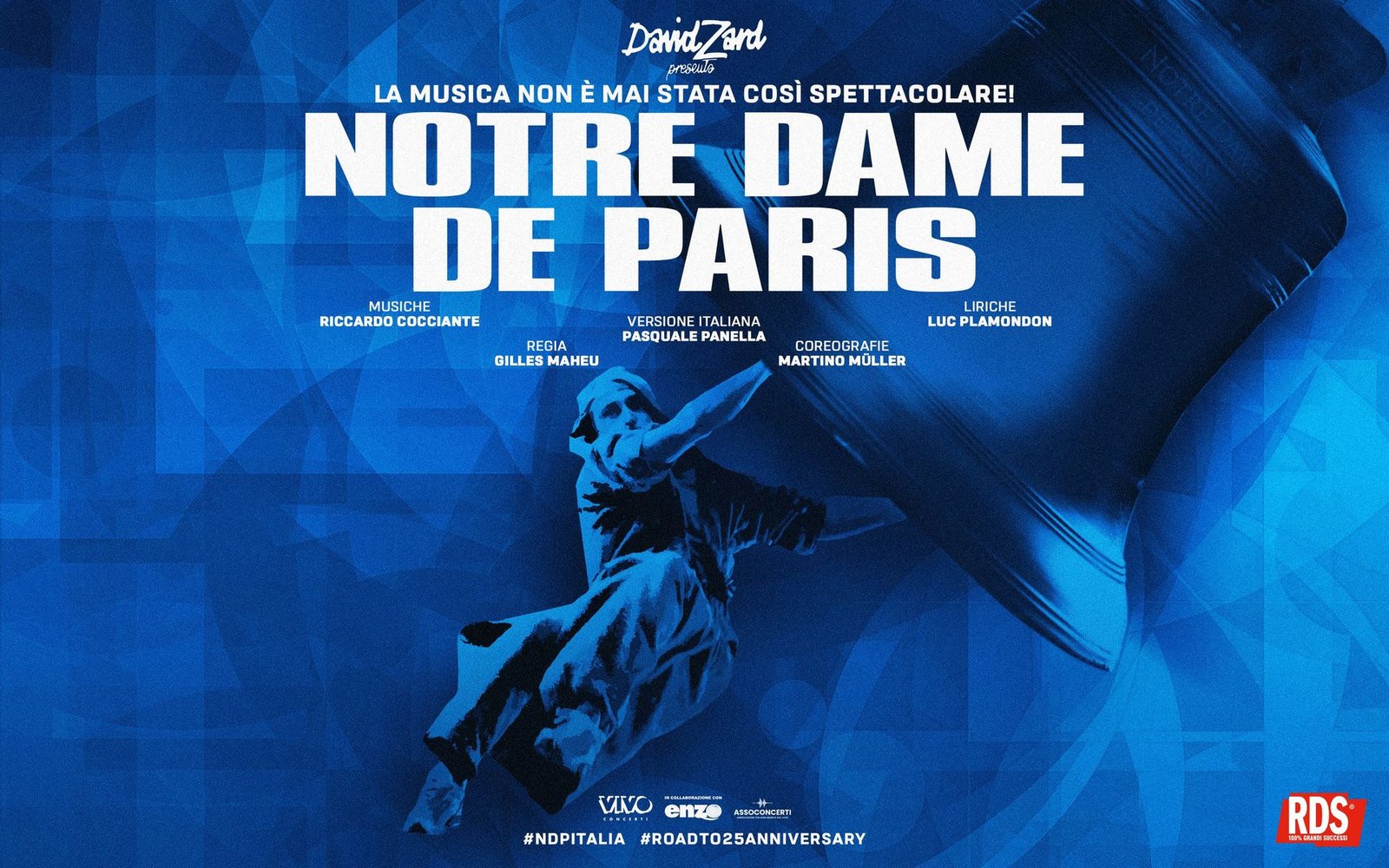
Notre Dame de Paris, the popular opera by Riccardo Cocciante with lyrics by Luc Plamondon in the Italian version by Pasquale Panella, is on stage at Palazzo dello Sport in Rome from December 26, 2026 to January 10, 2027, with 16 shows. The venue is the Palazzo dello Sport in EUR, at Piazzale Pier Luigi Nervi 1, 00144 Rome. The times given by the promoter Vivo Concerti are 21:00 for the evening shows and 16:00 or 17:00 for the afternoon ones: Saturday, December 26 at 21:00, Sunday the 27th at 17:00 and 21:00, Monday the 28th and Tuesday the 29th at 21:00, Saturday, January 2 at 16:00 and 21:00, Sunday the 3rd at 17:00 and 21:00, Monday the 4th and Tuesday the 5th at 21:00, Wednesday the 6th at 17:00, Friday the 8th at 21:00, Saturday the 9th at 16:00 and 21:00, Sunday the 10th at 17:00. You get there by metro line B, stops EUR Palasport or EUR Fermi, a few minutes on foot from the arena. Prices are published by the authorized reseller named by the organization, and tickets are bought through the authorized presale network, reachable from the official tour page on the Vivo Concerti website. On the same page the promoter lists two discounts: children up to age 5 enter free without a ticket if held on a parent's lap, children from 6 to 12 get 20% off and a seat, and groups of at least 20 people get 20% off.
Language: a performance based on dance, music or visual acts; no English version is announced, any spoken parts are in Italian.
Rome is the second-to-last city of a tour that began on February 26, 2026 at Teatro Arcimboldi in Milan and closes again in Milan in March 2027. It is also the city where the Italian version of Notre Dame de Paris was born, on March 14, 2002, in a theater built for the purpose. 24 and a half years later, the show returns to the capital for the holidays, in an Olympic arena, and stays more than two weeks.
The schedule of Notre Dame de Paris shows in Rome
There are 16 Notre Dame de Paris shows in Rome, spread over 12 days between December 26, 2026 and January 10, 2027: 10 evening shows at 21:00 and six afternoon shows at 16:00 or 17:00. There are no shows on December 30 and 31, January 1 and January 7. The times below are those published by Vivo Concerti for each date, converted to Rome time. The time printed on the ticket is what counts.
December 26 to 29: the Christmas holidays
- Saturday, December 26, 2026, Saint Stephen's Day: 21:00
- Sunday, December 27, 2026: 17:00 and 21:00
- Monday, December 28, 2026: 21:00
- Tuesday, December 29, 2026: 21:00
January 2 to 6: the first weekend of the year and Epiphany
- Saturday, January 2, 2027: 16:00 and 21:00
- Sunday, January 3, 2027: 17:00 and 21:00
- Monday, January 4, 2027: 21:00
- Tuesday, January 5, 2027: 21:00
- Wednesday, January 6, 2027, Epiphany: 17:00
January 8 to 10: the closing weekend
- Friday, January 8, 2027: 21:00
- Saturday, January 9, 2027: 16:00 and 21:00
- Sunday, January 10, 2027: 17:00, the last Roman show
Afternoon or evening: how to choose
The six afternoon shows all fall on holidays or the days before them: December 27, and January 2, 3, 6, 9 and 10. They are the shows designed for families, and you can tell from the time: with a start at 16:00 or 17:00, you are still out in time for dinner at home. The 21:00 evening shows are better for those coming from outside Rome who want to make the day a complete outing, with the afternoon in the city and the show in the evening. On double-show days, December 27 and January 2, 3 and 9, the arena's forecourt sees two waves of audience a few hours apart. If you have the evening show, it is best not to arrive too early, so as not to run into the crowd leaving the afternoon one.
Notre Dame de Paris, the popular opera that changed musical theater
Notre Dame de Paris debuted in its original French version on September 16, 1998 at the Palais des Congrès in Paris, and in its Italian version on March 14, 2002 at the Gran Teatro in Rome. The promoter calls it the most famous modern popular opera in the world, and the numbers it publishes explain why: translated into 9 languages, staged in 24 countries, more than 5,650 shows and 18 million spectators worldwide, according to the April 2026 press release.
From Victor Hugo to the stage
The story comes from Victor Hugo's novel of the same name, and at its center is the dramatic love story between Esmeralda and Quasimodo, against the backdrop of the cathedral of Notre-Dame in Paris. The promoter insists on the themes, and is right to do so: marginalization, fear of the different, the weight of prejudice, the search for a place in the world, the need for justice, the desire for love. These are themes that need no updating to speak to today's audience, and that is why the show has held up for almost 30 years.
Why it is called a popular opera
It is not a musical in the Broadway sense, with spoken dialogue alternating with sung numbers. It is an entirely sung opera, built as a succession of songs. The formula, in the promoter's words, joins the European tradition of music drama with the techniques of concerts and large live productions. You can then see why a show born for theaters feels at ease in an arena: its grammar is that of the concert, with songs that live outside the story too and that the audience knows by heart. In our judgment this is Cocciante and Plamondon's decisive choice: to have written songs before scenes.
The success in Italy
In Italy the numbers are impressive. In more than 20 years, according to the promoter, the show has played 49 cities, with 181 stops and 1,548 performances, to which are added the more than 200 shows of the current tour, and has reached 4.5 million spectators. In 2022 it celebrated the 20th anniversary of the Italian debut with the full original cast. In 2027 it will celebrate the 25th anniversary. In April 2026, a little over a month before the restart, tickets sold for the new tour had passed 350,000.
A word on the numbers
A show's numbers change from one press release to the next, and it is fair to say so. In April 2025, at the announcement of the return, the promoter spoke of 13 million spectators worldwide, 20 countries and more than 5,400 shows. In April 2026 the figures became 18 million, 24 countries and more than 5,650 shows. The Italian figure of 4.5 million spectators, on the other hand, stayed stable across the two texts. Take them for what they are: the order of magnitude of a phenomenon, more than an accounting.
The authors of Notre Dame de Paris: Cocciante, Plamondon, Panella
The music of Notre Dame de Paris is by Riccardo Cocciante, the original French lyrics by Luc Plamondon, the Italian version by Pasquale Panella. They are three very different signatures, and the Italian show is the result of their meeting, made possible by a producer who believed in it before anyone else.
Riccardo Cocciante, the composer
The promoter puts him at the center of the project, and his signature is recognizable in every piece: broad melodies, built to rise, written for voices able to carry the emotional impact of the story. In 2026 Cocciante also returned with a new album of unreleased songs, Ho vent'anni con te, released on March 13, and with the concerts Io... Riccardo Cocciante in 2026, which began on June 6. Some moments of the genesis of Notre Dame de Paris are told in the documentary Il mio nome è Riccardo Cocciante, the first dedicated to the artist. Presenting the show's return, Cocciante said: "The show constantly reinvents itself."
Luc Plamondon, the lyricist
Plamondon wrote the original lyrics in French, starting from Hugo's novel. His work is the dramaturgical structure of the opera: the choice of characters, the division into songs, the alternating points of view. The Italian audience knows him indirectly, through Panella's words, but the backbone of the show is his.
Pasquale Panella, the Italian voice
The promoter speaks of a masterful adaptation, and the word adaptation is the right one. A sung version cannot be translated line by line: you have to match syllables to notes, accents to melody, and meanwhile keep the meaning. Panella gave the Italian show a language of its own, and it is that language the Italian audience has learned by heart. Titles like Il tempo delle cattedrali and Vivere per amare are now part of the vocabulary of anyone who has seen the show.
David Zard, the producer
The Italian version was produced by David Zard, whom the promoter describes as a key figure of live entertainment in Italy. Noting the absence of theaters suited to such an innovative production, he had the Gran Teatro di Roma built for the purpose: a courageous choice, according to the press release, that marked a turning point. Zard's name still appears today at the top of the tour's official poster, with the words David Zard presents.
The creative team: direction, choreography, costumes and sets
The direction of Notre Dame de Paris is by Gilles Maheu, the choreography and stage movement by Martino Müller, the costumes by Fred Sathal, the sets by Christian Ratz. This is the team the promoter names for the show, and the same direction and choreography are mentioned in the call for the 2026 and 2027 tour.
Gilles Maheu, the direction
Maheu signs the staging that has accompanied the show in its Italian editions. In an entirely sung opera the director's work is above all a work of space: where the singers stand, how the ensemble moves around them, how you pass from an intimate scene to a mass tableau. This is what makes the show legible even from the farthest rows of an arena.
Martino Müller, the choreography
The choreography is one of the most recognizable elements of the production. The promoter explains that the dance fuses classical ballet and breakdance, and the call published in July 2025 confirms it in detail: the production was looking for dancers with a solid classical and contemporary base, acrobats and gymnasts able to perform series of back flips, and breakers able to do head spins and combinations of power moves.
Fred Sathal and Christian Ratz, costumes and sets
Fred Sathal's costumes and Christian Ratz's sets complete the picture. For the new production the scenography has been renewed: it is dominated by an imposing wall that transforms into everything, while shades of gray envelop the scene and make it, in the promoter's words, surprisingly metropolitan, close to today's urban reality.
What you will see at Palazzo dello Sport: the new production of Notre Dame de Paris
The 2026 production of Notre Dame de Paris brings to the stage a new cast, a renewed scenography dominated by a large wall and a dance ensemble that joins classical dancers, acrobats and breakers. It is the same show in structure and songs, but with a darker, more urban look than previous editions.
The wall
The wall is the strong choice of the staging. Not a reconstruction of the cathedral, but a surface that becomes in turn facade, street, prison, refuge. In an arena this choice works better than a detailed scenography: from the high stands details are lost, while a single large element can be read from every point of the hall.
The dance and the acrobatics
The ensemble of dancers is the physical engine of the show. While the leads sing, the dance ensemble fills the space around them, and the acrobatic numbers are designed to be seen from afar. The auditions for the 2026 and 2027 tour were held right in Rome, at the end of September 2025: part of the company arriving at Palazzo dello Sport was chosen in this city.
A new cast
Presenting the return, Cocciante spoke explicitly of a new cast. The names of the tour's performers do not appear in the promoter's official materials. Those who want to know who will sing at their show should check the show's official channels in the days before, bearing in mind that on a tour this long the main roles can have more than one performer.
The songs of Notre Dame de Paris to know before you go in
The most celebrated songs of Notre Dame de Paris, cited by the promoter, are Bella, Il tempo delle cattedrali and Vivere per amare. They are pieces that became hits independent of the show, and many spectators know them before even knowing where in the story they come in.
Bella
Bella is the first of the three titles the promoter highlights, and it is the piece that more than any other made the show known to the Italian general public. The title says it all: it is a song that revolves around Esmeralda, and live it is one of the moments when the hall holds its breath. Those who know it only from the radio will discover how much it changes inside the story.
Il tempo delle cattedrali
Il tempo delle cattedrali is, in our judgment, the song that best sums up the tone of the show: a reflection on time, on stone, on what remains and what changes. After the fire at the cathedral of Paris in 2019, the title took on a new weight for many spectators.
Vivere per amare
Vivere per amare is the third title the promoter highlights. It is one of those songs the audience sings under its breath, and the advice is to listen to it carefully before the evening. In the hall, at full volume and with the scene around you, you will recognize it from the first notes.
The characters and the historic cast of Notre Dame de Paris
The main characters of Notre Dame de Paris are Esmeralda, Quasimodo, Frollo, Clopin, Gringoire, Febo and Fiordaliso, the same roles that in 2022 the original Italian cast brought back on stage for the 20th anniversary. They are seven voices for seven destinies, and the show weaves them around the figure of Esmeralda.
The cast of the debut and the 20th anniversary
For the 20th anniversary in 2022, the promoter recalls the return of the entire original cast of the Italian debut: Lola Ponce as Esmeralda, Giò Di Tonno as Quasimodo, Vittorio Matteucci as Frollo, Leonardo Di Minno and Marco Guerzoni as Clopin, Matteo Setti as Gringoire, Graziano Galatone as Febo, Tania Tuccinardi and Claudia D'Ottavi as Fiordaliso.
Esmeralda and Quasimodo
The couple at the center of the story is Esmeralda and Quasimodo, two human beings who fight against life's injustices and for a love that seems impossible, in the words with which Cocciante presented the new tour. It is on this couple that the show builds its discourse on diversity: who stands at the margins of the city, and why.
The other roles
Around them revolve Frollo, Clopin, Gringoire, Febo and Fiordaliso. Each has their own songs, and each has a different relationship with Esmeralda, who is the center around which the story turns. You do not need to know the novel to find your way: the songs tell the story directly, and each character introduces themselves through their songs.
The cathedral of Notre-Dame and the show: a bond that has been renewed
The 2026 tour of Notre Dame de Paris was announced a few months after the reopening of the cathedral of Notre-Dame in Paris, which took place in December 2024 after the devastating fire of 2019. The promoter wanted to underline the coincidence, and not without reason: for many spectators the relationship with the show changed after those images.
2019 and 2024
The press release on the return speaks of the cathedral's reopening as the rebirth of a symbol of Paris and a message of hope. The show, which takes its name and setting from the cathedral, thus found itself accompanying, without meaning to, the building's recent history. Those who walk into Palazzo dello Sport in December 2026 watch an opera set in a cathedral that, two years earlier, had just returned to welcoming the faithful.
The bells
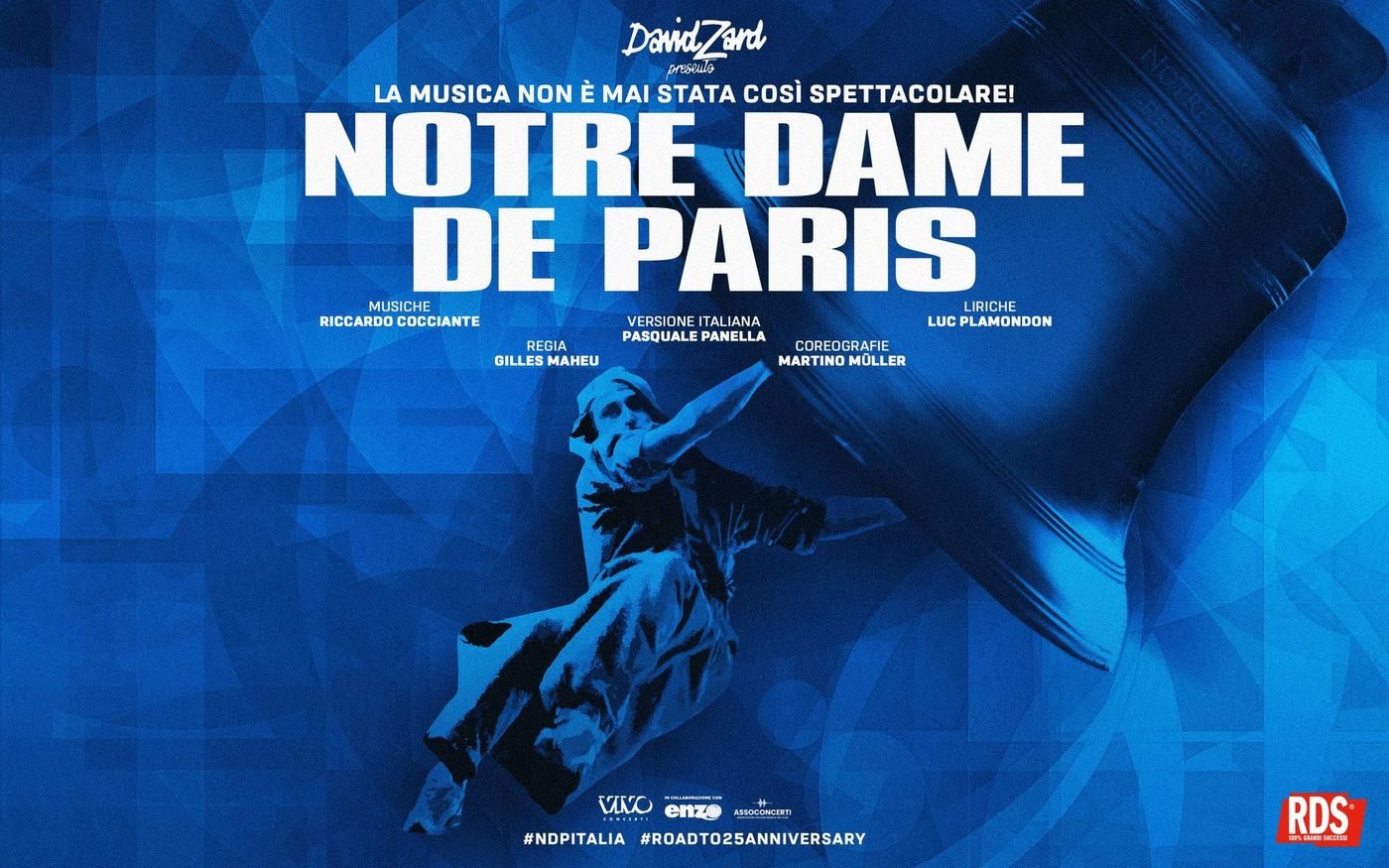
The tour's official poster shows a figure suspended beside a large bell, on a blue background crossed by motifs that recall stained glass. It is a carefully chosen image: the bell is the link between Quasimodo and the cathedral, and the poster puts it at the center.
Palazzo dello Sport in EUR, home of the Roman shows
Palazzo dello Sport in Rome stands at Piazzale Pier Luigi Nervi 1, in EUR, and was designed by Pier Luigi Nervi with Marcello Piacentini for the Rome Olympics of 1960. It is the great covered arena of the city's southern quadrant, and for decades it has hosted, alongside sport, the big indoor shows and concerts. For the full history of the building, see the page on Palazzo dello Sport.
An Olympic building
Nervi is the engineer who made reinforced concrete an expressive material, and Piacentini the architect most tied to the history of EUR. The arena was born from their collaboration for the 1960 Games, the occasion when Rome had to show itself to the world as modern and rebuilt. The great roof is still today the image you recognize on arriving in the district.
The names of the hall
Over time the hall has changed its name several times. For many Romans it is still the Palaeur, for others the PalaLottomatica, today once again Palazzo dello Sport. The metro station, EUR Palasport, keeps the simplest reference. If you ask for directions, all three names lead to the same place.
An opera in an arena
Notre Dame de Paris already knows arenas: the 20th anniversary tour had its grand finale at the Mediolanum Forum in Milan on January 5, 2023, as the promoter's photo gallery documents. The challenge remains: bringing a theatrical show into a hall designed for sport. The production's answer lies in its nature as a sung and danced opera, built like a concert. The audience is distributed between the floor and the stands that rise around the arena. The layout of the sections is the one indicated by the sales network for these shows, and it is worth looking at carefully before choosing your seat.
Where to sit
The verdict is clear: for this opera the best position is frontal, at mid-height. From the first rows of the floor you see the faces, but you lose the overall design of the dance ensemble and the wall. From the highest stands you see everything, but small. At mid-height, facing the stage, you get the whole picture and hear the voices in the right balance with the orchestration. The extreme side positions are to be avoided, because a staging built on a large frontal wall is meant to be seen head on.
How to get to Palazzo dello Sport for Notre Dame de Paris
The simplest way to reach Palazzo dello Sport is metro line B, getting off at EUR Palasport or EUR Fermi station: from both, the arena is a few minutes' walk. During the holidays it is also the most predictable way, because it avoids the traffic on Via Cristoforo Colombo and the parking problem.
By metro
There are two useful stops, both on line B in the direction of EUR: EUR Palasport, the closest, and EUR Fermi, slightly farther. From Termini station you get there with no changes. Those on line A change at Termini. On double-show days, trains toward EUR fill up before each show and those toward the center right after, so allow some margin.
Holiday hours
The Roman schedule of Notre Dame de Paris runs through holidays and the days before them: December 26, the Sundays, January 6. On holidays public transport may follow different hours from weekdays. Before heading out, check the Rome transport company's website for the times on the day of your show, and above all for the time of the last run if you have an evening show.
By bus
EUR is served by many urban bus lines, which link it to the center and the nearby districts. Routes and frequencies change with evening and holiday hours: the transport company's route planner, consulted on the day itself, is the most reliable tool for choosing the right line from where you start.
By car
I advise against the car, and all the more during the holidays. EUR is reached from the center along Via Cristoforo Colombo, but at show time the streets around the arena fill up, and after the show they empty slowly. If the car is essential, for example for those coming from outside Rome with small children, park some 200 meters from the forecourt and do the last stretch on foot.
Tickets for Notre Dame de Paris in Rome: discounts and safe purchase
Tickets for Notre Dame de Paris at Palazzo dello Sport are bought through the presale network authorized by the organization, reachable from the official tour page on the Vivo Concerti website. The prices of the different sections are published by the authorized reseller and vary by position in the hall.
Discounts for children
On the official tour page the promoter states a clear policy for the youngest. Children up to age 5 enter free, without a ticket, as long as they are held on a parent's lap. Children from 6 to 12 get 20% off and are entitled to a seat. The practical advice: even for a five-year-old, consider if a seat of their own is preferable. A whole show on an adult's lap, in a large hall, is long for both.
Discounts for groups
For groups of at least 20 people the discount is 20%, again according to the tour page. It is a formula designed for schools, associations, clubs and company groups. During the holidays group evenings are a classic: whoever organizes must move well in advance, because adjacent seats for 20 people in the best sections run out early.
Buy only from authorized channels
The promoter writes it in every press release: it declines all responsibility for tickets bought outside the authorized networks named in the official releases. For a much-requested show, at Christmas, resale offers at inflated prices always circulate. Buy only through the official tour page, check the date and time on the ticket before paying, and be wary of anyone offering seats for a show that appears sold out.
A curiosity about Notre Dame de Paris at Palazzo dello Sport in Rome, December 26, 2026 to January 10, 2027
The most interesting curiosity of these Roman shows is a matter of calendar and anniversaries. The Italian version of Notre Dame de Paris debuted in Rome on March 14, 2002. The 25th anniversary therefore falls on March 14, 2027. Looking at the dates published by the promoter, on that day the company will be on stage in Milan, at Teatro Arcimboldi, where the tour will return for the last series of shows from March 11 to 21, 2027. Rome, the city of the debut, is thus the last big stop before the 25-year celebration: the city where the show was born hosts it for the holidays, a little over two months before the anniversary.
The detail gains flavor if you remember how that debut came about. David Zard, noting that in Italy there were no theaters suited to such an innovative production, had the Gran Teatro di Roma built for the purpose. It was a bet on the city: a French show, entirely sung, in a new hall, in the capital. The bet was won, and from Rome the show set off on a journey that in more than 20 years has touched 49 Italian cities.
There is also a subtle thread tying 2002 to 2026. Back then Rome built a theater to welcome the show. Today the show arrives in a hall built for the 1960 Olympics, and adapts to it. It is the sign of an opera that has meanwhile learned to live in very different spaces: on this tour alone, an open-air theater in Palermo, the Arena di Verona, Teatro Carlo Felice in Genoa, the arenas of half of Italy. In our judgment this is the most convincing proof of its solidity: a fragile show needs its own theater, a solid show carries the theater with it.
The tour of Notre Dame de Paris: from Milan to Rome, and back
The 2026 and 2027 tour of Notre Dame de Paris started on February 26, 2026 at Teatro Arcimboldi in Milan and, according to the official tour page, closes again in Milan on March 21, 2027. Rome, from December 26 to January 10, is the second-to-last city on the calendar.
The autumn before Rome
In autumn 2026 the show crosses Italy at a brisk pace: the Arena di Verona from October 1, then Bergamo, Messina, Naples, Bari, Florence, Conegliano, Turin, Casalecchio di Reno and finally Trieste, at Politeama Rossetti, until December 22. Four days later, on December 26, the company is in Rome. Those who come to the Roman shows see a production broken in by months of performances, with a company that knows every passage.
Something nobody tells you about Notre Dame de Paris at Palazzo dello Sport in Rome, December 26, 2026 to January 10, 2027
What nobody underlines is that the Roman run grew along the way. In the schedule announced in April 2025, at the time of the return, Rome had four days: December 26 to 29, 2026. Today the official tour page lists 16 shows through January 10, 2027. The January dates were added later, and those from January 8 to 10 appear on the promoter's page but not in all the calendars circulating online, some of which still stop at January 6. It is a practical detail: if you are looking for a date and cannot find it on a generic site, check the official page before concluding that it does not exist.
The most useful consequence, for those who still have to choose, is that the last dates added are often the ones with the most availability. Those who moved at the first announcement bought for the late December holidays. Those who move now have a good chance of finding better seats for the last weekend, January 8 to 10, when the school holidays end and the city returns to its rhythms.
The second thing that goes unsaid concerns the difference between afternoon and evening shows. The afternoon ones, all on holidays or the days before them, have an audience with many families and many children: it is a warm atmosphere, but also a noisier one, with a bit more movement during the show. The weekday evening shows have a more adult and quieter audience. Neither is better in absolute terms, but it is best to know before choosing accordingly. If you go with small children, the afternoon show puts you in the company of other families and removes the embarrassment. If you are looking for the most concentrated listening, take an evening show on a Monday or Tuesday.
How to organize your Notre Dame de Paris evening in EUR
A Notre Dame de Paris show at Palazzo dello Sport is organized in three stages: arrive in EUR with at least an hour of margin, go in unhurried, plan the return before leaving home. During the holidays, with the city full and public transport on holiday schedules, planning matters more than usual.
Before the show
For a 21:00 evening show, the recommended plan is to arrive in EUR around 19:30, eat something simple nearby, and enter the arena at least half an hour early. For a 16:00 or 17:00 afternoon show, it is best to have lunch unhurried and arrive an hour early: entry for the afternoon shows, with many families, is slower. In both cases, going in early means finding your seat without rushing, using the restrooms before the crowd and watching the hall fill up.
What to bring
Little and well chosen: ID, the ticket on a charged phone or printed, a warm layer for the way out. In late December and early January the difference between the warmth of the full hall and the evening air is felt, especially by children. Small bags: in arenas the entrance checks are quicker for those carrying little. The promoter's general conditions, published in the customer service section of its site, set out the rules for access to the show area.
After the show
On the way out, do not rush to the metro. Let the crowd disperse for 10 or 15 minutes, then set off. You will get home at the same time and more calmly. If you are in a group, set a precise meeting point outside beforehand, away from the main exit: with thousands of people leaving together, an appointment decided in advance is worth more than 10 phone calls.
The advice I give you for visiting Notre Dame de Paris at Palazzo dello Sport in Rome, December 26, 2026 to January 10, 2027
The advice is this: choose the show based on the audience you want to share it with, not only on your free day. It is a difference that gets underestimated. The 16 Roman shows are the same production, but they are not the same evening. The first, on Saturday, December 26, has the flavor of an opening night: the most impatient audience, the one that bought at the announcement. The holiday afternoon shows are family evenings. The weekday evening shows, Monday and Tuesday between Christmas and New Year's or after Epiphany, are the most intimate. The last, on Sunday, January 10 at 17:00, will have the flavor of a farewell, with a company closing the Roman run and an audience that knows it.
Second piece of advice, more practical: choose your seat with the nature of the show in mind. It is an opera built on a large frontal wall and on a dance ensemble that fills the whole stage. The right seat is in front, at mid-height, where the eye takes in the whole design. The first rows of the floor are exciting for the first 10 minutes and uncomfortable for the rest of the show, because you look up and lose the overall picture.
Third piece of advice: listen to the songs beforehand. Not all of them, just the three the promoter highlights, Bella, Il tempo delle cattedrali and Vivere per amare. Those who have them in their ear follow the story more easily and live the key moments as an awaited appointment. For a child in particular, recognizing a song heard in the car in the days before turns the show into an experience of their own.
Last piece of advice: do not treat the return trip as a detail. On holidays public transport follows different hours, and the city, between Christmas and Epiphany, is full of visitors. Decide beforehand how you get back, and you will have a carefree evening.
Notre Dame de Paris with children: what to know
For Notre Dame de Paris the promoter provides free entry without a ticket for children up to age 5 held on a parent's lap and a 20% discount with a seat for children from 6 to 12. The show, with its famous songs and the dance ensemble's acrobatics, is one of the Roman holiday offerings best suited to a family.
At what age
The story is dramatic and has dark moments: it speaks of exclusion, injustice, unrequited love. For a child of seven or eight and up, used to listening to stories, it is a show they follow and remember, above all thanks to the dance and the acrobatics. For the youngest, the length of an entire sung opera can be demanding: choose an afternoon show and be ready for a few questions.
How to prepare them
Tell the story beforehand, in a few words: a girl, Esmeralda, and a man, Quasimodo, whom the city keeps at the margins, a love that seems impossible, an enormous cathedral in the background. Have them listen to Bella and Il tempo delle cattedrali. In the hall, the child will already have a map and will enjoy the show instead of asking what is happening.
Another well-known fact, yet rarely mentioned
It is a fact known to enthusiasts, but almost never recalled when speaking of the show: the Italian version of Notre Dame de Paris was born in Rome, and to bring it to life Rome got a new theater. On March 14, 2002 the Italian premiere took place at the Gran Teatro di Roma, built for the occasion on the initiative of the producer David Zard, who could not find halls in Italy suited to a production of that scale. The promoter defines it as a courageous choice that marked a historic turning point, and looking at what happened afterward it is hard to disagree.
The point rarely cited is the consequence. From that Roman theater the show has reached 4.5 million spectators in Italy, has surpassed in attendance many large rock and pop concerts, and has shown that in Italy there was an enormous audience for musical theater sung in Italian. Many productions that came afterward owe something to that bet. It is remembered as a success story of Cocciante's. It is also, and perhaps above all, a story of production, and a Roman story.
There is a second fact, known to those who follow the show but rarely recalled: before Italy there had been France. The original version debuted on September 16, 1998 at the Palais des Congrès in Paris, where it was an immediate triumph, and from there the opera has reached, besides Italy, England, Switzerland, Russia, Canada, China, Japan, South Korea, Lebanon, Turkey and dozens of other countries. The languages into which it has been translated and adapted number nine: French, English, Italian, Spanish, Russian, Korean, Flemish, Polish and Kazakh. The Italian one, for longevity and numbers, is among the most successful versions, and it began in Rome.
What to see in EUR around Palazzo dello Sport
Palazzo dello Sport is in EUR, a few minutes on foot from the little lake and Fuksas's Nuvola, and those who arrive a few hours early have plenty to see within walking distance. The guide EUR: what to see is the starting point for those who want to turn the show into a full day.
The little lake
The EUR lake is the landscape closest to the arena, with tree-lined avenues all around. In winter, in the daylight hours before an afternoon show, it is the most pleasant place for a walk and the easiest meeting point to give to a group.
The Nuvola
The congress center known as Fuksas Cloud is the most recognizable contemporary architecture in the district. Pairing it with Palazzo dello Sport means seeing, in a short walk, two opposite ways of conceiving a large public building half a century apart.
The Colosseo Quadrato and the Museo delle Civiltà
The Square Colosseum, that is the Palazzo della Civiltà Italiana, is at the opposite end of the district and is the most famous image of EUR. Those with a free afternoon before an evening show can devote it to the Museo delle Civiltà, which brings together collections such as those of the Museo Preistorico Pigorini.
Just outside the district
A short distance from EUR, the Abbey of Tre Fontane is a place of silence that counterpoints an evening of music. For families with children who have energy to spend before the show there is also LunEur Park, whose opening hours for the holiday period should be checked.
The right photo to take at Notre Dame de Paris at Palazzo dello Sport in Rome, December 26, 2026 to January 10, 2027
The right photo, for these shows, is taken outside and before the show. In late December and early January in Rome the sun sets early, shortly before five in the afternoon. Those who come for an evening show find the arena already lit in the dark. Those who come for a 16:00 or 17:00 afternoon show have the best chance: the light falling on Nervi's great roof, the sky going from light blue to dark blue, the audience gathering on the forecourt. Stand a few dozen meters from the building, far enough to catch the whole silhouette of the roof, and shoot in the half hour after sunset: it is the photo that tells of an Olympic hall welcoming an opera.
The second photo is the poster. The tour's key visual, with the figure suspended beside the large bell on a blue background, is recognizable at a glance. If you find it displayed at the entrance or in the foyer, photograph it with your ticket in hand. It is a simple keepsake, and in a few years it will be proof that you saw the show in the year of its Italian 25th anniversary.
Inside, during the show, the phone should be put away. It is not only a matter of courtesy toward whoever sits next to you: the promoter's general conditions devote a specific item to audio and video recording during shows, and they should be read and respected. For an opera that lives on darkness and light, a lit phone in the audience disturbs more than at a rock concert.
Finally, for those who love family photographs: the right photo is the one of the children on the way out, on the lit forecourt, right after the show. It is the moment when they still have the songs in their heads, and you can see it.
Where to eat in EUR before or after Notre Dame de Paris
Around Palazzo dello Sport you find bars, pizzerias, trattorias and restaurants of different levels, concentrated along EUR's main avenues and near the metro stations. During the holidays many places have special hours, and it is best to book.
Before an evening show
For a 21:00 show I recommend an early, simple dinner, a pizza or a single dish around 19:30, booking if you are in a group. On show nights the venues closest to the arena all fill up at the same hour. After an evening show, on the other hand, many kitchens are already closed: do not count on a late dinner in the area.
Some important events that took place here in history
The first important event in the history of Palazzo dello Sport is the very reason for its existence: the Rome Olympics of 1960, for which it was designed by Pier Luigi Nervi with Marcello Piacentini. Those Games were meant to show the world a rebuilt and modern capital, 15 years after the end of the war, and the EUR arena was one of the buildings that gave the image of it. The forecourt around it now carries Nervi's name, and the metro stop carries the name of the building: few Roman halls declare their identity as clearly.
Since then the hall has lived two parallel lives, the sporting one and that of the big shows. For generations of Romans it has been the place of the great indoor concerts, and its successive names tell how the city lived it: the Palaeur of the 1980s, the PalaLottomatica, once again Palazzo dello Sport. A documented example, from Bob Dylan's official setlist archive: in June 1984 Dylan played here three nights in a row, when the hall was called Palaeur, and came back in 1987 and 2011, before the concert of November 5, 2026 described in the page Bob Dylan at Palazzo dello Sport in Rome.
For Notre Dame de Paris, the historic event that counts is Roman but did not take place in this hall: the Italian debut of March 14, 2002, at the Gran Teatro di Roma built for the occasion. The Palazzo dello Sport shows of 2026 and 2027 slot into that story like a homecoming, 24 years later and a few months before the 25th anniversary. For the EUR hall, hosting a popular opera for more than two weeks during the holidays is a different chapter from the usual one-night concert: 16 shows, 12 days, an audience that changes from the family at the holiday afternoon show to the lone spectator on a Tuesday evening. It confirms a function the arena has never lost, that of home to Rome's big shows.
Notre Dame de Paris and the holidays in Rome: how to fit it into the period
The Roman shows of Notre Dame de Paris cover the period from Saint Stephen's Day to Epiphany and beyond, until January 10, 2027: the weeks when Rome lives the holidays and welcomes many visitors. Fitting the show into this calendar takes a minimum of attention.
Between Christmas and New Year's
The first four days, December 26 to 29, fall in the quietest week of the year for work and the fullest for family visits. It is the moment when many Romans have relatives at home and look for an outing to do together: a Notre Dame de Paris show is an idea that brings different generations into agreement. For ideas on the rest of the period, the page Christmas in Rome gathers the holiday offerings.
New Year's Eve and the first days of January
There are no shows on December 30 and 31 or on January 1. The run resumes on Saturday, January 2 with a double show. Those who spend New Year's in Rome, and look for ideas for the night, find pointers in the page New Year's Eve in Rome. The show can become the appointment of the first weekend of the year.
Epiphany
On Wednesday, January 6, Epiphany, there is a single show, at 17:00. It is the most family-friendly date of the entire calendar, the one when the school holidays head toward their end.
Accessibility at Palazzo dello Sport for Notre Dame de Paris
Vivo Concerti's general conditions for shows devote a specific section to access for spectators with reduced mobility, as well as items on pregnant women and injured people. Those with particular needs should read them before buying and move in advance.
Before buying
Seats reserved for people with disabilities and their companions are limited in number in every hall, and the booking procedures are indicated by the organization and the sales network. For a run of 16 shows during the holidays, the rule is the same as always: move early, choose the date, check availability before organizing the rest of the day.
Getting there
For those with mobility difficulties, arriving by metro requires checking in advance the status of the elevators in the line B stations involved, through the transport company's channels. Alternatively, a taxi or a car with a companion to the forecourt is often the simplest solution, knowing that on the way out the crowd slows everything down.
Who has passed through Notre Dame de Paris at Palazzo dello Sport in Rome, December 26, 2026 to January 10, 2027
Through Palazzo dello Sport have passed the athletes of the 1960 Olympics, for which the hall was built, and over the decades the protagonists of Italian and international music. Among the documented visits is Bob Dylan's, who played here in 1984, for three nights in a row, in 1987 and in 2011, when the hall was called first Palaeur and then PalaLottomatica, and who returns on November 5, 2026.
The season that brings Notre Dame de Paris to EUR is packed. In autumn and winter 2026 the hall has seen or will see, among others, Giorgia in September, the Pooh and Raf in October, Kid Yugi with two evenings in October, Dylan in November, Irama on December 12 and ANNA on December 19, a few days before the Notre Dame de Paris company sets up its wall on the stage. After the opera, the hall's 2027 opens with Max Pezzali's winter dates.
For Notre Dame de Paris, those who pass through here are also the history of the show itself. The company arriving in Rome in December carries with it roles that in 2002 were created, for the Italian audience, by Lola Ponce, Giò Di Tonno, Vittorio Matteucci, Matteo Setti, Graziano Galatone and the other performers of the original cast, who came back together for the 2022 anniversary. None of them is announced for the Roman shows, and it would be incorrect to let anyone believe it, but those who sit in the hall often carry their voices in memory.
And then there is the company of dancers, acrobats and breakers of the new production, partly selected right in Rome at the auditions of late September 2025. Finally, those who really pass through this hall are the audience: among the holiday spectators there will be people who saw the Italian premiere in 2002 and who come back with children and grandchildren. It is one of the few occasions when a place in Rome lines up three generations for the same story.
Frequently asked questions about Notre Dame de Paris in Rome
When is Notre Dame de Paris on stage in Rome?
Notre Dame de Paris is on stage at Palazzo dello Sport in Rome from December 26, 2026 to January 10, 2027, with 16 shows over 12 days. There are no shows on December 30 and 31, January 1 and January 7. The double shows, afternoon and evening, are on December 27 and January 2, 3 and 9.
What time does Notre Dame de Paris start at Palazzo dello Sport?
The evening shows of Notre Dame de Paris at Palazzo dello Sport start at 21:00. The afternoon ones start at 17:00 on December 27 and January 3, 6 and 10, and at 16:00 on January 2 and 9, according to the calendar published by the promoter Vivo Concerti. The time printed on the ticket is what counts.
Where is Palazzo dello Sport in Rome and how do you get there?
Palazzo dello Sport in Rome is at Piazzale Pier Luigi Nervi 1, 00144 Rome, in EUR. You reach it by metro line B, stops EUR Palasport or EUR Fermi, from which the arena is a few minutes on foot. From Termini station no changes are needed. On holidays it is best to check transport hours.
How much do Notre Dame de Paris tickets cost in Rome?
The prices of Notre Dame de Paris tickets in Rome are published by the authorized reseller named by the organization and vary by section. The promoter provides a 20% discount for children from 6 to 12 and for groups of at least 20 people. They are bought through the authorized network reachable from Vivo Concerti's official tour page.
Do children pay for Notre Dame de Paris?
For Notre Dame de Paris, children up to age 5 enter free without a ticket, as long as they are held on a parent's lap. Children from 6 to 12 pay a reduced ticket at 20% off and are entitled to a seat. For families the most suitable shows are the afternoon ones on holidays.
Who wrote Notre Dame de Paris?
Notre Dame de Paris has music by Riccardo Cocciante and original lyrics by Luc Plamondon, from the novel by Victor Hugo. The Italian version is by Pasquale Panella. The direction is by Gilles Maheu, the choreography by Martino Müller, the costumes by Fred Sathal, the sets by Christian Ratz. The Italian version was produced by David Zard.
When was Notre Dame de Paris born in Italy?
Notre Dame de Paris debuted in Italy on March 14, 2002 at the Gran Teatro di Roma, built for the occasion by the producer David Zard. The original French version had premiered on September 16, 1998 at the Palais des Congrès in Paris. In 2027 the Italian version turns 25.
What are the most famous songs of Notre Dame de Paris?
The most famous songs of Notre Dame de Paris, cited by the promoter, are Bella, Il tempo delle cattedrali and Vivere per amare. They are pieces that became hits outside the show too, and listening to them before the show at Palazzo dello Sport helps you follow the story, especially for children.
Where should you sit to see Notre Dame de Paris well at Palazzo dello Sport?
For Notre Dame de Paris at Palazzo dello Sport the best position is frontal, at mid-height, from which you see together the singers, the dance ensemble and the large wall of the new scenography. The first rows of the floor are close but force you to look up. The extreme side positions penalize a staging designed to be seen head on.
In closing: why the evening is worth it
Sending the audience out singing is not for everyone, and Notre Dame de Paris is one of the few titles that always manages it. The clear advice is this: book now, choose a weekday show or the closing weekend, January 8 to 10, if you want the best seats, sit in front at mid-height, and arrive with the three main songs already in your ear. Rome saw the Italian version of this opera born. Coming back to see it here, a few months before its 25th anniversary, makes a sense it would not have elsewhere.
Article written by the editorial team of Tour Leader Pro, contact them for Private/Corporate/V.I.P. Tours and Experiences.
Planning a trip to Rome? The English-language guides to visiting the city are on ItalyPlanner.com.