Musica ai Musei 2026 at the Vatican Museums and Castel Gandolfo, March 14 to November 27, 2026
https://www.estateromana.com/en/rome/trip-planner/musica-ai-musei-2026-at-the-vatican-museums-and-castel-gandolfo-march-14-to-nove/
Musica ai Musei 2026. Il canto delle stagioni: viaggio tra luce, passione e spiritualità is the series of 11 afternoon concerts that the Vatican Museums offer visitors from March 14 to November 27, 2026, between the halls of the Museums in the Vatican and the Papal Palace of Castel Gandolfo. After the concerts of Saturday, October 24 and Tuesday, October 27 at the Papal Palace of Castel Gandolfo, in Piazza della Libertà, the last event remains on the calendar, Friday, November 27 in the Braccio Nuovo of the Vatican Museums, with the entrance on Viale Vaticano. Concerts start at 18:00 and last about 60 minutes. Listening is included in the Museums admission ticket, which you buy on the official Vatican Museums website. Attendance is guaranteed while places last. For the Vatican Museums the nearest metro A stations are Ottaviano and Cipro. For Castel Gandolfo it's best to check the connection on the ATAC journey planner and on the Museums website. Information: eventi.musei@scv.va, phone 06 6986 4692.
Musica ai Musei 2026: what the series is
Musica ai Musei is the concert series with which the Vatican Museums pair the visit to the collections with a run of afternoon concerts, included in the ticket. The 2026 edition is titled Il canto delle stagioni: viaggio tra luce, passione e spiritualità (The song of the seasons: a journey through light, passion and spirituality), and takes place between the Vatican Museums and the Castel Gandolfo museum complex.
A common thread
The program alternates three souls. There are the theme concerts, which give voice to the feelings of spiritual life. The performances by bands return, carriers of tradition and a sense of community. And there's room for young talent from Italian conservatories and academies, to whom the series offers a highly prestigious stage. The theme of the seasons ties it all together: a journey in sound that follows the rhythm of time, between nature and art, contemplation and celebration.
The artistic direction
Artistic direction is shared between CIDIM, the Italian National Music Committee, with Francescantonio Pollice, and the Associazione Maria Di Pasquale, with Anna Paola Milea. CIDIM looks after the bands and the young performers from the academies in particular. The Associazione Maria Di Pasquale handles the theme concerts, which trace the history of music through the seasons with pieces by Antonio Vivaldi, Giovan Battista Pergolesi, Wolfgang Amadeus Mozart, Niccolò Paganini and Astor Piazzolla.
The director's words
In the greeting that opens the program, the director of the Vatican Museums Barbara Jatta describes the concert hour as the time when the golden light of sunset enters the courtyards and the places that popes and great artists have passed through over the centuries, and music accompanies visitors on an ideal walk from the banks of the Nile to ancient Greece, from Raphael's Rooms to Michelangelo's frescoes in the Sistine Chapel. It's a good description of what the series wants to be: a different way of moving through the collections.
The Musica ai Musei 2026 program, date by date
The official Musica ai Musei 2026 program has 11 concerts, from March 14 to November 27, all starting at 18:00 and lasting about 60 minutes.
Saturday, October 24, Papal Palace of Castel Gandolfo: Virtuosismi dell'Anima
The first of the three autumn events brought to Castel Gandolfo Felix Mendelssohn's Double Concerto for violin, piano and string orchestra, together with pieces for violin and string orchestra by Massenet, Tchaikovsky, Paganini, Sarasate and Pugnani/Kreisler. Ars Duo played, that is Marco Fiorentini on violin and Laura Pietrocini on piano, with the Orchestra delle Cento Città conducted by Mirco Roverelli. Curated by the Associazione Maria Di Pasquale. It was the concert devoted to instrumental virtuosity, with the violin as the star.
Tuesday, October 27, Papal Palace of Castel Gandolfo: the bands
On October 27 three groups tied to the Holy See performed together: the Pontifical Band conducted by Antonio Barillari, the Band of the Pontifical Swiss Guard conducted by François Fournier and the Band of the Gendarmerie Corps of Vatican City State conducted by Stefano Iannilli. Curated by CIDIM. It was the most unusual event on the calendar: three bands usually heard at ceremonies, brought together in concert.
Friday, November 27, Braccio Nuovo of the Vatican Museums: Gioia e Spiritualità
The series closes in the Braccio Nuovo with Wolfgang Amadeus Mozart's Exultate Jubilate and Ariel Ramírez's Misa Criolla. Performing are the Orchestra delle Cento Città, Coro Musicanova and Ensemble Matices Folclor, conducted by Mirco Roverelli. Curated by the Associazione Maria Di Pasquale. The concert's title gives the key: two different ways of singing the joy of faith, set side by side.
The spring concerts
The series had opened on Saturday, March 14 at the Papal Palace of Castel Gandolfo with Giovanni Battista Pergolesi's Stabat Mater, titled Il Dolore e la Preghiera, with the Orchestra da camera delle Cento Città and Coro Eos conducted by Mirko Roverelli. On March 27, in the Gallery of Busts and Statues, pianist Élisabeth Pion for the Fondazione Accademia di Musica di Pinerolo. On April 23, in the same gallery, a trio from the Accademia Nazionale di Santa Cecilia with Costantino Rucci on violin, Giulia Sanguinetti on cello and Anna Rigoni on piano.
May and June
On May 7 pianist Josef Edoardo Mossali for the Fondazione Accademia Internazionale Incontri con il Maestro of Imola. On May 14 the Quartetto Sincronie of the Fondazione Accademia Musicale Chigiana of Siena, both in the Gallery of Busts and Statues. On May 28, in the Hall of Raphael, Vivaldi's Four Seasons with Ensemble Roma Virtuosi and Marco Fiorini, conductor and solo violin. On June 11 in the Braccio Nuovo the National Band of the Penitentiary Police conducted by Fausto Remini with the Gendarmerie Band. On June 18, on the Pinacoteca Terraces, Astor Piazzolla's Cuatro Estaciones Porteñas performed by the Parsifal Piano Trio.
The Musica ai Musei 2026 performers: who they are
The performers of the three autumn Musica ai Musei concerts are orchestral and choral groups linked to the Associazione Maria Di Pasquale and the official bands of the Holy See, joined in summer by the National Band of the Penitentiary Police.
The Orchestra delle Cento Città and Mirco Roverelli
The Orchestra delle Cento Città is the ensemble that runs through the whole series: it opens the edition with Pergolesi's Stabat Mater, in chamber formation with Coro Eos, came back in October for Mendelssohn's Double Concerto and closes in November with Mozart and Ramírez. On the podium is always Mirco Roverelli: three very different programs, from Pergolesi to Mendelssohn to Ramírez, entrusted to the same conductor. It's a sign of the artistic direction's confidence, and for listeners a chance to follow a performer through distant repertoires.
Ars Duo
Ars Duo is made up of violinist Marco Fiorentini and pianist Laura Pietrocini. In the October 24 concert the duo was the soloist in Mendelssohn's Double Concerto, a piece in which violin and piano converse with the string orchestra. The violin then returned to the spotlight in the pieces by Massenet, Tchaikovsky, Paganini, Sarasate and Pugnani/Kreisler.
The bands of the Holy See
The Pontifical Band is conducted by Antonio Barillari, the Band of the Pontifical Swiss Guard by François Fournier, the Band of the Gendarmerie Corps of Vatican City State by Stefano Iannilli. These are the three groups that accompany the ceremonial life of the Vatican, and their presence in the series was made possible by the collaboration with CIDIM.
Coro Musicanova and Ensemble Matices Folclor
For the November 27 Misa Criolla, Coro Musicanova and Ensemble Matices Folclor join the orchestra. The presence of an ensemble devoted to folk repertoire, alongside orchestra and choir, is the choice that sets this performance apart from the other concerts of the series.
CIDIM and the Associazione Maria Di Pasquale
CIDIM, the Italian National Music Committee, brings to the series the academies and foundations that train young Italian performers: Pinerolo, Santa Cecilia, Imola, the Chigiana of Siena. The Associazione Culturale Musicale Maria Di Pasquale ETS signs instead the theme concerts, built as chapters of a history of music told through the seasons.
The Vatican Museums, the venue of Musica ai Musei
The Vatican Museums are the national museum of Vatican City: founded by Pope Julius II in 1506 and opened to the public in 1771 by Clement XIV, they occupy a large part of the Belvedere courtyard and are one of the largest art collections in the world. Although they lie entirely on Vatican territory, their entrance is on Italian soil, on Viale Vaticano.
Born with the Laocoön
The sculpture that laid the foundations of the museum was the Laocoön group, found on January 14, 1506 in a vineyard near Santa Maria Maggiore. Julius II sent Giuliano da Sangallo and Michelangelo to examine the discovery and, on their advice, bought the work right away. A month later it was on display in the Vatican. From that marble group came the collection that today includes the Pinacoteca, the Pio-Clementino Museum, the Gregorian Egyptian Museum, the Gregorian Etruscan, the Chiaramonti Museum, Raphael's Rooms and the Sistine Chapel.
The Braccio Nuovo
The closing concert on November 27 takes place in the Braccio Nuovo, the new wing of the Chiaramonti Museum, the museum named after Pope Pius VII Chiaramonti, who founded it at the beginning of the 19th century. The Braccio Nuovo was built by Raphael Stern and houses famous statues, including the Augustus of Prima Porta. Hearing Mozart in a gallery of ancient statues is one of those short circuits only these museums allow.
The other halls of the series
During the year the concerts also took in the Gallery of Busts and Statues, the Hall of Raphael and the Pinacoteca Terraces. The Pinacoteca has a purpose-built home commissioned by Pius XI, designed by Luca Beltrami, and holds works by Giotto, Leonardo, Raphael and Caravaggio.
The numbers
The Vatican Museums passed 6,900,000 visitors in 2025. Since January 1, 2017 they have been directed by Barbara Jatta, the first woman to hold the post. In 1925 there were 400,000 visitors. A million was first passed in the Jubilee year 1950.
Castel Gandolfo and the Papal Palace
The Papal Palace of Castel Gandolfo, overlooking Piazza della Libertà, is part of the Castel Gandolfo museum complex run by the Vatican Museums and is the venue of the two October Musica ai Musei concerts.
A summer residence turned museum
Today the Palace and the Gardens are part of what the Vatican Museums offer: the page on the Pontifical Palace of Castel Gandolfo has information on visiting. Hearing a concert in the palace means seeing it in a different guise from that of the ordinary visit.
An episode from 1938
An episode links Castel Gandolfo and the Vatican Museums in a curious way. In May 1938 Adolf Hitler came to Rome, guest of King Victor Emmanuel III and Mussolini. Pope Pius XI refused to receive him and moved for a few days to the villa at Castel Gandolfo. He also decided, in an unprecedented move, that the museum and the basilica would stay closed to all visitors for the duration of the visit. That way Hitler couldn't enter Vatican territory even through the Museums.
How to plan
Castel Gandolfo is outside Rome. If you're not traveling by car, my advice is to plan the round trip in advance, checking the directions for the museum complex on the Vatican Museums website and the evening return times on the ATAC journey planner and the regional rail sites, since the concert ends around 19:00.
Musica ai Musei tickets and times
Musica ai Musei concerts are included in the Museums admission ticket: there's no separate concert ticket, and attendance is guaranteed while places last.
Where to buy the ticket
You buy the ticket on the official Vatican Museums website, in the online booking section. The price and reductions are those published by the Museums for regular admission. For Castel Gandolfo you need the ticket for the museum complex, also on the Vatican Museums website.
Times
Concerts start at 18:00 and last about 60 minutes. The Vatican Museums are open Monday to Saturday: they're closed on Sunday, except the last Sunday of the month. The calendar and program may change due to force majeure, so it's best to check the official series page in the days before.
Information
For questions about the series the Museums give the address eventi.musei@scv.va and the number 06 6986 4692. For general information on visiting, the website museivaticani.va.
How to get to the Vatican Museums for Musica ai Musei
The Vatican Museums can be reached from the Ottaviano and Cipro stations on metro A. The entrance is on Viale Vaticano, along the walls.
By metro
Line A has two useful stops: Ottaviano and Cipro. From either one you walk along the Vatican walls to the entrance. For an 18:00 concert it's best to arrive well ahead of time, also for the visit.
By bus, taxi or car
For surface lines and up-to-date routes, use the ATAC journey planner. The Prati area around the walls is busy and parking is difficult: public transportation is the most sensible choice.
The entrance
At the start of the Holy Year 2000 a new entrance was opened in the Vatican walls, next to the historic one from 1932: one passage is for entering, the other for exiting.
A curious fact about Musica ai Musei 2026 at the Vatican Museums and Castel Gandolfo, March 14 to November 27, 2026
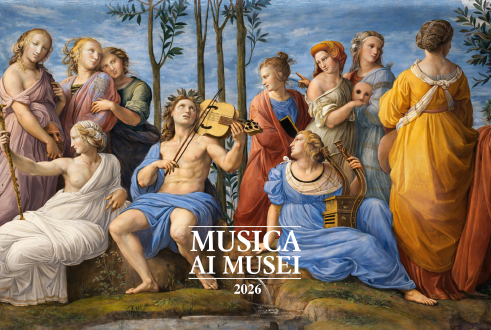
The cover of the Musica ai Musei 2026 program reproduces a detail of Raphael's Parnassus, the fresco in the Room of the Segnatura. The choice isn't decorative. The Parnassus is the painting of music par excellence inside the Museums: Apollo in the center, surrounded by the Muses and the poets, plays a bowed instrument. Putting that image on the program means declaring that music, in these palaces, was here before the concerts: painted on the walls, carved in the statues, sung in the chapel.
There's a second detail that makes this year's series curious. The theme is Il canto delle stagioni, and the program takes it literally: Vivaldi's Four Seasons in May, Piazzolla's Cuatro Estaciones Porteñas in June. Two cycles on the seasons, heard three weeks apart in the popes' halls. For those who were there, a rare comparison. For those who come in autumn, there's the closing concert with Ariel Ramírez's Misa Criolla, paired with Mozart. To me, the pairing of art music and folk tradition is the real surprise of this edition.
Something nobody tells you about Musica ai Musei 2026 at the Vatican Museums and Castel Gandolfo, March 14 to November 27, 2026
What the announcements don't say is that the concert is part of the visit, it doesn't replace it. There's no ticket for the concert alone: you enter with the Museums ticket, and the concert accompanies the visitors who are inside at that hour. If you plan to show up at 17:45 for an hour of music, you're in for a disappointment.
The second point concerns seating. The program states that attendance is guaranteed while places last. In the Museums' galleries the space for the audience is what it is, and the halls weren't built as concert halls. The practical advice is to plan your visit so you're in the concert hall a little early, instead of rushing there from the Sistine.
Third, Castel Gandolfo. Two of the three autumn concerts, the October ones, were held there, not in Rome: the last one, on November 27, is instead in the Vatican Museums.
My advice for Musica ai Musei 2026 at the Vatican Museums and Castel Gandolfo, March 14 to November 27, 2026
It's best to choose November 27 and build an afternoon visit around it. Go in early in the afternoon, take the main route calmly, Pio-Clementino, Raphael's Rooms, the Sistine Chapel, and keep the Braccio Nuovo for last. Getting there with your eyes full of Raphael and Michelangelo and sitting down to hear Mozart and the Misa Criolla among the ancient statues is the best way to end a day at the Museums.
The two October concerts at Castel Gandolfo, Mendelssohn's Double Concerto on the 24th and the bands on the 27th, have already taken place.
Finally, if you'd like a guided visit to the Museums built around your interests, before the concert, you can contact the editorial team of Tour Leader Pro, which organizes private visits.
Another well-known fact, and yet not often mentioned
It's well known that the Vatican Museums are among the most visited museums in the world. It's rarely mentioned that public access to them is guaranteed by a treaty. A specific article of the 1929 Treaty states that the Holy See may not dispose of the property held in the Museums, may set entry dates and hours, but is obliged to allow visits by tourists and scholars. It's a sort of international easement: a sovereign state that commits, toward another state, to keep its own museum open.
Just as little known is how recent mass tourism in these halls is. In the Jubilee year 1925 there were 400,000 visitors. In 1950, another Holy Year, they passed a million, with peaks of 12,000 people a day. In 1980 they reached 2 million a year, in 2000 3 million, in 2015 6 million, and in 2025 they passed 6,900,000.
A series like Musica ai Musei should also be read in this light: in museums crossed every day by tens of thousands of people, an hour of music at sunset is a way to slow down and give the halls back their dimension as places of encounter, not just of transit.
The right photo to take at Musica ai Musei 2026 at the Vatican Museums and Castel Gandolfo, March 14 to November 27, 2026
During the concerts, common sense applies: no flash, no raised phones while the musicians are playing. The rules on photography in individual halls are set by the Museums staff. Look for the right photo before or after.
In the Braccio Nuovo, before the November 27 concert, look for the Augustus of Prima Porta, the most famous statue in the gallery. A three-quarter shot, with the orchestra tuning up in the background, tells the story of the event better than any close-up.
On the way out, the classic photo is Giuseppe Momo's spiral staircase, from 1932, with the bronze panels by Antonio Maraini. It's the photo everyone takes, but there's a reason: the geometry works even with a phone. At Castel Gandolfo, on the other hand, the right photo is of Piazza della Libertà with the facade of the Papal Palace in the late afternoon light, before going in.
Some important events that happened here in history
On January 14, 1506 the Laocoön group was found in a vineyard near Santa Maria Maggiore: Julius II bought it on the advice of Michelangelo and Giuliano da Sangallo and put it on display in the Vatican. It's the birth certificate of the Museums. In 1771 Clement XIV opened the collections to the public and founded the Pio-Clementino Museum, enlarged by his successor Pius VI. At the beginning of the 19th century Pius VII Chiaramonti created the museum that bears his name. In 1836 Gregory XVI founded the Gregorian Etruscan Museum, and the same pope founded the Gregorian Egyptian. In 1926 Pius XI founded the Missionary Ethnological Museum.
In 1929 the Treaty governing relations between the Holy See and Italy committed the Vatican to allowing visits to the Museums. In 1932 the historic entrance opened, with Giuseppe Momo's spiral staircase. In May 1938, during Hitler's visit to Rome, Pius XI withdrew to Castel Gandolfo and had the Museums and the basilica closed. In 1994 the restoration of the Sistine Chapel was completed. In 2000, for the Jubilee, the new entrance in the walls opened. In October 2006 the Museums celebrated their 500th anniversary by opening to the public the excavations of a necropolis on Vatican Hill. On January 1, 2017 Barbara Jatta became the first woman to direct the Museums.
Who has passed through Musica ai Musei 2026 at the Vatican Museums and Castel Gandolfo, March 14 to November 27, 2026
The greatest artists of European history have passed through the Vatican Museums, and many worked there. Michelangelo, who painted the ceiling and the Last Judgment of the Sistine Chapel and examined the newly discovered Laocoön. Raphael, author of the frescoes in the Rooms. Giuliano da Sangallo. And, on the walls of the Sistine, Perugino, Botticelli, Ghirlandaio, Cosimo Rosselli, Luca Signorelli. The Pinacoteca holds works by Giotto, Leonardo, Caravaggio, Titian, Veronese, Guido Reni. The collection of modern religious art includes works by Chagall, Dalí, de Chirico, Kandinsky, Matisse, Van Gogh and Francis Bacon.
Among visitors, history remembers above all the one who didn't get in: Adolf Hitler, who in 1938 found the Museums closed at the will of Pius XI. Among the men who built these spaces are Raphael Stern, architect of the Braccio Nuovo, Luca Beltrami, designer of the Pinacoteca, and Giuseppe Momo with his staircase.
In 2026 the musicians of Musica ai Musei pass through: the Orchestra delle Cento Città with Mirco Roverelli, Ars Duo, the Eos and Musicanova choirs, the bands of the Holy See and of the Penitentiary Police, the young players from the academies of Pinerolo, Santa Cecilia, Imola and Siena.
What to see around the Vatican Museums
The Vatican Museums are a few minutes' walk from St. Peter's Square and St. Peter's Basilica, in the Prati neighborhood.
St. Peter's and Borgo
Leaving the Museums you follow the walls to St. Peter's Square. Heading down toward the Tiber, through the streets of Borgo, you reach Castel Sant'Angelo. The guide Prati and Borgo: what to see gathers the routes of the area.
The Vatican Gardens
If you come back another time, the Vatican Gardens can be visited on dedicated tours. They're the natural complement to a day at the Museums, and a good way to understand Vatican City beyond the collections.
Where to eat before or after the concert
The concert ends around 19:00: the right time for dinner in Rome, without waiting.
Prati
The Prati neighborhood, in the streets around Ottaviano, offers trattorias, pizzerias and restaurants frequented by Romans, with more reasonable prices than the places facing St. Peter's Square. It's best to move a few blocks away from the walls.
Borgo
The streets of Borgo, between St. Peter's and Castel Sant'Angelo, have a more touristy offer. It makes sense if the evening continues with a walk along the Tiber.
In Castel Gandolfo
After a visit to Castel Gandolfo you can have dinner in town. My advice is to book and to work out the return time carefully.
Accessibility and kids
The Vatican Museums are a long route, with many halls and considerable distances between one section and another. If you have mobility difficulties, contact the Museums before your visit to learn the accessible routes to the concert hall.
With kids
For the Vatican Museums with little ones the usual rule applies: better a short, focused visit than a full route, especially if at the end there's an hour of concert to listen to in silence.
Length and breaks
The concert lasts about 60 minutes. Keep in mind that, added to the visit, the afternoon can go beyond four hours on your feet: comfortable shoes and a planned break halfway through are essential.
Autumn in Rome: the last dates of the series
Late October and November are good months for the Vatican Museums: less crowded than summer, with days still bright and the sunset light that, at concert time, director Barbara Jatta describes in the Museums' courtyards.
A day to combine
If you're in Rome on November 27 you can build a full day: morning at St. Peter's, lunch in Prati, afternoon at the Museums with the final concert in the Braccio Nuovo. If you love archaeology, in October the series MOISAI at the Domus Aurea brought live performances to Nero's villa, near the spot where the Laocoön was found.
Frequently asked questions about Musica ai Musei 2026
When are the last Musica ai Musei 2026 concerts?
The last Musica ai Musei 2026 concert is on Friday, November 27 in the Braccio Nuovo of the Vatican Museums, after those of Saturday, October 24 and Tuesday, October 27 at the Papal Palace of Castel Gandolfo. All start at 18:00 and last about 60 minutes. The program may change due to force majeure.
How much does Musica ai Musei cost?
Musica ai Musei is included in the admission ticket to the Vatican Museums or the Castel Gandolfo museum complex: you don't need an extra ticket for the concert. Prices are those of regular admission published on the official Museums website, and attendance is guaranteed while places last.
Where do you buy tickets for Musica ai Musei?
Tickets for Musica ai Musei are the same as admission tickets and are bought on the official Vatican Museums website, in the online booking section. It's best to book ahead, especially for the busiest days, and to choose an entry slot that leaves time for the visit.
What will you hear on November 27 at the Vatican Museums?
On November 27 Musica ai Musei closes in the Braccio Nuovo with Mozart's Exultate Jubilate and Ariel Ramírez's Misa Criolla, performed by the Orchestra delle Cento Città, Coro Musicanova and Ensemble Matices Folclor conducted by Mirco Roverelli. The concert is titled Gioia e Spiritualità.
How do you get to the Vatican Museums?
You reach the Vatican Museums by metro A, Ottaviano and Cipro stops, then walk along the walls to Viale Vaticano entrance. For surface lines, use the ATAC journey planner. Parking in the area is difficult.
Who played on October 27 at Castel Gandolfo?
On October 27, for Musica ai Musei, the Pontifical Band conducted by Antonio Barillari, the Band of the Pontifical Swiss Guard conducted by François Fournier and the Vatican Gendarmerie Band conducted by Stefano Iannilli played at Castel Gandolfo, curated by CIDIM.
Is Musica ai Musei suitable for kids?
Musica ai Musei can work with kids. The concert lasts about an hour: with little ones, it's best to shorten the visit beforehand, so you reach the hall without being tired.
Our verdict on Musica ai Musei 2026
At the Vatican Museums the finest moment is always the same: when the crowd thins and the halls can breathe again. Musica ai Musei gives that moment to those patient enough to stay until sunset. The best date is November 27: a slow visit in the afternoon, then Mozart and the Misa Criolla among the statues of the Braccio Nuovo. Book your entry for early afternoon and don't look at your watch.
Article written by the editorial team of Tour Leader Pro, contact them for Private/Corporate/V.I.P. Tours and Experiences.
Planning a trip to Rome? The English guides for visiting the city are on ItalyPlanner.com.