Murubutu at Auditorium Parco della Musica, Sala Petrassi, November 13, 2026
https://www.estateromana.com/en/rome/trip-planner/murubutu-at-auditorium-parco-della-musica-sala-petrassi-november-13-2026/
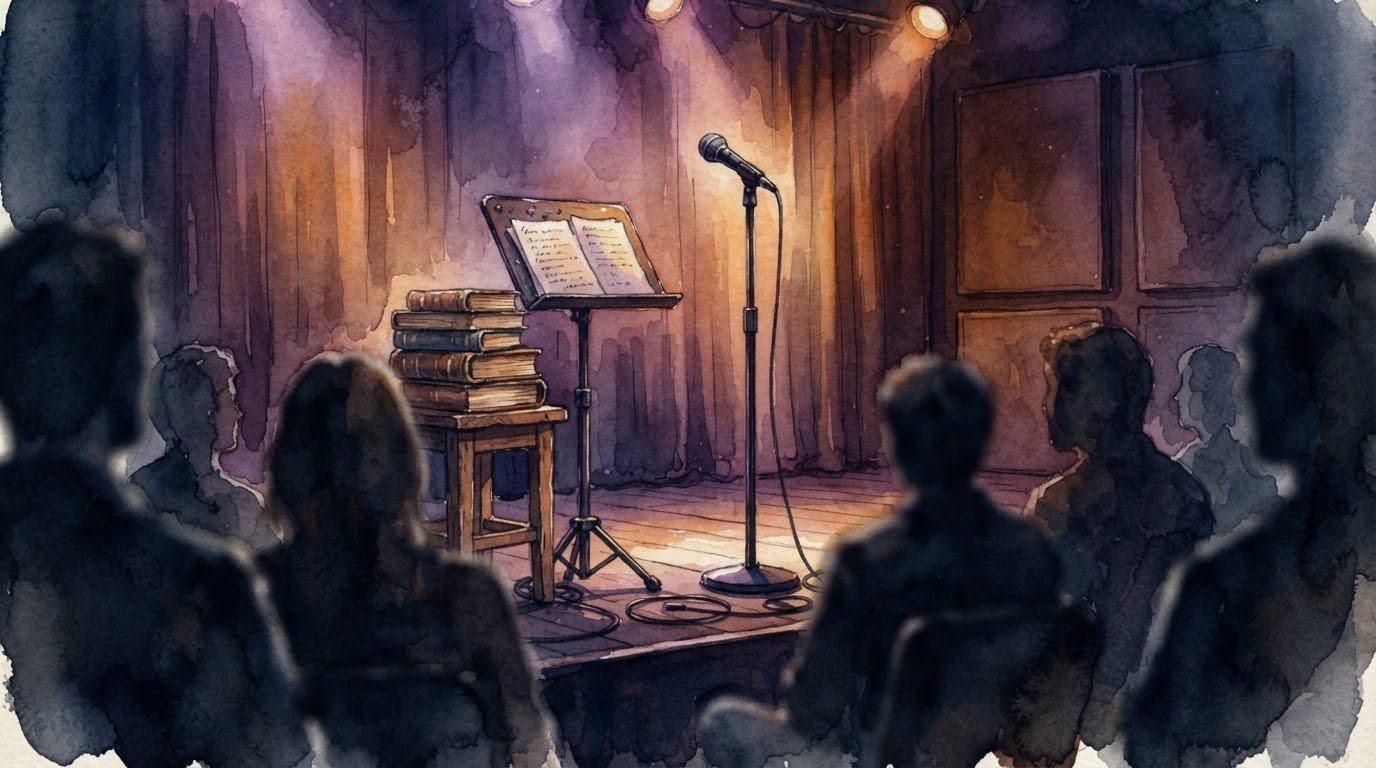 Illustrazione generata con intelligenza artificiale: non è una fotografia dell’Auditorium Parco della Musica né dell’evento.
Murubutu is in concert on Friday, November 13, 2026 at 20:00 in Sala Petrassi at Auditorium Parco della Musica Ennio Morricone, Viale Pietro de Coubertin 30, Rome. The rapper and teacher from Reggio Emilia, author of a storytelling rap inspired by literature, brings his narrative writing to the hall. According to the venue tickets start at 25 euros, but on October 23, 2026 the event page of the online box office listed them as unavailable: check availability on the event page of the official Auditorium website (auditorium.com) or at the box office. For the route to Flaminio use the ATAC planner: the line setup changes and it's best to check it the day before.
The concert
The official page presents Murubutu, real name Alessio Mariani, as an artist who got into hip hop in the early 1990s and who teaches philosophy and history at the “Matilde di Canossa” high school in Reggio Emilia. From 2000 he began to think about the interaction between school content and rap, with the aim of making rap an expressive means to convey cultural content without losing care for style. The result, the venue says, is a new subgenre: educational rap.
Since 2009, only storytelling
In 2009 Murubutu launched a solo project devoted entirely to storytelling, in which classic hip hop sounds form the backdrop to lyrics with a strong singer-songwriter slant and poetic touches. Among his collaborators the venue names Caparezza, Dargen D’Amico, Rancore, Ghemon and Giuliano Palma.
Jazz and the Moon Jazz Band
The official text adds that 2024 was also the year Murubutu decided to revisit his repertoire in a jazz key, accompanied live for the first time by the Moon Jazz Band. The page doesn't say if the November 13 concert is with the Moon Jazz Band: this hasn't been published.
Alessio Mariani, a teacher on stage
Murubutu was born in Reggio Emilia on July 27, 1975. His stage name comes from “marabutto” (marabout), which in sub-Saharan Africa means a shamanic figure able to heal physical and social ills with talismans and, above all, with words. He has a degree in philosophy from the University of Parma and a specialization from Bologna. Since 2011 he has taught philosophy and history at the “Matilde di Canossa” high school in Reggio Emilia.
First a breaker and writer
He got into hip hop first as a breaker and graffiti writer, then as an MC. He began his career in 1991 in Reggio Emilia, when with Depy MC, Mastrosuono and Muracaman he founded Kattiveria Posse, the first Reggio Emilia music collective tied to the posse phenomenon.
Family and dedications
He is the father of a son and a daughter. The song and album “Il giovane Mariani e altri racconti” are dedicated to his son, the song “La bellissima Giulietta” to his daughter, from the title of the 2011 album “La bellissima Giulietta e il suo povero padre grafomane”.
“Letteraturap”
Murubutu's music is described as “literary-inspired rap” or “letteraturap”. It sets the artist apart on the Italian scene because it combines hip hop with literature, history and philosophy. It's a trait the venue sums up in the phrase “educational rap”.
Rap that comes close to singer-songwriter music
In his solo records there emerges the will to offer a rap that carries messages close to singer-songwriter music, freeing it from the cliché that sees it as a genre only for teenagers.
A story for every song
The album titles use the word “racconti” (stories) repeatedly: “Il giovane Mariani e altri racconti”, “L’uomo che viaggiava nel vento e altri racconti di brezze e correnti”, “Storie d’amore con pioggia e altri racconti di rovesci e temporali”. The idea is a collection of short stories, in which every song is a story with characters, settings and an ending.
La Kattiveria: from posse to collective
Murubutu's story begins in a group. Kattiveria Posse produced the demo “Nati in Kattività” (1993) and the EP “Scellerati nella prassi” (1998), and became known for its theatrical political hip hop performances in period costumes and for its results in regional music competitions.
The lineup change
At the end of 1999 the lineup changed radically: DJ Gamon, U.G.O. and Il Tenente joined, and the group became La Kattiveria. Today it includes Murubutu, Il Tenente, U.G.O., Yanez Muraca and DJ Caster.
The collective's records
With La Kattiveria he made “Dove vola l’avvoltoio” (2006), a title that takes up the song by Italo Calvino and Sergio Liberovici recorded by Pietro Buttarelli in 1958, and “Sillabum Delirorum” (2008).
The records, one per theme
Since 2009 Murubutu has built his albums around a central element. An annotated list, with release years:
- 2009, “Il giovane Mariani e altri racconti”: his first solo album
- 2011, “La bellissima Giulietta e il suo povero padre grafomane”
- 2014, “Gli ammutinati del Bouncin’ ovvero mirabolanti avventure di uomini e mari”: the sea, for the first time as the sole theme
- 2016, “L’uomo che viaggiava nel vento e altri racconti di brezze e correnti” (the man who traveled on the wind and other tales of breezes and currents): the wind, in 15 tracks
- 2019, “Tenebra è la notte ed altri racconti di buio e crepuscoli” (darkness is the night and other tales of dark and dusk): the night
- 2020, “Infernvm”, with Claver Gold, loosely inspired by the “Divine Comedy”
- 2022, “Storie d’amore con pioggia e altri racconti di rovesci e temporali” (love stories with rain and other tales of downpours and storms): the rain
- 2025, “La vita segreta delle città”: the city seen as a sentient organism.
The sea as a lens
For “Gli ammutinati del Bouncin’”, released on May 2, 2014, Murubutu explained that he wanted to talk about the sea also as a way to read complex phenomena like migration flows, imprisonment, loneliness, abortion and disability. It was also the album that marked the return of the hip hop label Mandibola Records.
Calvino, Verga, Leopardi, Dante
The relationship with literature isn't just a reference in the titles. In 2015 Murubutu took part with the experimental duo Uochi Toki in the track “Rest in Prose, Rest in Poetry”, on the album “Il limite valicabile”: in his verses it's dedicated to Giovanni Verga, in Napo's to Giacomo Leopardi.
Dante and “Infernvm”
“Infernvm”, made in 2020 with Claver Gold, is loosely inspired by the “Divine Comedy” and includes collaborations with, among others, Giuliano Palma and En?gma. The single “Paolo e Francesca” with Claver Gold and Giuliano Palma dates from 2020.
A tribute to Calvino
In 2023 the single “L’avventura di due sposi” came out, recalling Italo Calvino. The title of La Kattiveria's 2006 album already quotes the song “Dove vola l’avvoltoio” written by Calvino with Sergio Liberovici.
An aviator
The 2016 album and its title song are inspired by Angelo D’Arrigo, a hang gliding champion who died in 2006.
Collaborations and comics
The official page lists among his partners Caparezza, Dargen D’Amico, Rancore, Ghemon and Giuliano Palma. The guests also include, on the 2019 record, Mezzosangue, Willie Peyote and Dutch Nazari, and on the 2025 one Dia, Elisa Aramonte, Davide Shorty, Alborosie, Danno and Erica Mou.
Comics
In 2020 he worked on the graphic novel “Murubutu. RAPconti illustrati”, published by BeccoGiallo.
Two recent singles
In January and February 2025 the singles “Flaneur” and “La città degli angeli” came out, previewing the March 2025 album.
Hip hop in Italy: from the origins to the posses
To understand where Murubutu fits it's worth looking at the history of the genre. Italian hip hop was born in the early 1980s, with lyrics first in English and then in Italian. The first experiment in Italian is credited to Raptus from Bologna in 1986.
The posses
In the early 1990s the posses were political and social collectives that used music to voice demands, especially in social centers. Rome's Onda Rossa Posse recorded the first Italian rap vinyl record in 1990, with the single “Batti il tuo tempo”. Assalti Frontali grew out of them. In 1991 Bologna's Isola Posse All Stars recorded “Stop al panico”.
The first hit records
In 1993 Frankie HI-NRG with “Verba Manent” was the first Italian rapper to release a record in Italian distributed by a major label. Articolo 31 released “Strade di città” (1993), which sold over 90,000 copies, and “Così com’è” (1996), considered the most important Italian rap album, with more than 600,000 copies.
After 2000
In 2006 Fabri Fibra signed with Universal and in 2010 “Tranne te” helped give rise to rap as a mainstream phenomenon.
Rap and jazz in the hall
The fact that the venue presents Murubutu's concert in the program of a music institution like the Auditorium should be read together with the other news in the text: in 2024 the repertoire was revisited in a jazz key.
A choice of hall
Sala Petrassi is the Auditorium hall that mainly hosts opera, jazz, theater, dance and film. For a rap made of stories, where words matter, a place on a theatrical scale is a consistent choice: 673 seats, a stage with movable walls and an audience used to listening.
An open question
The venue doesn't list the lineup on stage, beyond Murubutu's name in the list of artists. If you want to know if the Moon Jazz Band will be there, check the official page closer to the date.
A curious fact about Sala Petrassi
The hall hosting Murubutu is named after a composer who set a poet to music. Goffredo Petrassi, born in Zagarolo on July 16, 1904, wrote “Coro di morti” in 1941 on a text by Giacomo Leopardi, presented at Teatro La Fenice in Venice.
Leopardi in the hall and in rap
Leopardi also appears in the world of literary rap: Napo of Uochi Toki devoted his verses to him in the track “Rest in Prose, Rest in Poetry”, in which Murubutu pays tribute to Verga. It's a coincidence that links the hall to the concert.
From Sala Settecento to Petrassi
The hall opened as Sala Settecento, from its number of seats, and was named after the composer after his death, in 2003.
Something nobody tells you about Sala Petrassi
Anyone looking for Petrassi on site might expect a 19th-century theater. The Auditorium is a complex of separate volumes, with three lead-covered halls arranged like rays around the cavea. The halls are different sizes and Petrassi, the smallest, also has its own separate building.
A theater inside the concert
The hall has an orchestra pit and movable side walls on the stage. For a concert of stories, where words are at the center, this theatrical structure is a plus.
Before you sit down
The foyer shared by the halls has a bar, a café and a bookstore. If you arrive early, the bookstore is a good place to spend 10 minutes before going in.
My tip for visiting Sala Petrassi
If you follow Murubutu for the lyrics, choose a seat where you can see the stage well but also hear clearly: in narrative rap every word counts. Avoid arriving at the last minute.
Prepare with a record
A good starting point is the 2009 album “Il giovane Mariani e altri racconti”, his first solo record, or “Tenebra è la notte”, if you like a nocturnal theme. If you want to understand the jazz side, look for the live versions available through the Auditorium's official channels.
After the concert
The starting price given by the venue is 25 euros, but as of October 23, 2026 seats on the online box office showed as unavailable. If you like the format, you can carry on with other concerts: the Auditorium's general program is on the Auditorium Parco della Musica page.
Another well-known fact, yet not often mentioned
It's known that Murubutu is a teacher. It's less known that his songs are used in schools. His songs, with their literary slant, make their way into classrooms.
Friday the 13th
The concert date is Friday, November 13, 2026: a coincidence that has nothing to do with the programming, but that the artist, author of stories and tales of darkness and night, might have appreciated as a narrative cue.
A historic label
The return of Mandibola Records with “Gli ammutinati del Bouncin’” in 2014 and the later “L’uomo che viaggiava nel vento” on Mandibola and Irma Records (October 14, 2016) show how closely his music is tied to an independent scene.
The right photo to take at Sala Petrassi
The most recognizable subject is the outside of the complex: volumes clad in lead strips on a brick base, arranged like rays around the cavea. It's the image most used to describe the Auditorium.
The terrace
Around the buildings runs a large walkable terrace. From the terrace, between Sala Santa Cecilia and Sala Sinopoli, you can see the remains of the Roman villa discovered during construction.
Inside the museum
Under the cavea there's a small museum with the finds. Ask the venue which parts can be visited on the day of the concert.
Some important events that happened here in history
The history of the Auditorium begins on April 21, 2002.
The two inaugurations
That day Sala Sinopoli opened. On December 21, 2002 the rest of the complex opened and Sala Santa Cecilia was inaugurated with the Accademia's orchestra conducted by Chung Myung-whun.
2003 and 2006
In 2003 the Auditorium became the permanent home of the Accademia's season. In 2006 it hosted the Rome Film Fest.
2020
The city council approved naming it after Ennio Morricone, born in Rome on November 10, 1928 and died on July 6, 2020, a student of Petrassi at Santa Cecilia.
Who has passed through Sala Petrassi
For the Auditorium as a whole, the artists whose music was recorded in the complex include Keith Jarrett, Mark Knopfler, Vinicio Capossela, Tuxedomoon, William Parker.
Live albums
The live albums mentioned are those by Fennesz and Sakamoto (2005), Enrico Rava and Joe Lovano (2014) and The National (2024).
A great neighbor
The Auditorium is home to the Accademia Nazionale di Santa Cecilia: you'll find its 2026-2027 season on the Accademia di Santa Cecilia page.
Nearby: Teatro Olimpico
On Piazza Gentile da Fabriano, on Lungotevere Flaminio near Ponte della Musica, is Teatro Olimpico. It has operated since 1936 as a cinema-theater and since 1981 as Teatro Olimpico. The block was built in 1935-36. For years it was mostly a cinema, with variety acts during the intervals.
Postwar years and the Filarmonica
After the war the Accademia Filarmonica Romana rented it for its music season. On March 4, 1965, under the direction of Pierre Boulez, it hosted a concert with two premieres: the Italian premiere of Stravinsky's “Abraham and Isaac” and the European premiere of “Elegy for J.F.K.”, also by Stravinsky.
Today
It has 1,410 seats, 966 in the orchestra and 444 in the gallery. It has hosted Marillion in 1988, Lucio Dalla in 1994 and Giorgio Gaber in 1998. On ER you'll find the Teatro Olimpico page.
Renzo Piano and the three beetles design
The Auditorium was designed by Renzo Piano, winner of the 1993 invited competition. The complex stands in Parioli, in an area between Villa Glori, Villaggio Olimpico, the Corso di Francia viaduct and Viale Maresciallo Pilsudski. The Villaggio Olimpico area was chosen by the city council in 1992 after a long debate.
Three beetle-shaped halls
The main volumes are the three concert halls, in buildings of different sizes with a shape that recalls a beetle. They're roofed with lead sheets and arranged like rays around an open-air theater, the cavea, which can hold about 3,000 spectators.
The Roman remains that changed the design
During the works the remains of a Roman villa came to light. The discovery led to a substantial change to the original design: two of the three beetles were moved west, almost to the Corso di Francia viaduct that cuts Villaggio Olimpico in two. Among the consequences was the closing of Viale De Coubertin to traffic.
Who Piano worked with
For the acoustics he worked with Jürgen Reinhold of the Müller-BBM firm in Munich. For the outdoor spaces and urban planning advice, with the landscape architect Franco Zagari.
Recognition from the ministry
The work is included in the Censimento delle architetture italiane dal 1945 a oggi promoted by the Ministry of Culture. The record attributes it to Renzo Piano Building Workshop, for the period 1994-2002, and credits it with all seven criteria of the method. In the category of buildings for cultural promotion, which counts 79 works, only two meet them all: the Auditorium and the renovation of the Lingotto in Turin.
The halls and the numbers
The halls have a brick base and an upper part clad in lead strips. The stated seat counts are these:
- Sala Santa Cecilia: 2,756 seats
- Sala Sinopoli: 1,133 seats
- Sala Petrassi: 673 seats
- cavea named after Luciano Berio: 3,000 seats
- Teatro Studio named after Gianni Borgna: 308 seats.
Santa Cecilia
It has a ceiling made of 26 American cherry wood shells, each with an average surface of 180 square meters. The reverberation time is 2.2 seconds.
Sinopoli
Its distinctive feature is that the interior space can adapt to the number of performers and the acoustics the event requires, with a gallery on three of the four sides.
Petrassi
It's the smallest of the three. Petrassi, who died in 2003, wanted to attend the inauguration of the complex and heard the world premiere in Sala Sinopoli of his Ouverture da concerto per orchestra, composed in 1931.
An international comparison
In 2014 total visitors to Parco della Musica were estimated at more than 2 million: the leading cultural venue in Europe by visitors and the second in the world after Lincoln Center in New York.
Who keeps the Auditorium alive
The Auditorium is run by Fondazione Musica per Roma, founded on July 19, 2004 from the transformation of the joint-stock company set up in 1999. The founding members are the City of Rome, which granted use of the building for 99 years, the Chamber of Commerce, the Province of Rome and the Lazio Region.
The Accademia Nazionale di Santa Cecilia
It's one of the oldest music institutions in the world. It has been a foundation since 1998 and has an academic body of 70 full members and 30 honorary ones. Since 2003 the Auditorium has been the permanent home of its concert season, and it hosts the Bibliomediateca and the Museo degli Strumenti Musicali.
A broad program
The Foundation offers multidisciplinary events, rock, pop, jazz, contemporary, opera, electronic and world music concerts, theater, dance, circus, literature and poetry, exhibitions, author talks and festivals. Upcoming events also include the Blade Runner cine-concert.
Radio and video channel
Since March 16, 2010 Radio Parco della Musica has been broadcasting. Since October 4, 2011 there has been Auditorium TV, a YouTube channel with artist interviews and archive footage.
The controversies, without beating around the bush
An honest account of the Auditorium doesn't skip the criticism.
Acoustics and comfort
In the first months acoustic problems were found. The conductor Wolfgang Sawallisch said: “The new Auditorium is impressive, but I'm not convinced by the hall's stage and acoustics”. Changes were made later. The large hall was criticized for its heating and accessibility, with only two elevators for the galleries.
Parking
The internal parking lots are considered too expensive, so cars parked for concerts invade Villaggio Olimpico. Better to choose public transportation.
The construction site
The works were troubled: the contract with the winning firm was terminated and a new tender was called. Costs rose sharply and the Corte dei conti raised criticisms.
The organ that isn't there
There's no pipe organ in the halls. The association Italia Nostra launched an appeal in 2002 and the critic Paolo Isotta called Santa Cecilia “a living room without a sofa”. Rome is the only European capital without a pipe organ in a concert hall.
Nearby: Ponte della Musica
Ponte della Musica Armando Trovajoli, 190 meters long, with a steel arch over the Tiber, links Foro Italico to the Flaminio area, home to the Auditorium, the Villa Glori park, MAXXI and Teatro Olimpico. It was inaugurated on May 31, 2011 and since 2013 has carried the name of the composer Armando Trovajoli.
From the bridge to Foro Italico
If you arrive early, crossing the bridge takes you to Foro Italico, the sports complex on the other bank of the river. The walk is a way to get ready for an evening of listening.
MAXXI a short walk away
In the same area stands MAXXI, the museum of 21st-century arts: another piece of contemporary architecture, a short distance from the Auditorium area.
Before or after the concert
The evening starts at 20:00, so the best time to walk around the area is the late November afternoon, with the low light on the Tiber. After the concert, public transportation is the most convenient option.
Practical information
- Date and time: Friday, November 13, 2026, 20:00.
- Venue: Sala Petrassi, Auditorium Parco della Musica Ennio Morricone, Viale Pietro de Coubertin 30, 00196 Rome.
- Price: from 25 euros, according to the venue.
- Tickets: event page on the official Auditorium website.
- Running time and intermission: not published.
Getting there
Lines 910, 982, 168 (weekdays only) and 53 stop in front of the entrance, and the nearest metro station is at Piazzale Flaminio. Use the ATAC journey planner for the up-to-date route. Ponte della Musica and the Villa Glori park are nearby.
FAQ about Murubutu
When and where is the concert?
Friday, November 13, 2026 at 20:00, Sala Petrassi, Auditorium Parco della Musica Ennio Morricone, Viale Pietro de Coubertin 30, Rome.
How much does it cost?
Tickets start at 25 euros, according to the venue.
Who is Murubutu?
It's the stage name of Alessio Mariani, a rapper from Reggio Emilia, a philosophy and history teacher, known for a storytelling rap inspired by literature.
What is educational rap?
It's the definition the venue gives of his work: using rap to convey cultural content without losing care for style.
Will the Moon Jazz Band be there?
The official page recalls that in 2024 the repertoire was revisited in a jazz key with the Moon Jazz Band, but doesn't say if this lineup will be on stage on November 13.
Which records should you listen to first?
“Il giovane Mariani e altri racconti” (2009) to start, “Tenebra è la notte” (2019) for the nocturnal side, “Storie d’amore con pioggia” (2022) for the most recent themed album.
How many seats does Sala Petrassi have?
Sala Petrassi has 673 seats. It's the smallest of the Auditorium's three concert halls and was originally called Sala Settecento, from its number of seats, before being named after Goffredo Petrassi after his death in 2003.
Who designed the Auditorium?
The design is by Renzo Piano, winner of the 1993 invited competition. The three beetle-shaped halls, clad in lead, were partly moved west after the remains of a Roman villa were found during the works.
Can you get there by public transportation?
Yes: several bus lines stop in front of the entrance and the nearest metro is at Piazzale Flaminio. Check times with the ATAC planner.
Final advice on Murubutu
Go with the curiosity of someone listening to a story. Murubutu writes the way a narrator tells a tale, and Sala Petrassi, built for opera and theater, is a fitting setting for listening to words. If you can, arrive with one title in your head: “Il giovane Mariani” is a good start.
Article written by the editorial team of Tour Leader Pro, contact them for Private/Corporate/V.I.P. Tours and Experiences.
Planning a trip to Rome? English guides to visiting the city are on ItalyPlanner.com.