Murder on the Orient Express at Teatro Brancaccio, December 26 to 29, 2026
https://www.estateromana.com/en/rome/trip-planner/murder-on-the-orient-express-at-teatro-brancaccio-december-26-to-29-2026/
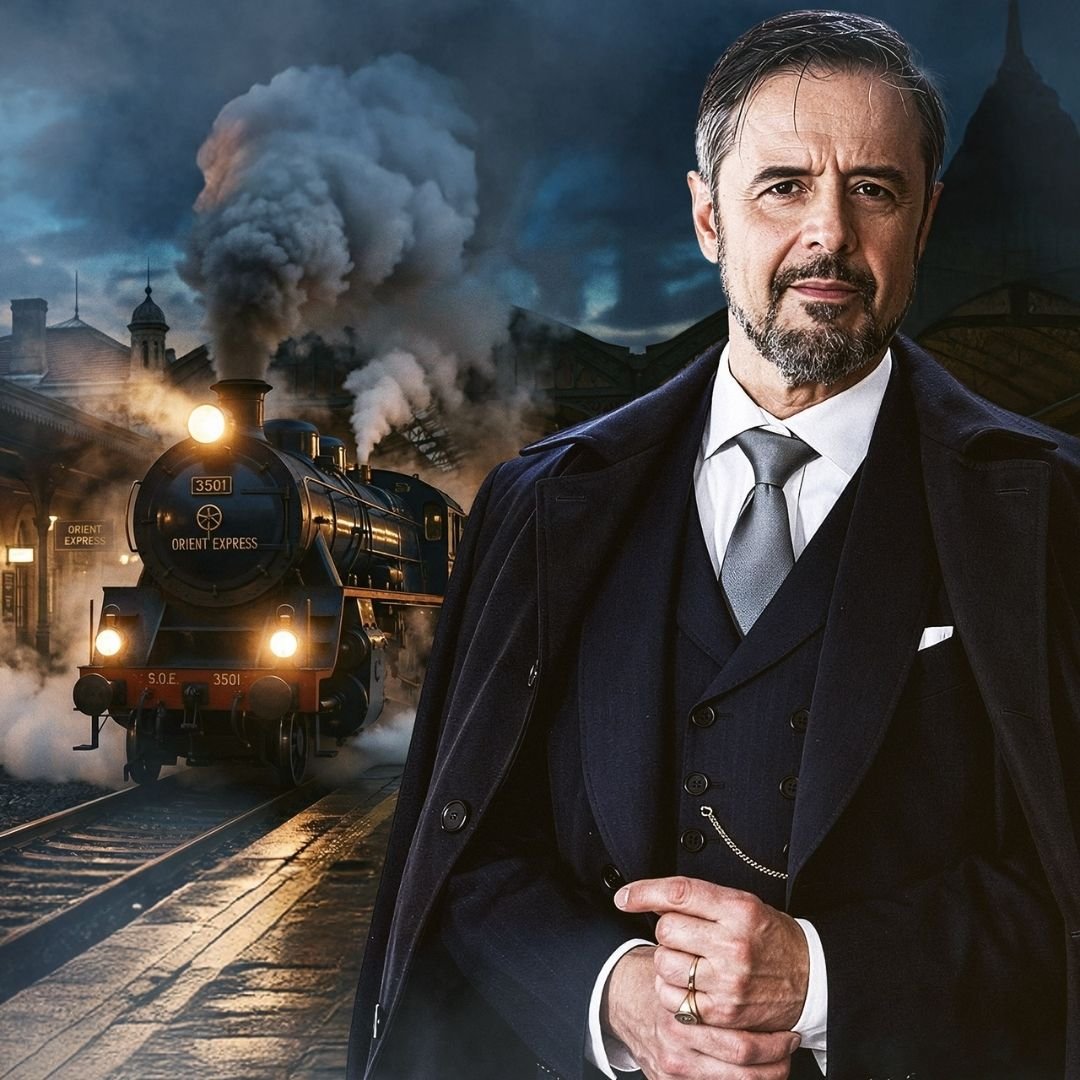
Murder on the Orient Express, Ken Ludwig's stage adaptation of the Agatha Christie novel, is on stage at Teatro Brancaccio, at Via Merulana 244 (00185 Rome), from December 26 to 29, 2026, with Claudio Greg Gregori as Hercule Poirot. There are four performances: Saturday, December 26 at 20:30, Sunday 27 at 16:00, Monday 28 and Tuesday 29 at 20:30. You get there on metro line A, Vittorio Emanuele stop, on metro line B, Cavour stop, or on buses 16, 75, 714, 717 and C3, which stop on Via Merulana at the theater. The prices published by the theater range from 33 euros (Poltrona B) to 49 euros (Poltronissima Gold). Tickets are bought at the box office on Via Merulana and on the authorized presale network indicated on the official website of Teatro Brancaccio.
Language: performed in Italian. No English version or English surtitles are announced.
The translation is by Edoardo Erba, the direction by Roberto Valerio, the production by Viola Produzioni, the theater production center based right at the Brancaccio. Alongside Greg act Valentina Sperlì and Simone Montedoro, with a large company. The classic whodunit on stage is a genre rarely seen in Rome's big halls, and placing it in the week between Christmas and New Year's is a smart choice. The holiday audience looks for a story everyone knows, and the Orient Express is one of those. The real curiosity is seeing Greg, one of the two faces of Lillo e Greg, as the most serious detective in crime fiction.
Murder on the Orient Express on stage: the story
Murder on the Orient Express tells of Hercule Poirot's investigation into the murder of a rich American, found killed in his cabin while the train is stuck in the snow, in the winter of 1934. It is the plot of Agatha Christie's novel, published in 1934, which Ken Ludwig's adaptation brings to the stage as a locked-room thriller.
The train stopped by the avalanche
The official presentation describes the opening: an avalanche stops the legendary Orient Express in a desert of ice. The train, motionless between snow and silence, becomes a closed space. During the night an American passenger is found killed with many stab wounds, with no tracks in the snow and no way of escape. The murderer, therefore, is still on board.
Poirot and the interrogations
Among the travelers is Hercule Poirot, the Belgian detective, forced to face one of the most complex cases of his career. The structure is that of tight interrogations: one after another, the passengers tell their version, and Poirot reconstructs a mosaic of testimonies, contradictions and false leads. For the theater it is a natural form, made of two-person dialogues in a single space.
Law and justice
Those who know the novel know how it ends. Those who do not would do well not to look it up beforehand. The Brancaccio's presentation insists on the central point of the story: the crime turns out to be the outcome of a collective affair, and Poirot must solve a logically perfect puzzle and at the same time take a position before a truth that puts his method in crisis. The boundary between law and justice, between guilt and punishment, between revenge and redemption, is the question the show leaves to the spectator.
Roberto Valerio's direction
The theater presents Roberto Valerio's direction as an immersive stage device, in which the train becomes a living organism that holds the characters in and lays them bare. The sets are by Laura Benzi, the costumes by Daniele Gelsi, the sound by Alessandro Saviozzi, the lighting by Gianluca Cappelletti and Giuseppe Filipponio, the video by Lorenzo Bruno. The presence of a video designer suggests that the snowy landscape outside the windows is also entrusted to projections.
Ken Ludwig's adaptation and Edoardo Erba's translation
The text staged at the Brancaccio is the stage adaptation signed by Ken Ludwig, copyright 2016 of Agatha Christie Limited and of Ludwig himself, translated into Italian by Edoardo Erba. The rights are granted by Agatha Christie Limited through the agency Arcadia and Ricono, as the official show page states.
A whodunit born for the novel
Murder on the Orient Express is one of Christie's most famous novels, brought to the screen several times. The stage adaptation has a precise problem to solve: the novel has a dozen suspects and a long investigation, and the theater cannot afford everything. Ludwig concentrates the action in the carriage and builds the rhythm on the interrogations.
Edoardo Erba
The Italian version is signed by Edoardo Erba. In a whodunit the translation weighs more than elsewhere: every line can contain a clue, and a name, a time or a detail said in a certain way must come back, identical, at the moment of the solution. It is precision work that the spectator does not see, but would notice at once if it were missing.
The cast of Murder on the Orient Express at the Brancaccio
Claudio Greg Gregori is Hercule Poirot. With him are Valentina Sperlì and Simone Montedoro, and then Franca Penone, Massimo Grigò, Andrea Bartolomeo, Elisabetta Mirra, Federico Le Pera, Guido Targetti, Viola Dini, Alice Silvestrini, Tommaso D'Alia and Claudio Castruccio. It is a large company, as a whodunit with a train full of suspects requires.
A classic whodunit company
In its presentation the theater speaks of a cast of 12 actors. In a text like this every character has their moment in the spotlight, their interrogation, their lie, and the quality of the evening depends on the balance among all more than on the lead alone. Claudio Castruccio, on stage, is also the company's administrator.
The team behind the scenes
The assistant director is Gemma Costa, the production director Rosi Tranfaglia. The graphic concept and communication coordination are by Livia Clementi, the press office is Sisi Communication. The producer is Alessandro Longobardi, for Viola Produzioni, Centro di Produzione Teatrale.
Who is Claudio Greg Gregori
Greg, stage name of Claudio Gregori, was born in Rome on November 17, 1963. An actor, comedian, singer, musician, radio and TV host and cartoonist, he is half of the comic duo Lillo e Greg together with Pasquale Lillo Petrolo. For Roman audiences he is a familiar face, and seeing him as Poirot is the real surprise of these holidays.
Music: from blues to rockabilly
Greg's first calling is music. In 1979 he forms the Jumpin Blues Boys, in 1982 the Jolly Rockers, with whom he plays rock and roll until 1999. In the same year the Blues Willies are born, with whom he releases the albums of 2004 and 2006. In 1992, with Lillo, he founds the goofy rock group Latte e i Suoi Derivati. Over the years he has led dozens of groups tied to the 1950s, from doo-wop to swing. He wrote the theme of two editions of Le Iene and, with Attilio Di Giovanni, the music of the program 610 and of several films.
Radio: 610 on Rai Radio 2
He debuts on radio in 1982 on Radio Città Futura, a Roman station, with the Wolfman Greg Show, dedicated to rock and roll. Since 2003 he has hosted with Lillo on Rai Radio 2 the program 610, awarded the Microfono d'Oro in 2022. It is one of the longest-running comedy programs on Italian radio.
Comics and books
Since 1985 he has drawn comics: Sergio il Detective, I Vigili, I Mufloni, I Sottotitolati, published in Lupo Alberto, Cattivik, Sturmtruppen, Corriere della Sera and other magazines. He also draws theater show posters. In 2008 he publishes AgGregazioni, a collection of stories, aphorisms and poems. In 2021 the comic biography of the duo. In 2023 Il mio nome è Sorciosecco.
Television and cinema
On television Greg has been on Le Iene, L'ottavo nano, for years on Stracult on Rai 2, Bla Bla Bla, Parla con me on Rai 3, among many others. In cinema he has acted in Giorgio Panariello's Bagnomaria, Marco Risi's Tre mogli, Lillo e Greg, The Movie!, Neri Parenti's Colpi di fulmine and Colpi di fortuna, Volfango De Biasi's Un Natale stupefacente and Natale col boss, up to D.N.A. Decisamente non adatti and Gli idoli delle donne, directed with Lillo. For Un Natale stupefacente he received in 2015 a nomination for the Nastro d'argento, Premio Nino Manfredi.
Theater
Theater is his most continuous territory. With Lillo he wrote and performed Gli squallidi, 20 Quarantino, Il mistero dell'assassino misterioso, La baita degli spettri, Far West Story, L'uomo che non capiva troppo, Occhio a quei 2, Movie erculeo. Alone or in other companies he directed L'accendino magico and, with Simone Colombari, Harold Pinter's The Dumb Waiter in 2021. In 2025 and 2026 he is on stage in A Mirror, directed by Giancarlo Nicoletti. Since 2023 he has directed L'anatra all'arancia. The Brancaccio's Poirot fits this line: a comic actor who has been measuring himself against drama for years.
A detective already in the repertoire
There is a detail enthusiasts will catch. Il mistero dell'assassino misterioso, a historic Lillo e Greg show revived in 2023, is a parody of the whodunit, and among Greg's comic characters is Sergio il Detective. The crime genre, in short, Greg has been poking fun at for 30 years. Now he plays it straight.
Dates and times of Murder on the Orient Express at the Brancaccio
Murder on the Orient Express is on stage at Teatro Brancaccio in four performances, from December 26 to 29, 2026. The schedule published by the theater is this:
- Saturday, December 26, at 20:30.
- Sunday, December 27, at 16:00.
- Monday, December 28, at 20:30.
- Tuesday, December 29, at 20:30.
Santo Stefano and Sunday afternoon
The first is the evening of Santo Stefano, a holiday: an evening at the theater after two days of family lunches is a Roman tradition worth honoring. The Sunday afternoon performance at 16:00 is the one designed for those who want to get home early or come from out of town.
The Monday and Tuesday evenings
December 28 and 29 are weekdays, but in the week between Christmas and New Year's many Romans are on vacation. They are the evenings with the most relaxed audience, and often those when central seats can still be found.
Tickets and prices for Murder on the Orient Express
Tickets for Murder on the Orient Express at Teatro Brancaccio cost from 33 to 49 euros, at full price, according to the price list published by the theater. The sections listed are four:
- Poltronissima Gold: 49 euros.
- Poltronissima: 46 euros.
- Poltrona A: 39 euros.
- Poltrona B: 33 euros.
Where to buy
The theater's box office, at Via Merulana 244, is open Tuesday to Saturday from 16:00 to 19:00. On Sundays it opens during show hours and on Mondays it is closed. Online, the official Brancaccio website links to the authorized presale network. The theater's rules specify that fees and presale charges are shown at the time of purchase.
The balconies
The theater's booking system also lists the first and second balcony sections, which do not appear in the price list published for this title. If they will be on sale, and at what price, will be shown by the sales system at the time of purchase.
A curiosity about Murder on the Orient Express at Teatro Brancaccio, December 26 to 29, 2026
Murder on the Orient Express is a home production: Viola Produzioni, which signs it, is the theater production center based at the Brancaccio, and its producer, Alessandro Longobardi, has also been the theater's artistic director since 2012. The audience sees a show born in the same hall that hosts it.
It is not an insider detail. Most of the shows that pass through Rome's big halls are tours: they arrive, set up, perform a few evenings and leave again. A production by the theater itself has a different relationship with the space, because sets, lights and movements can be designed on the exact measurements of the stage. The Brancaccio is also home to acting and musical academies, and the shows produced in-house are the showcase of that work.
The second curiosity concerns the calendar. A few days earlier, on December 21 and 22, Maccio Capatonda makes his theater debut at Teatro Olimpico. In 2026 he is in cinemas in Agata Christian, Delitto sulle nevi, an openly declared parody of Christie's whodunits. Shortly afterward, the Brancaccio stages the original. Fans of the genre have a Roman Christmas that goes from parody to classic in one week.
Teatro Brancaccio: the hall and how it is built
Teatro Brancaccio, at Via Merulana 244, has had its current configuration since 1937: two foyers, a wide stalls area and two balconies, for about 2,000 seats at the time. It is one of the largest halls in Rome for drama and musicals.
Stalls and balconies
The stalls are divided into Poltronissima and Poltrona, with the Gold and Gold Vip bands that appear in the booking system. Above are the first balcony, divided into A and B, and the second balcony. For a whodunit, where faces and the suspects' reactions count, the stalls are the right position.
Where to sit for a whodunit
The judgment is clear: for Murder on the Orient Express it is best to sit close. Unlike a mass-audience musical, here the show is played on glances, on pauses, on details an actor lets fall during an interrogation. Poltronissima, at 46 euros, is the best compromise between price and closeness. Poltrona A, at 39, remains a sensible choice. A practical warning: the balconies are not served by elevators.
The Brancaccino and the cultural hub
The Brancaccio is the main hall of a wider complex: the Brancaccino, a theater of about 100 seats dedicated to contemporary drama and children's theater, a park area for training and a terrace on Via Merulana. The theater hosts the Accademia STAP Brancaccio for acting, directing and playwriting, the Brancaccio Musical Academy and the Brancaccio Danza center.
Something nobody tells you about Murder on the Orient Express at Teatro Brancaccio, December 26 to 29, 2026
The rules of Teatro Brancaccio ask spectators to show up at least an hour before the start, and forbid entering the hall once the show has begun. Almost nobody reads them, and on holiday evenings they find out in line.
For the 20:30 evening shows it means being on Via Merulana around 19:30. For the Sunday 27 matinee, around 15:00. With a hall this big, two foyers, visual checks on bags and backpacks and a coat check where umbrellas must also be left, the line at the entrance is real. Those who arrive late wait in the foyer until the first suitable break.
In a whodunit this is a bigger loss than elsewhere. The first scenes of Murder on the Orient Express introduce the passengers, the train, the victim: these are the minutes when the clues are planted. Missing them means watching an investigation whose pieces you do not know.
A second thing left unsaid: backpacks. The rules forbid bringing into the hall bulky containers over 17 liters not authorized by the staff. In the holiday days, with gifts and Christmas shopping bags, the risk of ending up at the mandatory coat check is real. Small bag, folding umbrella, coat kept on your knees. Third: tickets are issued in the buyer's name and cannot be transferred without an agreement with the theater. Those buying for a group should know this beforehand.
The advice I give you for visiting Murder on the Orient Express at Teatro Brancaccio, December 26 to 29, 2026
The advice is to choose the evening show on Monday, December 28 or Tuesday, December 29, take a seat in Poltronissima and not read the ending of the novel before going. Three simple pointers, and each has its reason.
The midweek evening shows between Christmas and New Year's have the most attentive audience: those who go to the theater on December 28 chose it, they did not end up there between one lunch and the next. The evening of Santo Stefano is lovely but noisier, the Sunday afternoon is the families' performance. The company, at the third or fourth Roman performance, will also have taken the measure of the hall.
The seat in the stalls, I repeat, counts more than in a musical. A whodunit is watched the way it is read: following the details. At half the price between the Gold and Poltrona A, Poltronissima is the right choice.
And on the ending: the strength of Murder on the Orient Express is its final revelation, one of the most famous in crime fiction. Those who do not know it, and there are more than you would think, have the luck of discovering it in the theater, with the hall holding its breath. Those who know it can enjoy Greg's work on Poirot and the orchestration of the clues. Both evenings are worth the ticket.
Another well-known fact, yet rarely mentioned
That the Brancaccio is one of Rome's musical theaters everyone knows. Less cited is the fact that from 1985 to 2000 the hall hosted the Fondazione dell'Opera di Roma. The stage on which Poirot questions the passengers was for 15 years one of the homes of opera in the capital.
This explains the hall. A theater that held opera has a wide stalls area, two deep balconies and a stage able to take imposing sets. For a staging that has to rebuild a carriage of Europe's most famous luxury train, the space is there.
After the Opera the management passed to the City of Rome, which entrusted the direction to Gigi Proietti until 2007. Maurizio Costanzo followed until 2010 and Stage Entertainment Italia until 2012. Since September 2012 the artistic direction has been Alessandro Longobardi's, the same man who produces Murder on the Orient Express. Today the theater presents itself as one of the main national references for musicals, alongside dance, contemporary circus, stand-up, drama and children's theater.
And another rarely mentioned fact: the Brancaccio was not born with this name. It was inaugurated in January 1916 as Teatro Morgana, and took its current name only in 1937. Many Romans who have attended it for decades do not know this.
House rules at Teatro Brancaccio
The rules of Teatro Brancaccio apply to all performances of Murder on the Orient Express: arrive an hour early, no entry once the show has begun, no photos or filming, no food in the hall.
Seats and tickets
The rules ask you to occupy only your assigned seat: for safety reasons changing seats is not allowed, even to empty ones. The staff may ask to see your ticket at any time. Reduced tickets are valid only with a document proving entitlement to the discount.
Bags, umbrellas and coat check
The theater has a coat check, a bar and merchandise sales. Umbrellas do not go into the hall and must be left at the coat check. Plastic bottles larger than half a liter, glass containers, helmets, professional cameras, tripods and selfie sticks are forbidden. Food and drinks are consumed only at the bar.
Phones and dress
The rules forbid photos and filming, even with a cell phone, and ask you to turn off phones. On dress the theater asks for attire suited to the decorum of the hall. On holiday evenings you will see everything: the real rule is not to show up in a tracksuit.
How to get to Teatro Brancaccio
Teatro Brancaccio is at Via Merulana 244, in the Esquilino district, less than a kilometer from Termini station and a few steps from the Vittorio Emanuele stop on metro line A. It is among the easiest Roman theaters to reach by public transport.
By metro
Metro line A, Vittorio Emanuele stop, is the nearest: you exit onto Piazza Vittorio Emanuele II and reach Via Merulana in a few minutes. Metro line B, Cavour stop, is the alternative for those arriving from the Monti or Colosseum side. From Termini the theater is less than a kilometer away, and you can walk via Santa Maria Maggiore.
By bus
At the Merulana/Brancaccio and Merulana/Mecenate stops pass lines 16, 75, 714, 717 and C3. At the Labicana/Merulana stop pass lines 3, 53, 75, 85, 87, 186, 571, 810, C3 and the night line N10, to note for the return after the evening shows. On holidays between Christmas and New Year's frequencies may change: it is best to check before going out.
By taxi
The theater lists the taxi stands at Largo Brancaccio, Piazza Vittorio Emanuele II at number 113, Via Principe Amedeo at 138, Via Giolitti at 6 and Via Venosta. When a full hall lets out, the Largo Brancaccio stand empties in a few minutes: better to move toward Piazza Vittorio or book by phone.
By car
The theater does not list any affiliated parking, and parking in Esquilino in the evening is hard. Those arriving from outside Rome do better to leave the car near a metro station and continue to Vittorio Emanuele or Cavour.
The right photo to take at Murder on the Orient Express at Teatro Brancaccio, December 26 to 29, 2026
During the show the rules forbid photos and filming, so the right photo is taken outside: the Brancaccio's facade on Via Merulana, in the evening, with the lit Orient Express poster.
The advice is to cross the street and shoot from the opposite sidewalk, with a wide lens: you get the whole front of the theater and a stretch of Via Merulana, one of the longest and straightest streets in the center. At the end of December at 17:00 it is already dark, and the hour before the evening shows is the right one, with the audience arriving and the lights on. At the end of the street, toward the north, you glimpse the mass of Santa Maria Maggiore, which in the Christmas period draws many visitors.
The second image is the hall from above, before the lights go down: from the balcony you see the stalls filling and the closed curtain. It is the only image of the interior you take home, without flash and with the phone back in your pocket as soon as the lights dim.
For a more original keepsake, tied to the show: a photo at Piazza Vittorio, under the Porta Alchemica, with its enigmatic inscriptions. For an evening of mysteries and clues, it is the most fitting setting in the neighborhood.
Some important events that took place here in history
The history of Teatro Brancaccio begins in January 1916, when the hall was inaugurated under the name Teatro Morgana, against the embankment of the gardens of the Field-Brancaccio palace. The name comes from Isabella Field, married to Prince Brancaccio, and the link with Palazzo Brancaccio is physical even before it is nominal.
The theater has had several renovations, to enhance the exterior and improve internal operation. The decisive step is 1937, with the inauguration of the current configuration and the name Teatro Brancaccio. Since then it has been considered, by tradition, the theater of Rome.
In 1985 the hall became the seat of the Fondazione dell'Opera di Roma, which stayed until 2000. Then the City entrusted the direction to Gigi Proietti until 2007. Maurizio Costanzo followed until 2010 and Stage Entertainment Italia until 2012. Since September 2012 the artistic direction has been Alessandro Longobardi's.
Recent years are those of the transformation into a cultural hub: the Brancaccino, the park area for training, the terrace on Via Merulana, the academies. In 2014 the Spazio Impero was inaugurated, with nine rehearsal rooms, networked with Sala Umberto and Spazio Diamante. The theater then launched an energy efficiency project financed with Next Generation EU funds through the Ministry of Culture. Murder on the Orient Express, produced in-house, is a fruit of this transformation.
Who has passed through Murder on the Orient Express at Teatro Brancaccio, December 26 to 29, 2026
Across the Brancaccio's stage have passed Totò, Anna Magnani, Aldo Fabrizi and Gigi Proietti among the actors, and Fabrizio De André, Louis Armstrong and Jimi Hendrix among the musicians. It is the theater itself that recalls them, and the list says a lot about the hall: variety, Roman cinema, the singer-songwriter tradition, jazz and rock had a home here before musicals.
Proietti, in particular, was not just a passing actor: after 2000 he directed the theater on behalf of the City of Rome, until 2007. It is a precedent that makes the presence of Greg, a Roman comic actor who chooses drama, natural in the same hall.
The 2025/2026 season gives an idea of who passes through Via Merulana today: Anastasia, Aggiungi un posto a tavola with Giovanni Scifoni and Lorella Cuccarini, Singin' in the Rain, the Rocky Horror Show, Frida Opera Musical with Drusilla Foer, Akram Khan's dance, the concerts of Roberto Vecchioni, Patty Pravo and Michele Zarrillo.
In the 2026/2027 season, that of the Orient Express, the Brancaccio hosts among others The Prince of Egypt the musical in its national premiere, Amélie the musical, Aggiungi un posto a tavola from December 10 and, from spring 2027, Mrs Doubtfire the musical with Francesco Cicchella. Poirot, for four evenings, sits down in the middle of this company.
Around the Brancaccio: Esquilino, Monti and Via Merulana
Teatro Brancaccio is on Via Merulana, in the Esquilino district, between the Basilica of Santa Maria Maggiore and the Basilica of San Giovanni in Laterano. In the week between Christmas and New Year's, with nativity scenes in the churches, it is one of the most beautiful areas to walk before a show.
The basilicas and the Christmas season
Via Merulana runs between Santa Maria Maggiore and St. John Lateran, two of the major basilicas of Rome. Between Christmas and New Year's the churches are in the full Christmas liturgical season, and a visit in the late afternoon, before the evening show, is the best way to spend the wait.
Palazzo Merulana and the Auditorium of Maecenas
On the same street are Palazzo Merulana, with its collection of 20th-century art, and a little farther the Auditorium of Maecenas. To the north, beyond the metro, Piazza Vittorio Emanuele II with the Porta Alchemica. To the west you descend into the Monti district: our guide to the Monti district helps you discover it at leisure.
Where to eat before or after the show
Via Merulana and the streets around the theater have neighborhood bars and restaurants, suited to an aperitif or a quick meal before the evening show. Piazza Vittorio and surroundings are multiethnic Esquilino, with cuisines from half the world and modest prices. The Monti district, a 15-minute walk away, has trattorias, osterie and wine bars: the best choice for a dinner after the theater. Between Christmas and New Year's many places keep reduced hours or close for vacation: book and check beforehand.
Accessibility of Teatro Brancaccio
Teatro Brancaccio states that it has no architectural barriers for access to the stalls: there is a ramp, an area for wheelchairs and an accessible restroom on the ground floor, reachable from the stalls foyer.
The theater makes available, while seats last, four seats in the stalls for people in wheelchairs with a companion and two for people with walking difficulties. The balconies have no elevator. Seats are booked by sending the box office the theater's form with the required certification, and the theater specifies that an ordinary ticket bought by other means does not guarantee access. For spectators with visual and hearing disabilities seats in the stalls are reserved on request. Those with a service dog can ask to enter the hall with the animal by writing to the box office.
Murder on the Orient Express with teens
Murder on the Orient Express is a whodunit for an adult audience and for teens who love the genre: it deals with a murder, revenge and justice, without being a show for small children. A teenager who has read Christie, or who has seen one of the films, will follow it with interest.
The Sunday matinee on December 27 at 16:00 is the performance best suited to a family with teens. The Brancaccio's rules state that minors under 14 enter only if accompanied. For recommended ages and discounts the reference is the theater's box office.
Late December in Rome: theater between Christmas and New Year's
The week between Christmas and New Year's is one of the fullest of the Roman theater calendar, and Murder on the Orient Express at the Brancaccio, from December 26 to 29, occupies its heart. For those visiting Rome in those days, an evening at the theater is an alternative to touring the lights and nativity scenes.
The climate is that of the Roman winter: short days, cold evenings, some rain. Museums and basilicas are crowded, restaurants in the center booked. For ideas about the rest of the holidays in the city there are our guides to Christmas in Rome and New Year's Eve in Rome. For everything about the theater, see the page on Teatro Brancaccio.
Frequently asked questions about Murder on the Orient Express at the Brancaccio
When is Murder on the Orient Express on stage in Rome?
Murder on the Orient Express is on stage at Teatro Brancaccio in Rome from December 26 to 29, 2026, in four performances: Saturday 26 at 20:30, Sunday 27 at 16:00, Monday 28 and Tuesday 29 at 20:30. The theater is at Via Merulana 244.
Who plays Poirot in Murder on the Orient Express at the Brancaccio?
In Teatro Brancaccio's Murder on the Orient Express, Hercule Poirot is played by Claudio Greg Gregori, of the duo Lillo e Greg. With him are Valentina Sperlì, Simone Montedoro and a large company. The direction is by Roberto Valerio, the translation by Edoardo Erba, the production by Viola Produzioni.
How much do tickets for Murder on the Orient Express cost?
Tickets for Murder on the Orient Express at Teatro Brancaccio cost, at full price, 49 euros in Poltronissima Gold, 46 in Poltronissima, 39 in Poltrona A and 33 in Poltrona B. Any fees and presale charges are shown at the time of purchase.
Where do you buy tickets for the show at the Brancaccio?
Tickets for Murder on the Orient Express are bought at the box office of Teatro Brancaccio, at Via Merulana 244, open Tuesday to Saturday from 16:00 to 19:00 and on Sundays during show hours, or from the theater's official website, which links to the authorized presale network.
Is the show based on Agatha Christie's novel?
Yes, Murder on the Orient Express at the Brancaccio is Ken Ludwig's 2016 stage adaptation of Agatha Christie's 1934 novel, translated into Italian by Edoardo Erba. The story is that of the book: Poirot investigates the murder of an American on a train stopped by snow.
How do you get to Teatro Brancaccio by public transport?
Teatro Brancaccio, at Via Merulana 244, is reached by metro line A, Vittorio Emanuele stop, or by metro line B, Cavour stop. Lines 16, 75, 714, 717 and C3 stop on Via Merulana. At the Labicana/Merulana stop the night line N10 also passes. From Termini the theater is less than a kilometer away.
What time should you arrive at the Brancaccio?
The rules of Teatro Brancaccio ask you to show up at least an hour before the start: around 19:30 for the 20:30 evening shows of Murder on the Orient Express, around 15:00 for the Sunday matinee. Entry once the show has begun is forbidden until the first suitable break.
One last word. A classic whodunit in a big hall, with a comic actor changing register, in the week when Rome wants stories to tell at the table: it is the recipe for a good holiday evening. Choose a midweek evening show, sit in the stalls, arrive an hour early as the theater asks and leave Poirot the pleasure of surprising you.
Article written by the editorial team of Tour Leader Pro, contact them for Private/Corporate/V.I.P. Tours and Experiences.
Planning a trip to Rome? The English-language guides to visiting the city are on ItalyPlanner.com.