Michele Bravi in concert in Rome, Teatro Brancaccio, November 20, 2026
https://www.estateromana.com/en/rome/trip-planner/michele-bravi-in-concert-in-rome-teatro-brancaccio-november-20-2026/
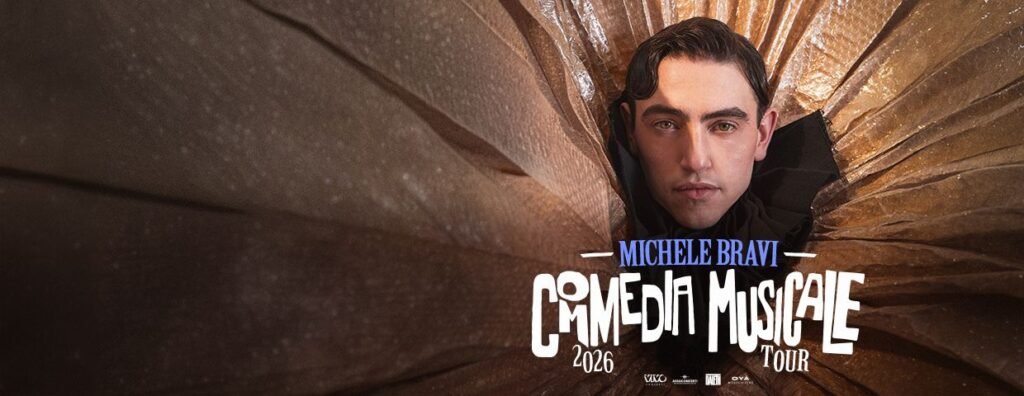
On Friday, November 20, 2026, at 21:00, Teatro Brancaccio in Rome, Via Merulana 244, will host a concert by Michele Bravi. The theater lists it in its program under the title COMMEDIA MUSICALE TOUR, within the 2026 and 2027 season, and names VivoConcerti as the production. An evening of songs and words in an Italian-style hall, in the heart of the Esquilino district, at the end of November.
If you're reading this now, you still have a few weeks ahead of you. The date is on the calendar, there are still a few weeks to go and this changes the sensible way to get organized: there's time to understand how that hall works, to decide calmly which sector to sit in, to find out what's around it and to build the evening instead of just grabbing a seat and showing up. The neighborhood you're walking into isn't just any neighborhood, and neither is the theater.
Below you'll find everything worth knowing beforehand: what this event is and at what point in Michele Bravi's career it comes, who the young man from Umbria really is who won a talent show in 2013 and who today writes, sings, acts and teaches, how the Brancaccio is built and how the acoustics behave in the different sectors, how a concert in an Italian-style theater generally works compared with an arena or a club, how to get there, what the theater states about accessibility, and finally what's worth seeing or walking through within 10 minutes on foot, because Via Merulana runs through one of the most layered areas of the city.
A note on method, because it helps to read the rest in the right measure. The setlist, guests, band lineup and availability of individual sectors for the evening of November 20, 2026, aren't reported here, because they're exactly the information that changes until the last moment and that no reliable source publishes in advance. Nor are song lyrics quoted. What follows concerns the artist, the hall, the context and the practical side: things that remain true even weeks ahead, and that can be checked.
What this concert is
It's a single date, in a theater, within a season that at the Brancaccio mixes drama, musicals, dance, youth theater and a solid live music section. The format matters more than it seems, and in Michele Bravi's case it matters more than in almost any other.

A concert in an Italian-style theater isn't the scaled-down version of an arena concert: it's something else, with other rules and another pact between the person singing and the people listening. In a sports arena the voice arrives amplified inside an enormous volume, the audience moves, the bass works on the body before the ear, and the usable dynamics get compressed into a narrow band, because the reverb of a sports venue swallows everything below a certain threshold. In a hall with an orchestra and balconies the opposite happens: the overall volume is lower, the silence between one phrase and the next is practically total, and the singer can afford to go down to a whisper knowing the hall will catch it and give it back.
For a voice like Michele Bravi's the difference is substantial, and it should be explained without rhetoric. His way of singing works a lot on soft dynamics, on half voice, on phrases that fade out instead of closing. In a big venue that material gets swallowed: you hear the choruses and lose everything else. In a hall like the Brancaccio, instead, everything else is exactly the part that comes through, and it reaches the second balcony intact. It's not a detail for fans: it's why an artist with a catalog like this chooses theaters over arenas even when he'd have the numbers to fill something bigger.
The title under which the event is announced, COMMEDIA MUSICALE TOUR, should be read for what it is: the name of the tour, not the list of what will be performed. It serves to identify the evening on the calendar and to say which part of his output it looks at. The presentation published by the theater speaks of a show that weaves together music, storytelling and theatricality, with songs from his career reworked in arrangements designed for this occasion. It's a formula that works as a statement of intent, not as a precise promise: the real setlist, as always, is known only when the lights go down.
The date, the time and the time of year
November 20, 2026, falls on a Friday. It's a detail that weighs more than it seems, and it's worth putting on the table right away because it shapes the rest of the day.
For the start time the official event page gives 21:00. It's the time the theater publishes, and the one to go by. That said, the Brancaccio has historically also used 20:00 for music nights depending on the show, and half-hour shifts on a music date are more frequent than audiences imagine. The time that counts above all is the one printed on your ticket and published on the official page: read it there, and read it again in the days just before.
Who is Michele Bravi
Michele Bravi was born in Città di Castello, in the province of Perugia, on December 19, 1994. So he's from Umbria, and that matters more than a date of birth: Città di Castello is a small art town in the upper Tiber valley, far from the entertainment circuits, and coming from there at 18 into the Italian TV machine means entering it with no safety net and no prior familiarity with that world.
The step that made him known was winning the seventh edition of X Factor, in 2013, in the Boys category, led that year by Morgan. The song he won with, La vita e la felicità, was written by Tiziano Ferro together with Zibba, reached number one on the Italian chart and was certified gold. The same title named the EP released in 2013.
His first studio album, A passi piccoli, came out in 2014. In 2015 came the EP I Hate Music, a title that by itself tells of his complicated relationship with the machine he had ended up in. In 2017 came Anime di carta, the record that marks the shift from a singer coming out of a TV show to a songwriter recognized as such.
In that same 2017 he took part for the first time in the Sanremo Festival in the main category, with Il diario degli errori, and finished fourth. It's a result worth looking at closely: fourth in the overall ranking of an edition with top-level competition, with a song built on its lyrics and on soft dynamics, at a festival that historically rewards other things. From then on he stopped being presented as the winner of a talent show and started being presented under his own name.
In 2021 La geografia del buio came out, his third studio album, and in 2022 he returned to Sanremo with Inverno dei fiori, finishing 10th in the final ranking. In 2024 he released Tu cosa vedi quando chiudi gli occhi, his fourth studio album.
The singles that have marked his path include Un giorno in più, The Days, Sweet Suicide, Solo per un po', Diamanti, Falene, Zodiaco and Odio. His collaborations cross worlds that rarely talk to each other: Elodie in Nero Bali, Mika in a new version of Bella d'estate, Carla Bruni in Malumore francese, the British duo Sophie and the Giants in Falene, and even Cristina D'Avena, in one of those projects that bring together cartoon theme songs and contemporary pop songwriting.
Then there's a parallel branch many people ignore: acting. He appeared in the series La Compagnia del Cigno in 2019, in Monterossi in 2022, in Amanda in 2022 and in Finalmente l'alba in 2023. These aren't courtesy cameos: they're productions with directors and casts of a high level, and his recurring presence shows that acting is part of his work and not a pastime. Keeping this detail in mind explains a lot about the word chosen as the title of the tour coming to Rome.
A curious fact about Michele Bravi in concert in Rome, Teatro Brancaccio, November 20, 2026
The curious fact concerns the song where it all began, and it should be told in full because it contains a detail that changes the way you hear the rest.
The song Michele Bravi won X Factor with in 2013, La vita e la felicità, wasn't written by him. It's credited to Tiziano Ferro together with Zibba. At the time this went almost unnoticed, because in the talent show format it's normal for the winner to receive a song packaged by others: it guarantees an immediately marketable product in the very short window of attention that follows the final.
The interesting point is what happens next. In the vast majority of cases, that song becomes a sentence: the audience identifies the artist with a song that doesn't belong to him, the artist spends the following years chasing an identity of his own, and the comparison with the debut single remains merciless. The opposite path, building a personal songwriting voice solid enough to make that first song an episode and not a definition, is rare and long.
In Michele Bravi's case the operation succeeded, and it can be dated precisely. The moment the general public stopped seeing him as the kid who won a talent show was 2017: the year of Anime di carta and fourth place at Sanremo with Il diario degli errori. Four years, then. Four years of work to move his public identity from a song written by others to a repertoire recognizable as his own.
A last detail, the lightest and at the same time the most revealing. In 2015, two years after his win, the title of the EP he released was I Hate Music. Three words in English on the cover of an artist who had just topped the chart with a love song in Italian. It can be read as a 20-year-old's provocation, and partly it is. But it's also the sign, arriving very early, that the young man had understood perfectly what kind of machine he had ended up in and had no intention of staying comfortable in it.
The voice, the songwriting and why theater is the right format
It's worth pausing a moment on the sound, because the way it's usually described tends to oversimplify, and in this case the simplifications lead astray.
The most common formula is that of the fragile voice. It's a description that catches something and at the same time misses the target, because it suggests a technical limit that doesn't exist. Michele Bravi's is a clear tenor voice, with a range that moves easily in the upper zone and with breath control that allows long phrases held at very low volume. Singing softly, contrary to what the average ear believes, is technically harder than singing loud: a note held at half voice rests only on perfect support, and any uncertainty is heard immediately. What passes for fragility is actually a choice of timbre exercised with great precision.
The second trait is his relationship with silence. In his songwriting pauses aren't empty spaces between one phrase and the next: they're part of the phrase. A song built this way, in a noisy setting, loses half its content, because background noise fills exactly the spaces where the emotional information is laid down. That's the technical reason why a repertoire like this works in a theater and struggles elsewhere, and also why, on an evening like this, chatter in the hall weighs more than in any other setting: in a sports arena nobody notices a conversation in the fourth row, in an Italian-style hall even the singer hears it.
Something nobody tells you about Michele Bravi in concert in Rome, Teatro Brancaccio, November 20, 2026
The thing almost nobody tells you concerns the hall, not the artist, and it concerns an asymmetry that's particularly sharp at the Brancaccio: the best sector for seeing and the best sector for hearing aren't the same.
The Brancaccio has a large orchestra and two balcony levels. The sector grid the theater uses for this evening distinguishes poltronissima gold and poltronissima, then poltrona in the orchestra, then the first balcony and the second balcony. The commercial logic is linear and predictable: the closer you are to the stage, the more the seat costs. The acoustic logic is something else entirely, and the two criteria don't overlap.
In the very first rows you see everything, including the details of the face and hands, and for a performer who works on nuance this has real value. The sound in those rows, though, arrives unbalanced: you're below the level of the main speakers and inside the direct field of the side speakers, with the result that you hear a lot of stage and little mix. The point where a theater sound system is actually tuned is the center of the orchestra, roughly between the 8th and 15th rows, on the center axis. That's where the sound engineer sets up the mixing desk, and that's where you hear exactly what's been decided you should hear. If you choose that range, you pay less than the front rows and get a better result.
The first balcony deserves its own discussion, because it's the sector most systematically underrated by Italian audiences, used to seeing the balcony as a fallback choice. In an Italian-style hall the front first balcony often offers the cleanest listening of all: you're slightly above the sources, the sound wave arrives without being absorbed by the heads and coats of the rows in front, and the view of the stage is complete instead of partial. For a concert built on soft dynamics and silences it's, in many halls, the smartest position for what you spend.
There is, however, a structural constraint to keep in mind, and it's the reason this section exists: the Brancaccio's balconies can be reached only by stairs. The theater states explicitly that the elevators don't reach the balcony. If you have difficulty walking, even temporarily, take this into account when you choose your sector, not on the day itself.
Teatro Brancaccio as a space
Teatro Brancaccio is at Via Merulana 244, in the Esquilino district, along the straight street linking Santa Maria Maggiore to San Giovanni in Laterano. It's part of the Palazzo Brancaccio complex, the last noble palace built in Rome, designed by Luca Carimini for the Brancaccio family at the edge of the Oppian Hill.
The hall opened on January 16, 1916 under the name Teatro Morgana, built by the engineer Carlo Sacconi. The name didn't last long: it soon became Politeama Brancaccio, a term that in the language of the time indicated a hall able to host different genres, from opera to variety, from ballet to drama. That mixed calling has never been lost and is still today the hallmark of the program, which is why a musical, a drama season and a series of pop concerts coexist on the same bill.
The succession of artistic directors tells well how the space's calling has changed. Gigi Proietti from 2001 to 2007. Maurizio Costanzo from 2007 to 2010. Stage Entertainment from 2010 to 2012, an international company specialized in musicals, which in those two years steered the hall firmly toward big imported musical productions and equipped it accordingly. Alessandro Longobardi from 2012 on, with a line that holds together musicals, drama, dance, contemporary circus, youth theater and a now permanent concert section.
On the exact capacity, a note of transparency. The precise number of seats isn't explicitly published on the theater's official website, and the figures circulating elsewhere vary considerably, partly because the hall's configuration changes with the staging and some rows may be sacrificed for technical needs. What is certain is its size range: the Brancaccio ranks among Rome's largest theaters, in a range comparable to the city's great historic halls, and well above a club or a neighborhood auditorium.
For a general profile of the space, regardless of which show is on, the reference remains Teatro Brancaccio.
My advice for attending Michele Bravi in concert in Rome, Teatro Brancaccio, November 20, 2026
There's only one piece of advice and it concerns time: get to Via Merulana at least an hour before the start time, and make that hour part of the evening rather than time wasted.
Put that way it sounds like the usual generic recommendation. Instead it has very specific reasons, and I'll list them in increasing order of importance.
First reason: the check at the entrance of a theater with a full house takes real time. With a few hundred people entering almost all in the same half hour, with ticket checks and ushers showing people to their seats, a line always forms. On November 20 that line forms on the street, in the evening, in the cold and with the risk of rain, on a narrow sidewalk facing a busy road. If you arrive with an hour's margin, you get in when there's still nobody at the entrance and sit down calmly.
Second reason, and for me the main one: that hour is the best time to be in Esquilino. Via Merulana in November, after sunset, with the shop windows lit and the traffic starting to thin, is one of the most underrated evening walks in Rome. From the theater, heading north, in seven or eight minutes you reach Santa Maria Maggiore, which in the evening, lit from the square, has a presence that by day, among the tour buses and organized groups, gets completely lost. Heading the opposite way, in 12 or 13 minutes you reach the Basilica of San Giovanni in Laterano, at the end of the straight. They're the two ends of one of the most deliberately planned streets in the city.
How concerts in theaters work
If you mostly go to clubs and arenas, a concert in a theater has different rules worth knowing in advance, because they're what determines if the evening works or not.
Everyone seated, every seat numbered. There's no standing room. The number printed on the ticket corresponds to a specific seat and you stay there for the whole show. Standing up halfway through, in an Italian-style hall, blocks the view of the entire row behind, and the audience generally avoids it on its own until the finale, when standing becomes collective and therefore harmless.
The start is punctual. In theaters the stated time is kept within a small margin, much more than in clubs, where half an hour's delay is considered normal and 40 minutes surprises no one. If you time your arrival on club habits, you risk missing the opening of the show, which in an evening built as a story is the part that gives meaning to everything else.
There may or may not be an intermission. It depends on the structure of the evening and isn't always announced in advance. If there is one, it lasts 15 to 20 minutes and the audience goes out into the foyers. If there isn't, the show runs without breaks from beginning to end. Don't take either for granted, especially if you need to time your trip back by public transportation or have dinner planned afterward.
Photos and filming. At music nights the policy varies from production to production, and the rule is communicated in the hall by the staff or announced before the start. The prudent criterion that always applies: no flash, ever, no prolonged filming, no lit screen pointed at the stage while the people behind are trying to watch.
The encore. At theater concerts the finale almost always comes in two parts, with a return after the applause. If you get up at the first dimming of the lights to avoid the crush, you regularly miss the most intimate part of the evening, which is often when the singer stays with just one or two instruments and the hall is at its most silent. That's five minutes gained on the exit and 20 minutes lost from the concert.
Another well-known fact, yet rarely mentioned
The fact is this: Via Merulana isn't an ancient street. It looks like the natural backbone of the Esquiline, but it's a deliberate urban planning operation, created to connect two papal basilicas in a straight line.
Anyone walking from Santa Maria Maggiore to San Giovanni in Laterano has the feeling of walking along something that's always been there. In reality that straight avenue is the product of a precise idea of the city: making the pilgrimage between the great basilicas readable and walkable, giving the faithful a single route instead of a maze of lanes. For centuries Rome worked this way, and this street is one of the clearest examples of that way of thinking about urban space: first you decide the destination, then you cut the route to get there.
The consequence is that everything you see along Via Merulana is more recent than the street itself, or came to face it later. The Palazzo Brancaccio that houses the theater dates from the late 19th century, and it's the last noble palace a Roman aristocratic family had built from scratch: after it the city built ministries, banks, hotels and middle-class apartment buildings, but no more stately residences. Palazzo Merulana, further on toward Piazza Vittorio, is a 20th-century building converted into a museum. The surrounding buildings are overwhelmingly post-unification, the product of the building fever that turned the Esquiline from an area of villas and vineyards into a residential neighborhood within a few decades.
Why is this fact rarely mentioned despite being well known? Because it clashes with the mental image we have of Rome, where everything that looks old is automatically considered ancient. Esquilino is one of the most deeply redesigned districts of the modern city, and the theater you walk into on November 20, 2026, belongs exactly to that season: a building from the early 1910s, on a 19th-century street, in a rebuilt district, resting on one of Rome's oldest hills. Four eras layered within 200 meters.
Tickets and access, in general
Only the mechanisms and stable information are reported here, not availability for the November 20, 2026, date: that's data the theater publishes on the official event page and that changes over time.
The theater box office. Teatro Brancaccio has a physical box office at Via Merulana 244. The published hours are Tuesday to Saturday from 16:00 to 19:00. On Sunday the box office opens to the public during show times, if scheduled. It's closed on Monday. November 20, 2026, is a Friday, so it falls within the regular opening hours, which makes the box office a practical option even on the afternoon of the same day if you need clarification in person.
Direct contact. The theater gives botteghino@teatrobrancaccio.it as the box office contact. It's the useful channel for questions no web page answers: reserved seats, accessibility, special situations, requests that need documentation.
The official page. Prices by sector, exact start time, any discounts and entry rules are on the official Teatro Brancaccio website, which publishes a dedicated page for each event on its program. It's the only source worth checking for data that changes.
On the sector structure. For this evening the theater uses a grid of five bands: poltronissima gold, poltronissima, poltrona, first balcony and second balcony. The figures aren't reported here because that's exactly the kind of data to read at the source, but the criterion is the usual one for the Brancaccio's music nights, with a significant difference between the highest and lowest bands. It's a gap that makes thinking about the sector, discussed in the section on acoustics, much more than a matter of detail: the choice affects both listening and spending, and the two don't go in the same direction.
On presales. For music nights sales generally go through an authorized circuit, as well as the theater box office. The safest way not to go wrong is always to start from the event page on the theater's website and follow the channel the theater itself indicates, instead of searching for the show name on a search engine and trusting the first result. The difference, in terms of guarantees on the ticket bought and assistance in case of problems, is substantial. Be wary, in particular, of pages reselling tickets above list price: they're the most widespread problem at music nights with high demand.
Accessibility
On this point Teatro Brancaccio publishes precise information, and it's right to report it as it's worded, because it's rare to find a theater that writes so clearly about its own limits too.
Dedicated seats. The theater provides four orchestra spaces for people with motor disabilities who use a wheelchair, with their companions, plus two more seats for people who have difficulty walking. Orchestra seats are also reserved for spectators with visual and hearing disabilities.
Access to the orchestra. Access to the orchestra is made easier by a dedicated ramp. Ushers indicate the compliant route.
Restrooms. The wheelchair-accessible restroom is on the ground floor and can be reached from the orchestra foyer.
Stated limitations. There are no elevators to the balcony: wheelchairs can't access the balcony sectors. It's the most important information in this whole section, because it means that for wheelchair users the choice of sector is fixed, and should be set up at the booking stage and not on the day itself.
Service dogs. Entry with service dogs is allowed on request sent by email to the box office, attaching the disability certificate specifying the service the animal performs.
How to book. The procedure requires sending the specific completed form to botteghino@teatrobrancaccio.it, attaching a copy of the disability certificate or the Disability Card, and if applicable the attendance allowance certificate. The box office communicates the applicable rate and confirms availability. Discounts are available to holders of the certification of need for a companion or the Disability Card.
Three practical observations the theater doesn't write but that follow directly from what it publishes. The first: four wheelchair spaces for a large hall are few, so the request should be sent as soon as sales open and not in the final weeks. The second: the procedure goes through email and attachments, so it isn't instant, and you should allow for a response time that can be days. If you need those spaces for November 20, 2026, you have to move well ahead of anyone taking an ordinary seat. The third, the least obvious: even people who don't use a wheelchair but have trouble climbing stairs fall into this category, because the balconies can be reached only on foot, and the two seats for people with walking difficulties exist precisely for this reason.
The right photo to take at Michele Bravi in concert in Rome, Teatro Brancaccio, November 20, 2026
The right photo, for an evening like this, isn't taken inside the hall. I say it with conviction, and the reason isn't only etiquette.
Inside a theater, with stage lighting and no flash, a smartphone almost always produces the same image: a dark silhouette against a colored blur, the face overexposed by the spotlights and everything else black. It's a photo that conveys nothing and meanwhile lights up the face of the person taking it in a dark hall, disturbing the three rows behind. Add that in an evening built on soft dynamics even the sound of the simulated shutter can be heard, and the math is quickly done. If you really want a memento from inside, a single shot during the final applause, with the hall lit and the house lights on, is worth more than 20 attempts during the show.
The photo that lasts is a different one, it's taken before going in, and there are two.
The facade from the opposite sidewalk. The best view of the Brancaccio is had by crossing Via Merulana and standing on the opposite sidewalk, slightly off to the side of the entrance axis. From there you get the whole facade with the lit sign, and the street in the foreground with the lights of moving cars gives depth to the image. In November, at 20:00, the scene is fully nocturnal: rest your phone on a pole or a parked car and let the exposure lengthen, instead of raising the sensitivity and getting a grainy photo.
The apse of Santa Maria Maggiore. Seven or eight minutes' walk from the theater, heading up. The back of the basilica, the side facing Piazza dell'Esquilino with the obelisk, lit at night, is one of the most photogenic and least photographed subjects in the city, because everyone focuses on the main facade on the other side. Vertical framing, obelisk included, with the apse as backdrop: it almost always works.
Some important events that happened here in history
The Brancaccio is just over a century old and in that century it has gone through every possible phase of an Italian theater. The milestones that really matter are four.
January 16, 1916, the opening. The hall opened under the name Teatro Morgana, inside the Palazzo Brancaccio complex, built by the engineer Carlo Sacconi. The historical moment isn't secondary: Italy had been at war for less than a year, and opening a large theater at that juncture says a lot about the vitality of the neighborhood where it was born, post-unification Esquilino, then the newest and fastest-growing part of the city.
1937, the arrival of cinema. From that year the space also worked as a movie theater. It's the story of almost all the great Roman theaters in the 20th century: film pays the bills, live performance retreats. Decades of mixed use and gradual wear followed, until a decline that brought the hall to the brink of irrelevance.
1978, the reopening. After a restoration, the theater returned to full activity on the initiative of Gabriele Lavia and Gigi Proietti. It's the moment the Brancaccio rejoined the circuit that matters. That it was reopened by those two names, one tied to classical theater and the other to a direct bond with the Roman audience, is almost a declared program: the large hall that gives up neither quality nor popularity.
Between 2010 and 2012, the international musical. The management entrusted to Stage Entertainment brought international-scale musical productions to the Brancaccio, with all the technical demands they involve: an equipped fly tower, systems, long setup times. It's the phase that gave the hall its reputation as a space suited to big musical shows, a reputation that remained afterward too, under the direction of Alessandro Longobardi, which began in 2012 and is still ongoing. For a concert with careful arrangements, that technical equipment is good news.
Above this theater history runs another, that of the place. The theater rests on the Oppian Hill, a spur of the Esquiline, an area of Rome that below street level preserves layers from the imperial age. A few hundred meters away is the Domus Aurea, and within 10 minutes on foot you come across San Pietro in Vincoli and the Basilica of Santa Prassede. A century of theater history resting on 2,000 years of urban history.
Who has passed through Michele Bravi in concert in Rome, Teatro Brancaccio, November 20, 2026
The list of those who have taken that stage is one of the reasons it's worth arriving early and looking around before the lights go down.
On the side of drama and Italian popular theater, the Brancaccio has hosted Ettore Petrolini, Totò, Aldo Fabrizi and Anna Magnani. These are four names that tell a whole era: Roman variety, avanspettacolo, the move from stage to cinema that in Rome was smoother than elsewhere. Petrolini and Magnani, in particular, belong to that line of theater born in halls like this one that went on to shape postwar Italian cinema.
On the opera side there's Giuseppe Di Stefano, one of the most famous Italian tenors of the 20th century, and this confirms the politeama calling mentioned above: a hall that in the same decade could host an international tenor and a variety show.
The music chapter is the most surprising. Louis Armstrong, Fabrizio De André, Adriano Celentano and, in 1968, Jimi Hendrix have performed at the Brancaccio.
That last name is worth pausing on for a second, because it's the kind of information that sounds like an urban legend but is documented. In 1968 Jimi Hendrix was at the absolute peak of his international fame, and his Italian tour reached only a few cities. That one of those dates took place in an Italian-style theater on Via Merulana, in a district then considered peripheral to Rome's entertainment center, says a lot about how the concert circuit worked before arenas and stadiums existed. There was no alternative: the large theaters were the only spaces with adequate capacity, stage and electrical system. For a handful of years, between the late 1960s and early 1970s, Italian theaters hosted international rock before rock built its own venues.
Lining up Armstrong, Hendrix, De André, Celentano, Petrolini, Totò, Magnani and Di Stefano conveys the sense of the hall you walk into on November 20, 2026. It isn't a specialized venue: it's a place that for a century has hosted everything that needed a large hall and good acoustics. A pop singer-songwriter concert, on that list, is perfectly at home, and indeed it may be the genre that more than any other makes use of what that hall can do.
As for the present, the Brancaccio's music season keeps weaving genres together. In the same span of months the program welcomes very different events, from songwriter pop to Italian song to soul: among others, Roberto Vecchioni, Arisa, Mr. Rain and Mario Biondi have played or will play this hall. It's the same politeama logic of 1916, applied 100 years later.
How to get there
The address is Via Merulana 244, Esquilino district. The area is well served by public transportation and poorly served for parking: the practical conclusion is only one.
Metro, line A. It's the natural route. The reference stop is Vittorio Emanuele, from which you reach the theater in a few minutes on foot along a flat route. Alternatively, the Manzoni stop works well if you're coming from the San Giovanni side. From Termini station, which is on the same line A, it's just one stop.
Metro, line C. Line C serves the eastern side of the city and connects with line A at San Giovanni. If you're coming from the southeastern neighborhoods it's a convenient option, changing at San Giovanni and then one stop on line A to Manzoni, or with a few minutes of bus along Via Merulana.
Train and Termini station. Termini is about 15 minutes' walk from the theater, with a simple route that passes in front of Santa Maria Maggiore and then turns onto Via Merulana. It's the route I recommend if you arrive from out of town for the day with light luggage: it's short, lit and crosses the most beautiful point of the neighborhood. On a Friday evening, with the metro crowded, you often get there faster on foot than underground.
On foot. From the Colosseum it's about 15 minutes climbing the Oppian Hill. From Santa Maria Maggiore seven or eight minutes downhill along Via Merulana. From St. John Lateran about a dozen minutes on a gentle uphill. If you're staying between Monti, Esquilino and Termini, walking is by far the best choice.
Car. Not recommended. The area is subject to traffic restrictions, street parking in the evening is rare and illegal parking in that area is fined regularly. If you come by car anyway, plan on a paid parking garage and a stretch on foot, and allow extra time.
Getting back. It's the part people always forget. A show starting at 21:00 presumably ends between 23:00 and 23:30. Rome's metro extends service on Friday and Saturday nights compared with ordinary weekdays, which makes getting back easier than on another day of the week. Still, check the time of the last useful run before leaving home, because finding out at midnight that the turnstile is closed is an avoidable end to the evening. Otherwise there are the night surface lines, with longer travel times and low frequencies.
What's around: Via Merulana, Santa Maria Maggiore, Esquilino
The theater is in one of the densest spots in Rome, and if you arrive a couple of hours early you have serious choices, not fallbacks. Since it's a Friday, most museums are open, which widens the range considerably compared with a date early in the week.
Santa Maria Maggiore. Seven or eight minutes' walk away is Santa Maria Maggiore, one of the four papal basilicas, with the early Christian mosaics of the nave and the gilded coffered ceiling. Entry to the church is free, as in the other papal basilicas. If you have enough time, you can also consider the basilica's museum route, which has its own hours and access rules and should be checked first. It's the visit that holds up best in the late afternoon, when the organized groups have already thinned out.
Palazzo Merulana. A few minutes toward Piazza Vittorio is Palazzo Merulana, a museum devoted to the Scuola Romana and 20th-century Italian art, housed in a converted rationalist building. It's a collection of reasonable size, easily seen in an hour and a half, and it's the right choice if you want something substantial but not demanding before an evening at the theater. Check opening hours and days in advance, because the museum isn't open every day.
Palazzo Brancaccio. It's the building the theater is part of. The page on Palazzo Brancaccio clarifies a point on which many printed guides have fallen behind: for decades it housed the Museo Nazionale d'Arte Orientale, which is no longer here today, having merged into the collections of the Museo delle Civiltà at EUR. If you show up expecting to visit that museum on Via Merulana, you'll make the trip for nothing.
Piazza Vittorio and the market. Piazza Vittorio Emanuele II is the large arcaded square that forms the heart of post-unification Esquilino, with its gardens and ancient remains inside, including the famous Porta Alchemica, one of the most enigmatic sights in the city. Not far away is the Nuovo Mercato Esquilino, which inherited the square's historic market: it's Rome's most international market, where Roman grocery shopping sits alongside stalls of products from half the world. It runs in the morning and early afternoon, so it's an option for the day and not for the evening.
The less traveled churches. They're the area's real treasure, and almost always free to enter. The Basilica of Santa Prassede, a short walk from Santa Maria Maggiore, holds in the Chapel of San Zenone one of Rome's most extraordinary mosaic cycles, a space entirely covered in gold that organized groups almost always skip. A little further on, on the Monti side, is the Basilica of Santi Silvestro e Martino ai Monti, with a crypt and layers going back to the origins of Christian Rome. At a similar distance, heading up toward the Oppian Hill, San Pietro in Vincoli holds Michelangelo's Moses. Check its afternoon opening, because it observes the usual midday break of Roman churches.
If the evening becomes a weekend. If you're building a stay around this date, you'll find other opportunities in the city in the nearby weeks. To stay with live music in an intimate setting, the city's historic clubs are Alexanderplatz Jazz Club, Gregory's Jazz Club and Elegance Cafè Jazz Club, while Casa del Jazz, in its park near the Aventine, remains the genre's institutional home in the city. On the large-hall front, Auditorium Parco della Musica runs a broad season in parallel. At the same theater, a few weeks later, the program continues with Mario Biondi, on December 14.
Quick questions
When is the concert?
Friday, November 20, 2026.
Where?
At Teatro Brancaccio, Via Merulana 244, Rome, Esquilino district.
What time does it start?
The official event page gives 21:00. The time that counts above all is the one published on the theater's website and printed on the ticket, and it should be checked again in the days before.
Under what title is it announced?
The theater lists it on its program as COMMEDIA MUSICALE TOUR, within the 2026 and 2027 season. The production listed is VivoConcerti.
Who is Michele Bravi?
An Italian singer-songwriter and actor, born in Città di Castello on December 19, 1994. He won the seventh edition of X Factor in 2013 and has released four studio albums so far.
What are his studio albums?
A passi piccoli from 2014, Anime di carta from 2017, La geografia del buio from 2021 and Tu cosa vedi quando chiudi gli occhi from 2024. Add to these the EPs La vita e la felicità from 2013 and I Hate Music from 2015.
Has he been to Sanremo?
Twice in the main category: in 2017 with Il diario degli errori, fourth place, and in 2022 with Inverno dei fiori, 10th place.
Is the setlist known?
No, and it isn't guessed at here. Setlists aren't released in advance and change from date to date.
Is it known who will play with him?
The lineup for this date hasn't been announced. Lineups change from tour to tour.
How much are tickets?
Prices by sector are on the official event page on the theater's website. The price bands are poltronissima gold, poltronissima, poltrona, first balcony and second balcony.
Which sector is best?
It depends on your priority. To see up close, the front rows of the orchestra. For the best listening, the center of the orchestra between the 8th and 15th rows, or the front first balcony, which in an Italian-style hall often gives the cleanest sound for what you spend.
Where is the box office?
At Via Merulana 244, open Tuesday to Saturday from 16:00 to 19:00. On Sunday it opens during show times, if scheduled. It's closed on Monday. November 20, 2026, is a Friday and falls within regular opening hours.
What's the box office contact?
The address given by the theater is botteghino@teatrobrancaccio.it.
Is the theater wheelchair accessible?
Yes, in the orchestra. The theater states four spaces for wheelchair users with their companions, plus two seats for people with walking difficulties, a ramp to access the orchestra and an accessible restroom on the ground floor. There are no elevators to the balcony, so the balcony sectors aren't wheelchair accessible.
How do you book accessible seats?
By sending the box office the specific completed form, with a copy of the disability certificate or the Disability Card and, if applicable, the attendance allowance certificate. The box office communicates the rate and confirms availability. Move as soon as sales open, because the dedicated seats are few.
Can you enter with a service dog?
Yes, on request sent by email to the box office, attaching the disability certificate specifying the service the animal performs.
Can you take photos during the concert?
It depends on the production's rules, which are communicated in the hall. In any case, no flash and no prolonged filming. The best photos, on an evening like this, are taken before going in.
How do you get there by public transportation?
Metro A, Vittorio Emanuele or Manzoni stops, both a few minutes' walk away. From Termini it's about 15 minutes on foot, passing in front of Santa Maria Maggiore.
Is it worth coming by car?
No. The area has restrictions, street parking is rare and illegal parking is fined. On Friday evening traffic toward the center is the worst of the week.
Before you leave home
A summary of the essentials. Michele Bravi concert at Teatro Brancaccio, Via Merulana 244, Rome, Friday, November 20, 2026, time given by the theater 21:00, program title COMMEDIA MUSICALE TOUR, production VivoConcerti. Italian-style hall with orchestra and two balcony levels, sectors poltronissima gold, poltronissima, poltrona, first balcony and second balcony, all seated and numbered. Box office at Via Merulana 244, Tuesday to Saturday from 16:00 to 19:00, closed on Monday, contact botteghino@teatrobrancaccio.it. Accessibility: four orchestra spaces for wheelchair users with companion plus two for walking difficulties, ramp to the orchestra, accessible restroom on the ground floor, balconies not reachable by wheelchair, booking by email with documentation. Arrival by metro A at Vittorio Emanuele or Manzoni, or 15 minutes on foot from Termini. Car not recommended.
Three things count more than the others. The first: check the time again on the official event page in the days just before, because half an hour's difference changes the planning of the whole day, and the Brancaccio has also used 20:00 for music nights in the past. The second: choose your sector by thinking about what really matters, because in an Italian-style hall the front orchestra is the best place to see but not to hear, the central band of the orchestra is where the sound system is tuned, and the front first balcony remains the smartest choice for what you spend, as long as you can climb stairs. The third: arriving an hour early, on a Friday in late November, means having time to walk Via Merulana up to Santa Maria Maggiore and back with the lit basilica behind you, a much better way to start the evening than standing in line in the cold.
For prices, exact time, sector availability and entry rules, the source to check remains the official Teatro Brancaccio website, which publishes a dedicated page for each event on its program.
Frequently asked questions about Michele Bravi in concert in Rome, Teatro Brancaccio, November 20, 2026
When is Michele Bravi's concert in Rome?
Michele Bravi's concert in Rome is on Friday, November 20, 2026, at Teatro Brancaccio, at Via Merulana 244, in the Esquilino district. It's a single theater date, on the program as COMMEDIA MUSICALE TOUR, produced by VivoConcerti.
Where is Michele Bravi's concert?
Michele Bravi's concert is at Teatro Brancaccio, Via Merulana 244, Rome, Esquilino district, along the straight street linking Santa Maria Maggiore to San Giovanni in Laterano. The theater is part of the Palazzo Brancaccio complex, the last noble palace built in Rome.
What time does Michele Bravi's concert start?
According to the official event page, Michele Bravi's concert at Teatro Brancaccio starts at 21:00. The time that counts above all is the one published on the theater's website and printed on the ticket, and it's worth checking again in the days before because it may be confirmed or updated.
How is the seating arranged at the concert?
At Teatro Brancaccio, venue of Michele Bravi's concert, all seats are seated and numbered: there's no standing room. The Italian-style hall has an orchestra and two balcony levels, with sectors poltronissima gold, poltronissima, poltrona, first balcony and second balcony.
How do you get to Teatro Brancaccio?
Teatro Brancaccio, venue of Michele Bravi's concert, is at Via Merulana 244, Esquilino district. The easiest way is the metro, line A, Vittorio Emanuele stop, from which you reach the theater in a few minutes on foot along a flat route. Alternatively, the Manzoni stop works.
Is Teatro Brancaccio accessible to people with motor disabilities?
Yes, for Michele Bravi's concert Teatro Brancaccio provides four orchestra spaces for people with motor disabilities who use a wheelchair, with their companions, plus two more seats for people with walking difficulties.
Is it worth arriving early for Michele Bravi's concert?
Yes, for Michele Bravi's concert at Teatro Brancaccio get to Via Merulana at least an hour before the start time, because the check at the entrance of a theater with a full house takes real time and a few hundred people enter almost all in the same half hour.
If you're looking for other itineraries in Rome and Italy, practical guides and travel ideas built by people who work in the field, you'll find it all on ItalyPlanner. If instead you need a licensed guide, a tour leader or professional assistance for a group or an organized stay, the reference is TourLeaderPro.