Max Gazzè in concert in Rome at Auditorium, December 26 to 30, 2026
https://www.estateromana.com/en/rome/trip-planner/max-gazze-in-concert-in-rome-at-auditorium-december-26-to-30-2026/
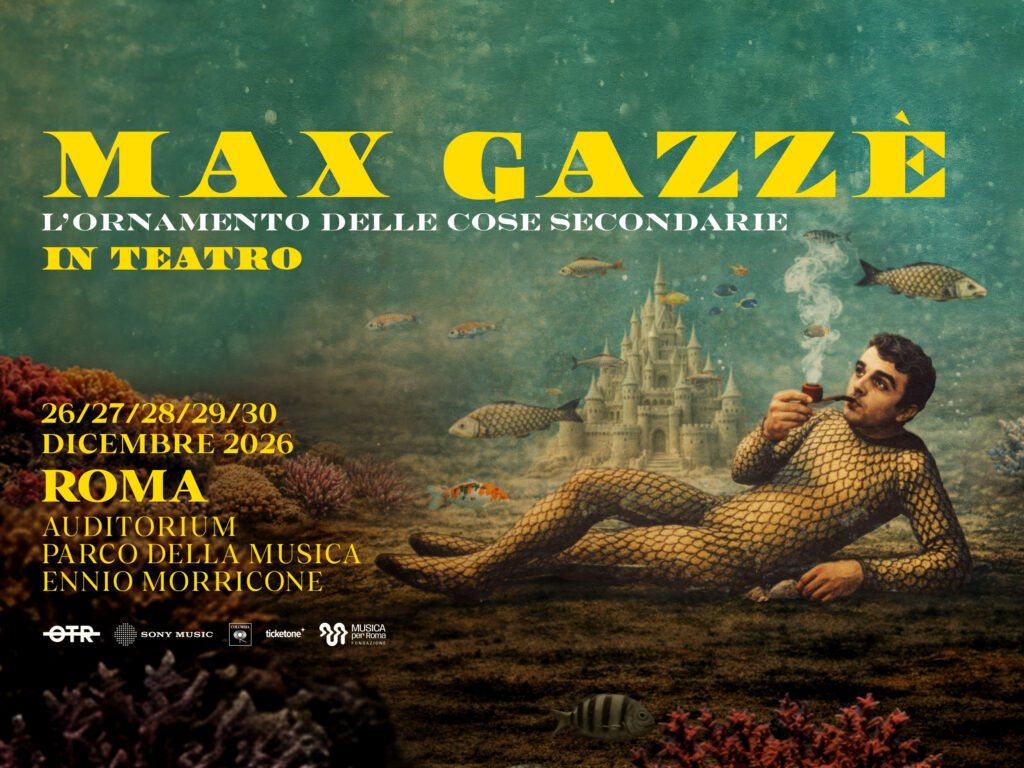
Max Gazzè in concert in Rome: five evenings at the Auditorium. He plays from December 26 to 30, 2026, five consecutive evenings: 26, 27, 28, 29 and 30. It is the Rome singer-songwriter's Christmas residency at the complex on Viale Pietro de Coubertin, and it is not just any date wedged in at the end of the calendar: it is the long tail of a tour built precisely to stay a long time in the same place, and Rome is the only Italian city where the number of evenings goes up from three to five. The official calendar of Auditorium Parco della Musica Ennio Morricone lists Sala Petrassi for all five evenings, starting at 20:00. The title of the show is the same as the new record: L’ornamento delle cose secondarie.
Who he is. Roman, born in 1967, a bass player before a singer-songwriter: from Cara Valentina to La favola di Adamo ed Eva, Massimiliano Gazzè has built a cultured and rhythmic author's pop, with symphonic and theatrical incursions. Born in Rome on July 6, 1967, from a family of Sicilian origin, he begins studying piano at six and moves to electric bass at 13, the age at which he moves to Brussels with his father, who worked at the Italian embassy. His career starts from there: first the Belgian clubs, then five years as bass player, arranger and co-author in an English northern soul band with excursions into acid jazz, the 4 Play 4, and finally the return to Rome in 1992 with a small recording studio and a precise desire to experiment.
The venue. Auditorium Parco della Musica Ennio Morricone, Viale Pietro de Coubertin 30, postal code 00196, is Renzo Piano's complex with three scarab-shaped halls arranged in a fan around an open-air theater. Tram 2 from Piazzale Flaminio, or bus from the center along Viale Tiziano axis. The hall for these five evenings, Petrassi, is the smallest of the three: 673 seats. Keep this number in mind, because it explains almost everything that follows.
The five evenings, one by one: dates, hall and time
I will line up right away what is needed by those who have to book a flight, a train or a dinner, because the rest comes after. The five dates are Saturday, December 26, 2026, Sunday, December 27, 2026, Monday, December 28, 2026, Tuesday, December 29, 2026 and Wednesday, December 30, 2026. Five separate listings on the Auditorium calendar, five separate access tickets, five evenings that the program classifies under pop and rock. For all five the hall listed is Sala Petrassi and the start time is 20:00.
The detail of the days of the week is not decorative data, and those organizing a trip notice it at once. December 26, 2026 falls on a Saturday: Santo Stefano and the weekend together, the evening when Rome is fullest of families out and about and of restaurants with a single seating. The 27th is a Sunday, and the Roman Sunday at the end of December has a rhythm of its own, with museums crowded in the afternoon and streets emptying early. The 28th, 29th and 30th are weekdays on paper, but there is almost nothing weekday about them that week: they are the soft days between Christmas and New Year's, when offices work at a minimum, traffic changes shape and the city fills with those who came for the holidays. Choosing one evening over another also means choosing a different version of Rome around the concert.
What the residency formula really means
The idea around which the tour is built has a precise name: residency. The official presentation explains it without circumlocution. In each city the singer-songwriter stays for three consecutive evenings, with the sole exception of the long Roman run, and turns each stop into a story in several chapters, able to evolve evening after evening. Not a repeat, but a stay: a way of inhabiting the stages, layering the repertoire, leaving room for variation and the unexpected.
Translated for someone buying a ticket, the reasoning is this. An ordinary tour passes through a city, sets up the stage, plays the setlist built in rehearsal, takes down and leaves. Logistics impose a certain rigidity: the sound service is the same, the lights are programmed, the transfers are long, and the margin for improvisation shrinks to the choice of two or three songs. When instead the stage stays set up for three or five evenings in a row in the same theater, the internal economy of the show changes. The sound technician has already tuned the hall. The band knows the reverb, the dead spots, the audience reaction. And above all nobody has to redo everything from scratch the next day, so they can afford to change something.
The practical corollary for Rome is obvious: five evenings are well over double the standard format of this tour. Those who live in the city and have a long-standing relationship with this repertoire can reasonably think of going twice, on two different evenings, and finding two evenings that do not coincide. Those who instead arrive from out of town for a single evening should simply choose the date that works best logistically, without looking for the best evening: it does not exist, or rather, it cannot be known in advance.
The tour that leads to Rome: from Spoleto to the five evenings at the Auditorium
The five Roman evenings are the conclusion of a long path, and it is worth seeing it in full because it explains the state in which the show will arrive at the end of December. The announced calendar speaks of over 40 dates between October and December, almost all grouped in blocks of three evenings in the same city.
It starts on October 10 at Teatro Nuovo Gian Carlo Menotti in Spoleto, with what in jargon is called a zero date: the dress rehearsal in front of a real audience, the one where you find out what works and what needs redoing. Then begins the series of residencies in Italian theaters. Three consecutive concerts in Mestre, from October 14 to 16 at Teatro Toniolo. Palermo from October 22 to 24 at Teatro al Massimo. Naples from October 26 to 28 at Teatro Bellini.
November is the busiest month: Bologna from the 5th to the 7th at Teatro Duse, Milan from the 9th to the 11th at Teatro Dal Verme, Genoa from the 12th to the 14th at Verdi Teatro, Florence from the 16th to the 18th at Teatro Puccini. Then Ascoli Piceno from November 19 to 21 at Teatro Ventidio Basso and Bari from the 23rd to the 25th at Teatro Piccinni.
December opens with Turin from the 2nd to the 4th at Teatro Colosseo and Trento from the 5th to the 7th at Teatro Sociale. After the mid-month break comes Cagliari, from December 21 to 23 at Teatro Massimo. And finally Rome, from the 26th to the 30th, five evenings at Auditorium Parco della Musica Ennio Morricone.
The count of days says something worth keeping in mind: when the show arrives in Sala Petrassi it will have behind it almost three months of performances and at least a dozen residencies. It will not be a show in its running-in phase. It will be a layered show, grown, with all the corrections accumulated since Spoleto, and with a band that by then knows the material by heart well enough to move away from it. The last dates of a theater tour are often the best precisely for this reason, and the Roman tail is literally the last.
The record the tour comes from
The show takes its title from the new album, L’ornamento delle cose secondarie, announced for release on May 15. It is the twelfth album of new songs in a discography that starts in January 1996 with Contro un’onda del mare, and the title, however you turn it, declares a poetics: secondary things, ornaments, the details that are usually cut. In an evening of theater, and even more in a five-evening residency, it is exactly the kind of material that can emerge.
Where Auditorium Parco della Musica is and how you really get there
The address is Viale Pietro de Coubertin 30, postal code 00196, Flaminio district, Parioli area, Municipio II. The complex occupies an area of about 55,000 square meters between Villa Glori, the Villaggio Olimpico, the Corso di Francia viaduct and Viale Maresciallo Pilsudski. If you do not know Rome, picture it like this: it is the band of the city north of Piazza del Popolo, across the Tiber from the monumental center, in a quadrant built almost entirely in the 20th century among sports facilities, rationalist buildings and wide avenues.
The first thing to know, and the least pleasant, is that the Auditorium has no metro station at its door. The useful stop is Flaminio, the northern terminus of line A, and from there a couple of kilometers remain. This is not a management flaw: it is a consequence of the choice of the area, made by the city council in 1992 after a debate lasting years, and criticized even then precisely for the distance from the metro and from the public transport lines. 30 years later the problem is still the same.
By tram and metro
The best solution for those arriving from the center is the oldest: metro line A to Flaminio, exit onto Piazzale Flaminio, and then tram 2. The tram starts right there, goes up Viale del Vignola and then Viale Tiziano, and has a stop a short distance from the Auditorium's entrance. The route is short, the tram is frequent during the evening rush, and the trip is entirely at street level, which helps with orientation.
From the center there are also direct surface connections, including a line labeled M that goes up toward the Villaggio Olimpico. The bus lines of this quadrant, however, are reorganized fairly often, and evening routes do not always match daytime ones: checking the Roman transit company's information service, on the same day, remains the only sensible move. Tram 2, on the other hand, has been a fixed point for years, and it is the reason I list it first.
The real public transport problem is not the way there, it is the way back. A concert that starts at 20:00 in a 673-seat theater most likely ends between 22:00 and 23:00, depending on encores and introductions. Metro line A closes at midnight on weeknights and later on Fridays and Saturdays, so for most of these five evenings there is margin, but not an abundant one. Those with a train to catch at Termini after the show should do the math carefully, because the Auditorium-Flaminio-Termini trip is not instant.
By car and the parking chapter
By car you arrive from the Tangenziale Est exiting toward the Villaggio Olimpico and Flaminio, or coming up from the center along the Lungotevere and crossing the river. Viale De Coubertin is closed to car traffic in one stretch, a consequence of the changes to the road layout imposed when the two scarabs were moved west because of the archaeological finds: the GPS, if not updated, may try to send you onto a stretch that no longer exists as a drivable road.
The internal parking lot exists and is underground, but the public has always considered it expensive, and the result is that on high-attendance evenings cars spill into the Villaggio Olimpico. It is a problem recognized for years and never solved. In the week between Christmas and New Year's the pressure on the neighborhood is different from usual, because work travel collapses, but the practical advice does not change: if you come by car, allow 30 minutes of margin just for parking, and do not count on finding a spot near the entrance.
On foot, from the Ponte della Musica
There is a way to get there that I recommend to those with time and comfortable shoes, and it concerns those on the opposite bank of the Tiber. The Ponte della Musica links the Flaminio district to the Foro Italico, and is reserved for pedestrians, cyclists and public transport. Crossing it on foot on an evening in late December, with the river below and the lights on both sides, is a much better way to enter the evening than 20 minutes shut in a car looking for a space. From the bridge to the Auditorium's entrance it is a few minutes' walk.
Sala Petrassi: 673 seats, the smallest of the three
Here is the point that makes the difference between these five evenings and an ordinary concert, and it deserves space. The Auditorium has three concert halls and two additional spaces. Sala Santa Cecilia, the largest, has 2,756 seats. Sala Sinopoli, the intermediate one, has 1,133. Sala Petrassi, the smallest, has 673. To these are added the Cavea, the open-air theater of about 3,000 seats named after Luciano Berio, and the 308-seat Teatro Studio named after Gianni Borgna.
Gazzè plays in the smallest. Five evenings of 673 seats add up to a little over 3,000 spectators in total, only slightly more than fit in a single evening in Sala Santa Cecilia. It is an artistic choice before a commercial one, and it tells exactly what this tour is: not a round of arenas, but a series of theater evenings in halls where the relationship between those who play and those who listen stays close.
Petrassi also has a curious history in its name. At the time of the inauguration it was generically called Sala Settecento, from the approximate number of seats. It was named after Goffredo Petrassi after the composer's death, in 2003. Petrassi, who was very old, wanted to attend the complex's inauguration anyway, and had the honor of the world premiere, in Sala Sinopoli, of his Ouverture da Concerto per Orchestra, composed in 1931.
Why the hall changes the concert
The repertoire to which Petrassi usually devotes itself is made of opera, jazz, theater, dance and film screenings. To meet theatrical needs it has an orchestra pit and self-moving side walls of the stage, which let you reduce the size of the proscenium and create room at the sides for actors to enter. It is the Auditorium hall designed for performance, not for pure symphonic music.
This has concrete consequences for an evening like Gazzè's. In a 673-seat hall the voice arrives without having to be pushed, the bass does not need to fill an enormous volume, and the dynamics can truly drop: a passage played softly stays soft and is still heard, something that in an arena simply does not happen. For a musician who has built his identity on layered arrangements, with the bass in the foreground and writing that plays on details, it is the ideal condition.
There is also a flip side, and it is right to say so. In a small hall there are no anonymous seats, but there are very different ones. The front rows offer a closeness that in a theater of this size is almost a dress rehearsal. The back rows and the sides offer a better overview of the show, lights included, but lose something in intimacy. There is no absolutely right position: there is the one that matches what you came looking for.
Who is Max Gazzè: the career in order, without legends
The biography deserves more than two lines. It is worth opening it, because without it you cannot understand why five evenings in a 673-seat theater make sense.
The beginnings: Brussels, the bass, France
Massimiliano Gazzè was born in Rome on July 6, 1967. His father is from Scicli, in the province of Ragusa, his mother from Catania: Sicilian origins in a Roman family. At six he begins studying piano, at 13 he moves to electric bass. Also at 13, after his parents' separation, he moves from Rome to Brussels with his father, who worked at the Italian embassy. He attends the European school and starts performing in clubs with several groups.
For five years he is bass player, arranger and co-author of the 4 Play 4, an English northern soul band with pioneering excursions into acid jazz. With the group he moves to the south of France, where he also works as an artistic producer. Several tours take him to the Netherlands. It is a biographical detail that explains much of the sound he would build afterward: before being an Italian singer-songwriter he was an Anglo-Saxon-schooled bass player, inside a genre, northern soul, that lives on groove and rhythm section.
He returns to Rome in 1992 and devotes himself to experimentation in his small studio, composing soundtracks and beginning to collaborate with Frankie hi-nrg mc, Alex Britti, Niccolò Fabi and Daniele Silvestri. With the last two, in particular, a partnership will arise that continues today. Between 1990 and 1992 he also plays in the trio Leone-Sorrenti-Gazzè with Gianni Leone and Duilio Sorrenti, performing in Rome and the surrounding area covers of foreign artists and of the Balletto di Bronzo: a detail that tells a lot to those who know Italian progressive rock.
Success: from 1996 to 2004
Between 1994 and 1995 he works on his first album, Contro un’onda del mare, released in January 1996 and presented in an acoustic version on Franco Battiato's tour. The album inaugurates the partnership with Virgin and draws critics' attention for the diversity of musical climates and the originality of the lyrics.
In 1997 he presents Cara Valentina at Sanremo Giovani, where he comes in 27th. In 1998 Vento d’estate, sung together with Niccolò Fabi, wins that year's edition of Un disco per l’estate. The two singles anticipate the second album, La favola di Adamo ed Eva, released in October 1998, whose lyrics are written together with his brother Francesco Gazzè. Also in 1998 he takes part in the Robert Wyatt tribute album The Different You with the track O Caroline, and takes part in the Premio Tenco.
In February 1999 he goes to the Sanremo Festival among the New Proposals with Una musica può fare, eighth, a song later included in the reissue of La favola di Adamo ed Eva. The following year he returns to the festival, this time among the big names, with Il timido ubriaco, fourth. On March 13, 2000 he releases the third album, titled simply Max Gazzè and also known as Gadzilla, the title the author had initially wanted to give it. In the summer of the same year he takes part in the Festivalbar with L’uomo più furbo.
In October 2001 the fourth album comes out, Ognuno fa quello che gli pare?, a record built on collaborations: Il debole fra i due is sung with Paola Turci, in Il motore degli eventi he duets with Carmen Consoli, Non era previsto is co-produced with Francesco Magnelli of the CSI, Il dolce della vita is made with Stephan Eicher. Here too the lyrics are written in collaboration with his brother Francesco.
From 2010 to 2013: cinema, theater, Sanremo
On April 9, 2010 comes out the first film in which he acts, Rocco Papaleo's Basilicata coast to coast, for which he composes with Gimmi Santucci the song Mentre dormi. The song wins the Mario Camerini prize for best song in a film and, the following year, the 2011 David di Donatello for best original song. On May 4, 2010 the album Quindi? comes out, debuting at sixth place on the official Italian chart. Between October and November of the same year he plays Herod in the musical Jesus Christ Superstar, staged at the Teatro Sistina in Rome: a theatrical parenthesis that, with hindsight, seems an anticipation of the relationship he would build with stages.
In 2012 the Over Tour begins, a trio project with Rita Marcotulli on piano and Roberto Gatto on drums: two leading names of Italian jazz, which says how little Gazzè considers himself a prisoner of a format. In 2013 he returns to Sanremo with I tuoi maledettissimi impegni and Sotto casa: the competition mechanism chooses the second, which comes in seventh and gives its title to the album released on February 14. It is the moment of greatest commercial success of his career, with the gold record for the album and the platinum record for the single. In June he receives in Lamezia Terme the Riccio d’Argento of the Fatti di Musica festival, a prize for the best author's live shows of the year. In 2014 he wins the Premio Amnesty Italia for Atto di forza, a song written with his brother Francesco.
The trio, the symphonic years and the last decade
In the spring of 2014 the group Fabi Silvestri Gazzè is born with Niccolò Fabi and Daniele Silvestri. On April 25, 2014 the single Life is Sweet comes out, anticipating the album Il padrone della festa. The trio starts with a European tour on September 26 from Cologne, with stops in France, the United Kingdom, Belgium, the Netherlands, Luxembourg and Spain, then comes the Italian tour, which ends in Rome on July 30, 2015 in front of about 18,000 people.
In 2017 he collaborates with Caparezza and with Levante, acts in Simona Izzo's film Lasciami per sempre, and above all launches the Alchemaya Tour: a project in which his songs are rearranged in a key that he calls "sintonica", that is, played together by the symphony orchestra and synthesizers, with the narrating voice of Ricky Tognazzi and the Bohemian Symphony Orchestra of Prague conducted by maestro Clemente Ferrari. The project leads to the double album Alchemaya, released on February 9, 2018, and to participation in the 2018 Sanremo Festival with La leggenda di Cristalda e Pizzomunno, sixth place and the Premio Giancarlo Bigazzi for best musical composition. The tour restarts on August 5 from the Baths of Caracalla and ends on September 2 at the Arena di Verona.
On November 16, 2018 he collaborates with Carl Brave on the single Posso. To celebrate the 20 years of La favola di Adamo ed Eva he announces for 2019 a European club tour in which he performs only the tracks of that album, preceded by a triple date at Auditorium Parco della Musica in Rome with a second part devoted to other hits. Keep this detail in mind: the Roman triple date of 2019 is the direct precedent of the five evenings of 2026. In the summer of 2019 the On the Road tour starts.
In 2020 he collaborates with Francesca Michielin on the track La vie ensemble and is the first Italian artist to restart live music after the pandemic shutdown: he interrupts the recording of the record in preparation, accepts the proposal of his manager Francesco Barbaro and the agency OTR Live, and returns to concert with limited seating but with a full lineup of musicians, technical crew and production, waiving his own fee so that the sector could restart. It is the kind of gesture that in a biography is summed up in one line and that in the industry is remembered for years.
In 2021 he returns to Sanremo with Il farmacista, presenting himself as Max Gazzè and La Trifluoperazina Monstery Band, a band of cardboard cutouts depicting Queen Elizabeth on drums, Marilyn Monroe on backing vocals, Jimi Hendrix on guitar, Paul McCartney on bass and Igor from Young Frankenstein on keyboards. Over the course of the evenings he appears dressed as Leonardo da Vinci, then seated in an armchair as Salvador Dalí, and finally as Clark Kent discovering the S of Superman under his shirt and throwing himself onto the empty seats of the Ariston. On April 9 of the same year he releases La matematica dei rami, produced and played with the Magical Mystery Band, a title that takes up Leonardo's thesis that tree branches grow in a balanced way to resist the wind.
From there on: Considerando in April 2021, Il vero amore with Greta Zuccoli in July, the return to touring in 2022 with Cristo di Rio together with Carl Brave and the concert event in the Amphitheater of the Archaeological Park of Pompeii dedicated to the Pink Floyd. In 2023 come Riviera with Frenetik & Orang3, the summer project Musicae Loci with Max Dedo and different local orchestras for each stop, the single Che c’è di male and then L’epica della guerra, both tied to the album Amor Fabulas, the theater tour Amor Fabulas - Preludio and a part in the Manetti Bros.' film Diabolik - Chi sei?. Also in 2023 he writes, with his brother Francesco and with Francesco De Benedettis, the winning song of the Zecchino d’Oro, Non ci cascheremo mai.
In March 2024 he restarts with an international tour that begins in Brussels, the city of his adolescence, and ends in Rome. On May 24 Sarà papà comes out. On July 6, 2024, his 57th birthday, he reunites with Fabi and Silvestri for a single date at the Circus Maximus, for the 10 years of Il padrone della festa. The summer of 2024 crosses the stops of Musicae Loci with those of Amor Fabulas - Interludio. In 2025 he is the protagonist, with Fabi and Silvestri, of the docufilm Fabi Silvestri Gazzè - Un passo alla volta, which tells of 30 years of friendship among the three.
A curiosity about Max Gazzè in concert in Rome at Auditorium, December 26 to 30, 2026
The curiosity concerns the number five, and it is not a programming whim. Across the whole tour the standard measure is three consecutive evenings per city: three in Mestre, three in Palermo, three in Naples, three in Bologna, three in Milan, three in Genoa, three in Florence, three in Ascoli Piceno, three in Bari, three in Turin, three in Trento, three in Cagliari. Rome is the only declared exception, and goes to five. The official presentation writes it exactly that way: in each city three consecutive evenings, with the sole exception of the long Roman run.
The curious thing is not the exception itself, it is where it falls. It falls in Rome, which is his city, and it falls in the week between Christmas and New Year's, which is the period of the year when a Roman has the least trouble filling a hall because everyone is in town, and at the same time the period when concert organizers usually stop. The calendar of the big Italian tours traditionally closes before December 20 and reopens in January: the holiday week is territory for New Year's Eve parties, family shows and New Year concerts. Placing five theater evenings between December 26 and 30 means going against a well-established habit of the industry.
And there is a second layer, even more interesting. Five evenings of 673 seats make a little over 3,000 spectators in total. The same artist, in the same city, has filled the Circus Maximus with the trio Fabi Silvestri Gazzè and closed a tour in front of about 18,000 people in 2015. He could have chosen a big hall and a single evening. He chose the smallest hall of the complex and five evenings. In terms of potential gross receipts it is not the obvious choice. In terms of what you manage to do on stage, it very much is.
A third curiosity, for those who keep track of anniversaries: it is not the first time Gazzè has occupied the Auditorium for several evenings in a row. In 2019, to celebrate the 20 years of La favola di Adamo ed Eva, he opened the European club tour with a triple date right at Auditorium Parco della Musica, structured in two parts: first the album in full, then the tracks from the other records. The residency formula, in Rome, he had already tried seven years before.
Something nobody tells you about Max Gazzè in concert in Rome at Auditorium, December 26 to 30, 2026
What nobody says concerns the Auditorium in winter, and it is an enormous difference from the image almost everyone has of this place.
In most people's minds the Auditorium is summer: the open-air Cavea, 3,000 seats under the sky, the big July concerts, the evenings when you arrive in a T-shirt and leave at two in the morning. That is the most photographed face of the complex, that of the Roma Summer Fest, and for half the year it is the main reason people go there.
At the end of December the Auditorium is something else. The Cavea is empty and swept by wind, the three halls work indoors, and the complex behaves like what it has always been under the skin: a covered public building, with a huge foyer, a bookstore, the bars, the walkable terrace that runs around the buildings. The practical difference is that in winter the time you spend here before and after the concert changes nature: you do not sit on the open-air steps, you stay inside. And inside there is much more space than those who come only in summer imagine.
There is also something you really find written almost nowhere: the complex has a small archaeological museum carved out under the Cavea, which displays the finds of the Roman villa that came to light during the works. The remains of the villa are visible outdoors, between Sala Santa Cecilia and Sala Sinopoli. If you arrive an hour early, on an evening in late December, you can spend 20 minutes looking at the walls of a Roman country house 2,000 years old before going in to hear a record released the year before. The overlap is so Roman as to be almost banal, and in fact almost nobody notices it.
The advice I give you for visiting Max Gazzè in concert in Rome at Auditorium, December 26 to 30, 2026
The main advice is only one and concerns time: arrive early. Not 20 minutes before, but an hour and a half before. The reasons are three and all concrete.
The first concerns parking. The neighborhood around De Coubertin does not have an infinite reserve of parking, the internal lot is perceived as expensive and fills up, and on evenings with shows in several halls the audience of three different events arrives in the same half hour. Those who arrive at 19:50 for a 20:00 concert risk entering out of breath with the lights already down, which in a 673-seat hall means disturbing half a row.
The second concerns the complex itself. The Auditorium is not a theater with a lobby and a hall: it is a piece of city. There is the foyer shared by the three halls, a large bookstore, the bars, the walkable terrace that goes around the scarabs, the archaeological remains. If you come here only for the concert you miss half the reason this place was built the way it was: Renzo Piano designed it as a place you enter hours before and leave hours after, not as a box in which you sit for two hours.
The third concerns the cold. The outdoor terrace, on the evening of December 28, is windy. The walk from the tram stop to the entrance is uncovered. Dress for a real Roman winter evening, which means low but not freezing temperatures and damp wind from the river, and keep in mind that inside the hall it is warm: a heavy coat becomes a problem after two hours in an armchair. The coat check, where available, solves it.
How to choose among the five evenings
If you are free to choose, here is how to think about it. The 26th, Saturday and Santo Stefano, is the most festive evening and the one when the city around is liveliest: good if you want to make a night of it before and after, less good if you hate crowds. The 27th, Sunday, is the most convenient evening for those coming from outside Rome with a return train the next day. The 28th and 29th, Monday and Tuesday, are the quietest evenings logistically. The 30th, Wednesday, is the last date of the entire tour: those hunting for memorable evenings know that last dates often have something extra, guests included, but it is also the evening when the city starts preparing for New Year's Eve and moves around worse.
A note on presale. Five evenings in a 673-seat hall make a total of just over 3,000 access tickets for an artist who plays at home in Rome and who in the same city has filled much larger spaces. The math is simple and worth doing in time: purchase is made through the channels indicated by the Auditorium, and the complex's box office, in the winter season, works every day with continuous hours in the afternoon.
Another well-known fact, yet rarely mentioned
The fact is this: Auditorium Parco della Musica exists because Rome, for more than 60 years, did not have a concert hall worthy of the name. The matter is known to insiders and is cited very little outside.
Until the 1930s the city's reference symphonic hall was the Augusteo, carved inside the Mausoleum of Augustus. That hall was demolished, and from then until 2002 the Italian capital, home to one of the oldest musical institutions in the world, the Accademia Nazionale di Santa Cecilia, did not have an auditorium designed expressly for music. Barely 60 years of the provisional: unsuitable halls, adaptations, borrowed spaces. Renzo Piano's Auditorium was born to close that wound.
The path was not simple. The invitation-only competition dates to 1993, the Villaggio Olimpico area was chosen by the city council in 1992 after a long debate, the construction site ran from 1995 to 2002 and was very troubled: the contract with the winning firm was terminated midway and a new tender was called, with a consequent rise in costs on which criticism and accusations focused. In 1995 and 1997 the Consiglio superiore dei lavori pubblici issued strongly critical opinions. And above all, midway through the excavation, the remains of a Roman villa surfaced: a discovery that forced a substantial change to the original design, with two of the three scarabs shifted west until almost brushing the Corso di Francia viaduct.
Piano worked in synergy with Jürgen Reinhold of the Munich studio Müller-BBM on the acoustics of the three halls and with the landscape architect Franco Zagari on the outdoor spaces. The Auditorium was inaugurated on April 21, 2002 with the opening of Sala Sinopoli, and on December 21 of the same year with the rest of the complex and Sala Santa Cecilia, opened by a concert of the Orchestra of the Accademia Nazionale di Santa Cecilia conducted by Chung Myung-whun. Since 2003 the complex has been the permanent home of the Academy's concert season. In 2020 the Rome city council approved the dedication to Ennio Morricone.
There is also a controversy that has accompanied the complex from the start and that almost nobody tells: the total absence of pipe organs in the halls. The appeal was launched in 2002, with works not yet finished, and the music critic Paolo Isotta went so far as to call Sala Santa Cecilia, for this reason, a living room without a sofa. More than a million euros had been allocated for the instrument and a commission of organists was appointed, but it was suddenly dismissed just when it had reached a difficult agreement on the tonal characteristics. More than 20 years later the organ is not there.
One last figure that is usually not cited: in 2016 the Fondazione Musica per Roma alone held 608 events here, excluding conference ones, selling 287,109 tickets. The total visitors to the Parco della Musica, in 2014, were estimated at more than 2 million, a number that made it the first European cultural facility by number of visitors and the second in the world after Lincoln Center in New York. Put bluntly: the hall where Gazzè will play five evenings in a row is inside one of the most visited cultural complexes on the planet, and almost nobody knows it.
The right photo to take at Max Gazzè in concert in Rome at Auditorium, December 26 to 30, 2026
Let us start with the rule, because without it the rest is useless: inside the hall, during the concert, you photograph only if and as the production allows, and in a 673-seat theater a lit screen in the fifth row is seen by everyone. The photo worth taking home, in any case, is not the one of the stage.
Photo one: the scarabs from the terrace above, in the evening. A walkable terrace runs around the buildings, and from there the three lead-covered volumes can be seen in their complete form. By day the lead is matte gray and the photograph comes out flat. In the evening, with the complex's lights on and the sky not yet fully black, the shells become dark curves against a blue background. The good window, at the end of December, is very narrow: between about 17:15 and 17:45, because the sun sets early. If the concert is at 20:00 and you arrive at 18:30, you have already missed that window. It is the most serious argument in favor of arriving very early.
Photo two: the empty Cavea in winter. The open-air theater of 3,000 seats, deserted, with the wet steps and the three halls surrounding it, is an image nobody takes because everyone photographs the Cavea full in July. The winter version is much more interesting: you read the geometry of the design, you see the fan layout, and there are no heads in front of the lens.
Photo three: the remains of the Roman villa. Between Sala Santa Cecilia and Sala Sinopoli the walls of the villa that came to light during the construction emerge. Framing the ancient remains with the curved lead flank of a Renzo Piano scarab behind them is the photograph that sums up in a single image what it means to build in Rome in the 21st century. It is also the only photo of this place that looks like no other.
Photo four, for those with time: the Ponte della Musica at sunset. Arriving on foot from the Ponte della Musica as the light fades means having the Tiber, the white arch of the bridge and, in the distance, the outline of the Foro Italico. It is the best way to photograph the context, not just the building.
Some important events that took place here in history
The history of the complex is short, because it is a little over 20 years old, but it is dense, and the passages that matter are these.
1992. The Rome city council chooses the Villaggio Olimpico area after a debate lasting years. The choice is contested even then, for the shape of the terrain and the distance from the metro.
1993. Renzo Piano wins the invitation-only competition. The design provides for three distinct halls arranged around an open-air theater, an unusual solution born from a precise acoustic need: to separate the volumes instead of compressing them into a single building.
1995. The construction site opens. Shortly afterward the excavations return the remains of a Roman villa. The discovery forces a substantial revision of the design: two of the three scarabs are shifted west, and the neighborhood's road layout is modified accordingly, with the closure to car traffic of a stretch of Viale De Coubertin.
April 21, 2002. Inauguration of Sala Sinopoli, the first to open. It is in this hall that Goffredo Petrassi, very old, attends the world premiere of his own Ouverture da Concerto per Orchestra, written in 1931. He will die the following year, and the complex's smallest hall, until then called Sala Settecento, will take his name.
December 21, 2002. The rest of the complex opens and Sala Santa Cecilia is inaugurated with a concert of the Orchestra of the Accademia Nazionale di Santa Cecilia conducted by Chung Myung-whun.
2003. The Auditorium becomes the permanent home of the concert season of the Accademia Nazionale di Santa Cecilia, which brings here also its Bibliomediateca and the Museum of Musical Instruments.
2006. The Auditorium begins hosting the Rome Film Festival, which since then has occupied the complex every autumn and has changed its public perception: from a place for music to a place for entertainment in the broad sense.
2019. Max Gazzè opens here, with a triple date, the tour for the 20 years of La favola di Adamo ed Eva. It is the direct Roman precedent of the five evenings of 2026.
2020. The city council approves the dedication of the complex to Ennio Morricone, who died that year. The official name becomes Auditorium Parco della Musica Ennio Morricone.
December 26-30, 2026. Five consecutive evenings of Max Gazzè in Sala Petrassi, closing a tour of over 40 dates built on the residency formula.
Who has passed through Max Gazzè in concert in Rome at Auditorium, December 26 to 30, 2026
The question can be read in two ways, and I answer both.
Who has passed through these halls
The Auditorium is home to the Accademia Nazionale di Santa Cecilia, one of the oldest musical institutions in the world, born as a congregation of musicians and today a foundation with an academic body of 70 full members and 30 honorary ones. Every year the capital's symphonic season passes through this stage. The conductor who inaugurated Sala Santa Cecilia in December 2002 was Chung Myung-whun.
But the complex's vocation has always been double. Alongside the Academy's program is that of the Fondazione Musica per Roma, which brings here rock, pop, jazz, contemporary music, opera, electronic and ethnic music, as well as theater, dance, circus, literature, poetry, exhibitions, author meetings and festivals devoted to science and books. Four resident orchestras anchor jazz, contemporary music and popular music.
In the recent calendar alone the complex has hosted names that show how wide the range is: the metal of the Judas Priest, the Italian song of Fiorella Mannoia, the American rock of Wilco, the new Italian song of Angelina Mango, the international electronics of Dissonanze. Add the Film Festival every autumn and the Roma Summer Fest every summer, and you have the picture of a place with no single genre.
Who has passed through Gazzè's music
From the singer-songwriter front: Niccolò Fabi and Daniele Silvestri, companions of a 30-year friendship that became first a record and then a group, Fabi Silvestri Gazzè, with which he filled the Circus Maximus in 2024. Paola Turci and Marina Rei, with whom he has shared stage and records since 2007. Carmen Consoli, who played a good part of the guitars on his 2008 record. Franco Battiato, on whose tour the first album was presented in acoustic version in 1996.
From the international front: the Swiss Stephan Eicher, for whom he was the regular bass player and with whom he wrote and sang, together with the German Herbert Grönemeyer, the track that gives its title to the album Taxi Europa. Stewart Copeland of the Police, in the cover band Gizmo, together with Raiz of Almamegretta and Vittorio Cosma.
From the jazz front: Rita Marcotulli on piano and Roberto Gatto on drums, companions of the 2012 Over Tour. From the symphonic front: the Bohemian Symphony Orchestra of Prague conducted by Clemente Ferrari and the narrating voice of Ricky Tognazzi in the Alchemaya project, and then the local orchestras, different from city to city, of the Musicae Loci project, with his longtime collaborator Max Dedo.
From the contemporary pop front: Carl Brave, with whom he has recorded twice, Caparezza, Levante, Francesca Michielin, Greta Zuccoli, the producers Frenetik & Orang3. And then his brother Francesco Gazzè, co-author of the lyrics since the second album and co-author, in 2023, of the song that won the Zecchino d’Oro.
It is not the list of collaborations of a singer-songwriter hunting for the single: it is the map of someone who has moved among northern soul, progressive, jazz, symphonic, Roman rap and the singer-songwriter tradition without ever asking permission. Five evenings in a 673-seat hall are exactly the place where this map can be opened in full.
How to build the evening around the concert
Five evenings between December 26 and 30 mean five chances to do something Rome does well: turn a show into a whole day.
The afternoon before
Those who arrive early in the area have, a few minutes' walk away, the MAXXI, the national museum of 21st-century arts, which is the other great contemporary building of Flaminio. Seeing Zaha Hadid and Renzo Piano in the same afternoon is an exercise that in Rome can be done in a handkerchief of a neighborhood, and it is one of the few things worth leaving the historic center for. Those who prefer to be outdoors can head up toward Villa Glori, the park on the hill behind the complex, or go down toward the Tiber and walk along the river.
Those who instead come from the center and want a walk with a point can start from Piazza del Popolo, go up the Flaminio district, cross the Ponte della Musica, take a look at the Foro Italico on the other bank and return toward De Coubertin. It is about an hour and a half of walking with stops, and it is the best way to understand how this part of the city is built.
Eating before or after
I am always asked, and the honest answer is that it depends on the time. With a start at 20:00, dinner before means eating at 18:30, which in Rome means finding little open and poorly. The solution is the reverse: something light before, in the complex's bars or in the neighborhood, and a real dinner after the concert, around 22:30, which is a perfectly normal time for a Roman trattoria. In the week between Christmas and New Year's, however, many places change hours or close, so booking is the sensible move, not excess zeal.
The most frequent questions
Are the five evenings the same? No, and that is the declared point of the project. The residency formula explicitly provides that each stop becomes a story in several chapters, evolving evening after evening. How much it changes in practice cannot be predicted in advance, but the intention is written in black and white in the official presentation.
In which hall is the concert held? Sala Petrassi, for all five dates. It is the smallest of the complex's three concert halls, 673 seats, the one equipped for theater with an orchestra pit and self-moving stage walls.
What time does it start? The official calendar lists 20:00 for all five evenings. Keep in mind that entry to the hall happens earlier and that in a theater of this size entering after the show has begun is awkward for everyone.
How do you get there without a car? Metro line A to Flaminio, then tram 2 along Viale Tiziano. Alternatively the surface lines from the center, to be checked the same day because they change often. On foot from Piazza del Popolo it is a good 20 minutes.
Is the event confirmed? All five dates appear regularly in the Auditorium's official calendar, with hall and time listed, and none of the five carries any indication of cancellation or postponement. For dates falling more than three months away, it remains good practice to take a look at the official calendar before setting off.
Why these five evenings are worth the trip
A 59-year-old Roman singer-songwriter, with a 30-year career and 12 albums behind him, closes his theater tour in his own city, with five consecutive evenings in the smallest hall of the capital's main music complex. Not in the big hall, not in an arena, not on a single date for 10,000 people: five evenings of 673 seats, in a theater equipped for drama, in a week of the year when the rest of the industry is at a standstill. It is the last stop of a path that began on October 10 in Spoleto and passed through 13 cities, within a formula designed so that the show changes as it goes.
Nothing more is needed to decide. You only need to pick the evening and move in time.
Frequently asked questions about Max Gazzè in concert in Rome, Auditorium, December 26 to 30, 2026
When are Max Gazzè's concerts in Rome in 2026?
Max Gazzè's concerts in Rome take place on five consecutive evenings: Saturday, December 26, Sunday 27, Monday 28, Tuesday 29 and Wednesday, December 30, 2026, each with a separate listing on the Auditorium calendar and its own access ticket.
Where are Max Gazzè's concerts in Rome held?
Max Gazzè's concerts are held at Auditorium Parco della Musica, at Viale Pietro de Coubertin 30, in the Flaminio district, a complex of about 55,000 square meters between Villa Glori, the Villaggio Olimpico and the Corso di Francia viaduct.
In which hall of the Auditorium does Max Gazzè play?
Max Gazzè plays in Sala Petrassi, the smallest of the Auditorium's three concert halls, which has 673 seats, compared with the 1,133 of Sala Sinopoli and the 2,756 of Sala Santa Cecilia, the largest in the complex.
Are Max Gazzè's five evenings all the same?
No, Max Gazzè's five evenings are not the same: the residency formula explicitly provides that each stop becomes a story in several chapters, evolving evening after evening. How much it changes in practice cannot be predicted in advance, but the intention is declared in the official presentation.
Why is it best to arrive early at Max Gazzè's concerts?
It is best to arrive an hour and a half before Max Gazzè's concerts, not 20 minutes, because the neighborhood around De Coubertin does not have an infinite reserve of parking and on evenings with several events scheduled in the different halls the audience multiplies.
How many seats does Sala Petrassi, where Max Gazzè plays, have?
Sala Petrassi, where Max Gazzè plays, has 673 seats and is the smallest of the three concert halls of Auditorium Parco della Musica, designed for a more intimate audience than Sala Sinopoli and Sala Santa Cecilia.
To organize the rest of the trip
Once the evening is set, all the surroundings remain: how many days to stay, how to fit museums around holiday hours, if it is worth leaving Rome for a day, how to move between one neighborhood and another without losing half days in traffic. For the trip-planning side of Italy, itineraries, realistic timing and building the days, a useful reference is italyplanner.com, which tackles exactly this kind of problem. For those who instead work with groups, accompany people or organize visits and transfers as a profession, the professional tools and content are found on tourleaderpro.com.
The rest, on the evening of the concert, is done by the hall and the one who steps onto its stage. Five times in a row, in a 673-seat hall, between December 26 and 30, 2026.