Mamma Mia! the Musical at Teatro Sistina, December 17 to 31, 2026
https://www.estateromana.com/en/rome/trip-planner/mamma-mia-the-musical-at-teatro-sistina-december-17-to-31-2026/
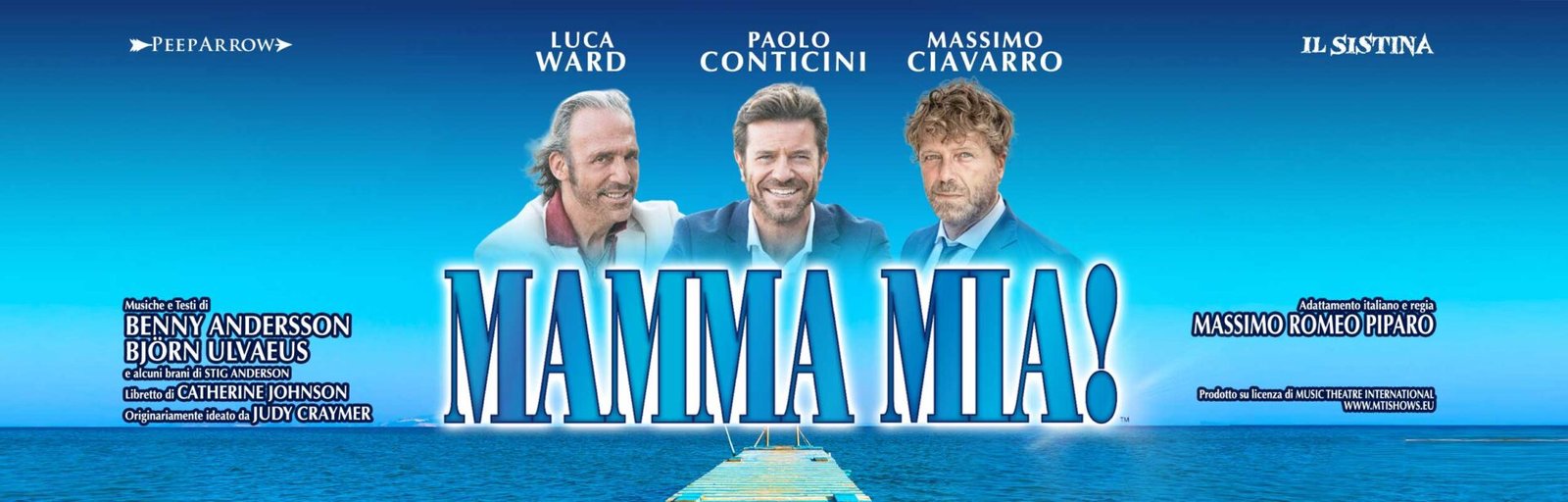
Mamma Mia! the Musical, in the Italian version directed and adapted by Massimo Romeo Piparo and produced by Peep Arrow and Il Sistina, returns to Teatro Sistina, at Via Sistina 129 (00187 Rome), from December 17 to 31, 2026, with 13 performances: Thursday the 17th, Friday the 18th and Saturday the 19th at 20:30, Sunday the 20th at 16:00, Monday the 21st, Tuesday the 22nd and Wednesday the 23rd at 20:30, Friday the 25th at 18:00, Saturday the 26th and Sunday the 27th at 16:00, Tuesday the 29th and Wednesday the 30th at 20:30, and on New Year's Eve, Thursday the 31st, at 21:00. The theater is a few steps from Piazza Barberini, served by metro line A, Barberini stop. The prices published by the theater are 79 euros in premium stalls, 73 in stalls, 69 in the first gallery, 61 in the second gallery and 39 in the third gallery. For the December 31 performance the box office starts at 95 euros. Tickets are bought on the official Sistina website, in the online ticket office linked from the show page, or at the theater box office.
Language: opera sung in its original language; no English surtitles are announced, so check with the theater.
Mamma Mia! at the Sistina has become a fixture of the Roman holidays: the story of Sophie, her three possible fathers and the ABBA songs, translated into Italian, on a stage with 11,000 liters of water, a pier and a moored boat. Below you will find the dates, the prices, what you will see, the history of the musical from London to Rome, the director, the theater and everything you need to organize the evening or the afternoon.
Mamma Mia! at the Sistina at a glance
Mamma Mia! is on at Teatro Sistina from December 17, 2026, with weekday performances at 20:30 and Sunday ones at 16:00. The dates on sale at the official box office run to December 31, for a total of 13 performances.
The full calendar
Thursday, December 17, at 20:30. Friday the 18th, at 20:30. Saturday the 19th, at 20:30. Sunday the 20th, at 16:00. Monday the 21st, at 20:30. Tuesday the 22nd, at 20:30. Wednesday the 23rd, at 20:30. Friday the 25th, Christmas Day, at 18:00. Saturday the 26th, Boxing Day, at 16:00. Sunday the 27th, at 16:00. Tuesday the 29th, at 20:30. Wednesday the 30th, at 20:30. Thursday the 31st, New Year's Eve, at 21:00. There are no performances on December 24 and 28.
The production
Peep Arrow and Il Sistina present the show under license from Music Theatre International. Music and lyrics by Benny Andersson and Björn Ulvaeus, book by Catherine Johnson, original idea by Judy Craymer. Directed by Massimo Romeo Piparo.
Dates beyond New Year's
The official page lists the show as running from December 17, with no closing date. The performances on sale today run to December 31. Any later dates are published in the theater's box office, and that is where to check.
Tickets and prices for Mamma Mia!
Tickets for Mamma Mia! at Teatro Sistina cost, according to the price list published by the theater, 79 euros in premium stalls, 73 in stalls, 69 in the first gallery, 61 in the second gallery and 39 in the third gallery.
The New Year's Eve performance
For the evening of December 31, at 21:00, the official box office lists prices starting from 95 euros. It is the most expensive and the most coveted performance: ending the year dancing to Dancing Queen in a theater on Via Sistina is an offer that in Rome sells out early.
Where to buy
Sales are on the official Sistina website, in the online box office reached from the buy button on the show page, and at the box office on Via Sistina. The box office shows the available seats for each performance, and lets you choose your seat on the plan.
The advice on sections
The Sistina hall has no columns and you see well from every point. The first gallery, at 69 euros, offers an overall view of the revolving platforms and the water on stage that the stalls do not have. The third gallery, at 39 euros, is the honest choice for those on a tight budget or coming with a large family.
What you will see: the Greek island on the stage of Via Sistina
Piparo's Mamma Mia! is an entirely Italian version of the musical on ABBA's songs, with a staging that brings to the Sistina stage a pier suspended over real seawater, a moored boat, a real shoreline and 11,000 liters of water.
The plot
Sophie lives on a Greek island and is about to get married. She has never met her father. Secretly reading her mother Donna's diary, she finds three possible candidates and invites all three to the wedding, without telling her. Sam, Harry and Bill arrive, Donna's two old friends Tanya and Rosie arrive, with whom as a girl she formed the trio Donna and the Dynamos, and the wedding becomes something else entirely.
The sets
The theater's presentation describes the atmosphere of a small Mediterranean island: an inn in white and blue, cascades of bougainvillea, revolving platforms that change the scene in view. The real water is the element that distinguishes this production: you hear it, as well as see it.
The songs in Italian
There are 24 songs, translated into Italian at the wish of the original authors, and in the first Roman edition the lyrics and dialogues were edited directly by the director. The announced songs include Mamma Mia!, Dancing Queen, The Winner Takes It All and Super Trouper.
The finale to dance to
At the end of the show there is an appendix made for dancing: the audience is invited to stand up and let loose to the disco version of the soundtrack. Those afraid of feeling awkward can rest easy: in a theater with over 1,500 people on their feet, nobody watches their neighbor.
Mamma Mia!, the history of the musical from London to Rome
Mamma Mia! is a two-act musical written by the English playwright Catherine Johnson on ABBA's songs, which debuted in London on April 6, 1999 at the Prince Edward Theatre. The title takes its name from a 1975 song by the Swedish group.
The West End and Broadway
After London, the show reached Toronto in May 2000 and Broadway on October 18, 2001, at the Winter Garden Theatre. By July 2003 it had passed 10 million spectators worldwide. In 2005 on Broadway it overtook, in number of performances, historic productions such as The Sound of Music and The King and I, and in Las Vegas it reached a thousand performances, becoming the longest-running theatrical show in the city.
The film
In 2008 Universal Pictures made the film, with Meryl Streep as Donna, Pierce Brosnan and Colin Firth. In 2018 the sequel, Mamma Mia! Here We Go Again, arrived. Many spectators come to the musical today after seeing the films, and find on stage the same story with a few differences.
The first versions in Italy
In Italy the musical arrived in English in 2009, with a tour that started from the Teatro degli Arcimboldi in Milan and passed through Trieste and Forlì, where it was a guest of the Ravenna Festival. The Italian-language version produced by Stage Entertainment stayed seven months at Teatro Nazionale in Milan and then, from October 13, 2011 to February 29, 2012, at Teatro Brancaccio in Rome.
The Piparo era at the Sistina
With Massimo Romeo Piparo Mamma Mia! has become a house title at the Sistina: an Italian production with translation and adaptation by the director, which stayed on the bill for several seasons to sold-out houses. The December 2026 revival is its latest chapter.
The ABBA songs in the musical
The soundtrack of Mamma Mia! includes ABBA's greatest hits, from Super Trouper to Dancing Queen, from Thank You for the Music to The Winner Takes It All, Lay All Your Love on Me and SOS.
The first act
In the musical's original structure the first act includes Honey, Honey, Money, Money, Money, Thank You for the Music, Mamma Mia, Chiquitita, Dancing Queen, Lay All Your Love on Me, Super Trouper, Gimme! Gimme! Gimme!, The Name of the Game and Voulez-Vous.
The second act
In the second act there are Under Attack, One of Us, SOS, Does Your Mother Know, Knowing Me, Knowing You, Our Last Summer, Slipping Through My Fingers, The Winner Takes It All, Take a Chance on Me, I Do, I Do, I Do, I Do, I Do and I Have a Dream. In the encores of the original edition Mamma Mia and Dancing Queen return, with Waterloo.
Translating ABBA
Translating songs the audience knows by heart in English is the riskiest bet of this version. It works because the musical is a comedy, and the songs carry the story forward. Understanding the words of The Winner Takes It All while Donna sings it to Sam is worth more than nostalgia for the original text.
Massimo Romeo Piparo and the creative team
Massimo Romeo Piparo has been artistic director of Teatro Sistina since the 2013-2014 season and the director of the great international musicals produced in Italian on the stage of Via Sistina. Of Mamma Mia! he signs the direction and adaptation.
The Sistina's musicals
Under his direction the Sistina has staged Jesus Christ Superstar with Ted Neeley, the Jesus of the 1973 film. Evita. Billy Elliot. School of Rock. Il Marchese del Grillo. Cats. Matilda. West Side Story. Mamma Mia! is the title that more than any other has tied his name to the holiday audience.
The team of the first Roman edition
In the edition staged at the Sistina from December 6, 2021 to February 14, 2022 the choreography was by Roberto Croce, the sets by Teresa Caruso, the costumes by Cecilia Betona, the sound by Alfonso Barbiero and Stefano Gorini, the lighting by Daniele Ceprani, with musical direction by Emanuele Friello and executive production by Francesca Piparo for PeepArrow Entertainment.
The cast
In that edition the three fathers were Luca Ward, Paolo Conticini and Sergio Muniz, and Donna was Sabrina Marciano, with a cast of over 30 artists and a live orchestra. For the December 2026 revival the official page does not yet list the company: those choosing a date based on the performers should check the theater's website before buying.
A curiosity about Mamma Mia! the Musical at Teatro Sistina, December 17 to 31, 2026
There is an ABBA song that in Mamma Mia! is not sung, but whistled. It is Fernando: Donna whistles it in a scene where, alone, she takes care of the small maintenance of her run-down hotel. It is a kind of surprise for fans, a hidden tribute to one of the group's most loved hits, which had not found a place in the story.
Another song, instead, was cut. The musical's initial staging had Summer Night City right after the prologue, with the wedding rehearsals and the arrival on the island of Tanya and Rosie. The scene was eliminated before the debut, and the song never entered the show.
The third curiosity concerns Rome. Piparo's Mamma Mia! was not the first in the city: Stage Entertainment's Italian version had already been staged at Teatro Brancaccio from October 2011 to February 2012. That the same title has had two Roman lives, in two different theaters and with two different productions, says how fond the city's audience is of this story. At the Sistina, then, it has become something more: a Christmas custom, like the nativity scene.
Teatro Sistina, Italy's answer to Broadway
Teatro Sistina, at Via Sistina 129, was inaugurated on December 28, 1949 to a design by Marcello Piacentini and is one of the most important private theaters in Italy, with 1,015 seats in the stalls and 566 in the gallery. The American magazine Variety called it Italy's answer to Broadway.
A hall without columns
The hall is semicircular, 28 meters wide and 30 deep, with no columns: from every seat you see the stage without obstacles. For a musical with full-stage scenery like Mamma Mia! it is a quality best appreciated from the gallery.
The orchestra pit
The Sistina has an orchestra pit, indispensable for a show with live music. In the first Roman edition of Mamma Mia! the orchestra was conducted by maestro Emanuele Friello.
The temple of musical comedy
From 1960 to 2006 the theater was run by Garinei and Giovannini, the authors of Rugantino and Aggiungi un posto a tavola. Since 2013 by Massimo Romeo Piparo. The venue's page is Teatro Sistina. The full program is on the official Sistina website.
Something nobody tells you about Mamma Mia! the Musical at Teatro Sistina, December 17 to 31, 2026
The Sistina was inaugurated on December 28, 1949, in the middle of the Christmas holidays. Almost nobody remembers it, but the theater on Via Sistina was born as a year-end show: it opened as a cinema and theater, with Le mura di Malapaga on the screen, and a few days later the first revue was staged, Bada che ti mangio, produced by Remigio Paone, with Totò and Isa Barzizza. On December 28, 2026, in the middle of the Christmas performances of Mamma Mia!, the Sistina will turn 77.
The second thing little said concerns the holiday audience. The Christmas and Boxing Day performances are in the afternoon or early evening, at 18:00 and 16:00. They are designed for families who want to go out after lunch, and are often the most crowded with children and grandparents. The New Year's Eve one, at 21:00, is the opposite: an adult audience, dressed for the party, who will leave the theater close to midnight.
It is worth choosing the performance based on the kind of evening you want. For a quiet Mamma Mia!, with the best seats, the weeknight evenings from the 21st to the 23rd or from the 29th to the 30th. For atmosphere, New Year's Eve. For the family, the afternoon of the 26th or 27th.
The advice I give you for visiting Mamma Mia! the Musical at Teatro Sistina, December 17 to 31, 2026
The first piece of advice is to rewatch the film, or at least listen again to an ABBA album, in the days before. Not to learn the songs, which you already know, but to notice the differences: in Italian some lines change meaning, and spotting where is part of the fun.
Second: arrive early and do not rush out. With a hall of over 1,500 seats, the lines at the coat check and entrances are long, and 30 minutes' margin avoids the dash. At the end, stay for the disco appendix: it is the part the audience remembers most, and leaving during the applause means missing it.
Third: if you come as a group or a family, choose the gallery. The first gallery gives an overall view that the stalls do not have, and the water on stage, the revolving platforms and the boat are best appreciated from above. Those who want to see the performers up close should choose the first rows of the stalls, knowing that they will see the scenery at an angle.
Finally: no car. The Sistina is in the ZTL of the center, and in the Christmas weeks Piazza di Spagna area is among the busiest in the city. Metro line A to Barberini, and five minutes' uphill walk.
Another well-known fact, yet rarely mentioned
That Mamma Mia! is a musical made with ABBA's songs everyone knows. It is less remembered that the plot rests on an unanswered question. At the end of the show nobody knows who Sophie's father is, and none of the three minds: they all want to be part of her life. Sophie, meanwhile, understands that she does not want to marry, and the preparations are not wasted because it is Donna who gets married, to Sam. It is an ending that overturns the comedy of errors: the confusion is not cleared up, it becomes a family.
The second well-known and little-cited fact concerns the form. Mamma Mia! is a jukebox musical, that is, a show built with already famous songs instead of ones written for it. Piparo has said he learned that genre in the field, with Mamma Mia! itself, before applying it to an Italian story: the Sistina followed the same model for its first entirely Italian jukebox musical, Il ragazzo dai pantaloni rosa.
For those going to the Sistina, the two facts go together. Mamma Mia! works because ABBA's songs, outside their context, already speak of ended loves, of mothers and daughters, of past summers. Catherine Johnson built a story that links them, not a story that uses them.
How to get to Teatro Sistina
Teatro Sistina is reached by metro line A, Barberini stop: from Piazza Barberini you walk up Via Sistina and the theater is at number 129, a few minutes on foot.
By metro
Line A links Barberini to Termini in two stops and to San Giovanni and Ottaviano in a few minutes. In the Christmas weeks it is by far the simplest way to arrive.
On foot from the center
Via Sistina links Piazza Barberini to Trinità dei Monti, at the top of the steps of Piazza di Spagna. Those in the center can arrive by climbing the steps and walking the flat street.
By car and taxi
The Sistina is in the historic center, inside the ZTL: a car is not recommended. Those arriving from outside can leave it in a garage outside the limited traffic zone and continue by metro. For the evening exit, and above all New Year's Eve night, a taxi is the most convenient solution for those who do not live near line A. Piazza Barberini is an easy pickup point to name.
The right photo to take at Mamma Mia! the Musical at Teatro Sistina, December 17 to 31, 2026
The photo of the Sistina is taken from the other side of Via Sistina, with the sign and the lit facade of the theater in the frame. On December evenings, with the area's Christmas lights and the crowd in front of the doors, the image is that of a theater in celebration. Take it on arrival: on exit the street fills and the photo comes out worse.
The second photo is a few steps away, at the top of the Trinità dei Monti steps: Piazza di Spagna lit for the holidays seen from above, with Via dei Condotti stretching toward the Corso. Those arriving on foot from the center find it on the way. Those arriving by metro can make the five-minute detour before or after the show.
Inside, during the show, no photos or videos: it is a rule of the theater and a form of respect for the performers. The moment of the disco appendix, with the whole audience on their feet, is when the temptation is strongest. Ask an usher if a shot is allowed, and for the rest, dance.
Some important events that took place here in history
Teatro Sistina was built between 1946 and 1949 on the site of the church of Santa Francesca Romana, along what was called Strada Felice, and inaugurated on December 28, 1949. Soon after, the finale of Totò cerca moglie was shot there. In October 1950 the curtain rose on La Bisarca by Pietro Garinei and Sandro Giovannini, with sets by Giulio Coltellacci. On December 15, 1952 Attanasio cavallo vanesio debuted with Renato Rascel, the first of a trilogy of musical fairy tales that opened the era of Italian musical comedy.
In the 1950s a group of film industrialists turned the theater into a Cinerama hall, with a screen 27 meters wide and 11 high. The experiment failed. From 1960 to 2006 the management was Garinei and Giovannini's, and the Sistina saw the birth of Rugantino, Aggiungi un posto a tavola, Il giorno della tartaruga, Un paio d'ali and Alleluja brava gente.
Since 2013 the artistic direction has been Massimo Romeo Piparo's, who brought the Sistina back to producing musicals in-house: from 2014 Jesus Christ Superstar with Ted Neeley, then Mamma Mia!, Cats, West Side Story. From December 6, 2021 to February 14, 2022 Mamma Mia! returned to the stage with Luca Ward, Paolo Conticini, Sergio Muniz and Sabrina Marciano. The December 2026 revival adds to this history.
Who has passed through Mamma Mia! the Musical at Teatro Sistina, December 17 to 31, 2026
Through the Sistina's stage have passed the great names of Italian entertainment, many of whom debuted or were consecrated here: Marcello Mastroianni, Renato Rascel, Delia Scala, Carlo Dapporto, Aldo Fabrizi, Walter Chiari, Gino Bramieri, Johnny Dorelli, Paolo Panelli, Bice Valori, Enrico Montesano, Gigi Proietti, Mariangela Melato, Sabrina Ferilli, Valerio Mastandrea, Massimo Ghini, Serena Autieri. And Totò, who inaugurated the theatrical season there.
In the years of Piparo's direction the Sistina has hosted concerts by John Legend, Massimo Ranieri, Ornella Vanoni, Renzo Arbore and Fiorello, and musicals with Ted Neeley. Delia Scala deserves a line apart: in 1953 Sandro Giovannini saw her dance a Charleston right at the Sistina, in a charity show, and decided she would be the lead of the musical theater that he and Garinei had in mind. The Sistina has always been a place where careers begin.
For Mamma Mia! there have passed through here Luca Ward, Paolo Conticini, Sergio Muniz and Sabrina Marciano, in the roles that on film were Stellan Skarsgård's, Pierce Brosnan's, Colin Firth's and Meryl Streep's, with a cast of over 30 artists. In the December 2026 performances a new company is added, and in the hall on Via Sistina thousands of spectators will once again pass through, standing and dancing to Dancing Queen.
Via Sistina and the area around the theater
Teatro Sistina is between Piazza Barberini and Trinità dei Monti, in one of the most elegant areas of central Rome, which in December is also one of the most illuminated.
Piazza Barberini
At the foot of Via Sistina is Piazza Barberini, with Bernini's Fountain of the Triton. A little above, Palazzo Barberini houses the Galleria Nazionale d'Arte Antica. Opposite begins Via Veneto.
Trinità dei Monti and the Pincio
From the other end of Via Sistina you reach Trinità dei Monti and, continuing, the Pincio, with the terrace over Piazza del Popolo, and then Villa Borghese. For the afternoon performances on the 26th and 27th, a walk on the Pincio in the morning is the ideal complement.
Toward Trevi
Going down from Piazza Barberini toward Via del Tritone you reach the Trevi Fountain in 10 minutes. In the evening, after the show, it is less crowded than by day, even in the holiday weeks.
Where to eat before and after the show
The area between Piazza Barberini, Via Sistina and Piazza di Spagna has a wide offer of restaurants, trattorias and bars, with prices on average higher than in other neighborhoods.
Before 20:30
With the start at 20:30 it is best to dine afterward, or to eat something quick beforehand around Piazza Barberini or toward Via del Tritone.
After the show
On exit many kitchens in the center are still open, especially on weekends. Going down toward Trevi and the Pantheon the choice grows. Those who want to spend less can move toward Monti, a few metro stops away.
Christmas and New Year's
On December 25 and 26 many restaurants in the center are booked weeks ahead, and on the evening of the 31st almost all offer fixed New Year's menus. Booking well in advance is not prudence, it is necessity.
Accessibility, children and practical information
For accessibility needs, wheelchair seats and companions, the reference is the Teatro Sistina box office, to be contacted before buying.
With children
Mamma Mia! is a musical comedy suited to families, with songs children often recognize from the films. The afternoon performances on Sunday the 20th, Saturday the 26th and Sunday the 27th at 16:00, and the Christmas one at 18:00, are the most convenient with the little ones.
Length and intermission
The running time is not given on the official page. The musical is in two acts, with an intermission. For the exit time, especially useful on New Year's Eve, it is best to ask the box office.
Arriving on time
At the Sistina, as in all large theaters, latecomers enter only at specific moments. With a hall of over 1,500 seats, arriving 20 minutes early avoids lines at the coat check and entrances.
Christmas and New Year's in Rome with Mamma Mia!
The 13 performances of Mamma Mia! cover the whole of the Roman holiday period, from the weekend before Christmas to New Year's Eve night. It is the period when the city lights up Via del Corso and Via dei Condotti, a few steps from the theater, and when a cheerful, family-friendly musical becomes the easiest Christmas gift to give.
For those coming from outside, an evening at the Sistina among the holidays is a way of experiencing Rome that you do not find in guidebooks: the stroll to a lit Piazza di Spagna, the historic theater of Italian musical comedy, the ABBA songs. In the same season, for other musicals in the city, Teatro Brancaccio also offers its program.
Frequently asked questions about Mamma Mia! at the Sistina
When is Mamma Mia! on at Teatro Sistina?
Mamma Mia! the Musical is on at Teatro Sistina in Rome from December 17, 2026. The performances on sale run to December 31: weekdays at 20:30, Sundays and December 26 at 16:00, Christmas at 18:00 and New Year's Eve at 21:00. There are no performances on December 24 and 28.
How much do tickets for Mamma Mia! in Rome cost?
Tickets for Mamma Mia! at the Sistina cost 79 euros in premium stalls, 73 in stalls, 69 in the first gallery, 61 in the second and 39 in the third gallery, according to the theater's price list. For the New Year's Eve performance, December 31 at 21:00, prices start from 95 euros.
Is there a Mamma Mia! performance on New Year's Eve?
Yes, Mamma Mia! is on at Teatro Sistina on Thursday, December 31, 2026 at 21:00, with prices starting from 95 euros. There is also a performance on Christmas Day, Friday, December 25, at 18:00, and one on Boxing Day at 16:00.
Who is in the cast of Mamma Mia! 2026?
The official Mamma Mia! page at the Sistina for December 2026 does not yet list the company. In the 2021-2022 Roman edition the leads were Luca Ward, Paolo Conticini, Sergio Muniz and Sabrina Marciano. Direction and adaptation are by Massimo Romeo Piparo.
Are the songs in Italian?
Yes, in Piparo's Mamma Mia! the 24 ABBA songs are translated into Italian, at the wish of the original authors. The songs include Mamma Mia!, Dancing Queen, The Winner Takes It All and Super Trouper. At the end there is an appendix to dance to, with the soundtrack in disco version.
How do you get to Teatro Sistina?
Teatro Sistina is at Via Sistina 129 and is reached by metro line A, Barberini stop, a few minutes' walk. From the center you can also arrive by climbing the steps of Piazza di Spagna and passing through Trinità dei Monti. The theater is in the ZTL: a car is not recommended.
Is Mamma Mia! suitable for children?
Mamma Mia! at the Sistina is a musical comedy suited to families, with well-known songs and scenery with real water on stage. The 16:00 afternoon performances and the Christmas one at 18:00 are the most convenient with children.
The final advice
At the Sistina, Mamma Mia! is the show that brings everyone together: the grandparents who used to dance to ABBA, the parents who have seen the film, the kids who know Dancing Queen without knowing where it comes from. Choose the first gallery, arrive by metro, stay until the last note of the disco version. And if you can, take the performance on the 29th or 30th: fewer crowds, same party.
Article written by the editorial team of Tour Leader Pro, contact them for Private/Corporate/V.I.P. Tours and Experiences.
Planning a trip to Rome? The English-language guides to visiting the city are on ItalyPlanner.com.