Labro (RI)
https://www.estateromana.com/en/rome/trip-planner/labro-ri-rome/
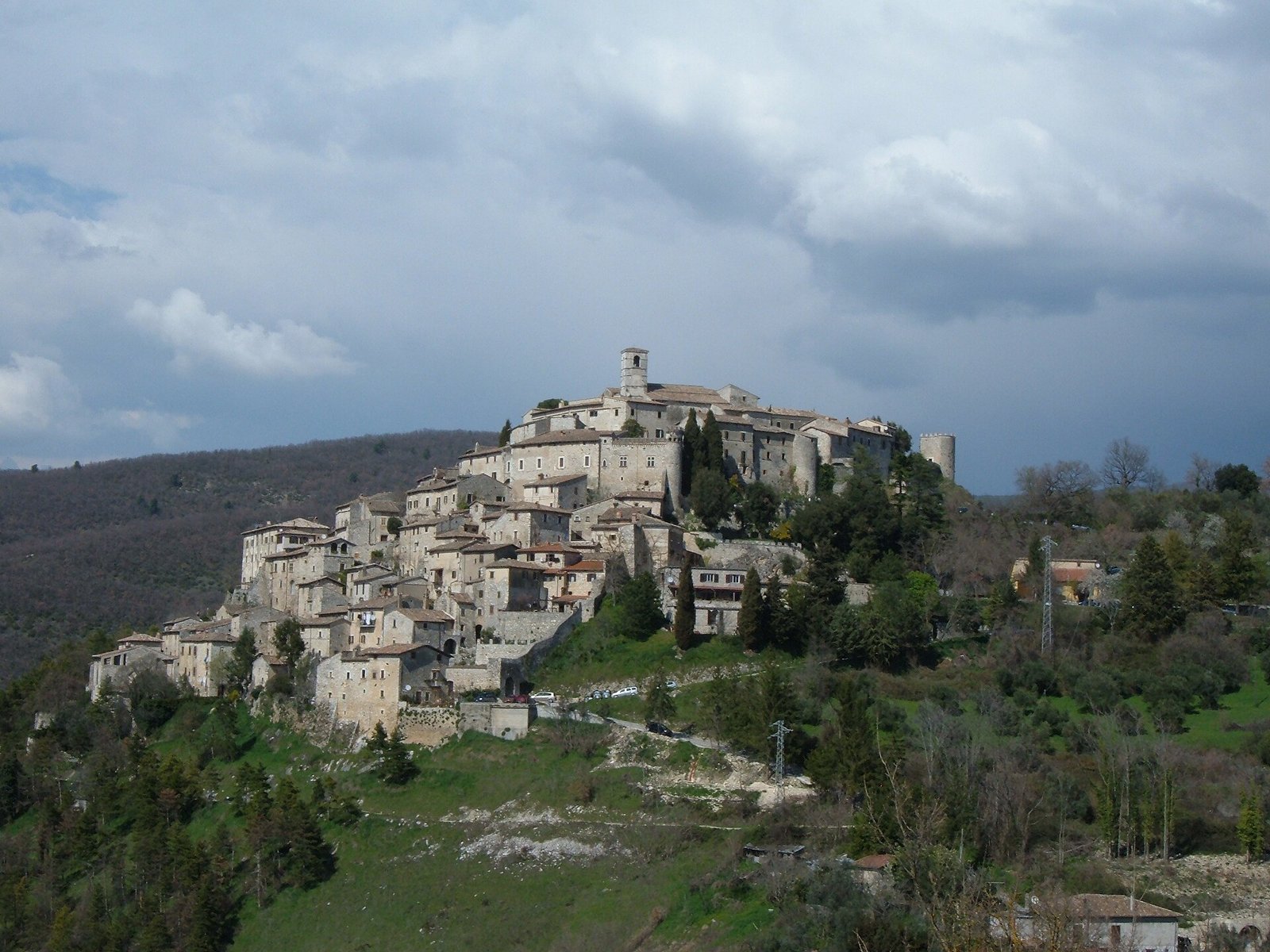
Labro is visited freely and on foot: it's a stone village in the province of Rieti, right on the border with Umbria, built on a hill overlooking Lake Piediluco, and you pay no ticket to walk its alleys. Cars stay outside the walls, and you enter through Porta Reatina. The Nobili Vitelleschi castle, at the top of the village, is a private residence still lived in by the Nobili family: hours and prices for the interior are not published, and the contact to ask is the Municipality of Labro.
The village has about 347 residents and owes its look to a precise choice. After the depopulation of the post-war years, from 1968 the heirs of the Nobili family began the complete restoration of the village, building by building, under the direction of the Flemish architect Ivan Van Mossevelde. The result is what you see today: stone houses restored one by one, paved alleys climbing uphill, a village restored as a whole. The Touring Club Italiano has awarded it the Orange Flag, the tourist quality mark for small towns.
Data checked on September 29, 2026 on the Lazio Region tourism portal, on the RFI page for the Labro-Moggio stop, and on the historical accounts published about the village and Lake Piediluco. The municipality's official website remains the channel for offices, events and ordinances. For the castle interior it's best to write before leaving: it's a lived-in house, also used for weddings and hospitality, and the public openings have no fixed calendar published by the official sources.
In brief: address, hours, ticket
- Where: Labro (RI), a municipality in the province of Rieti on the hill above Lake Piediluco, on the border with Umbria. Municipality website: comune.labro.ri.it.
- How to enter: the village is pedestrian, and you enter on foot through Porta Reatina. Cars stay outside the walls.
- Price: no ticket for the village and the alleys. The castle is a private residence: prices for visiting the interior are not published.
- Hours: the village is always accessible. Hours of the castle and the churches are not published, ask the municipality.
- By car: 104 kilometers from Rome according to Visit Lazio, via Regional Road 79 Ternana between Rieti and Terni and Provincial Road 5 of Leonessa.
- By train: the Labro-Moggio stop on the Terni-Sulmona line, about 8.6 kilometers from the village, with few trains a day.
- Accessibility: narrow, uphill, paved alleys. The stop has a level path to the platform but no assistance service according to RFI.
Where it is and what you really see
The Lazio Region tourism portal places Labro between the Monti Reatini and Lake Piediluco, at the entrance to the Valle Santa, the Rieti basin linked to the passage of St. Francis of Assisi. The village stands on a hill that looks on one side to the lake and on the other to the valley of the Rio Fuscello. The neighboring municipalities are Arrone, Terni, Colli sul Velino and Morro Reatino: two Umbrian and two from Lazio, which explains a lot about the border character of the place.
On the altitude the sources disagree: Visit Lazio speaks of 600 meters, other accounts give 628 meters. The lake sits at 375 meters, so between the highest square of the village and the water there are over 200 meters of difference in height. That difference is what makes Labro. From almost every lookout the sheet of water appears below, with the Umbrian hills on the other side, and the feeling is of a balcony built on purpose above the basin.
Inside the walls you only walk. Visit Lazio describes narrow, cobbled alleys that climb toward the castle, among small houses in the natural colors of the stone. The crenellated walls keep three gates: Porta Cavour, Porta Reatina and the gate of Piazzale Genzi. Porta Reatina is the entrance indicated for visitors. From there the climb is short but continuous, with stairways and covered passages, and in under an hour you reach the top and come back down without hurry.
The buildings that matter are few and recognizable. At the top, the Nobili Vitelleschi castle, with its hanging gardens, small loggias and crenellations. A little below, the church of Santa Maria Maggiore, a collegiate church since 1508, from which the widest view opens. The third is the former convent of the Observant Franciscans, from the end of the 1600s, with the church of Santa Maria della Neve. The rest is minor fabric restored with care: arches, outdoor stairs, portals, a few flower pots on the steps.
What you don't find, instead, is a service town. There are no big commercial squares or a street of shops, and even the town hall and offices have the size of a municipality of a few hundred residents. The visit is made of climbing, lookouts and stone details. Whoever arrives with this idea in mind leaves satisfied, while whoever expects a small town with museums and shops in a row risks finding the walk too short.
A curiosity about Labro (RI)
The village you visit is in large part the result of a construction project begun in 1968. After the war Labro had emptied out, like many hill towns of the Rieti area, and the risk was of seeing it collapse house after house. According to the history of the village, it was Countess Ottavia Nobili-Vitelleschi who brought in the Flemish architect Ivan Van Mossevelde, who directed the restoration of all the buildings with the declared aim of bringing life and tourism back to the center.
The curious detail is precisely the nationality of the project. A border village between Lazio and Umbria, tied for centuries to a noble family from Rieti, owes its contemporary face to an architect who came from Flanders. The project was not limited to a monument or a square: the historical accounts speak of the restoration of all the buildings of the village. An intervention so extensive, entrusted to a single designer and wanted by a single family, gives the village a unity of language that you notice as soon as you pass through the gate.
The makeup of the village also tells something. The municipal territory measures about 11.4 square kilometers and the residents are a few hundred. In 2015 the foreign residents were 52, almost 14 percent of the population, coming mostly from Romania. They are small numbers, but in a village of this size every family counts, and helps keep open houses that would otherwise stay closed for much of the year.
A second, more recent experiment took place in the former Franciscan convent. Between 2010 and 2013 the building hosted the Art Monastery Project, a community of artists who lived and worked in the convent spaces. The project has ended and the complex is today an accommodation facility with conference rooms. What remains, though, is the mark of a place that, by the owners' choice, has repeatedly looked for paths other than the simple postcard.
One thing nobody tells you about Labro (RI)
The station that carries the name of the village is not in Labro. The Labro-Moggio stop, on the Terni-Sulmona line, is in the territory of Colli sul Velino, about 8.6 kilometers from the village. It is the first stop in Lazio after the Umbrian border, with a single track and few trains a day headed to Terni or L'Aquila. Whoever reads the name on the timetable and thinks of getting off under the walls ends up in the middle of the valley, with no published connection to the village.
Colli sul Velino too, the municipality where the station is, has a close tie to Labro. Until 1957 it was a hamlet called Colli di Labro, then its territory was split off and raised to an autonomous municipality. This is why the place names of the area can confuse: double names, shared stations, borders that don't match the ones you imagine looking at the map. Whoever organizes the trip by train has to keep this in mind from the start.
The practical result is simple. Without a car, or without a ride booked from the station, Labro is hard to reach. The RFI page confirms that the stop has no assistance service and that it has a level path to the single track used by passenger trains. No official source indicates a connecting bus between Labro-Moggio and the village: the information is not published, and you have to ask the municipality before counting on a connection.
There is a second misunderstanding, a subtler one, about the lake. Many think Labro is on the shore, like Piediluco, and look for beaches or piers under the walls. The village is instead up high, on the hill, and the relationship with the water is visual. To touch the lake you have to drive down toward the shore, and the services on the water, from boats to rowing, mostly belong to the Umbrian shore and the Terni hamlet of Piediluco.
Who are the Nobili Vitelleschi and what remains of their castle?
The history of the village and that of the family almost entirely coincide. According to the historical accounts, the first lord of Labro was Aldobrandino de Nobili, invested by Emperor Otto I in 956. Since then the Nobili have stayed tied to the village for more than a thousand years. The double name, Nobili Vitelleschi, is the one under which the family and the castle appear today in tourist sources and in the history of the 20th-century restoration.
The castle you see at the top of the village was built in the second half of the 16th century by Giordano de' Nobili, on the site of the older fortress. The descriptions speak of hanging gardens crossed by stairways, of small loggias, balconies and crenellations. It's a building that joins the original defensive function to that of a noble residence, and from below it reads well: the compact mass at the top, the terraced gardens that descend toward the houses.
Today it is still lived in by the Nobili family, and its spaces hold hospitality activities, a restaurant and a wedding service. Visit Lazio also cites Palazzo Nobili Vitelleschi, near the entrance to the village, as a noble residence with preserved furnishings and the complete archive of the family. The sources don't specify if it is the same complex or two distinct buildings, nor do they publish hours. Before planning the visit it's best to clarify this with the municipality.
A complete family archive, in a village of a few hundred residents, is a rare thing. Documents of investitures, border disputes, administration of the fiefs: material that tells the history of a territory contested among Rieti, Spoleto and Terni. No official source indicates how to consult it or if it is open to scholars. Whoever does historical research on the Rieti area has in any case a concrete reason to contact the family, through the municipality or the castle's hospitality channels.
My advice for visiting Labro (RI)
The advice is to arrive in the late afternoon and go straight up to Santa Maria Maggiore, without stopping at the first shops. The low light on the lake is the reason you come all the way here, and it doesn't last. The tour of the alleys comes after, on the way down, when the sun has set and the stone still holds the warmth of the day. With this sequence the village is understood better than by starting from the bottom with the camera in hand.
Comfortable shoes, not city shoes. The alleys are paved, sloping, with irregular steps, and after rain the stone is slippery. Whoever travels with strollers or with people who have trouble walking should know that the village is pedestrian and that there are no level shortcuts to the top. Another useful rule: bring water in summer. The village is small and off season you may not find anything open on your first pass.
Finally, don't make Labro a half-hour stop between the Cascata delle Marmore and Rieti. It's the most frequent mistake, and in our judgment also the one that takes away the most. The village is quickly walked, true, but its value is in the time spent looking at the lake from the lookouts, sitting on a step, letting the valley change color. With less than two hours you take home only a photograph.
On the season, the advice is late spring or early autumn. In summer the village fills up on weekends, and the night of San Lorenzo draws people who come up to watch the stars from the churchyard, with parking taken by storm. In winter the short days leave little time for the light on the lake and the hill is more exposed to the cold. On weekdays in May, June, September and October you walk calmly and find a spot without effort.
Can you visit the castle and how much does it cost?
The village is free and open to everyone, at any hour. The Nobili Vitelleschi castle, instead, is a private residence lived in by the family, and no official source publishes visiting hours or fees for the interior. From the outside you can see the walls, the hanging gardens and the crenellations well, especially from the upper part of the village. Whoever wants to go in has to ask first, knowing that the answer may depend on the private events on the calendar.
There is no ticket to buy online for Labro, and no platform sells a castle entrance that can be verified on the official pages. The channel to use is the official website of the Municipality of Labro, which collects office contacts, news and events. Be wary of generic offers that promise entry to private castles in the Rieti area without naming the owner: in this case the family is the only real contact, and the municipality knows how to put you in touch.
For the churches too, no published hours appear. Santa Maria Maggiore is the parish church and opens for services. Whoever wants to see the Assumption, the baptismal font and the Rosary chapel on the upper floor does well to ask in the village or at the municipality about the Mass schedule. For the former Franciscan convent, now an accommodation facility, access to the interior spaces depends on the hotel operator and is not guaranteed to passing visitors.
There remains a different possibility from the cultural visit. The castle hosts hospitality activities, a restaurant and private events such as weddings. Whoever stays there or attends an event goes as a guest, not as a museum visitor, and conditions and prices depend on those activities, which the official sources don't report. For whoever wants instead a historical account of the rooms, the way is a written request to the municipality, with date, time and number of people.
Another well-known fact, yet rarely cited
Whoever arrives in Labro thinks it has always been in Lazio. It hasn't. Until 1923 the village was part of the province of Perugia, that is of Umbria. That year it passed to the province of Rome, and in 1927, with the creation of the province of Rieti, it was assigned to the latter. The regional border that today separates Labro from Piediluco and from Terni is therefore recent, less than a century old, and does not follow ancient divisions.
You understand it also by looking at the lake. Lake Piediluco lies almost entirely in southern Umbria, with a branch that enters Lazio right below Labro. The Umbrian village of Piediluco, a hamlet of Terni, faces it on the opposite shore. For centuries the area gravitated toward Rieti or toward Spoleto and Terni depending on the balance of power, and today's administrative borders are the latest of a long series of adjustments.
Under the Papal States too Labro had a particular position, because it depended on the Sacra Consulta, the central governing body, and not on a local delegation. It's an administrative detail, but it helps explain why the village, so small, kept for a long time an identity of its own distinct from its neighbors. Whoever visits both sides of the lake today notices the same stone, the same hills, the same cooking: the border line is almost invisible on the ground.
On the practical side the border can still be felt. Tourist information on the lake, on the waterfall and on Piediluco often goes through Umbrian channels, that on Labro through the channels of the Lazio Region and the province of Rieti. Whoever prepares the day must therefore consult two different systems, with separate event calendars and transport run by different companies. It's one of the reasons the village remains less known than it deserves, even among those who frequent the lake.
The right photo to take at Labro (RI)
The photograph that tells Labro is taken from the churchyard of Santa Maria Maggiore, with the lake below and the mountains in the background. Visit Lazio indicates exactly this point as the widest view of the village, from the peaks down to the sheet of water. The right moment is late afternoon, when the sun goes down behind the hills and the lake becomes a pale slab. A wide-angle lens helps keep together the foreground of stone and the basin.
The second image is sought from below, along the road that climbs to the village, where the profile of the village stands out against the sky with the castle on top. Stop only where the roadway allows and never on the curves. A third possibility concerns the night: according to Visit Lazio the sky of Labro has been included among the most beautiful skies in Italy, and on the night of San Lorenzo the village becomes a star-watching spot.
Inside the alleys the best photographs are the details: an outdoor stair, an arch, a portal with a coat of arms. The municipal coat of arms shows a wild boar under an oak, and it's worth looking for. Respect, though, the fact that many houses are lived in. No tripods in front of doors, no filming inside private courtyards, no drones over the castle without permission: it's a residence, not a set at your disposal.
The last shot is sought outside the village, from the lake shore. The village dominates the basin, and from below you recognize the profile of the houses packed around the castle, high on the hill. The best hours are in the morning, when the sun lights the hill and the lake is still calm. It's the photograph that explains why the lords of Rieti cared so much about this position: from here the whole basin was controlled, and you understand it even without reading a history book.
How do you get there from Rome, from Rieti and from Terni?
By car is the simplest solution. Visit Lazio indicates 104 kilometers from Rome. One route goes along the Salaria to Rieti and then continues north on Regional Road 79 Ternana, which connects Rieti and Terni along the Valle Santa. The other uses the A1 motorway to Orte and the connector toward Terni, then takes the Ternana toward Rieti. Provincial Road 5 of Leonessa connects the village to the main arteries.
Once under the walls, you leave the car outside, because the village is pedestrian and you enter through Porta Reatina. The municipality does not publish the location and fees of the parking lots on open channels: on summer weekends and on event evenings it's best to arrive early. From Rieti and from Terni the distance is short, and that is why Labro lends itself to being included in a wider day between the Rieti basin and the Nera valley.
By train you have to get organized. The nearest stop is Labro-Moggio, on the Terni-Sulmona line, with few trains a day among Terni, Rieti and L'Aquila, and it is about 8.6 kilometers from the village. From Rome you first reach Terni or Rieti, then change and continue on the local line, which crosses the Velino valley. Total times depend on connections and can get a lot longer. Hours and connections must be checked on Trenitalia, and the stop's page is on the RFI page.
For intercity buses between Rome and Rieti and for any runs toward Labro, hours and stops must be looked up with the route calculator on the Cotral site. The official sources consulted do not indicate a direct connection with the village, so whoever travels without a car must plan on a taxi or a ride from the station or from Rieti. Asking the municipality before leaving avoids being stranded in the valley.
Whoever arrives from Umbria has the advantage of proximity. From Terni the Ternana climbs toward Marmore and the lake, and the same direction lets you add the Cascata delle Marmore to the day. Whoever arrives from Rieti follows the Ternana north across the plain. In both cases, with a coach it's best to check beforehand with the municipality where it's possible to stop and let people off.
Some important events that happened here in history
The first settlement dates between the 9th and 10th centuries, and the key document is the investiture of 956, when Aldobrandino de Nobili received the fief from Emperor Otto I. In the Middle Ages Rieti controlled Labro as a defensive position against Spoleto, and the village found itself for this reason in a zone of continual friction. The border that today divides two regions was then a military frontier between rival cities.
At the beginning of the 13th century Labro fought against the lords of Luco, that is of present-day Piediluco, for control of Monte Caperno, the relief that closes the lake. The disputes became so serious that in 1298 Pope Boniface VIII had to intervene, and the historical accounts link the name of Cardinal Pedro Rodríguez to that year. The peace didn't last: in 1364 the people of Labro sacked the castle of Luco, on the other shore of the lake.
In 1508 Santa Maria Maggiore became a collegiate church, a sign of a village that had reached a certain religious and economic weight. In the second half of the 16th century Giordano de' Nobili built the castle in its present form. Under the Papal States Labro depended on the Sacra Consulta. Then the 20th century changed everything in a few years: the passage from Perugia to Rome in 1923, to Rieti in 1927, and the separation of Colli di Labro, which became an autonomous municipality in 1957.
The last decisive event is the one you see as you walk. From 1968, with depopulation already advanced, the Nobili began the complete restoration of the village under the direction of Ivan Van Mossevelde. From that project comes today's Labro, with the Orange Flag of the Touring Club Italiano and the hospitality activities born around the castle and the former convent. Without that choice, in all likelihood, the village would today be a ruin.
Who has passed through Labro (RI)
The first documented name is that of Aldobrandino de Nobili, founder of the lordship in 956. In 1298, during the disputes over Monte Caperno, the historical accounts cite Cardinal Pedro Rodríguez, linked by the sources to the intervention of Boniface VIII. In the second half of the 16th century Giordano de' Nobili left the most visible mark, the castle. They are figures different in era and role, united by having decided the fate of the village.
In the 20th century there are two names to remember. Countess Ottavia Nobili-Vitelleschi, who wanted the restoration of the village, and the Flemish architect Ivan Van Mossevelde, who directed it from 1968. Later, between 2010 and 2013, the former Franciscan convent hosted the artists of the Art Monastery Project. In 2018 some scenes of the film Il vegetale were shot in Labro, confirming a village that lends itself as a backdrop.
In summer musicians and dancers also pass through Labro. The former Franciscan convent hosts the Labro Festival, a series of music and dance that brings audiences and artists from outside to the village. The program changes from year to year and has to be looked up on the organizers' channels, because the official sources consulted do not report the 2026 calendar. Alongside the events remains a more discreet craft tradition, that of tapestries, recalled among the activities of the village.
Then there are the walkers. Visit Lazio indicates Labro as the starting point of the first stage of the Cammino di Francesco in the Valle Santa, headed to the convent of Poggio Bustone. Every year pilgrims and walkers therefore pass through here with backpacks on their shoulders. On the lake, just below, Jean-Baptiste Camille Corot also painted in 1826: the accounts of the history of Piediluco recall it, citing his paintings dedicated to those waters.
What is inside Santa Maria Maggiore?
The parish church of Santa Maria Maggiore dates from the 16th century and became a collegiate church in 1508. Visit Lazio recalls that its portal was once the entrance of the castle, a detail that says a lot about how church and fortress grew up together on the top of the hill. Inside there are a work with the Assumption, a 15th-century baptismal font and a 16th-century aedicule, pointed out by the historical accounts of the village.
On the upper floor is the Rosary chapel, built by the Chiaranti family of Terni, with a portal dated 1494. It's another sign of the ties with Umbria: a family from Terni investing in a chapel inside the church of a village then tied to Rieti. Whoever enters during a service must respect the timing of the liturgy and wait until the end to look at the works, with no flash photography.
The churchyard is the real reason everyone comes up here. From this point Visit Lazio describes a view that runs from the mountains to the lake, especially sought on the night of San Lorenzo for stargazing. The church's opening hours are not published: it's best to ask at the parish or the municipality, especially off season and on weekdays, when the church may stay closed for hours.
Whoever comes up for the stars should get organized as for a night outing in the mountains. A flashlight for the alleys, a jacket even in August, patience for parking. The churchyard is a space in front of a church in an inhabited village: low voices, no music, no glass bottles left on the steps. The lights of the village and those of the lake shores partly spoil the view, and for the darkest sky it's best to wait until the square empties.
The wild boar of the name: documents, tradition, legend
What the documents say is limited but clear. The settlement arises between the 9th and 10th centuries, and the investiture of 956 ties the fief to the Nobili. The municipal coat of arms shows a wild boar under an oak. Everything else, about the origin of the name, has no certain documentary basis, and the Lazio Region itself, on its tourism portal, warns that the story about the etymology has no historical foundation. It's a rare distancing for a promotional portal, and deserves to be remembered.
The local tradition tells that a patrician from Rieti of the Nobili family, during a hunt, built the first fortress on the spot where he had killed his first wild boar. Hence the animal on the coat of arms. It's a tale typical of noble families, who liked to tie the origin of their power to a hunting deed, and it still circulates in the village as the natural explanation of the coat of arms. No known document confirms it, but no one entirely disproves it either: it is the level of tradition, halfway between history and story.
The legend proper concerns the name. The Latin aper, wild boar, would have given rise to Labro, through steps that no one has ever documented. It's a folk etymology built after the fact to match the name to the coat of arms. You can tell it, you can even smile looking at the boar carved on a portal, but it has to be presented for what it is: a nice story, not a fact. Whoever looks for the true origin of the place name must accept that, given the sources available, a certain answer doesn't exist.
Labro between Lake Piediluco and the Valle Santa
Labro makes sense inside a system of places, not alone. Below the village is Lake Piediluco, a basin of 1.85 square kilometers at an elevation of 375 meters, with a maximum depth of about 19 meters. Its natural outlet is the Velino, diverted toward Marmore, where it plunges into the Nera and forms the Cascata delle Marmore. The lake and the waterfall are part of the same water system, and are better understood seen together.
The lake is also the seat of the national rowing center of the Italian Federation, thanks to the absence of currents and the regular winds, and from above you can happen to see boats in training. In the basin a hoard from the Late Bronze Age was found, between the 12th and 11th century BC, now kept at Museo Pigorini in Rome. In Roman times, according to the historical accounts, the lake was called Septem Aquae.
The relationship between the village and the lake was for centuries a relationship of border and conflict, as the disputes with the lords of Luco over Monte Caperno show. Today it is above all a visual relationship. Labro doesn't have a shore of its own to live, like Piediluco with its piers and boats, but it has the view from above. Whoever wants both experiences can go down to the lake after the visit and look at the village from below, along the shore.
On the other side is the Valle Santa of Rieti, with the Franciscan sanctuaries of Greccio and Poggio Bustone, the mountain of Terminillo and the towns of the plain such as Cittaducale. Labro is the northern gate of this world, the point where the Rieti basin looks toward Umbria. Whoever includes it in a Franciscan itinerary or in a tour of the lakes gets more out of it than whoever visits it as an isolated destination.
When is it closed and what shouldn't you expect?
The village never closes: the walls have no gates and the alleys are public streets. What closes, or doesn't open, are the interiors. The castle is private and has no published hours, the churches open for services, the former convent is a hotel. The hours of bars, shops and services are not published in any centralized way, and off season the open businesses can be few. Whoever arrives on a Tuesday in November should expect a quiet village, beautiful to walk but with few services.
Weather also has to be taken into account. The village is on a hill, above a lake surrounded by mountains, and the view that justifies the trip depends on visibility. On hazy days or with low clouds the lake can vanish from sight, and the churchyard of Santa Maria Maggiore loses much of its point. Before leaving it's best to look at the forecast for the Rieti and Terni area, and move the trip if the sky is closed.
The opposing position, in our judgment, is this: the Orange Flag and the photos of flowering alleys create expectations of a lively village that Labro doesn't meet, and shouldn't have to. It's a small village, restored with taste, inhabited by a few hundred people. There are no museums with fixed hours, no long street of shops. Whoever looks for an afternoon of shopping is disappointed, whoever looks for silence and a view finds exactly what they were looking for.
Don't expect to enter the castle just because you got there either. It's a lived-in residence, used for weddings and hospitality, and on ceremony days some areas can be inaccessible even from the outside. Ask the municipality before leaving, especially if the castle is the main reason for the trip. Same goes for the summer events: the Labro Festival of music and dance, at the former convent, follows the organizers' calendar.
Eating in the area
Around the lake and in the towns along the way the traps are the classic ones of tourist border areas. The menu with laminated photos of the dishes, the waiter calling out to passersby from the door, the place on the shore open from morning to evening with no break in the kitchen, the lake fish dishes with no price written. Local people avoid them for a simple reason: they know that whoever lives off passing trade doesn't need to be remembered.
There are two products to look for. Visit Lazio points out the fagiolo gentile of Labro, ivory white, with a thin skin that almost melts in cooking and makes the dish creamy, and the truffle of the territory. When you find them on the menu, ask where they come from: a product from a village this small has limited quantities, and the name of the village next to every dish of beans should raise a few questions about the supply chain.
A sensible alternative, on nice days, is a packed lunch bought before going up, maybe at the bakeries and groceries of the towns on the plain. The village, though, is not a picnic area: no tablecloths on the churchyard or on the steps of the houses, and trash carried back down to the valley. On the lake shores there are more suitable spaces, but the rules posted on site by the lakeside municipalities must be respected, which may forbid fires, camping and access to some shores.
Be wary also of the all-inclusive formula, with a fixed price handwritten on a board with no list of the courses, and of places that change the price of wine depending on who sits down. Look at where local families stop for lunch on Sunday, book on weekends and check closing days before going up. To find addresses chosen with care between Rome and Lazio there is the list of addresses on Google Maps.
What to combine in a day
The most natural pairing is with the Valle Santa. From Labro you go down toward Rieti and climb to the sanctuaries: Greccio with the memory of the first nativity scene, Poggio Bustone with the convent tied to St. Francis. In a full day you do two stops calmly, no more. Whoever is interested in thermal baths can add the Terme di Cotilia, along the Salaria beyond Cittaducale, on the road toward L'Aquila.
Whoever loves lakes can build a different route, comparing Piediluco with the other basins of Lazio: Lake Bolsena, Lake Vico, Lake Nemi and Lake Albano in the Castelli Romani. They are volcanic lakes, while Piediluco comes from a mountain water system, and the difference shows in the landscape: steeper shores, denser woods, fewer beaches.
To stay in the Sabina there are the Abbey of Farfa, Fara in Sabina, Torri in Sabina and Orvinio, closer to Rome and convenient on the way back. The nature of the area is found at the Farfa Gorges and in the Nazzano Tevere Farfa reserve. Whoever has a second day can go up to Terminillo, which in summer offers trails and cool air, and in winter goes back to being the snow mountain for many Romans. The Sabina serves to break up the return to Rome.
Whoever collects stone villages finds useful comparisons in other parts of Lazio. Civita di Bagnoregio is the opposite example: there too a village almost uninhabited, but crowded and with a paid entrance. Castel San Pietro Romano and Castagneto Prenestino are also hilltop villages with wide views. Anticoli Corrado shares with Labro the tie to artists. Sermoneta and Palombara Sabina combine castle and medieval center.
For a weekend devoted to the mountain towns around Rome, Labro compares well with the Aniene valley and the parks east of the capital. Subiaco and the Sacro Speco offer another chapter of monastic history, Vicovaro and San Polo dei Cavalieri other family castles. Nature is found in the Monti Lucretili Park, in the Monti Simbruini and at the Percile Lakes, below the village of Percile.
Whoever comes from northern Lazio can instead link Labro to the Tuscia, even if the distances must be calculated carefully. At Civita Castellana and at Castiglione in Teverina the Tiber valley offers tuff villages, very different from the stone village above Piediluco. On the site you also find Acquapendente, Bassano Romano and Trevignano Romano, on Lake Bracciano, which offers a comparison between two towns facing the water.
Frequently asked questions
Do you pay to enter Labro?
No. The village is public and is visited freely on foot, at any hour, entering through Porta Reatina. There is no ticket for the alleys, the squares and the viewpoints. The Nobili Vitelleschi castle is instead a private residence of the Nobili family, and for the interior neither hours nor prices are published. For information on possible visits the contact is the Municipality of Labro. The churches too are free to enter during openings, which however have no published hours.
Can you visit the castle of Labro?
From the outside yes, from the public spaces of the village, where you see the walls, the small loggias and the hanging gardens. The interiors belong to the Nobili family, who live there and also use them for hospitality and weddings. Visit Lazio describes Palazzo Nobili Vitelleschi as visitable, with furnishings and the family archive, but no official source publishes an opening calendar. It's best to ask the municipality before leaving.
Can you drive to the square in Labro?
No. The historic center is pedestrian, and access is reserved for those on foot. The car stays outside the walls and you enter on foot through Porta Reatina, the main entrance indicated by Visit Lazio. The municipality does not publish on open channels the location of the parking lots or any fees. On summer weekends and during events it's better to arrive early. Whoever has trouble walking should know that from the car to the upper part of the village you always climb on foot, with no published shuttles.
Is Labro in Lazio or in Umbria?
In Lazio, in the province of Rieti, but right on the border with Umbria. Until 1923 the village was part of the province of Perugia, then passed to that of Rome and in 1927 to that of Rieti. It borders Arrone and Terni, in Umbria, and Colli sul Velino and Morro Reatino, in Lazio. The lake below, Lake Piediluco, lies almost entirely in Umbrian territory.
What is the nearest railway station to Labro?
It's the Labro-Moggio stop, on the Terni-Sulmona line, which is in the territory of Colli sul Velino about 8.6 kilometers from the village. Few trains a day stop there, headed to Terni or L'Aquila. RFI indicates a level path to the platform, with no elevators and no assistance service. From the station to the village no public connection is published, so you need a car or a taxi.
Is Labro good to visit with kids?
Yes, with some care. The alleys are pedestrian, so no traffic, but they are uphill, paved and with many steps, poorly suited to strollers. Kids usually enjoy the hunt for the coat-of-arms boar on the portals and the view of the lake with the rowers' boats. Hold the little ones by the hand near the parapets of the lookouts. To pair other family-friendly ideas there is our page on Rome with kids.
What is the fagiolo gentile of Labro?
It's the typical product of the village pointed out by Visit Lazio: an ivory-white bean with a delicate flavor, with a skin so thin that it almost melts in cooking, making the dish velvety and creamy. The Region lists it as available in all seasons. Alongside the bean, the tourism portal cites the truffle as another product of the territory. Quantities are limited, and it's good to always ask where it comes from.
How much time do you need to visit Labro?
The walk around the village, from Porta Reatina to the castle and back, takes less than an hour. To really enjoy the place, though, it's best to count at least two hours, with a long stop in the churchyard of Santa Maria Maggiore in front of the lake. Whoever pairs the village with the Cascata delle Marmore or the sanctuaries of the Valle Santa must plan the whole day, leaving Rome early in the morning.
Does the Cammino di Francesco start from Labro?
According to Visit Lazio, Labro hosts the first stage of the Cammino di Francesco in the Valle Santa, the one that leads to the convent of Poggio Bustone. For walkers the village is therefore a natural starting point. Route, credentials and welcome points must be checked on the official channels of the path before leaving, because the stages can be reshaped over time and the facilities change management.
Who wrote this and from what sources
The text comes from the editorial team of Tour Leader Pro, the Rome-based organization that designs itineraries, visits and cultural events between Rome and Lazio. Fees, hours and booking methods reported here come from the official sources cited in the text as of the date indicated at the opening: the Lazio Region tourism portal, the RFI page on the Labro-Moggio stop and the historical accounts of the village and the lake. Let us know what you find changed.
Organizing a day in Labro for a group means dealing with an entirely pedestrian village, uphill alleys, limited parking space under the walls and a private castle that opens only on request. It's best to contact the municipality well in advance, plan generous walking times and build the rest of the day between Rieti and the lake. A useful resource for whoever organizes group travel in Lazio is Tour Leader Pro.
Labro gives more inside an itinerary on the Rieti area and the lakes than as an isolated trip: the Franciscan sanctuaries of the Valle Santa, the Rieti plain, Terminillo and, beyond the border, the Cascata delle Marmore together tell the story of a territory of waters and borders. Whoever has a few days can devote one to the Valle Santa and one to the lakes. A useful resource for putting together a multi-day itinerary is Italy Planner.