Keith Haring at Museo di Roma in Palazzo Braschi, from October 6, 2026 to April 11, 2027
https://www.estateromana.com/en/rome/trip-planner/keith-haring-at-the-museo-di-roma-in-palazzo-braschi-from-october-6-2026-to-apri/
The show Keith Haring is at the Museo di Roma in Palazzo Braschi from October 6, 2026 to April 11, 2027. The museum's official address is Piazza di San Pantaleo 10, with the second front on Piazza Navona 2, 00186 Rome. You get there on foot from the square or by bus: the nearest stops are C.so Vittorio Emanuele/Navona and Rinascimento, both about 100 meters as the crow flies, while the tram stops at Arenula/Cairoli, about half a kilometer away. The show-only ticket costs €17 full price and €15 reduced. The combined museum plus show ticket for people who don't live in Rome costs €25 full price and €19 reduced. Anyone who buys in advance pays €1 presale. Tickets are bought on the online presale circuit indicated by the official Musei in Comune website, at the call center 060608 (every day from 9:00 to 19:00) and at the museum box office. The permanent collection of Museo di Roma is open Tuesday to Sunday from 10:00 to 19:00, with last entry one hour before closing. On Monday the museum is closed.
A Haring show inside the museum that tells the story of Rome through images is a pairing that, on paper, looks like a provocation. In practice it's one of the most sensible moves of the season: Haring's mark is made to be seen by people passing by, and Palazzo Braschi has an entrance on Piazza Navona. Hard to imagine a more suitable address. Below you'll find what you need to organize the visit without waste: fares read one by one, hours, access, groups, children, the palace and the museum, the surroundings of the Parione district and some practical tips.
Keith Haring at Palazzo Braschi: the show at a glance
The Keith Haring show lasts a little over six months, from October 6, 2026 to April 11, 2027, and is hosted by Museo di Roma, the civic museum that the Capitoline Superintendency devotes to the history of the city. The Musei in Comune portal classifies it as a contemporary art show and presents it as devoted to one of the most recognizable figures of the second half of the 20th century. It's a long span of time, which runs through the autumn, the end-of-year holidays and the start of spring. If you live in Rome you have all the time to pick your moment, and if you're coming from elsewhere you can fit it into any trip in these months.
The dates to note down
The opening is Tuesday, October 6, 2026, the closing Sunday, April 11, 2027. Presales started on July 15, 2026. The open-date ticket, called Open, can be bought only until September 30, 2026 and only in the full-price show-only option, at €17 plus €1 presale. After that date you buy the fixed-date ticket, or you pay at the box office on the day.
The venue in one line
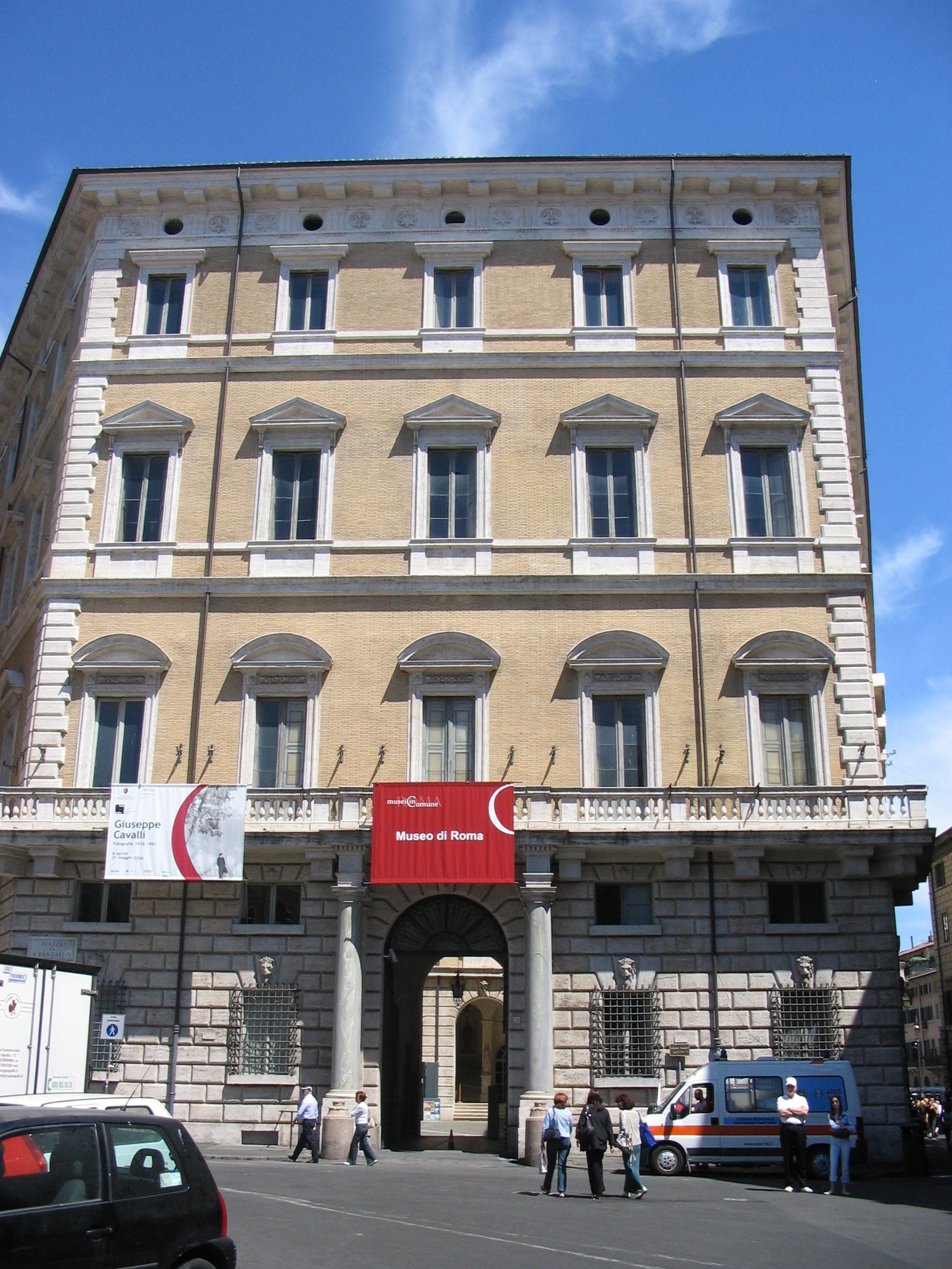
Palazzo Braschi is the 18th-century palace that the Superintendency describes as the home of Museo di Roma, designed by the architect Cosimo Morelli. It has two entrances: one on Piazza di San Pantaleo 10 and one on Piazza Navona. The courtyard, the monumental staircase and the decorated rooms are an integral part of the visit, even if you came only for Haring.
The network of civic museums
The show is part of the program published by the Musei in Comune portal, the system of civic museums of Roma Capitale that answers to the Capitoline Superintendency for Cultural Heritage. The museum services of the system are run by Zètema Progetto Cultura. That's why the access rules, reductions and reservations are those of the civic museums, with the single call center 060608.
What the show says about Keith Haring
The official presentation of the Keith Haring show boils down to one strong idea: Haring is the artist who made the line a public language, who brought the street into high art and who turned the image into a message anyone can understand. These are three steps worth keeping in mind while you walk through the rooms, because they give a simple and checkable key to reading in front of every work.
The line as public language
The first point is the mark. In Haring the black outline, thick and continuous, is not a detail of style: it's the very structure of the image. Look at how the line closes the figures and at the same time sets them in motion with a few short strokes that seem to vibrate around the bodies. It's a vocabulary you learn in five minutes and which, once learned, you can read from far away, at a glance. This is what makes the mark public: it doesn't ask for skills, it asks only that you look.
The street and high art
The second point is the most interesting for anyone visiting Rome. The presentation insists on the passage from the street to high art. Bringing this discussion inside a noble palace facing Piazza Navona means setting two ideas of public space against each other: the Baroque square, built for spectacle and for the crowd, and the contemporary street, where the image has to make itself understood fast by people who don't stop. In our view it's the best reason to see this show right here and not elsewhere.
The image as message
The third point is about communication. Haring's figures are built to reach everyone, without captions. The practical advice is simple: in front of each work, try to say in one sentence what is happening, before reading the panel. If you manage, the image has done its job. If you don't, the panel will explain why, and the second look will be different from the first.
X-Man, 1984: the image chosen for the Keith Haring show
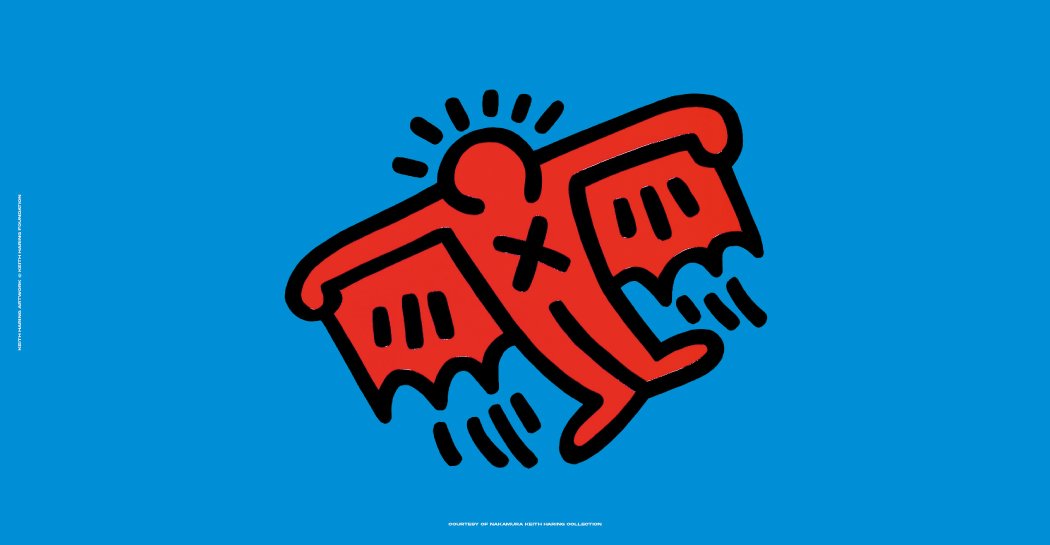
The guiding image of the Keith Haring show, published on the Musei in Comune portal, is X-Man, a work dated 1984. Two credits are printed on the official image: the wording Keith Haring Artwork with the copyright of the Keith Haring Foundation, and the formula Courtesy of Nakamura Keith Haring Collection. It's a sharp graphic choice, which says a lot about the tone of the show.
What the image looks like
On a solid light blue background stands a red figure with large wings, outlined by a thick black stroke. At the center of the body is a black X. Around the head, short dashes arranged in a radial pattern. Under the wings, other curved marks that suggest movement. The wings are marked with groups of vertical lines and end in a jagged edge. No perspective, no shadow: three colors, one outline, and the image reads from 50 meters away.
Why it works on an 18th-century palace
A red figure on a light blue background next to stucco, tempera and gilded frames creates an immediate visual friction. Contrast is the quickest way to spark attention. Here the contrast is not a special effect, it's the very theme of the show, which sets two opposite ways of speaking to the public against each other. Anyone who arrives with the idea that Haring is only light graphics usually leaves with a few more questions.
What the collection credit says
The formula Courtesy of Nakamura Keith Haring Collection concerns the guiding image. For the provenance of each exhibited work, the captions in the rooms are authoritative: that's where you read, work by work, who lent it. Reading them is a good habit, because it helps you understand how a show is put together and where the works in front of you come from.
A curiosity about Keith Haring at Museo di Roma in Palazzo Braschi, from October 6, 2026 to April 11, 2027
The subtlest curiosity concerns the very nature of the museum that hosts the show. The Superintendency describes Museo di Roma as the most significant institution for knowing the social history and artistic activities in Rome from the Middle Ages to the early 1900s. Its collections include paintings, drawings, sculptures, engravings, photographs, furniture, clothes, ceramics, carriages and sedan chairs, architectural elements and frescoes saved from demolitions. Put another way, it's the museum of the city seen by the city. And the official portal places the Haring show in the contemporary art category: a sharp leap from the chronological boundary of the collections.
The interesting point is that the leap is less wide than it seems. An important part of the museum's collections tells of feasts, ceremonies, life in the street. The Superintendency points precisely to the series of paintings made between the 1500s and 1800s to celebrate ceremonies and religious feasts, and to a collection of drawings, watercolors, engravings and photographs that documents the topography and social life of Rome. These are images born to record the public city, the city of processions and squares. A show devoted to an artist who made the street his natural space fits into this line more consistently than the name might suggest.
Then there's a practical detail that turns the curiosity into advice: the permanent collection is on the second and third floors of the palace. If you have the combined ticket, going up after the show lets you see, in the same hour, how Rome represented the crowd three centuries ago and how an artist of the second half of the 20th century represented it. It's the comparison no catalog can give you with the same immediacy.
Palazzo Braschi, the palace of Cosimo Morelli
Palazzo Braschi is an 18th-century palace designed by the architect Cosimo Morelli (1732-1812), according to the official entry of the Capitoline Superintendency. Today it is the home of Museo di Roma and, for six months, of the Keith Haring show. It deserves attention even just for the architecture: with the museum ticket you cross the courtyard, the staircase and the main floors.
The architect and the project
Morelli signs a palace of large scale, with two fronts that differ in character: Piazza di San Pantaleo, a few steps from Corso Vittorio Emanuele II, on whose side access by car and taxi now takes place, and Piazza Navona. Anyone who enters from one side and leaves from the other immediately perceives how the palace acts as a hinge between the traffic of the Corso and the open space of the square.
The monumental staircase
The most characteristic architectural element of the palace is the monumental staircase, on which Giuseppe Valadier (1762-1839) also worked, according to the Superintendency. Climbing it slowly is part of the visit: the proportions and the rhythm of the flights prepare you for entering the rooms better than any introductory panel.
The courtyard and the decorations
The palace has recently undergone complex renovation and restoration work, which has returned the splendor of the majestic architecture, the scenic courtyard, the refined stucco and the paintings of the rooms. Many rooms keep tempera decorations made between the late 1700s and the early 1800s. These are the walls that frame Haring's mark, by contrast.
A palace on three visiting floors
The official information on accessibility speaks of three visiting floors served by elevator. The permanent collection occupies the second and third floors. It's useful to know this before going in, to pace your energy: anyone who does show and museum on the same day walks through many rooms, and it's worth planning a break.
Museo di Roma: what it holds besides the Keith Haring show
Museo di Roma holds a collection that the Superintendency defines as the best account in images of the eternal city that you can see, with paintings, graphic works and photographs from the 1600s to the 1900s. Many works are displayed on rotation, so two visits months apart may show different things. With the combined ticket, the collection is the natural complement to the show.
Feasts, ceremonies and street life
The most recognizable core is the series of paintings made between the 1500s and 1800s to celebrate ceremonies and religious feasts. They are images of crowds, of ephemeral displays, of the city in festival. If the show has made you think about how an image speaks to people passing by, here you'll see how the painters called on to document Rome's public events did it.
Sculpture, graphics and photography
A remarkable core of sculptures illustrates the activity of some of the leading Roman artists. The collection of drawings, watercolors, engravings, antique books and historical photographs documents the history of graphic art in Rome and describes the topography and social life of the city. For those who love historical photography it's a section not to be underestimated.
Carriages, sedan chairs, clothes
Among the materials kept are also furniture, clothes, ceramics, carriages and sedan chairs. These are the objects kids like most, because they make the daily life of centuries ago concrete. With children, it's worth keeping them as the final reward of the visit.
Sala delle Muse
In Sala delle Muse a cycle of frescoes from the early 1500s, datable to around 1513, depicting Apollo and the Muses, is permanently displayed. The works are attributed to Gerino da Pistoia and come from the villa of Leo X at the Magliana, an old papal hunting lodge. They were detached from the original walls in the 1800s for reasons of conservation and stayed for decades in the museum's storerooms, before the permanent display.
A portrait by Pompeo Batoni
Among the masterpieces that the Musei in Comune portal associates with Museo di Roma is the Portrait of John Staples by Pompeo Batoni, a painter born in Lucca in 1708 and died in Rome in 1787. It's a good example of portrait painting in 18th-century Rome, which the museum documents alongside the views and the festival scenes.
The documentation center
In the museum's multimedia documentation center you can consult the database of the entire collection. It's a tool meant for scholars, but the curious visitor can also benefit from it, especially to understand how vast the holdings are that find no room in the galleries.
One thing nobody tells you about Keith Haring at Museo di Roma in Palazzo Braschi, from October 6, 2026 to April 11, 2027
What almost nobody says, and what causes problems every week for people organizing group outings, has to do with audio guides. The official conditions of the show are clear: groups, from 5 to 25 people plus the guide, enter only with a free reservation at 060608 and with the advance purchase of at least 5 tickets. For non-school groups, access to the show space is subject to the mandatory use of audio guides, to be rented independently. And the museum writes it plainly: the Museum has no audio guide rental service.
Translated into practice: if you arrive with a group of friends, a club, an association or a class of adults without bringing the receivers, you don't get into the show as a group. You have to get the kit beforehand, from an outside supplier, and show up already equipped. For group guided visits organized by the museum, up to 25 people, the cost is €90 on top of the tickets, and there too the audio guide requirement applies. For schools the audio guide requirement is not stated, but the reservation remains mandatory.
Second little-known thing: the palace has two entrances, and they are not equivalent for everyone. The accessibility indications explain that access with a private car or taxi is from Piazza San Pantaleo side, while wheelchair users can enter from both sides. If you get dropped off by taxi, ask therefore for Piazza di San Pantaleo and not Piazza Navona.
Third and last: tickets bought online, at the call center or at the box office are non-refundable and cannot be changed. With a six-month show there's no rush to buy weeks ahead: better to fix the date when you're sure.
Tickets for the Keith Haring show: fares and reductions
The show-only ticket for Keith Haring costs €17 full price and €15 reduced. The combined ticket with the permanent collection of Museo di Roma costs €25 full price and €19 reduced for non-residents. Presale adds €1. These are the figures published by the official ticket page of Musei in Comune, which is always worth rechecking before you leave.
Show only or combined?
The math is simple. The museum-only ticket, without the show, costs €13 full price and €7.50 reduced. Show plus museum bought separately would come to €30 full price and €22.50 reduced. The combined costs €25 and €19. You save €5 on full price and €3.50 on reduced. If you have at least one more hour, the combined is the right choice: the collection on the second and third floors is the best possible counterpoint to the show.
The family rate
This is the real bargain of this show. The special show-only family rate costs €22 for two adults with children under 18, and €11 for one adult with children under 18. It can be booked only through 060608 (from 9:00 to 19:00) or at the box office of the exhibition space of Museo di Roma in Palazzo Braschi. On the same day you pay at the box office in cash or by card with no presale. For later days you book at the box office by credit card with a €1 presale. For a couple with two teenage children, the difference compared with single tickets is huge.
Who is entitled to the reduced rate
The reduced rate applies to citizens of the European Union from 6 to 25 years old and over 65, to working teachers, to journalists with a document certifying the profession, to holders of a valid MIC card and to holders of a valid 48 or 72 hour Roma Pass. The documents that entitle you to the reduction must be shown at access control. If you don't meet the requirements, you pay the difference at the box office.
Who gets in free
Free admission applies to children under 6, to a person with a disability and one companion, to licensed European Union tour guides and interpreters, to ICOM members and ICOMOS associates, to members of cultural institutes such as Accademia dei Lincei and Istituto di Studi Romani, to the Friends of the Museums of Rome and to ICCROM. The free ticket is requested by contacting 060608.
Rome residents and the MIC card
Since February 2026, admission to the paid civic museums is free for residents of Rome and the Metropolitan City, by showing an ID card at the cash desk. Be careful, though: the free admission applies to the museum, while the show has its own fares, and the combined fares are published as fares for non-residents. The MIC card costs €5, lasts 12 months, gives free admission to the Museum System and discounts on shows with a separate ticket office. For Haring that means the reduced rate. For a Roman who goes to the civic museums, it's the smartest expense of the year.
Where to buy them
Online, on the presale circuit indicated by the official Musei in Comune website, for a fixed date. At the call center 060608, every day from 9:00 to 19:00. At the museum box office: for the same day in cash or by card with no presale, for later days only by credit card and with €1 presale. At the entrance, just show the purchase receipt, printed or on your phone screen.
Hours and closing days of Palazzo Braschi
The permanent collection of Museo di Roma is open Tuesday to Sunday from 10:00 to 19:00, with last entry one hour before closing. The closing days are Monday, May 1 and December 25. On December 24 and 31 the hours are reduced, from 10:00 to 14:00. For the Keith Haring show it's always worth checking the hours published by Museo di Roma and the notices page, which the civic museums recommend consulting before every visit.
Monday, watch out
Monday is Museo di Roma's closing day. It seems trivial, but you often see disappointed visitors in front of the portal on a Monday morning. If you're in Rome for a long weekend, put Palazzo Braschi on Saturday or Sunday, or on Tuesday.
The end-of-year holidays
The show runs through Christmas and New Year's. On December 25 the museum is closed, and on December 24 and 31 it closes at 14:00. For January 1, 2027 the hours the museum will publish are authoritative. In 2026 New Year's Day had special hours from 11:00 to 20:00.
The call center
060608 answers every day from 9:00 to 19:00. It's the number for group reservations, the family rate, free tickets and information. The museum also has an email address, museodiroma@comune.roma.it.
My advice for visiting Keith Haring at Museo di Roma in Palazzo Braschi, from October 6, 2026 to April 11, 2027
The advice is clear: get the combined ticket, go in on a weekday morning, and do the show first. Then go up to the second and third floors. Here's why.
First, the combined ticket. For non-residents the difference is €5 on full price compared with separate tickets, and in return you get a second visit that gives sense to the first. Haring alone is a good show. Haring followed by the paintings of Roman feasts and ceremonies in Museo di Roma becomes a lesson in how images speak to the crowd. No other venue in the city offers you this comparison with a single ticket.
Second, a weekday morning. Palazzo Braschi is among the civic museums most chosen by the public: at the Notte dei Musei 2026 it counted about 7,000 visitors, second only to the complex of the Capitoline Museums and the Campidoglio. A show on such a recognizable name will draw a lot of people, especially on weekends and during school vacations. Tuesday and Wednesday mornings, after the 10:00 opening, are the times when you look best.
Third, the order. Doing the show first, with a fresh eye, and then the permanent collection lets you reach the historic rooms with a question in mind: how do you represent the city as it passes by? It's an exercise that makes the museum visit far more alive than a courtesy walk among old paintings.
Finally, the ticket. If you're not a resident and don't have a MIC card, buy the fixed-date ticket online only when you're sure of the day, because tickets are non-refundable. If you're a resident, consider the €5 MIC card: it gives you the reduced rate at the show and a year of free civic museums.
How to get to Palazzo Braschi for the Keith Haring show
Palazzo Braschi is in the Parione district, between Piazza di San Pantaleo, a few steps from Corso Vittorio Emanuele II, and Piazza Navona. The best way to get there is on foot from the historic center, or by bus to the stops on Corso Vittorio Emanuele II and Corso del Rinascimento, which are about 100 meters from the entrance.
On foot
From Piazza Navona the entrance is immediate: the museum has an access on the square. From Campo de' Fiori it's about 200 meters as the crow flies, from the Pantheon less than 400, from Largo di Torre Argentina about 400. The historic center is easy to cross on foot, and it's the most pleasant way to arrive at a show that is all about the street and public space.
By bus
The nearest ATAC stops are C.so Vittorio Emanuele/Navona, about 90 meters from the museum, and C.so Vittorio Emanuele/S. A. della Valle, about 110 meters, both on Corso Vittorio Emanuele II. On Corso del Rinascimento there are the Rinascimento stops, a little over 100 meters away. A little farther, on the north side of Piazza Navona, is the Senato stop, in Piazza delle Cinque Lune. The lines serving each stop and their schedules need to be checked on the public transport company's information service before you leave, because in the historic center routes can change because of works and events.
By tram
The nearest tram stop is Arenula/Cairoli, in Piazza Benedetto Cairoli, about half a kilometer as the crow flies. From there you reach the museum on foot, heading north, in about 10 minutes at an easy pace.
By metro
No metro station is a short distance away. The Spagna station on line A is more than a kilometer as the crow flies. From there it's best to continue on foot through the center, or by surface bus.
By taxi or car
The taxi is the most comfortable solution for anyone who has trouble walking. Ask to be dropped off in Piazza di San Pantaleo: the official indications specify that access by private car or taxi is from that side. A private car in the historic center is not advisable for anyone without a specific reason: parking is scarce and the access rules for the limited traffic zones need to be checked before leaving.
Another well-known fact, yet rarely mentioned
Plenty of people know that Palazzo Braschi is a museum much loved by Romans. What is rarely cited is the numbers. At the Notte dei Musei di Roma 2026, the 16th edition of the event, the civic museum system welcomed about 50,000 visitors out of a citywide total of about 80,000. Among the most chosen destinations were the Capitoline Museums with the Campidoglio, with about 8,000 visitors, and right after them Museo di Roma in Palazzo Braschi, with about 7,000. Next come Trajan's Markets, with about 3,500 visitors, and Museo dell'Ara Pacis, with about 3,000.
The figure says two things. First: Palazzo Braschi is not a niche museum, even if it appears less than the big names in tourist guides. When the city opens its doors at night, Romans choose this palace in droves, maybe for the appeal of the entrance from Piazza Navona, maybe out of curiosity to see the museum devoted to their own city. Second: with a show like the one on Keith Haring, a name that draws a broad and cross-cutting public, the busiest days will be really full.
There's also a trend figure to keep in mind. The Notte dei Musei went from about 73,000 visitors in 2024 to 78,000 in 2025 and to about 80,000 in 2026. The audience of the civic museums is growing, and it's growing among young people too, whom the same official note reports as very present. For anyone organizing a visit, the conclusion is practical: don't underestimate the weekend lines and pick weekdays when you can.
Groups, schools and guided visits to the Keith Haring show
For groups the Keith Haring show has precise rules: from 5 to 25 people plus the guide, mandatory free reservation at 060608, advance purchase of at least 5 tickets and, for non-school groups, mandatory audio guides to be rented independently, because the museum doesn't provide them. The remaining tickets can be settled on site at the time of the visit.
Guided visits for groups
The museum organizes guided visits for groups of up to 25 people, with mandatory audio guides, at a cost of €90 on top of the ticket price. Reservation is mandatory at 060608, active every day from 9:00 to 19:00. There is also a reservation service for groups that does not include the guided visit and that lets you skip the line at the box office.
Schools
The special school rate for the show alone is €4 per student, with free admission for one accompanying teacher for every 10 students, bookable only at 060608. Guided visits for schools, up to 30 people, cost €70 on top of the tickets, and are free for schools in Rome and the Metropolitan City while the offer lasts. For schools the reservation is free and mandatory even for admission alone.
Advice for groups
If you're accompanying a group of adults, settle the audio guide question well in advance and confirm the updated conditions with 060608. Anyone who works with groups knows it: a visit falls through more often because of a logistical detail than a serious problem. If you prefer to hand the organization to professionals, agencies specialized in private and corporate tours handle reservations, audio guides and guide in a single package.
Accessibility: visiting Palazzo Braschi with a disability
Museo di Roma in Palazzo Braschi declares itself fully accessible from the mobility point of view, and admission to the museum for people with disabilities and one family member or companion is free. For the show, free admission for the person with a disability plus one companion is also stated in the show-only fares.
Mobility disability
The museum has two entrances, on Piazza di San Pantaleo 10 and on Piazza Navona. Wheelchair users can enter from both. On the ground floor a stairlift, with a maximum load of 300 kilograms and a platform of 64 by 78 centimeters, lets you get past the few steps and reach the elevator that serves the three visiting floors. The museum provides a wheelchair to request from the reception staff, along the route there are seats for resting, and the restroom for people with mobility disabilities is on all three floors.
Visual disability
In the courtyard, to the right of the museum entrance, there is a tactile orientation map. Tactile teaching aids and tactile copies, permanent or available on request, give tactile access to some of the most important works in the collection.
Hearing disability
The official information reports a dedicated station near the entrance. For details on the services available during the show, it's best to call 060608 before the visit.
The right photo to take at Keith Haring at Museo di Roma in Palazzo Braschi, from October 6, 2026 to April 11, 2027
The right photo, here, is not the one inside the show. It's the one that tells the dialogue between Haring's mark and the palace that hosts it. It's worth photographing the monumental staircase, the one Giuseppe Valadier worked on, from the bottom of the first flight, looking for the receding flights going up. If among the visitors there's someone with a T-shirt, a bag or a card with the image of the show, that red spot on the pale stone is worth more than 100 shots of the rooms.
Second option: the courtyard, which the Superintendency calls scenic and which the recent restoration has returned to its original quality. Stand in a corner and look for a diagonal that takes in the windows of the upper floors. It's a photograph that explains by itself why this palace is an exceptional venue for a contemporary show.
Third option, for those who enter from Piazza Navona: leave the museum on that side and photograph the square from the exit. It's an image of Rome with few equals, and it closes well the story of a day devoted to an artist who put public space at the center of his work.
A practical note: the rules on photographs in temporary shows can depend on agreements with lenders. Before shooting in the room, ask the staff if photographs are allowed and if the flash is banned. In the permanent collection, likewise, check the notices at the entrance. Respecting these rules is the best way to keep seeing loaned works in Rome.
Keith Haring with children: how to organize the visit
The Keith Haring show is one of the few contemporary art shows that really work with children, and the family rate of €22 for two adults with children under 18, or €11 for one adult with children, makes it affordable too. Children under 6 get in free.
Why the little ones like it
Haring's mark is readable without explanations: thick outlines, solid colors, figures in motion. Children recognize the shapes right away and start telling what is happening. The adult's role is to ask questions rather than give answers: what is this figure doing? Why does it have wings? What do those dashes around the head mean?
A game to play in the room
Give each child a simple task: find three works in which someone is moving, two in which more than one figure appears, one with a color you don't see in the others. The game keeps attention and teaches looking. At the end of the visit, ask them to draw from memory the work they liked most using just one color and a black marker.
After the show
With the combined ticket, on the second and third floors there are carriages, sedan chairs and antique clothes: objects kids like a lot. If the little ones are tired, instead, Piazza Navona is a few steps away: an open space to stretch your legs before heading back.
Stroller and services
The museum has an elevator for the three visiting floors, reached after a stairlift on the ground floor. If you arrive with a stroller, you're right to ask at the entrance for the most comfortable route.
Some important events that happened here in history
The history of Palazzo Braschi can be read in its walls and its collections. Here are some events documented by the Capitoline Superintendency and by Musei in Comune.
The first is the construction. The palace is 18th-century and was designed by Cosimo Morelli, an architect who lived between 1732 and 1812. Giuseppe Valadier also worked on the monumental staircase, the building's most characteristic element. Many rooms received tempera decorations between the late 1700s and the early 1800s. These are the walls you still see today going up to the museum's floors.
The second concerns a cycle of frescoes that arrived here from far away. Around 1513 a painter attributed to Gerino da Pistoia painted Apollo and the Muses in the villa of Leo X at the Magliana, a hunting lodge of the popes. In the 1800s the frescoes were detached for reasons of conservation, stayed for decades in the storerooms of Museo di Roma and are now permanently displayed in Sala delle Muse. It's an example of how the museum has safeguarded pieces of heritage that would otherwise have risked being lost, as the presence in the collections of frescoes and architectural elements saved from demolitions also shows.
The third is the recent season. The palace underwent complex renovation and restoration work that returned the splendor of the architecture, the courtyard, the stucco and the paintings. Since February 2026 admission to the museum is free for residents of Rome and the Metropolitan City. In May 2026, during the Notte dei Musei, the palace welcomed about 7,000 people in a single evening. For June 23, 2026 Musei in Comune announced at Palazzo Braschi a reading by Franco Nero devoted to the Magliana frescoes.
The last event is the opening, on October 6, 2026, of the Keith Haring show: the mark of an artist of the second half of the 20th century enters the palace that tells the story of the city from the Middle Ages to the early 1900s.
Who has passed through Keith Haring at Museo di Roma in Palazzo Braschi, from October 6, 2026 to April 11, 2027
Architects, painters, actors and an ever larger public have passed through Palazzo Braschi. Some names are tied to the birth of the building, others to its life as a museum.
Cosimo Morelli, the architect who designed the palace in the 1700s, is the first name to remember: the design of the building is his. Giuseppe Valadier, who lived between 1762 and 1839, put his hand to the monumental staircase, which the Superintendency identifies as the palace's most characteristic architectural element.
Among painters, the museum holds the Portrait of John Staples by Pompeo Batoni, born in Lucca in 1708 and died in Rome in 1787. The frescoes attributed to Gerino da Pistoia, which came from the villa of Leo X at the Magliana, bring early 1500s painting to Palazzo Braschi.
Among today's protagonists, Musei in Comune announced for June 23, 2026, at 16:00, a reading at Palazzo Braschi by the actor Franco Nero, called on to give voice to the verses of Gabriele Tinti inspired by the frescoes of Apollo and the Muses, as part of a poetry residency by Tinti in Musei in Comune, supported by Cinecittà in collaboration with Palazzo delle Pietre. The first stage of the same project was entrusted to Abel Ferrara, on June 18, in the courtyard of Palazzo Nuovo of the Capitoline Museums, with poems devoted to the talking statues.
And then there are the visitors: about 7,000 in a single night in May 2026. From October 6, 2026 the works of Keith Haring are added, along with the public who will come to see them.
Around Palazzo Braschi: what to see in the Parione district
Palazzo Braschi is in the Parione district, one of the densest stretches of the historic center. Within a few minutes' walk there are squares, churches, museums and palaces that deserve a stop before or after the Keith Haring show. Here is a selection for those with half a day.
Pasquino
On Piazza di Pasquino, about 60 meters from the museum, stands the talking statue of Pasquino. It was precisely to Rome's talking statues, which Musei in Comune describe as forgotten by citizens and tourist itineraries, that Abel Ferrara's reading at the Capitoline Museums in June 2026 was devoted. It's worth stopping for a minute.
Piazza Navona
Piazza Navona is a couple of steps away: the museum has an entrance right on the square. In the center is the Fontana dei Quattro Fiumi, on the west side the church of Sant'Agnese in Agone. In the surroundings you can also visit the underground remains of the Stadium of Domitian.
Museo Barracco
The Museo di Scultura Antica Giovanni Barracco is at Corso Vittorio Emanuele II 166/A, at the corner with Via dei Baullari, about 50 meters as the crow flies from Palazzo Braschi. It's part of the same system of civic museums. Until November 15, 2026 it hosts the show Divina d'Acciaio, devoted to the portrait statue of Maria Callas.
Campo de' Fiori and Palazzo della Cancelleria
Crossing Corso Vittorio Emanuele II you reach Campo de' Fiori in a couple of minutes, about 200 meters away. About 100 meters from the museum, toward Via del Pellegrino, is the Palazzo della Cancelleria.
The Pantheon and Palazzo Altemps
Toward the east, less than 400 meters away, is the Pantheon. Toward the north, beyond Piazza Navona, is Palazzo Altemps, in Piazza di Sant'Apollinare, a little over 400 meters away. They are two visits that combine well with Palazzo Braschi in a day entirely on foot.
Where to eat near Palazzo Braschi
Eating well around Piazza Navona is possible, but it takes a minimum of method. The advice is always the same: avoid the tables with a direct view of the square, where you mostly pay for the panorama, and move one or two streets into the interior of the district.
Quick lunch
Between Campo de' Fiori and Corso Vittorio Emanuele II there are bakeries, pizza by the slice shops and small stand-up lunch spots. For those doing show and museum on the same day, a light lunch between the two visits is the best choice: a pizza bianca, a supplì, a glass of water, and off you go.
Trattorias and osterias
In the side streets of Parione and the nearby districts you find trattorias serving Roman cuisine. Pick the ones with a short menu, written in Italian and changed with the season: they are more reliable clues than any sign. Always ask what the dish of the day is, and trust whoever proposes it without hesitation.
A coffee before going in
Having a coffee at the counter, before the 10:00 opening, is the best way to be among the first at the box office. At the counter, usually, a coffee costs less than at a table, and it's the choice of those in a hurry.
Autumn and winter in Rome: the period of the Keith Haring show
The Keith Haring show opens in a special week for the civic museums: from October 6 to 11, 2026 the Tevere Day takes place, with activities devoted to the dialogue between the river and the city. It's also the period in which Rome offers a notable concentration of shows, which you can combine with Haring on the same trip.
Shows on now in the civic museums
At the Capitoline Museums, until December 13, 2026, the show Diego Rivera e la costruzione dell'arte moderna in Messico nel XX secolo is open, which Musei in Comune present as the first held in Italy on Diego Rivera. At the Museo di Roma in Trastevere, until December 6, 2026, there is Fulco Pratesi. Acquerelli Pionieri. At Centrale Montemartini, until November 15, 2026, Moda in luce 1955-1975. Roma fra glamour e innovazione industriale.
The weather
For me October is the best month to walk in the center of Rome. In the colder months the days get shorter and a museum visit becomes the ideal plan for an uncertain afternoon. Toward April, when the show closes, the center fills with visitors again. If you can, don't leave it to the last week.
The Christmas holidays
Between December and Epiphany the show will be very busy with families and visitors on vacation. Keep in mind the closures and reduced hours on December 24, 25 and 31, and use the family rate, which is booked at 060608.
How to organize your visit to the Keith Haring show
A complete visit to the Keith Haring show and the permanent collection of Museo di Roma takes between two and three hours. For the show alone, an hour and a half is a reasonable measure, to be stretched if you like reading the panels at leisure.
Half a day
Arrive at 10:00, do the show, go up to the permanent collection, and come out on Piazza Navona around 12:30. A light lunch in the district, and the afternoon is free for the Pantheon, Campo de' Fiori or Museo Barracco.
A whole day
Morning at Palazzo Braschi, lunch, then a second civic museum: the Barracco is a few steps away, and the Capitoline Museums with the Diego Rivera show can be reached on foot through the center. If you have the MIC card, both fall under the same subscription logic.
The audio guide and the virtual tour
For the permanent collection an audio guide is available in Italian, French and English at €4, bought at the box office and handed over sanitized in a sealed bag with a single-use earpiece. Before the visit, or after, you can explore the virtual tour of Museo di Roma, one of the eight virtual tours of the civic museums. It also includes drone footage, which shows rooms and works from above and offers an unusual perspective on the palace and the city.
Official information
Before leaving, check the Musei in Comune page on tickets and audio guides, the page on hours and addresses and, if needed, the page on accessibility. They are the reference sources for fares, hours and services.
Frequently asked questions about Keith Haring at Palazzo Braschi
When can you see the Keith Haring show in Rome?
The Keith Haring show at Museo di Roma in Palazzo Braschi is open from October 6, 2026 to April 11, 2027. The museum is closed on Monday, May 1 and December 25. On December 24 and 31 it closes at 14:00. The permanent collection is open Tuesday to Sunday from 10:00 to 19:00, with last entry one hour before.
How much is the ticket for Keith Haring at Palazzo Braschi?
The show-only Keith Haring ticket costs €17 full price and €15 reduced. The combined ticket with the permanent collection of Museo di Roma costs €25 full price and €19 reduced for non-residents. Anyone who buys in presale pays €1 more. Children under 6 get in free.
Is there a rate for families?
Yes, the Keith Haring show has a special family rate: €22 for two adults with children under 18, €11 for one adult with children under 18. It's booked only at 060608, from 9:00 to 19:00, or at the box office of the exhibition space of Palazzo Braschi.
Do Rome residents get into the Keith Haring show free?
At Museo di Roma, residents of Rome and the Metropolitan City get in free since February 2026, by showing their ID card. The Keith Haring show, instead, has its own fares, and residency doesn't appear among the free categories. With the MIC card, which costs €5 and is valid for 12 months, you pay the reduced rate for the show.
Where is Palazzo Braschi and where do you enter?
Palazzo Braschi, home of Museo di Roma, is at Piazza di San Pantaleo 10, with a second entrance on Piazza Navona, in the Parione district. Those arriving by taxi or car enter from Piazza San Pantaleo side. Wheelchair users can enter from both sides.
How do you get to Museo di Roma by public transit?
Museo di Roma in Palazzo Braschi is served by the ATAC stops C.so Vittorio Emanuele/Navona and C.so Vittorio Emanuele/S. A. della Valle, on Corso Vittorio Emanuele II, and by the Rinascimento stops, all about 100 meters away. The tram stops at Arenula/Cairoli, about half a kilometer away. The nearest metro, Spagna, is more than a kilometer away.
Is the Keith Haring show wheelchair accessible?
Museo di Roma in Palazzo Braschi declares itself fully accessible for people with mobility disabilities: a stairlift on the ground floor leads to the elevator that serves the three floors, accessible restrooms are on all floors, and you can ask for a wheelchair at the reception. The person with a disability and one companion get in free.
Can you visit the Keith Haring show as a group?
Groups at the Keith Haring show, from 5 to 25 people plus the guide, enter only with a free reservation at 060608 and advance purchase of at least 5 tickets. For non-school groups the audio guides are mandatory and must be rented independently, because the museum doesn't offer the service. The group guided visit costs €90 plus the tickets.
The final advice
Many high-profile shows fill the rooms without leaving a trace. This one has one more chance, and it owes it to the venue: Haring's mark, born to speak to people passing by, placed in front of the paintings that for centuries told of Rome's feasts and crowds. Don't waste it. Get the combined ticket, go on a Tuesday morning, do the show at your own pace, then go up to the second floor and look for the images of the city at festival. When you step out onto Piazza Navona, you'll look at the crowd with different eyes. If you want someone to organize the visit for a group, a company or guests of honor, turn to professionals who know these spaces and can handle reservations and audio guides without surprises.
Article written by the editorial team of Tour Leader Pro, contact them for Private/Corporate/V.I.P. Tours and Experiences.
Planning a trip to Rome? The English-language guides to visiting the city are on ItalyPlanner.com.