Junctions Beyond Jazz: Le frontiere dell’arpa at Casa del Jazz, November 29, 2026
https://www.estateromana.com/en/rome/trip-planner/junctions-beyond-jazz-le-frontiere-dellarpa-at-casa-del-jazz-november-29-2026/
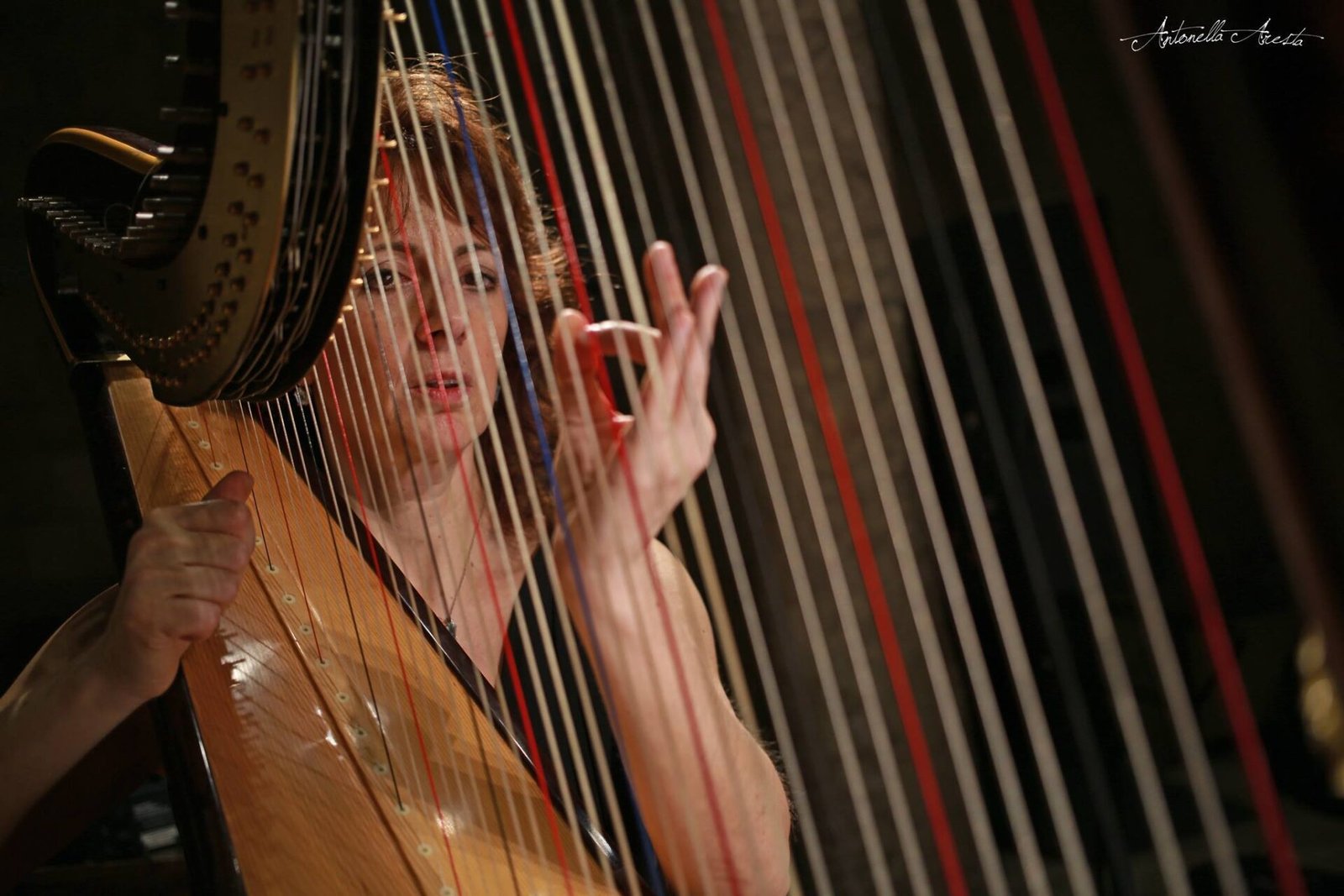
On Sunday, November 29, 2026, at 12:00 harpist Lucia Bova plays Le frontiere dell'arpa, a concert for harp and electronics in the Junctions Beyond Jazz series, in the Armando Trovajoli concert hall of Casa del Jazz, at Viale di Porta Ardeatina 55, in Rome. You get there on metro B to Piramide and then on foot along the Aurelian Walls, or on bus 714 to the Colombo/Marco Polo stop. If you come by car there's a parking lot next to the villa. There's a single ticket price of 15 euros, according to the official Casa del Jazz page, bought from the venue's official website, which links to the presale circuit authorized by the organizers. The program includes music by Å. Parmerud, K. Saariaho, T. Hosokawa, J. Dashow, V. Sannicandro and S. Lo. The organizers warn that it may change.
Le frontiere dell'arpa at a glance: date, time, hall, price
Le frontiere dell'arpa is a solo concert by Lucia Bova, scheduled for Sunday, November 29, 2026, at 12:00 at Casa del Jazz, with a single 15-euro ticket.
The essentials
The concert is part of Junctions Beyond Jazz, the Casa del Jazz series that the cultural portal of Roma Capitale presents as a journey through the avant-garde, memory and experimentation, from March 15 to December 13, 2026. It's played in the Armando Trovajoli concert hall, the villa's main hall. It's curated by Fondazione Musica per Roma, which runs Casa del Jazz together with Auditorium Parco della Musica. For information the Fondazione gives the number 06 80241281 and the address info@musicaperroma.it.
What you'll hear
The venue presents the concert as proof of how versatile and surprising an instrument the harp is. The announced program lines up six composers of today's music: Parmerud, Saariaho, Hosokawa, Dashow, Sannicandro and Lo. These are names that rarely appear on Sunday morning programs, and that's exactly the reason to go.
Who it's for
For lovers of contemporary music, of course. But also for those who know the harp only from orchestras or Christmas concerts and want to discover what happens when the instrument meets electronic sound. A noon hour, in a small hall, is the best setting for a first listen of this kind.
What Lucia Bova's Le frontiere dell'arpa is
Le frontiere dell'arpa (The frontiers of the harp) is a recital for harp and electronics: the acoustic instrument converses with sounds produced or transformed by technology, in a program devoted entirely to contemporary composers.
Harp and electronics
The harp is an ancient instrument, with a literature spanning the centuries, and Lucia Bova has written its history in a whole book. In the 20th century and in these first decades of the new century, composers have sought in the harp timbres the tradition didn't know: percussive sounds, harmonics, rubbed or muted strings, prolonged resonances. Electronics amplify this research, capture the instrument's sounds and give them back transformed, or set them alongside a recorded part. The result, for the listener, is a harp that seems bigger than itself.
The hidden face of the instrument
The key to the program lies in a title Lucia Bova used for an essay of hers, written with engineer Graziano Tisato of the Centro di Sonologia Computazionale of the University of Padua for the journal Sonus: La faccia nascosta dell'arpa (The hidden face of the harp), a journey through the timbral space of new performance techniques. The November 29 concert is the live version of that research, with the performer who knows it best.
James Dashow, a composer close to home
Among the six composers on the program is James Dashow, who has written expressly for Lucia Bova and whose works the harpist has premiered. The American label Capstone released a DVD of Dashow's music in which Bova plays in a quartet with Manuel Zurria, Paolo Ravaglia and David Bursack, on flutes, bass clarinet and viola respectively. Hearing Dashow played by her means hearing a repertoire born from a direct working relationship between composer and performer.
A program that may change
The venue warns that the program may change: the order of the pieces, the exact titles and the length aren't published. That's normal for contemporary music recitals, where the final choice also depends on the technology available in the hall. If you want to prepare you can look up recordings of the announced composers in advance.
Lucia Bova: the harpist's biography
Lucia Bova is an Italian harpist specializing in 20th-century and contemporary repertoire, holder of the Harp chair at Conservatorio Ottorino Respighi in Latina and a teacher on the second-level Master's in Interpretation of Contemporary Music at Conservatorio Santa Cecilia in Rome.
Training between Italy and Nice
After completing her music studies in Italy at a very young age, Lucia Bova spent two years in Nice, where at the city's conservatory in 1990 she earned the French harp diploma with the Premier Prix à l'Unanimité, under Elizabeth Fontan-Binoche. In the same years she studied the contemporary solo harp repertoire with Ursula Holliger. It's a double training that explains a lot: the French school of the harp, with its tradition of sound, and openness toward new music.
The orchestra years
From 1989 to 1992 she was principal harp of the Orchestra Alessandro Scarlatti of RAI in Naples. From 1994 to 1996 she worked, again as principal harp, with the Orchestra Sinfonica dell'Emilia Romagna Arturo Toscanini in Parma, also performing as a soloist at the city's Teatro Regio. From 1998 to 2005 she played with the Orchestra Roma Sinfonietta, in particular in the concerts conducted by Ennio Morricone in Italy, in Verona, Milan, Florence, Lecce, Pesaro, Naples and Rome, and abroad, in London, Paris, Tokyo, Osaka, Lisbon, Bilbao and Athens.
Morricone and the Due pezzi modali
The relationship with Morricone didn't stop at the orchestra stand. For him Lucia Bova recorded the Due pezzi modali for solo harp, which the composer wrote expressly for her. For a city that has named its Auditorium after Morricone, run by the same Fondazione that manages Casa del Jazz, it's a link worth remembering.
Contemporary music ensembles
Lucia Bova works with ensembles specializing in today's music: Ensemble Alter Ego, Ars Ludi, PMCE and Ensemble Dissonanzen of Naples. With the latter she recorded a monographic album of music by Hans Werner Henze, released in 2008 by the American label Mode Records.
Halls and festivals
Her résumé lists Fondazione Berio in Rome, Teatro La Fenice in Venice, Nuovi Spazi Musicali, RomaEuropa Festival, the American Academy in Rome, Nuova Consonanza, Musica Verticale, the Cantiere Internazionale d'Arte in Montepulciano, the Festival delle Nazioni in Città di Castello, the Sagra Musicale Malatestiana, the Società dei Concerti in Milan, Radio Rai3's concerts at the Quirinale Palace and even Umbria Jazz in 1996. She has played in France, Germany, Romania, the United States, Bethlehem and Tel Aviv, and has given recitals at the Warsaw Autumn Festival, the Reina Sofía Museum in Madrid, several American universities and for the Italian Cultural Institutes in Montreal and New York. In May 2009 she made her debut at the International Rio Harp Festival in Rio de Janeiro.
Premieres
Many composers have written for her. Her résumé mentions Fernando Mencherini, James Dashow, Claudio Ambrosini, Fausto Razzi, Fabrizio De Rossi Re, Eric Chasalow, Bill Smith, Maurizio Giri, Bruce Saylor, Gianluca Podio, Federico Biscione, Andrea Marena, Alessandra Bellino, Fabio Cifariello Ciardi and Giovanni Sollima. It's a list that alone tells 30 years of new Italian and American music.
Recordings
She has recorded as a soloist and in ensembles for EMI, BMG Ricordi, Universal, EDI-Pan, Capstone Records, Neuma, Label Bleu, Pro-Viva, Edizioni Musicali Valdom, RAITrade, Parco della Musica Records and Stradivarius. In 2002 Edizioni Bongiovanni released her album Il Settecento colto e galante, devoted to an unpublished or little-known repertoire for solo harp. With the Polimnia Ensemble she recorded an album of 19th-century Russian composers issued with the magazine Musicalia in 2001. She has been a guest, live or recorded, on Rai Radio Tre and Vatican Radio.
The Modern Harp, the book
At the end of 2008 Edizioni Suvini Zerboni published her book L'arpa moderna. La scrittura e la notazione, lo strumento e il repertorio dal '500 alla contemporaneità, with a preface by Luis de Pablo. The volume has been adopted in several conservatories as a textbook for the specialist two-year courses and in 2016 it came out in English, again from Suvini Zerboni, as The Modern Harp, translated by Brent Waterhouse. In September 2026 Conservatorio Pietro Mascagni in Livorno devoted three events to her: a masterclass in composition for harp, the presentation of the book and a concert in the Suoni Inauditi series.
The Junctions Beyond Jazz series at Casa del Jazz
Junctions Beyond Jazz is Casa del Jazz's Sunday series, with noon concerts in the Sala Armando Trovajoli, devoted to musicians who start from jazz or pass through it to go elsewhere.
The autumn Sundays
In autumn 2026 the series has three dates announced by the venue: on October 18 Lyrica, a work by double bassist Massimo Ceccarelli. On November 29 Le frontiere dell'arpa with Lucia Bova. On December 13 the Accademia Brass Quintet, which closes the series. Double bass, harp, brass quintet: the line is clear, instruments usually heard elsewhere, brought into a hall born for jazz.
Why a harp at Casa del Jazz
Some may wonder what a contemporary music recital has to do with a house devoted to jazz. More than it seems: improvisation, research into timbre, the use of electronics are common ground. And Lucia Bova's résumé includes an appearance at Umbria Jazz. The series, after all, has jazz in its title precisely to declare that it wants to go beyond it.
Casa del Jazz in the Roman calendar
During the year the venue alternates the summer season of Summertime alla Casa del Jazz, the autumn concerts and some evenings of the Roma Jazz Festival in November. Junctions Beyond Jazz is the most experimental item on the program and, given its time slot, the most convenient.
Casa del Jazz: the villa given back to the city
Casa del Jazz is at Viale di Porta Ardeatina 55, inside Villa Osio, and is run by Fondazione Musica per Roma. It was born from the confiscation of the villa that belonged to Enrico Nicoletti, identified as a member of the Banda della Magliana.
From confiscation to music
The confiscated villa was assigned to the City of Rome and, at the wish of the administration led by Walter Veltroni, turned into a center devoted entirely to jazz. At the entrance a plaque with the names of mafia victims, made with Don Luigi Ciotti's association Libera, gives the civic meaning of the operation. Whoever comes in for a concert enters a place taken away from crime and given back to the city: it's worth keeping in mind even at noon on a Sunday.
The villa and the park
Villa Osio covers about 2,500 square meters and is surrounded by a park of more than 25,000 square meters, open from dawn to dusk. There are three buildings: the main one has the concert hall, equipped for recording. The second has rehearsal rooms, recording studios and guest quarters for visiting musicians. The third a restaurant.
The Sala Armando Trovajoli
The concert is held in the hall named after Armando Trovajoli, a Roman pianist and composer, a leading figure of Italian jazz in the 1950s before becoming a writer of film scores and musical comedies. The venue's pages give a capacity of between about 134 and 150 seats. For an amplified, electronically processed harp it's the right size: small enough that no detail gets lost, big enough to let the sound breathe.
How to get to Casa del Jazz for Le frontiere dell'arpa
Casa del Jazz can be reached on metro B to Piramide and then almost a kilometer on foot, or on bus 714 to the Colombo/Marco Polo stop. By car there's a parking lot next to the villa.
By metro B
From Piramide it's a good quarter of an hour on foot. You pass the Pyramid of Cestius and Porta San Paolo, then follow the line of the Aurelian Walls to Viale di Porta Ardeatina. On a late November Sunday, with little traffic, it's a walk that prepares you for listening.
By bus 714
The 714 stops at Colombo/Marco Polo, a few steps from the entrance, and it's the best solution if you're coming from EUR or Termini. On Sundays transit runs on the holiday timetable: check the runs on the transit company's journey planner before going out.
By car
The parking lot is on Via Cristoforo Colombo, at the corner of Viale di Porta Ardeatina. At noon on Sunday the Colombo flows smoothly, and it's one of the rare moments of the week when the car really is the most convenient choice.
Tickets for Le frontiere dell'arpa
The ticket for Junctions Beyond Jazz: Le frontiere dell'arpa is a single price of 15 euros, as indicated on the official Casa del Jazz page.
Where to buy them
Tickets are bought from the official Casa del Jazz website, which links to the presale circuit authorized by the organizers. With just over 100 seats in the hall, for a noon concert it's wise to arrive with your ticket already in hand.
Where to sit
No sections, no categories. For a concert with electronics the best seat is in the center, mid-hall, where the harp and the speakers blend best. In the front rows you see the performer's hands, and that's no small thing: the new techniques on the harp are also a show for the eyes.
Discounts
Fondazione Musica per Roma provides discounts for people with disabilities and, where necessary, free entry for a companion: the details are in the accessibility section.
How to plan your Sunday with Le frontiere dell'arpa
A 12:00 concert on Sunday shapes the day on its own: a walk in the morning, the concert, lunch, a free afternoon between the Aventine, Testaccio and Caracalla.
The morning
The Villa Osio park opens at dawn. Arriving around 11:00 lets you walk among the trees before going into the hall. If you're coming from Piramide you can first climb the Aventine and pass by the Orange Garden: at the end of November the morning light over the city is cold and clear.
Lunch and the afternoon
When you come out it's lunchtime. One of the villa's buildings houses a restaurant. Beyond the Pyramid is Testaccio. The afternoon can continue at the Baths of Caracalla, about 600 meters away, or in the Testaccio district. If you still want music in the evening, Alexanderplatz Jazz Club has an almost daily program.
Accessibility at Casa del Jazz
The cultural portal of Roma Capitale lists Le frontiere dell'arpa as an accessible event, and Casa del Jazz invites wheelchair users to book their place in the hall at 06 80241281.
Discounts and companions
Fondazione Musica per Roma provides a 20 percent reduced ticket for people with disabilities, free entry for a companion where necessary and a 50 percent discount for blind people. Reserved places are few: it's best to call ahead.
The route
From Piramide the walk is almost a kilometer. For those with mobility difficulties the 714 is more suitable, with a stop at Colombo/Marco Polo, or the car, with the parking lot next to the villa.
Le frontiere dell'arpa with children and teenagers
The noon time is the most family-friendly, but a contemporary music recital for harp and electronics calls for attentive, continuous listening.
Who it suits
It's an ideal concert for young people who study an instrument, and particularly for those studying harp or composition: seeing up close how a performer of international standing uses the new techniques is a lesson. For small children the listening would be demanding. The villa's park, before or after, remains a perfect space for them. For the entry conditions for minors, the reference is the venue.
An exercise before going
Ask the kids to listen, the day before, to a harp piece from the tradition, even just a few minutes. In the hall the comparison will be immediate, and the question will arise by itself: is it still the same instrument?
Where to eat near Casa del Jazz
The restaurant in one of the three buildings of Villa Osio is the most convenient way to have lunch without moving after the concert.
Testaccio
About 20 minutes on foot, beyond the Pyramid, is Testaccio, the district of Roman trattorias frequented more by Romans than by visitors. Sunday is the busiest day: booking is a good idea.
San Saba and Piramide
Heading up toward San Saba you find a quiet residential neighborhood, with a few neighborhood places. Toward Piramide there are bars for something quick, along the road between the metro and the villa.
What's around Casa del Jazz
Casa del Jazz is between the Aventine and the Appia, about 600 meters from the Baths of Caracalla and a kilometer from the Pyramid of Cestius.
The Aurelian Walls
Viale di Porta Ardeatina runs along the 3rd-century circuit. It's one of the least visited stretches of the walls, and in winter one of the quietest.
Aventine and Testaccio
A few minutes away are the Little Aventine, with San Saba, and the Aventine proper: a complete guide is on the page Aventine: what to see. For the district of Monte dei Cocci and the market there's Testaccio: what to see.
Late November in Rome: the time of Le frontiere dell'arpa
At the end of November Rome is in full autumn: short days, cool mornings, often clear after the rain, and noons still pleasant in the sun.
The weather
A heavy jacket in the morning, an umbrella in your bag: in November rain is frequent, and on Sunday morning the weather can change quickly. In the hall, of course, it's not an issue.
The city in those days
The music seasons are all underway and the programs overlap. If you're in Rome for the weekend you can pair this concert with an evening event at Auditorium Parco della Musica: the same Fondazione, two halls, two ways of listening.
A curious fact about Junctions Beyond Jazz: Le frontiere dell'arpa at Casa del Jazz, November 29, 2026
The most interesting curious fact about this concert concerns the relationship between the harpist and Ennio Morricone. Lucia Bova played for seven years, from 1998 to 2005, in the Orchestra Roma Sinfonietta in the concerts conducted by Morricone, from Verona to Athens, from London to Osaka. And Morricone wrote the Due pezzi modali for solo harp for her, which the harpist recorded. Italian cinema's most popular composer, then, dedicated music to a performer who today brings a program of pure avant-garde to Casa del Jazz. It's a bridge that says a lot about Morricone, who never stopped writing absolute music alongside music for the screen, and a lot about Bova, who moves naturally between the two worlds.
The second curious fact concerns her book. L'arpa moderna, published by Suvini Zerboni in 2008 with a preface by Luis de Pablo, tells the story of writing for harp from the 16th century to today, and has become a study text in conservatories. In 2016 it came out in English as The Modern Harp. A performer who writes the manual for her own instrument isn't common: concertgoers hear the author of a book many harpists keep on their music stand.
The third curious fact is one of musical geography. Lucia Bova's résumé includes recitals in Warsaw, Madrid, Seattle, Boston, Detroit, San Diego, Montreal, even a debut in Rio de Janeiro in 2009. And yet some of her most frequent venues are Roman: Nuova Consonanza, Musica Verticale, Fondazione Berio, the American Academy. The concert at Casa del Jazz is, in a sense, a return to a city that knows her well.
Something nobody tells you about Junctions Beyond Jazz: Le frontiere dell'arpa at Casa del Jazz, November 29, 2026
What nobody says is that a concert for harp and electronics is listened to differently from an acoustic concert. It's not only where you sit that counts, but also where you look. The harp is a visual instrument: the hands move over long strings, the feet work the pedals, and contemporary techniques add unusual gestures, like objects placed on the strings or taps on the soundboard. In an essay on the harp Lucia Bova observes that for the harpist the color of the strings is the main point of reference, and that it's almost impossible to play without looking at them. The same goes for the listener: watching the hands helps you understand where the sound comes from.
The second thing concerns the electronics. In a small hall the speakers are close, and the feeling is of being inside the sound more than in front of it. Don't be surprised if a sound seems to come from behind or from the side: it's intentional. Don't change seats once the concert has started looking for better listening, because there's no absolute right spot.
The third concerns the audience. Sunday morning contemporary music concerts attract conservatory students, composers, musicians from Roman orchestras. The person next to you might be one of Bova's students on the Santa Cecilia Master's. It's an attentive, silent audience: phone off, no rustling, and applause only when the performer has really stopped. Between one piece and the next, in this repertoire, silence is part of the music.
My advice for seeing Junctions Beyond Jazz: Le frontiere dell'arpa at Casa del Jazz, November 29, 2026
The first piece of advice is to arrive an hour early and walk from Piramide. Come out of the metro around 11:00, pass the Pyramid of Cestius, follow the Aurelian Walls to Viale di Porta Ardeatina and enter the park. At the end of November the trees are almost bare, the light is low and cold, and you can see the whole villa. It's an hour that prepares you for listening better than any program note.
Second piece of advice: do a little preparation. The program announces six composers. Pick two names, for example Saariaho and Dashow, and listen to a few minutes of their music the evening before. You don't need to understand everything: you need to arrive in the hall with something to hold on to. In contemporary music, listening changes a lot if you recognize even one composer.
Third piece of advice: buy your ticket online as soon as you can. The hall has just over 100 seats, the price is modest, and Sunday at noon is a time many people like. The rule: tickets first, then the rest of the day.
Last piece of advice: book lunch. You come out of the hall just as all of Rome sits down to eat, and Testaccio's trattorias are full on Sundays. A morning of new music and a traditional Roman lunch are the best way to close November in this part of the city.
Another well-known fact, yet rarely mentioned
It's known that Casa del Jazz is run by Fondazione Musica per Roma, the same as Auditorium Parco della Musica, named after Ennio Morricone since 2020. It's less often remembered that the labels Lucia Bova has recorded for include Parco della Musica Records, which carries the same venue in its name. The November 29 concert is therefore not an outside incursion: it's a piece of the same Roman musical story the Fondazione tells every day in its halls.
Another fact that's known but rarely mentioned: PMCE, one of the contemporary music ensembles Bova works with, is also linked to the musical life of the Auditorium. And at Conservatorio Santa Cecilia the harpist teaches on the Master's in Interpretation of Contemporary Music, where the performers who will keep that network alive are trained. Rome has a denser network of new music than you'd think, and Lucia Bova is one of its hubs.
Finally, a fact about the venue. The Sala Trovajoli is equipped for recording, and live albums have come out of Casa del Jazz. There's no announcement of a recording for this concert, and I won't invent one. But it's worth knowing that the hall is designed to render details: for a harp with electronics, where the sound lives on nuances, it's the best condition you could ask for in Rome.
The right photo to take at Junctions Beyond Jazz: Le frontiere dell'arpa at Casa del Jazz, November 29, 2026
No photos during the concert: in a contemporary music recital the click of a shutter or a lit phone screen disturbs everyone, the performer included. The photo should be taken beforehand.
The first is the harp on stage, before the start. A concert harp, with its colored strings and gilded column, next to the cables and speakers of the electronics, is an image that tells the concert better than any description: an ancient object in a technological landscape. Shoot from the center of the hall, with the house lights still on.
The second is Villa Osio seen from the entrance drive, with the park around it. At the end of November the trees are bare and you can see the whole facade: it's the shot that shows the venue without filters.
The third is the plaque with the names of mafia victims, at the entrance. It's not a postcard photo, but it's the one that explains where the hall is. Add two lines of explanation to it.
The fourth, if you arrive on foot, is along Viale di Porta Ardeatina, with the Aurelian Walls and the raking morning light. A low shot, following the line of the bricks, has the same cleanness as a piece of contemporary music: a line, a rhythm, nothing superfluous.
Some important events that happened here in history
The concert's setting has a layered history. The oldest layer is that of the Aurelian Walls, along which Viale di Porta Ardeatina runs: the circuit built in the 3rd century to defend Rome, of which this stretch keeps the name of the gate that opened onto Via Ardeatina. If you arrive on foot from Piramide you walk beside 17 centuries of the city's military history.
The second layer is that of the villa. Villa Osio was the residence of Enrico Nicoletti, identified as a member of the Banda della Magliana, the criminal organization that marked Roman crime news between the 1970s and the 1990s. The confiscation and assignment of the villa to the City of Rome are the event where everything begins.
The third layer is the transformation. At the wish of Walter Veltroni's administration the villa became a center devoted to jazz, with a concert hall, recording studios, guest quarters for musicians. The plaque made with Don Luigi Ciotti's Libera marks the meaning of that choice at the entrance.
The fourth layer is musical. Since then the hall has hosted the summer series, the autumn concerts, some evenings of the Roma Jazz Festival and today the Sundays of Junctions Beyond Jazz, which in 2026 opened on March 15 and close on December 13. On November 29 a recital for harp and electronics arrives, with a program bringing together six composers of today's music. It's a small event, but it's consistent with the history of a villa that changed its destiny: from a place of criminal power to a place where you hear the freest music of our time.
Who has passed through Junctions Beyond Jazz: Le frontiere dell'arpa at Casa del Jazz, November 29, 2026
The hall where Lucia Bova plays bears the name of Armando Trovajoli, a Roman pianist and composer who in the 1950s was a figure of Italian jazz before becoming the writer of many film scores and musical comedies. It's a name that ties jazz to the city and its musical theater.
Figures of the first rank pass through the harpist's personal story. Ennio Morricone, under whose baton she played for years and who wrote the Due pezzi modali for her. Hans Werner Henze, whose music she recorded with Ensemble Dissonanzen. Luis de Pablo, who wrote the preface to her book. Her teachers, Elizabeth Fontan-Binoche in Nice and Ursula Holliger for the contemporary repertoire. And a long line of composers who have written for her, from James Dashow to Giovanni Sollima, from Claudio Ambrosini to Fausto Razzi, from Fabio Cifariello Ciardi to Fabrizio De Rossi Re.
Through Casa del Jazz, in the same series, autumn 2026 sees double bassist Massimo Ceccarelli with Lyrica on October 18 and the Accademia Brass Quintet on December 13. Outside music, the mayor who wanted its transformation and the association Libera, which gave voice to the memory of the victims, have passed through the villa. These are passages a concert doesn't erase, and that in fact give it meaning: in a villa that belonged to a boss, on a Sunday morning, a harpist plays music written for her by composers from half the world.
Frequently asked questions about Le frontiere dell'arpa at Casa del Jazz
When is Le frontiere dell'arpa at Casa del Jazz?
Le frontiere dell'arpa is on Sunday, November 29, 2026, at 12:00 at Casa del Jazz in Rome, in the Armando Trovajoli concert hall. It's an event in the Junctions Beyond Jazz series, curated by Fondazione Musica per Roma, which in 2026 closes on December 13 with the Accademia Brass Quintet.
How much is the ticket for Lucia Bova at Casa del Jazz?
The ticket for Junctions Beyond Jazz: Le frontiere dell'arpa is a single price of 15 euros, according to the official Casa del Jazz page. It's bought from the venue's website, which links to the authorized presale circuit. There are discounts for people with disabilities.
What music does Lucia Bova play on November 29?
Lucia Bova's concert at Casa del Jazz is for harp and electronics, with music by Å. Parmerud, K. Saariaho, T. Hosokawa, J. Dashow, V. Sannicandro and S. Lo. The venue warns that the program may change. Exact titles and length aren't published.
Who is Lucia Bova?
Lucia Bova is a harpist specializing in 20th-century and contemporary music, holder of the Harp chair at the Latina Conservatory and a teacher on the Master's in Interpretation of Contemporary Music at Conservatorio Santa Cecilia. She has played with Ennio Morricone and wrote the book L'arpa moderna.
How do you get to Casa del Jazz by public transportation?
Casa del Jazz, at Viale di Porta Ardeatina 55, can be reached on metro B to Piramide and about a kilometer on foot along the Aurelian Walls, or on bus 714 to the Colombo/Marco Polo stop. On Sundays transit runs on the holiday timetable.
Is Casa del Jazz wheelchair accessible?
Casa del Jazz states that it's fully accessible and the cultural portal of Roma Capitale lists the concert as an accessible event. Wheelchair users can book their place at 06 80241281. Fondazione Musica per Roma provides discounts and free entry for a companion where necessary.
Is Lucia Bova's concert suitable for children?
Le frontiere dell'arpa is a contemporary music recital that calls for attentive listening: it's ideal for young people studying music, less so for small children. The Villa Osio park, open from dawn to dusk, is a good compromise for families. For the entry conditions for minors, what the venue indicates applies.
Where can you eat after the concert at Casa del Jazz?
Casa del Jazz has a restaurant in one of the three buildings of Villa Osio, convenient if you don't want to move. About 20 minutes on foot away is Testaccio, with its Roman trattorias: at Sunday lunch they're crowded and it's best to book.
Final advice on Le frontiere dell'arpa at Casa del Jazz
Go even if you think contemporary music isn't for you. A noon hour, a small hall, a performer who knows her instrument like few others in the world: these are the ideal conditions for a first encounter. Walk from the Pyramid, sit in the center, watch the hands on the harp. And then, at lunch, talk about it: it's the best way to remember a concert.
Article written by the editorial team of Tour Leader Pro, contact them for Private/Corporate/V.I.P. Tours and Experiences.
Planning a trip to Rome? English guides for visiting the city are on ItalyPlanner.com.