Gordon Matta-Clark. Not the Work…The Worker at MAXXI, November 13, 2026 to February 28, 2027
https://www.estateromana.com/en/rome/trip-planner/gordon-matta-clark-not-the-work-the-worker-at-maxxi-november-13-2026-to-february/
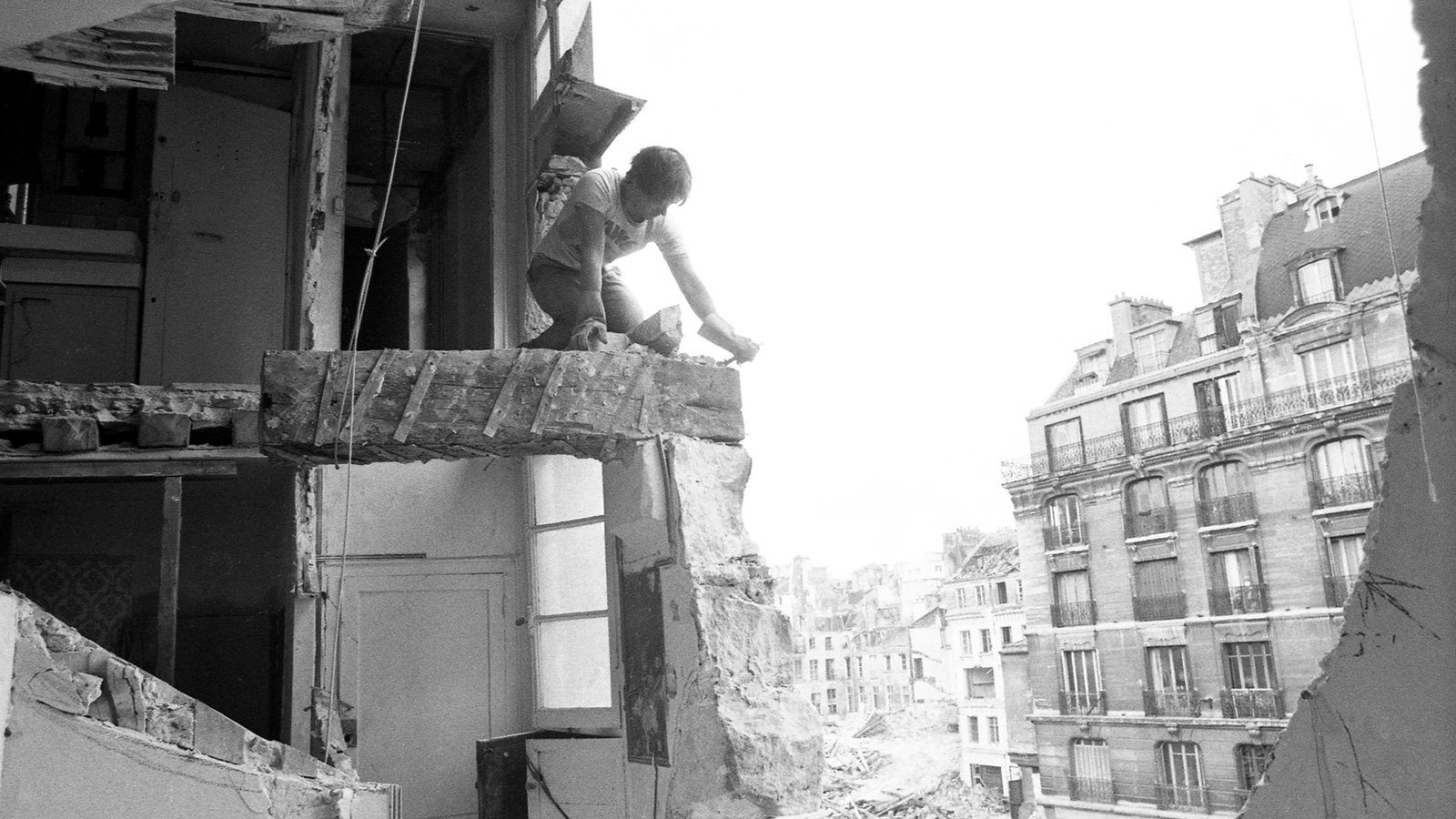
Gordon Matta-Clark. Not the Work...The Worker is the exhibition MAXXI dedicates to the American artist from November 13, 2026 to February 28, 2027, in Gallery 4 of the museum, at Via Guido Reni 4a, in the Flaminio neighborhood (00196 Rome). It is curated by Jessamyn Fiore and Francesco Stocchi. The museum is open Tuesday through Sunday from 11:00 to 19:00, closed on Mondays, and the ticket office stays open until one hour before closing. To get there, take metro line A to Flaminio and then tram 2 toward Piazza Mancini, or bus 910 from Termini and bus 53 from Largo Chigi. On Via Guido Reni there is an ATAC stop named after the museum. Prices are published on the official MAXXI website, and tickets are bought at the museum's box office or online, through the channel indicated by the venue's official site.
Rome rarely sees shows of this weight on an artist who worked with an electric saw more than with a brush. Matta-Clark died at 35, in 1978, and in less than a decade he changed the way artists and architects look at a building. MAXXI, which is a museum of art and architecture together, is the natural home for a man who trained as an architect and decided never to build anything.
Gordon Matta-Clark at MAXXI: dates, hours and address
The Gordon Matta-Clark exhibition opens on Friday, November 13, 2026 and closes on Sunday, February 28, 2027: three and a half months that cover late fall, the holidays and the end of the Roman winter.
The dates to mark
The first day is a Friday, the last a Sunday. Two days after the opening, on Sunday, November 15, 2026 at 11:30, the museum has a guided tour of the exhibition on its calendar. It is the first related event, and for anyone who wants an introduction from the institution itself it is the right date. The rest of the program of tours and talks can be followed on the official MAXXI website, where the museum publishes related events as it schedules them.
Opening hours
MAXXI is open Tuesday through Sunday from 11:00 to 19:00. It is closed on Mondays. The ticket office closes one hour before the museum, so at 18:00. If you arrive at 18:10, you'll find the box office closed even though the galleries are still open. On holidays the hours can change, and it's best to check the museum's website before you leave, especially between Christmas and Epiphany.
The address and the gallery
MAXXI is at Via Guido Reni 4a, 00196 Rome, in Flaminio, between Via Flaminia and the Tiber. The exhibition occupies Gallery 4, one of the exhibition galleries of Zaha Hadid's building. At the entrance it's best to ask right away how to reach it. The museum is made of ramps and paths that cross each other, and it's easy to end up in another exhibition.
Tickets, discounts and free admission
Prices are published by MAXXI on its official website. The museum offers discounts, among others, for young people between 18 and 25 years of age (25 not yet reached) and for groups of at least 15 people, and free admission, among others, for those under 18, for holders of the myMAXXI card and for anyone visiting the museum on their birthday with an ID document. The full list, long and detailed, is on the museum's ticketing page. It's worth reading, because it includes many agreements with Roman cultural institutions.
Who was Gordon Matta-Clark: the architect who cut houses
Gordon Matta-Clark was born in New York on June 22, 1943 and died in the same city on August 27, 1978, at 35. His name on the register was Gordon Roberto Matta-Echaurren. He adopted his mother's surname in 1971. He is remembered above all for the interventions he carried out in the 1970s directly on buildings slated for demolition.
A family of artists
His parents were both artists. His mother, Anne Clark, was an American painter. His father was Roberto Matta, the Chilean Surrealist painter. His godmother was Teeny, the wife of Marcel Duchamp. His brother Ramuntcho Matta, an artist and musician, lives in Paris. Growing up in that environment means learning early the idea that art can be a gesture before it is an object: Duchamp, in the family, was not a textbook chapter.
Cornell, Paris and the rejected architecture
From 1962 to 1968 Matta-Clark studied architecture at Cornell University, with one year at the Sorbonne in Paris devoted to French literature. In those years the architecture program at Cornell was also guided by Colin Rowe, one of the great theorists of modern architecture. Matta-Clark never practiced as an architect. He chose to work on what he called "Anarchitecture," a fusion of anarchy and architecture. It is the key to everything you'll see in Gallery 4: an architect who uses his own expertise to open, empty out and section.
From Ithaca to SoHo
In February 1969 the exhibition Earth Art, curated by Willoughby Sharp at the Andrew Dickson White Museum of Art at Cornell, marked a turning point. Matta-Clark, who was then living in Ithaca, was invited by Sharp to help the artists make their works on site. It was Sharp who pushed him to move to New York, introduced him to the postminimalist world and published him in the magazine Avalanche. In the fall of 1970 his work Museum, shown at the Bykert Gallery, appeared in the pages of the first issue.
FOOD, the artists' restaurant
In 1971 Matta-Clark founded FOOD with Carol Goodden and Tina Girouard, a SoHo restaurant owned, run and served by artists. The kitchen was open to view, the ingredients unusual, and the meal became an event. FOOD was the first place of its kind in SoHo and became a gathering spot for the Philip Glass Ensemble, Mabou Mines and the dancers of the Grand Union. Matta-Clark ran it until 1973. Today it is considered a forerunner of art tied to food and social participation, and the MAXXI exhibition, which is about collective and participatory creativity, can't do without that experience.
The cuts: Splitting, Bingo, Conical Intersect
In 1974 Matta-Clark made Splitting, the cutting of a house in two parts, and Bingo, in which he removed the facade of a house condemned to demolition along Love Canal and transported its walls to Artpark. In 1975, for the Paris Biennale, he cut a large conical hole through two 17th-century buildings in the Les Halles district, slated to be torn down to make room for the Centre Georges Pompidou. The work is titled Conical Intersect. In the same year he opened a circular opening in the shed of Pier 52 on the Hudson River in Manhattan, with Day's End. In 2019 the New York Times listed Splitting among the 25 works that define the contemporary age.
Fake Estates and the last project
With Fake Estates Matta-Clark bought at auction 15 leftover lots of land, strips too small to be used, in Queens and on Staten Island, paying between $25 and $75 each, and documented them with photographs, maps, deeds and land registry records. The last major project was Circus or The Caribbean Orange, from 1978: circular cuts in the walls and floors of a house next to the first home of the Museum of Contemporary Art in Chicago. He died that same year, of pancreatic cancer. His archive is held at the Canadian Centre for Architecture in Montréal.
What you'll see in the Gordon Matta-Clark exhibition
The MAXXI exhibition traces the creative career of Gordon Matta-Clark with a cross-cutting view, from the experimental years at the self-run space at 112 Greene Street in New York to the famous cuts, the cuttings. The museum presents him as a multifaceted artist, an architect by training, playful and radically anarchic.
112 Greene Street
The route starts with the experimental years at 112 Greene Street, in SoHo, a space run by the artists themselves. It is the right context to begin with. Before the big cuts, Matta-Clark works inside a community, and many of his works come out of that shared environment more than from the studio of a single person. For visitors, this means finding documents, photographs and traces of a scene at the start, before the most famous works.
Genoa and Milan: Matta-Clark's Italy
The Italian heart of the exhibition is the chapter on the trips to Genoa and Milan, which MAXXI describes as a central phase of Matta-Clark's research, one able to steer its later developments. This is what makes this exhibition different from a retrospective seen elsewhere: in Rome the relationship between the artist and Italy is also told. Anyone who knows Matta-Clark only through New York and Paris will find here a part of the story that is told less often.
From the urban fabric to the cuttings
The route continues with the first interventions on the urban fabric and arrives at the cuts in buildings. Since those buildings were demolished, what remains of the cuttings is photographs, films, drawings and fragments. It's good to know this beforehand: you won't see cut houses, you'll see what Matta-Clark chose to keep of those actions. The museum notes that the artist used film, video and photography to document his work, and that he loved wordplay in his titles and texts.
An exhibition about participation
MAXXI defines it as an interdisciplinary exhibition that promotes collective and participatory creativity, with works that show Matta-Clark's commitment to turning the urban environment into an aesthetic and social experience. The subtitle, Not the Work...The Worker, shifts the attention from the object to the person who works. The reading is clear-cut: it is an exhibition to visit while thinking about the city you walk out into, more than about the works themselves.
The curators
The exhibition is curated by Jessamyn Fiore and Francesco Stocchi. The header image chosen by the museum carries the credit of the Estate of Gordon Matta-Clark and David Zwirner Gallery, which represents the artist's legacy.
A curiosity about Gordon Matta-Clark. Not the Work...The Worker at MAXXI, from November 13, 2026 to February 28, 2027
The most interesting curiosity concerns one of his most famous works, Conical Intersect. In 1975, for the Paris Biennale, Matta-Clark opened a large cone through two 17th-century buildings in Les Halles. Those buildings were going to be torn down to build the Centre Georges Pompidou, which was then much contested. An artist cuts two old buildings to show Parisians what is about to disappear, right next to the construction site of the most debated contemporary art museum in Europe.
Seen from Rome, the parallel is inevitable. MAXXI too is a contemporary art museum born from a controversial project, Zaha Hadid's, on a disused area, the former Caserma Montello. Here too a piece of the city was emptied out and rethought. Bringing Matta-Clark inside Hadid's building means putting the artist who cut buildings in the belly of a building that was, in its own way, a cut in the neighborhood.
Second curiosity, less well known: Matta-Clark was the godson of Teeny Duchamp, wife of Marcel Duchamp. His father, Roberto Matta, was one of the painters of Surrealism. Nobody chooses their family, but few artists grew up so close to the gesture that turned a urinal into a work of art. The idea that you can make art by taking away instead of adding has its roots there.
Third: his restaurant FOOD, opened in 1971 in SoHo, was run and served by artists. Today it is studied in courses on participatory art. Anyone who thinks art tied to food is a recent fashion will find proof to the contrary in the exhibition.
Zaha Hadid's MAXXI, the home of the exhibition
MAXXI, inaugurated in 2010, is the first Italian national museum dedicated to contemporary arts and architecture. It was designed by Zaha Hadid, winner of the 1998 international competition. For an exhibition on an artist who was an architect, it is the most coherent venue Rome can offer.
From Caserma Montello to the museum
The museum was born on a military area. In 1997 the Ministry of Cultural Heritage obtained from the Ministry of Defense the area of the former Caserma Montello, in Flaminio, occupied by disused workshops and pavilions. Everything starts from that transfer: a plot closed to the city becomes, in a little more than a decade, a national museum.
The competition won by Zaha Hadid
In 1998 the international competition asked for a museum for architecture and one for the arts of the 21st century, spaces for experimental productions, a library, an auditorium, spaces for performance and for education. There were 273 entries. Zaha Hadid won, with a project chosen for its ability to blend into the urban fabric and to give the museum a sequence of public spaces.
Piazza Alighiero Boetti
The project extends over 29,000 square meters and has at its center a large open square, named for Alighiero Boetti, where works are displayed and which during events stays open free of charge even outside regular hours. For an exhibition like this, the square is the first and last chapter: you arrive and leave by crossing a public space, which is exactly the material Matta-Clark worked on.
The works always on view
MAXXI's collections are displayed on rotation. Three installations are always on view: those by Anish Kapoor, Sol LeWitt and Maurizio Mochetti. The museum presents its collection of art and architecture as the founding element of its identity, displayed with different installations since October 2015.
Other exhibitions at the same time
In the same months MAXXI hosts other exhibitions. In the Claudia Gian Ferrari room, from October 16, 2026 to February 7, 2027, there is the ninth edition of NATURE, the site-specific installation entrusted to the Mexican architect Tatiana Bilbao. In the same period the overview dedicated to Sophie Calle at MAXXI is also on. If you come for Matta-Clark and still have energy, you can pair it with Bilbao's installation, which speaks to the same theme: architecture as a space of relationship.
One thing nobody tells you about Gordon Matta-Clark. Not the Work...The Worker at MAXXI, from November 13, 2026 to February 28, 2027
Almost nobody says it: the Matta-Clark show is a show of documents. His most famous interventions were done on buildings slated for demolition, and those buildings no longer exist. Of Splitting, of Conical Intersect, of Day's End, what remains are photographs, films, drawings, fragments. Anyone who walks into Gallery 4 expecting to see houses cut in two will be disappointed. Anyone who walks in knowing they'll see the traces of vanished actions will understand the exhibition.
The second point concerns the films. Matta-Clark shot a lot: his videography includes titles such as Tree Dance, Fresh Kill, Clockshower, Day's End, Splitting, Conical Intersect, Office Baroque. If the exhibition presents them, and an exhibition on him can hardly do without them, the films take time. Allow at least half an hour more than for a show of still images only.
Third: the hours. MAXXI closes at 19:00, but the ticket office closes at 18:00. Anyone who arrives late on a Saturday afternoon thinking they have a good hour ends up with 40 minutes for an exhibition that needs at least 90. And on Monday the museum is closed. It's the day when many visitors passing through think they'll catch up on museums, and they find the gate shut.
Fourth, practical: MAXXI has a coat check, a café, a bar and a restaurant. On a rainy January day, in Flaminio, it makes a difference.
How to get to MAXXI for the Gordon Matta-Clark exhibition
MAXXI can be reached from the center by metro line A to Flaminio and then tram 2 toward Piazza Mancini. It's the most reliable combination on heavy-traffic days, and the one I recommend to anyone staying between Termini, the Spanish Steps and the Vatican.
Metro A and tram 2
From the Flaminio station of metro line A, in Piazzale Flaminio, tram 2 departs and goes to Piazza Mancini. The useful stop is the one closest to Via Guido Reni, and from there you walk toward the Tiber. Auditorium Parco della Musica, about 650 meters as the crow flies from the museum, lists the same combination as the main route for those arriving by public transit.
Buses
Four useful lines run in the area. The 910 goes from Termini to Piazza Mancini. The 53, from Piazza Mancini to Largo Chigi. The 168, from Largo Maresciallo Diaz to Tiburtina station. The 982, from Viale XVII Olimpiade to Quattro Venti station. The 910 is the most convenient choice from Termini, the 53 from Via del Corso. On Via Guido Reni, about 130 meters from the entrance, the ATAC stop named after the museum is marked as wheelchair accessible.
By car and parking
By car you arrive from Via Flaminia or the Lungotevere. On-street parking is hard on weekdays and becomes almost impossible on concert nights at Auditorium Parco della Musica or on match nights at Stadio Olimpico. Auditorium Parco della Musica has two paid parking lots with access from Viale Pietro de Coubertin, one at ground level and one multi-story, with spaces reserved for people with disabilities, about 10 minutes on foot from the museum.
On foot from Ponte della Musica
If you're staying in Prati or the Della Vittoria area, you can cross the Tiber on Ponte della Musica, pedestrian and bicycle only, from Lungotevere Cadorna to Piazza Gentile da Fabriano, and continue along Via Guido Reni. For an exhibition on an artist who looked at the city on foot, arriving on foot makes sense.
The advice I give you for visiting Gordon Matta-Clark. Not the Work...The Worker at MAXXI, from November 13, 2026 to February 28, 2027
My advice is precise: enter the exhibition by 16:00, on a weekday, and before going up to Gallery 4 take a full lap of the MAXXI square, looking at the building. Matta-Clark is better understood if you arrive with eyes already trained to look at a building as a body to be opened.
By 16:00 because the ticket office closes at 18:00 and the museum at 19:00, and an exhibition made of photographs, films and documents needs at least an hour and a half. On a weekday because MAXXI's galleries fill up on winter weekends, and films in a crowded room are hard to watch.
The lap of the square is not a waste of time. Zaha Hadid's building is made of volumes that cross, slashes of light, ramps that cross the void. Looking at it for 10 minutes before going in prepares you for the idea that a wall, a floor, a facade are not unchangeable givens. That is exactly Matta-Clark's lesson.
One last tip: if you can, come on Sunday, November 15, 2026 at 11:30, for the guided tour on the calendar. It is the first chance to hear the project told by the people who built it. For groups that want a private visit of the museum and the neighborhood, Tour Leader Pro organizes tailor-made routes.
How to organize your visit to the Gordon Matta-Clark exhibition
A visit to Gordon Matta-Clark at MAXXI takes half a day: an hour and a half for the exhibition, half an hour for the square and the permanent works, the rest for the neighborhood.
How much time you need
The exhibition takes from 90 minutes to two hours, more if you watch the films in full. Add half an hour for the always-on-view installations by Anish Kapoor, Sol LeWitt and Maurizio Mochetti. With transportation from the center, the visit takes between four and five hours.
Museum services
MAXXI offers a coat check, restrooms including accessible ones for people with disabilities, a café, a bar, a restaurant, audio guides also in languages other than Italian, guided tours, school visits and workshops. There is also a bookshop, where you usually find the catalogs of the current exhibitions.
Visiting as a group
With a group, Matta-Clark works well if you prepare beforehand. Here's what I do: 10 minutes of introduction in the square, with two or three names to remember (Splitting, Conical Intersect, FOOD), then an hour of free route and a final meeting at the bar. Groups of at least 15 people get the reduced rate indicated by the museum.
To pair in the same day
In the neighborhood there are Auditorium Parco della Musica and Ponte della Musica, which leads to Foro Italico. Farther south, on the edge of Villa Borghese, is the National Gallery of Modern and Contemporary Art, whose tickets entitle you to a discount at MAXXI. After Matta-Clark, a walk is better than another exhibition.
Another well-known fact, and yet rarely mentioned
Everyone knows Matta-Clark cut houses. Few remember that in 1969, before all this, he was called to help other artists make their works. At the Earth Art exhibition, curated by Willoughby Sharp at Cornell University, the young architect living in Ithaca worked on the on-site execution of the invited artists' works. It was Sharp, later, who convinced him to move to New York.
The fact is known to scholars and rarely cited in presentations, and yet it explains the subtitle of the Roman exhibition: Not the Work...The Worker, not the work but the person who works. Matta-Clark enters the art world as someone who works for others, with his hands, on the construction site. His restaurant FOOD, a few years later, was owned, run and served by artists. His cuts required days of physical labor. The idea of the artist that emerges is that of a worker, and the exhibition puts it at the center from the title on.
There is a second well-known and rarely cited fact: his archive is not in New York but in Montréal, at the Canadian Centre for Architecture. It is an architecture institution, not an art museum. The choice says a lot about how his legacy is read today: first of all as a chapter in the history of architecture. That is also why MAXXI, which has an architecture museum inside it, is the right place to see him in Rome.
Flaminio around MAXXI: what's nearby
MAXXI is in Flaminio, the neighborhood between Via Flaminia, the Tiber and the Parioli, which the tourism portal of Roma Capitale lists as the first neighborhood of the capital. It's a part of the city where, in recent decades, disused areas have become places of culture: the right theme for anyone leaving a show on Matta-Clark.
Auditorium Parco della Musica Ennio Morricone
Designed by Renzo Piano, Auditorium Parco della Musica opened in 2002 and was named for Ennio Morricone after his passing, in 2020. During construction the remains of an ancient Roman villa emerged, integrated into the complex, and in the foyer there is a small archaeological museum. It's open every day from 11:00 to 20:00, and in the foyer you can see for free the neon works by Maurizio Nannucci and some Cellotex by Alberto Burri.
Ponte della Musica
Ponte della Musica, dedicated to Armando Trovajoli, is 190 meters long and connects Flaminio with Lungotevere Cadorna, at the level of Foro Italico. The design is by the London firm Buro Happold with the Roman company Carlo Lotti e Associati. It can be crossed only on foot or by bicycle.
Villa Glori
Behind Auditorium Parco della Musica rises Villa Glori, opened in 1924 as the Parco della Rimembranza to a design by Raffaele De Vico. Since 1997 the park has hosted installations by contemporary artists, including Kounellis, Staccioli and, since 2000, Giuseppe Uncini's Porta del Sole and Paolo Canevari's Uomo-erba. It's the outdoor continuation of a day at MAXXI.
Foro Italico, Stadio Olimpico and Ponte Milvio
Beyond the Tiber are Foro Italico and Stadio Olimpico. Going up the river you reach Milvian Bridge. On league Sundays the area changes face, and traffic along the Tiber comes to a standstill: better to know that before organizing the visit.
The right photo to take at Gordon Matta-Clark. Not the Work...The Worker at MAXXI, from November 13, 2026 to February 28, 2027
The right photo for this exhibition is a cut. Go out onto the MAXXI square and look for a point where Zaha Hadid's building opens: an overhang, a glass wall, the void between two volumes. Frame only that, excluding the rest. It's the simplest way to pay homage to an artist who isolated and opened portions of architecture.
Inside the galleries the rules on photography are set by the museum, and for Matta-Clark's works, managed by the artist's Estate, it's best to ask at the entrance before raising your phone. Many of the works on display are themselves photographs: photographing a photograph rarely gives a result worth the trouble.
Second photo, for those with time: from Ponte della Musica, toward Flaminio, at the hour when the sky turns dark blue. On winter afternoons it happens shortly after 17:00. The bridge, with its structure, creates strong lines. The neighborhood behind gives depth.
Third photo, the most consistent with the exhibition: a detail of a city in transformation. A construction site, a wall being demolished, a half-finished building. Flaminio always offers some. Matta-Clark worked right there, in the moments when a building stops being what it was and isn't yet something else.
A few important events that happened here in history
The history of the place where you now visit Gordon Matta-Clark goes from a military area to a national museum in a little more than a decade.
1997: the transfer of Caserma Montello
In 1997 the Ministry of Cultural Heritage obtained from the Ministry of Defense the area of the former Caserma Montello, with its workshops and disused pavilions. It is MAXXI's birth certificate.
1998: the international competition
The following year the international competition was called for the new center for contemporary arts. Out of 273 entries, Zaha Hadid's project won, extending over 29,000 square meters around an open square.
2010: the opening
In 2010 MAXXI opened as the first Italian national museum for contemporary arts and architecture. Since October 2015 the collection of art and architecture has been displayed with different installations, alternating with the temporary exhibitions.
1867: the Cairolis at Villa Glori
One kilometer from the museum, on the hill of Villa Glori, on October 23, 1867 some 70 Garibaldian volunteers led by Enrico and Giovanni Cairoli, who had come from Terni to bring weapons to the Roman insurgents, were intercepted and defeated by the papal army. Enrico died, Giovanni was gravely wounded. In 1924 the hill became the Parco della Rimembranza for the fallen of World War I.
Who has passed through Gordon Matta-Clark. Not the Work...The Worker at MAXXI, from November 13, 2026 to February 28, 2027
First of all, Zaha Hadid passed through MAXXI, who won the 1998 competition and designed the first Italian national museum for the arts and architecture of the 21st century. With her, permanently, the artists whose works are always on view: Anish Kapoor, Sol LeWitt, Maurizio Mochetti. The square carries the name of Alighiero Boetti.
With this exhibition, Gordon Matta-Clark comes through Rome and, through his works, an entire scene. There are the artists of 112 Greene Street, the self-run space in SoHo where the route starts. There are, through memory, Carol Goodden and Tina Girouard, with whom he founded FOOD in 1971, and the musicians and dancers who frequented it: the Philip Glass Ensemble, Mabou Mines, the Grand Union. There is Willoughby Sharp, who brought him to New York and published him in Avalanche.
There are the curators, Jessamyn Fiore and Francesco Stocchi, who built the route, and there are the Estate of Gordon Matta-Clark and David Zwirner Gallery, which safeguard and represent his legacy.
And, behind the scenes, there is the family: his father Roberto Matta, Chilean Surrealist painter, his mother Anne Clark, American painter, his godmother Teeny Duchamp. Few artists arrive in a museum carrying such a dense genealogy of the 20th century. In Flaminio, where Renzo Piano built Auditorium Parco della Musica and where Villa Glori preserves works by Kounellis and Uncini, this story finds a fitting context.
Accessibility at MAXXI
MAXXI is listed by the tourism portal of Roma Capitale as a museum accessible to people with disabilities, with dedicated restrooms. The ATAC stop on Via Guido Reni is marked as wheelchair accessible.
Free admission and companions
The museum offers free admission, with the EU Disability Card or a letter from the relevant association or institution, for people with disabilities and a companion, people on the autism spectrum and a companion, deaf people, people with cognitive disabilities and complex communication needs and their caregivers, people with serious illnesses and their caregivers. For routes and elevators, it's best to ask at the ticket office.
Audio guides and tours
MAXXI provides audio guides, also in languages other than Italian, and guided tours. For an exhibition with many films, people with hearing disabilities should ask at the ticket office if the videos are subtitled.
Gordon Matta-Clark at MAXXI with children
The Gordon Matta-Clark exhibition suits children better than you'd think. Houses cut in two, holes in walls, a restaurant run by artists: these are ideas a kid grasps right away, often before an adult.
With the youngest
With children under 10 a short visit is best, three quarters of an hour, focused on the images of the cuts. Then the MAXXI square, to run around, and maybe the gardens of Auditorium Parco della Musica. Under-18s get in free. The museum runs educational workshops: the calendar is on the official website.
With teenagers
With older kids I'd propose a game: choose a building in their own city and imagine where it would be cut, and why. Matta-Clark did exactly this, and turning the visit into an exercise in looking works better than any explanation.
Where to eat near MAXXI
MAXXI has a café, a bar and a restaurant inside: it's the most practical solution for a break between the exhibition and the square.
At Auditorium Parco della Musica
10 minutes away on foot, Auditorium Parco della Musica has a bar and food service, and plenty of green around. For a long day in the neighborhood it's a good base.
Flaminio, Parioli and Ponte Milvio
Flaminio is residential, and the food around the museum is neighborhood fare, good for a quick lunch. For dinner after the exhibition, the Parioli are known for cocktail bars and fashionable restaurants. The other direction is Ponte Milvio, along the Tiber. Both can be reached in a few minutes by taxi.
Gordon Matta-Clark at MAXXI between November and February: the time of year in Rome
The exhibition covers the most intimate season of the Roman year, from mid-November to the end of February. It's the time when museums become places to spend a whole afternoon again.
November
In mid-November Rome alternates mild days with the first real rains. The opening on Friday the 13th and the guided tour on Sunday the 15th will draw the most attentive public. For anyone who wants to see the exhibition just after it opens, it's the right moment.
December and the holidays
In December the afternoon light disappears early and museums fill up with visitors on vacation. For the holidays it's best to check the opening hours on the museum's website.
January and February
January, after Epiphany, is the quietest month for Roman museums. The last weeks of February, before the closing on the 28th, will instead bring the latecomers: if you can, don't put it off.
Frequently asked questions about Gordon Matta-Clark at MAXXI
When can you see the Gordon Matta-Clark exhibition in Rome?
The exhibition Gordon Matta-Clark. Not the Work...The Worker is open at MAXXI from November 13, 2026 to February 28, 2027, in Gallery 4. The museum is open Tuesday through Sunday from 11:00 to 19:00, closed on Monday, and the ticket office closes one hour before the museum. For holidays it's best to check the official website.
Where is MAXXI and how do you get there?
MAXXI is at Via Guido Reni 4a, in the Flaminio neighborhood. From the center take metro line A to Flaminio and then tram 2 toward Piazza Mancini. Buses 910 from Termini, 53 from Largo Chigi, 168 and 982 also run in the area. On Via Guido Reni there is an ATAC stop named after the museum.
Who curates the Gordon Matta-Clark exhibition at MAXXI?
The Gordon Matta-Clark exhibition at MAXXI is curated by Jessamyn Fiore and Francesco Stocchi. The route goes from the years of the self-run space at 112 Greene Street in New York to the trips to Genoa and Milan, up to the first interventions on the urban fabric and the famous cuts in buildings.
How much is a ticket for Gordon Matta-Clark at MAXXI?
MAXXI ticket prices are published on the museum's official website. Discounts are available, among others, for young people between 18 and 25 and for groups of at least 15 people, and free admission, among others, for those under 18 and for anyone visiting the museum on their birthday with an ID document.
Who was Gordon Matta-Clark?
Gordon Matta-Clark, born in New York in 1943 and died in 1978, was an American artist trained as an architect at Cornell University. He is known for the cuts in buildings slated for demolition, such as Splitting and Conical Intersect, and for founding the artists' restaurant FOOD in SoHo in 1971.
How much time do you need for the Gordon Matta-Clark exhibition?
The Gordon Matta-Clark exhibition at MAXXI takes from 90 minutes to two hours, because the route includes photographs, documents and films. It's best to enter by 16:00, since the ticket office closes at 18:00. If you also want to see the permanent works and the square, add half an hour.
Is there a guided tour of the exhibition?
MAXXI has a guided tour of the Gordon Matta-Clark exhibition on its calendar on Sunday, November 15, 2026 at 11:30. Other related events are published on the museum's official website, on the page of events related to the exhibition.
Is the exhibition suitable for children?
The Gordon Matta-Clark exhibition at MAXXI can work well with kids, because the ideas of cuts in buildings are immediate. With the youngest, a short visit followed by a break in the museum square is better. Under-18s get in free, and the museum runs educational workshops.
Final advice on Gordon Matta-Clark at MAXXI
Architecture exhibitions are understood with the feet before the eyes. For Matta-Clark that's doubly true. Arrive on foot from Ponte della Musica, walk around Zaha Hadid's building, enter Gallery 4 unhurried and give the films the time they ask for. Then go out and look at Flaminio: the construction sites, the walls, the spaces left empty. If the exhibition worked, you'll see them differently.
Among the exhibitions of the Roman winter, this is the one I recommend to anyone who thinks they don't like contemporary art: it's about houses, cities, work, and it doesn't ask you to believe in anything. For the museum's page and the other proposals in the neighborhood, the starting point is the page for MAXXI. The official information on the exhibition is on the MAXXI website.
Article written by the editorial team of Tour Leader Pro, contact them for Private/Corporate/V.I.P. Tours and Experiences.
Planning a trip to Rome? The English guides to visiting the city are on ItalyPlanner.com.