Frissón
https://www.estateromana.com/en/rome/trip-planner/frisson-rome/
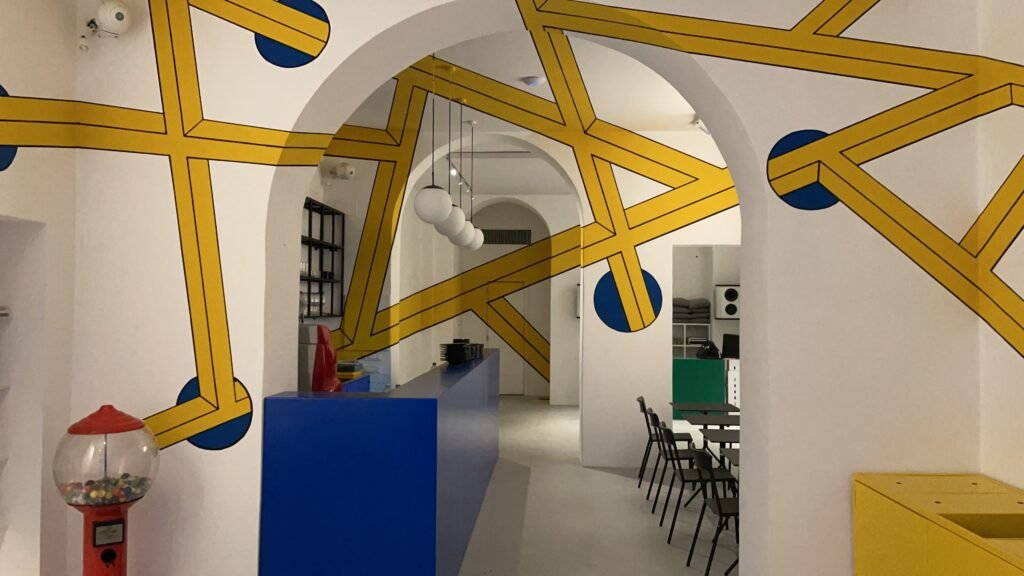 Frissón
Via dei Cartari, 7
Rome
Frissón is an ecosystem that revolves around music. A cultural space, a listening bar, a collective of artists, an aesthetic thrill: four definitions that sound like four different projects and instead describe the same address, a narrow door on a very narrow street in the historic center of Rome, halfway between the Ponte district and the Regola district, in that handkerchief of city between Via Giulia, the Tiber and the rear front of Palazzo della Cancelleria. Imagine everything you would put in your dream living room: a good wine cellar, international magazines and artists' books, vinyl records, a very high-quality sound system for open listening, contemporary artworks of all sizes and kinds. At Frissón, right in the center, all this awaits you, and also live music, music selections, exhibitions, screenings and meetings. An eclectic project born from "a team made up of musicians, artists, photographers, videomakers, designers, architects, curators and athletes of the unknown": it's the self-description the project chose for itself from the start, and it's worth taking seriously, because that list of trades explains better than any commercial category what happens inside these rooms.
The first thing to make clear concerns the category. Calling it a bar is convenient and partly correct, since there is a counter, there are glasses and there is a wine list built with judgment among Italian and French wineries. But calling it only a bar means missing the point. Frissón was born, by its own declaration, as the first listening bar in the capital, that is, as a venue where recorded and reproduced music is not background, sound furnishing or filler between one conversation and another, but is the main content of the evening. It's a distinction that arrived late in Rome compared with other European cities and very late compared with Japan, where this form of venue has existed for over 70 years. Understanding this difference is the key to understanding why the space on Via dei Cartari was built this way and not another.
What Listening Bar Really Means
A listening bar is a venue organized around a very high-quality audio playback system, designed for attentive listening to recorded music, almost always on physical media and largely on vinyl. The difference from a normal bar is not in the volume, which is often lower than you'd expect, but in the direction of attention. In a bar the music serves to cover silences and give rhythm to the service. In a listening bar the music is the reason the place exists, and everything else, drinking included, is arranged around that priority. The arrangement of the seating changes, tending to face the speakers rather than the counter. The acoustic treatment of the surfaces changes. The way the staff choose records changes: it's not a playlist but a built sequence, with a beginning, a development and an end.
The historic motto of these venues has stayed the same for decades and is disarmingly concise: less talk, more listening. It's not a rule written on the door or a ban imposed by the staff, but an implicit pact between those who come in and those who run the space. Whoever arrives knowing what a listening bar is spontaneously lowers their voice, notices the sound and understands that that evening conversation will be an accompaniment and not the main course. Whoever arrives thinking they'll find an ordinary aperitivo takes 10 minutes to get oriented and then, almost always, adapts without effort, because the environment does the work itself.
The formula the Roman project used to describe its idea of listening is even more precise: music in the headphones, from the speakers or from the chest. These are three distinct and non-interchangeable modes. Headphones are for individual listening, the kind where you isolate yourself from the room and enter a record alone. Speakers are for shared listening, the kind where a group of strangers goes through the same sound sequence together without having agreed to. The chest is the part that surprises those who have never frequented a well-built system: below a certain frequency threshold the sound stops being perceived only by the ear and becomes a physical pressure on the rib cage. It's a sensation that live concerts know well and that home systems, even expensive ones, rarely deliver.
Japanese Jazz Kissa, the Origin of Everything
To understand where this idea comes from, you have to move to Tokyo and go back several decades. Listening bars descend directly from Japanese jazz kissa, venues born in the postwar period where the customer paid for a drink, often just a coffee, and in exchange got access to a private collection of imported records and a playback system that nobody could afford at home. The word kissa comes from kissaten, which in Japanese indicates the place where you drink, typically coffee. Jazz kissa therefore means, literally, jazz café.
The economic context explains everything. In postwar Japan Western records were rare and very expensive goods, hi-fi systems even more so, and homes were small, thin-walled, poorly suited to high-volume listening. The jazz kissa solved three problems at once: it provided a catalog that an individual could not build, it supplied a system that an individual could not buy and it offered a space in which to listen without disturbing anyone. The owner became a precise figure, the master, who selected the records, decided the order, flipped the record halfway and imposed silence when needed. In many of those venues talking was openly discouraged: there were signs, and there were regulars who turned around if someone raised their voice.
From that matrix, over the years, several offshoots were born. The most orthodox kissa kept the rule of almost monastic silence. Others loosened the reins and added alcohol, food, evening hours, turning into what we now call a listening bar. In the 2000s and 2010s the model crossed the ocean and settled in London, New York, Berlin, Amsterdam, Paris, often through industry insiders who had seen the kissa in person and brought back the idea. In Italy the phenomenon arrived last, and Rome waited a bit longer than Milan.
There's an element that makes the Roman transplant less exotic than it seems. The jazz kissa was, in its social substance, a place where you went alone without feeling alone, where time stretched and the drink was a pretext to stay. It's not so far from the function that certain neighborhood bars served in Rome for decades, with the difference that there the glue was conversation and here it's the record. Frissón slotted exactly into that overlap: the project's statement stresses that you don't need to go with company, because the cues are enough to be well there even alone. In a very sociable city like Rome it's a sentence that sounds almost provocative, and yet it describes exactly the kind of evening this format makes possible.
A Curiosity About Frissón
The nicest curiosity concerns the name, and it's not the one you expect. Frissón recalls the French frisson, which means shiver, tremor, that brief charge that crosses the skin when a chord falls in the right place. So far the explanation is obvious and the project openly claims it, speaking of an aesthetic thrill. The funny point is another: in describing the venue at the time of opening, the journalist Chiara Colli on Zero proposed as the first translation of the term a thoroughly Roman word, friccicore. And she was right.
Friccicore, in Romanesco, precisely indicates that tingle of excitement and anticipation that rises before something good, the slight jolt you can't hold back. The phonetic kinship with frisson is evident, the semantic kinship even more so, and the fact that both languages produced such a similar term for the same sensation is one of those linguistic short circuits that make etymology a parlor game. So the venue with the French name, opened in Rome, importing a Japanese format, is actually named with a word that Romanesco has always known. I don't think there is a better summary of what this place is.
The second curiosity concerns the sound system. The final room of the space, the one intended for live sessions and DJ sets, hosts a handmade audio system, built outside the logic of industrial products. The description given of it at the opening spoke of the encounter between a 1930s cinema sound system and what was called a luminous supernova. It's a deliberately evocative formula, but the technical reference is serious: the systems of 1930s cinemas were built around large horns and high-efficiency loudspeakers, able to fill a hall with power that is ridiculous by today's standards, and delivered a sound that enthusiasts still consider unsurpassed in certain ranges. Bringing that logic into a room of a few square meters in the center of Rome is a collector's choice, not a decorator's.
Three Rooms, Three Ways to Be
The space on Via dei Cartari was conceived, materially and ideally, as a succession of three rooms with distinct functions, and this three-part structure is what strikes you most the first time. It's not a single hall in which functions overlap, but a sequence in which you advance by changing register.
The first room, the entrance, was imagined as a listening and reading room. It's the part where you find the foreign music magazines, the international publications, the artists' books, and it's the part where the interior aesthetic allows itself the most disorienting gesture, namely the colored balls that continue an imagery declaredly from an amusement park. It's a choice that defuses from the threshold the main risk of this kind of venue, namely solemnity. A deadly serious sound system in a room that quotes the funfair communicates immediately that here technical competence does not turn into rigidity.
The second room is the central one, with the counter and the chairs. It's the zone of socializing and service, the point where the venue most resembles a traditional bar, and it is also the balance point of the sequence: whoever comes in and doesn't feel up to facing the listening room stops here and still has a good evening. The third room, at the back, is that of the handmade system, and it is the space for live sessions, DJ sets, sound performances, but also for presentations, shows and exhibitions that have alternated over time.
This progression has a practical consequence worth knowing in advance: the position you choose determines the evening you'll have. There is no neutral placement. Near the entrance you read and observe, in the middle you talk, at the back you listen and that's all. Whoever arrives in a large group and camps at the back without realizing it ends up disturbing exactly the people who crossed the whole venue to find that condition.
Something Nobody Tells You About Frissón
The thing nobody tells you concerns the vinyl records on the walls, and it's a question of status. In almost all music-themed venues the records on the walls are decoration: covers chosen for color, glued or framed, untouchable. Here the relationship is different, because from the start the project planned for the records to be not only listened to but also purchasable. It changes everything. A wall of purchasable records is not a wall, it's a catalog, and the act of looking at it stops being contemplative and becomes active: you are choosing, even when you think you are only observing.
This detail has a consequence for behavior that I advise anticipating. In a record store you browse, pull out, read the back, put back. In a bar you touch nothing. In a place where the two coexist the rule is not obvious, and the most elegant solution is to ask. Whoever works behind the counter, in venues built around a selection, almost always is just waiting for someone to ask the right question, and the right question is not what's the price, but what's playing right now.
The second thing that is rarely said concerns publishing. The presence of foreign music magazines, declaredly off, is not a decorating whim. International independent music publications have almost nonexistent Italian distribution: in a city like Rome the addresses where you can physically leaf through them can be counted on the fingers of one hand, and in some cases they don't exist at all. A space that keeps them available performs, without declaring it, a function that elsewhere would belong to a specialized library. Whoever deals with music for work or out of obsession understands it in the first two minutes.
The third concerns the programming. The evening activities were conceived from the start with free admission, and this choice has an effect that goes beyond saving money. Free entry changes the makeup of the audience, because it eliminates the economic selection at the door and replaces it with a selection by interest: those who want to come in come in, not those who decided in advance to spend. In a city where experimental live music is often confined to membership, association-based or paid circuits, an open door is a political position disguised as an organizational detail.
Via dei Cartari, the Street That Carries the Name of a Trade
The street deserves a chapter of its own, because the name is not decorative. The cartari were the makers and sellers of paper, and their presence in this stretch of the city tells one of the most solid chapters of Rome's economic history between the 1400s and the 1800s. We are a few steps from the heart of the Rome of the book trades, that band that goes from the Banco di Santo Spirito toward Campo de' Fiori and that for centuries concentrated paper makers, booksellers, binders, printers, copperplate printers, engravers, bookbinders, ink makers.
The reason for this concentration is as banal as it is decisive: the Curia. An administrative machine that produced bulls, briefs, petitions, registers, notarial deeds, edicts, notices and books in industrial quantities needed paper, presses and specialized hands, and wanted them close. Around that need a productive district formed in the full sense of the term, with workshops grouped by specialty along adjacent streets, suppliers a few meters from clients and a system of relationships that toponymy has preserved better than any archive.
The proof survives in the street names of this quadrant, which are a list of trades and human groups: Via dei Cartari, Via dei Banchi Nuovi and Via dei Banchi Vecchi for the bankers, Via dei Baullari for the trunk makers, Via dei Cappellari for the hatters, Via dei Chiavari for the makers of keys and locks, Via dei Giubbonari for the makers of jerkins, Via dei Sediari for the chair makers, Via dei Balestrari for the crossbow makers, Via dei Leutari for the lute makers. Walking here means crossing a page of a medieval phone book left imprinted on the plaster.
That a place devoted to listening and independent print opens precisely on Via dei Cartari is not a planned coincidence, but one of those rhymes the city produces on its own. Magazines, artists' books, international publications, experimental print: paper has returned to Via dei Cartari through a side door, without presses but with the same function of a deposit of specialized knowledge. The fact that on the same street, 500 years earlier, reams were sold to those who had to print something on them that was equally new at the time is the kind of continuity that makes Rome hard to describe without sounding rhetorical.
It's worth adding that paper, in Rome, was a product largely imported from the paper mills of the Tivoli and Subiaco area, where the motive power of water allowed the maceration of rags. Subiaco, in particular, hosted in 1465 the first printing workshop active in Italy, set up by two German clerics in the monastery of Santa Scolastica, and from there the art of printing came down toward Rome within a very few years. The paper district that gives this street its name is the urban tail of that story.
The Advice I Give You for Visiting Frissón
There is only one piece of advice and it's worth more than all the others put together: go early and go alone, at least the first time. I know it's counterintuitive, because the Roman instinct in front of a new venue is to organize the group, book, arrive as five. But a crowded listening bar is a bar, and a crowded bar is a place where people talk. If you arrive in the early part of the evening, when the room is still half empty, you get three things you won't have later: you can choose where to sit, you can hear the system without the background noise of 40 conversations, and you can talk to whoever is playing the records without stealing their time.
The second piece of advice concerns the order of operations. Don't walk in ordering right away. Walk in, make a full tour of the three rooms, look at what is on the walls, leaf through something on the magazine table, figure out where the speakers are pointed and where instead the sound arrives as a rebound. Then choose your spot and then order. It seems pedantic, but the difference between a successful evening and a mediocre one in a venue built around sound depends almost entirely on where you sat in the first five minutes.
Third: have them tell you about the selection. In a place like this the question that opens all doors concerns the record that's playing, the label, the year, the reason it ended up in that sequence. Whoever builds a listening set list does so with a logic, and almost always is happy to explain it. It's also the fastest way to discover records you would never have looked for, which is the real service a venue like this offers to those who enter.
Fourth, a recommendation about the context. Via dei Cartari is a tiny street, without shop windows and without scenographic lighting, and in the evening the area between Via Giulia and the lungotevere is much quieter than the historic center would make you imagine. Don't expect a sign visible from afar. The practical advice is to look for the street number and not the venue: whoever arrives for the first time often walks past the right door without noticing.
Fifth, and perhaps the most useful: build the evening around the area, not only around the venue. You are a five-minute walk from Piazza Navona, a little more from Campo de' Fiori, barely 10 minutes from Castel Sant'Angelo crossing the bridge, and a short walk from the Pantheon. A serious listening session after an afternoon wandering the center has a different flavor from a serious listening session after an hour on the metro.
The Ponte District and the Regola District, Two Souls a Few Meters Apart
Via dei Cartari falls in the border band between two historic rioni, and that deserves an explanation because the Roman rioni are not decorative administrative divisions but sedimented identities that you can still recognize today by walking.
The Ponte district takes its name from Ponte Sant'Angelo, the ancient Pons Aelius built by Hadrian to connect the city to his mausoleum, and for centuries it was the entrance gate for pilgrims headed to St. Peter's. That function determined its economic vocation: hotels, inns, moneychangers, bankers. Via dei Banchi Nuovi and Via dei Banchi Vecchi owe their name exactly to this, to the counters of the Florentine, Sienese and Genoese merchants who handled papal credit. The Ponte district was for a long time the district of money and transit, and still today it keeps an air of passage that the inner rioni don't have.
The Regola district, which borders it immediately to the south, owes its name instead to the arenula, the fine sand that the Tiber deposited on the banks in flood. Regola is the popular deformation of arenula, and the same root survives in Via Arenula. It was the district of the water and river trades, of the unloaders, the tanners, of the activities that needed the bank and that from the bank also took their troubles, because here the floods of the Tiber arrived with brutal regularity before the construction of the embankment walls.
Between the two rioni runs a line that largely coincides with Via del Pellegrino and with the stretch leading toward Campo de' Fiori. It's an invisible but real border: to the north the city of the counters and the pilgrims, to the south the city of the river and the artisans. Frissón sits exactly on that hinge, in a stretch that shares both vocations and belongs entirely to neither.
It's worth remembering that this quadrant has kept a density of functions that the center has lost elsewhere. Here, within a few hundred meters, restoration workshops, frame shops, antique dealers, bookbinderies, fabric stores and a surprising number of businesses that have nothing to do with tourism still coexist. It's one of the reasons the area empties in the evening without becoming dead: those who work here leave, but the urban scale remains livable.
Via Giulia, the Straight Street That Changed the Center
A few steps from the venue runs Via Giulia, and no walk in this area is complete without taking it for at least a stretch. It is one of the most important streets in Roman urban history and its story explains much about how the center took on its present form.
The street was commissioned by Pope Julius II in the early 1500s, with a project entrusted to Donato Bramante. The idea was radical for the time: to cut a perfectly straight line of about a kilometer through the disordered medieval fabric that occupied the bend of the Tiber, creating a monumental axis connecting Ponte Sisto to the area of the banks and to San Giovanni dei Fiorentini. It was to be the administrative and judicial axis of papal Rome, with at its center a large palace of the courts that would have concentrated the scattered offices of the Curia.
The palace was never finished. What remains of the construction are the bases in roughly hewn travertine blocks, which protrude from street level and which Romans have called for centuries the sofas of Via Giulia. They are among the most fascinating urban objects in the city: a construction site interrupted 500 years ago and never removed, which became a bench, then a monument, then a meeting point. The interruption of the works followed the death of the pope and the rapid exhaustion of resources, and since then Via Giulia has remained a very beautiful street, unfinished in its original ambition.
What the street gained in exchange was the passage of the aristocracy and the great families, who built palaces along both sides, and of foreign nations, who set up churches and institutes there. The Basilica of San Giovanni Battista dei Fiorentini closes the northern end and is the national church of the Florentine community in Rome, a project that involved some of the greatest names of 16th and 17th-century architecture and that keeps the signature of Borromini in the final part of the building story.
At the other end, toward Ponte Sisto, the street passes under the ivy-covered arch that connects Palazzo Farnese to the gardens across the road: it is the most photographed image of the whole axis and one of the rare points in the center where 16th-century architecture physically spans the street above the heads of those walking. A little further on is the Mascherone fountain, a large face of ancient marble reused as a water spout, one of those grafts between ancient and modern that in Rome are the norm and elsewhere would be news.
Another Well-Known Fact, Yet Rarely Cited
The well-known but rarely cited fact concerns the scale of the project relative to the city. That Rome arrived late to high-fidelity listening everyone says, but almost nobody explains why. The reason is not public disinterest, which in this city is historically lively, but a question of square meters and licenses.
A listening bar requires an acoustically treated space, with absorbent surfaces, studied volumes and a seating layout that cannot be improvised. In the historic center of Rome the available spaces are almost always old commercial premises, with vaults, thick walls, protection restrictions and irregular geometries that complicate every intervention. To this is added the regime of sound permits, which in a dense residential fabric limits hours and volumes very tightly. The result is that for decades quality recorded music in Rome stayed confined to two extremes: the private homes of enthusiasts and the clubs, that is, venues built for dancing and not for listening.
The second rarely cited fact concerns the relationship between this format and record stores. The city has a tradition of specialized shops that went through difficult decades, surviving the end of vinyl in the 1990s and re-emerging with the return of physical media. Those shops performed for years a function that the listening bar now expands: they were places of listening as well as selling, with the counter, the headphones, the clerk who knew everything. The leap made by a project like this consists of having added to that function the evening hours, drinking and the possibility of staying seated for two hours without buying anything.
The third element that tends to be forgotten concerns visual art. The programming has never separated music from the rest: from the first week the space hosted installations, exhibitions and screenings, with an explicit choice to make the disciplines coexist in the same room instead of on dedicated evenings. It's a formula that in Rome has illustrious precedents in the self-managed cultural centers of the 1980s and 1990s, but that has rarely been brought inside a venue with a serving license and regular hours.
Piazza Navona and Palazzo della Cancelleria, the Two Imposing Neighbors
A few minutes' walk away are two monuments that tell two opposite ideas of Rome, and it's useful to know them even just to understand what kind of neighborhood you're entering.
Piazza Navona preserves the shape of the Stadium of Domitian, built at the end of the first century for athletic competitions on the Greek model. The square doesn't resemble a stadium: it is a stadium, with the same elongated plan and the same curves, because the buildings that line it rest on the structures of the ancient stands, reused as foundations during the Middle Ages. It's the most spectacular case of persistence of urban form in Europe: a function vanished 1,500 years ago still determines where the café tables go today. The remains of the original structures can be visited in the underground of the Stadium of Domitian, below the present level of the square, and it's one of the most underrated visits in the center.
The Baroque face of the square is due to the Pamphilj family and the pontificate of Innocent X, who concentrated there the family palace, the church of Sant'Agnese in Agone entrusted to Borromini and the Fountain of the Four Rivers made by Bernini. The rivalry between the two architects is the most told gossip in Rome, fed by legends about statues that cover their eyes in front of the rival facade: fascinating stories and chronologically untenable, since the fountain was completed before Borromini took over the church. I tell them anyway, because they are part of the city's oral heritage as much as the dates.
Palazzo della Cancelleria is instead the other side of the coin, and for me it is the most impressive building in the whole quadrant precisely because almost nobody stops to look at it. Built between the late 1400s and the early 1500s, it is considered the first fully Renaissance palace in Rome, with a travertine facade of an almost austere sobriety and an inner courtyard with a double order of loggias that is a lesson in proportions. The travertine, according to a very tenacious tradition, would come in part from the stripping of the nearby Colosseum and the Theatre of Marcellus, a practice documented for very many Roman building sites of the time.
The building also incorporates the basilica of San Lorenzo in Damaso, one of the oldest churches in the city, and still enjoys a particular legal status as an extraterritorial property of the Holy See. Walking past it in the evening, when the facade is lit and the street is empty, is one of the most quietly monumental experiences the center offers.
In the immediate vicinity are also the Museo Barracco, a small collection of ancient sculpture housed in a 16th-century palace known as the Farnesina ai Baullari, and the Galleria Spada, famous above all for the perspective gallery made by Borromini, a corridor that looks four times as long as it really is thanks to a play of decreasing proportions. A little further on, the Biblioteca Vallicelliana keeps one of the most important manuscript collections in the city in an 18th-century room that has remained almost intact, and the Museo di Roma at Palazzo Braschi tells the urban history of the city from the Middle Ages to today.
The Right Photo to Take at Frissón
The right photo is not the one of the sound system. I say it right away because the instinct of anyone entering a place built around sound is to point the lens at the speakers, the turntable, the knobs, and the result is almost always disappointing: a device photographed in the dark, with no scale reference, communicates nothing to someone who wasn't there.
The right photo is the one of the wall of records with a person in front, seen from behind, looking. It works for three reasons. The first is scale: the human figure immediately conveys the dimensions of the room and the wall, which otherwise would remain abstract. The second is the gesture: a person seen from behind looking at a wall of records communicates attention, and attention is exactly the content of this place. The third is composition: the record covers form a regular grid of colored squares, and a dark silhouette interrupting a regular grid is one of the most solid patterns in interior photography.
On technique, three practical pointers. First, don't use flash, ever: it would destroy the only thing that makes the scene legible, namely the warm, low light of the room, and in a small venue it is also discourteous to everyone else. Second, rest the phone or camera on a stable surface, a table or the back of a chair, and take advantage of a long exposure time: a slight blur on moving people does no harm, and in fact conveys the idea of an inhabited space. Third, look for the moment when the room light is most contrasted, generally when the spot lamps are on and the diffuse light is off.
The second photo to take home is the one of the colored balls at the entrance, and here the advice is to get very close. Photograph a close-up detail, only two or three elements, with the background completely blurred: the image becomes abstract and disorienting, and whoever looks at it can't tell where it was taken. It's the kind of photograph that ages better than any panorama.
The third, for those who want to tell the context, is taken outside. Leave the venue, walk Via dei Cartari to its end and photograph the street lengthwise, with the walls closing in at the sides and a single light at the far end. The narrow streets of the Roman historic center, shot at night without people, have an almost theatrical quality that no monumental square can deliver. If you then go down to the lungotevere and turn toward Ponte Sisto, the view of the river with the dome of St. Peter's in the background is one of the three or four most effective views in the city, and at the right hour of twilight it requires no particular skill.
The Tiber and Ponte Sisto, the Liquid Border of the Neighborhood
The river is two steps away, and for centuries it determined the life of this piece of the city far more than any papal decision. Before the construction of the embankment walls, begun after the flood of 1870 and continued for decades, the Tiber flowed flush with the houses, with accessible banks, river ports, floating mills and activities that drew from the water work and misfortune in equal parts.
Floods were a recurring and devastating fact. On the facades of several churches and palaces in the center there still survive the plaques marking the level reached by the water in the worst inundations, and in some cases the height indicated far exceeds the stature of an adult man. It's the most immediate way to understand what it meant to live in the Regola district before the 1800s: a low, damp, exposed zone, where the ground floor was a seasonal bet.
The embankment walls solved the hydraulic problem and forever changed the relationship between the city and the river. Rome stopped facing the Tiber and began turning its back on it: the houses that had their front on the water found themselves separated by a high bank and a through road, and the river-related activities disappeared within a generation. It's a loss still felt today, and which the summer initiatives along the banks periodically try to fill, as happens with Lungo il Tevere Roma, which every summer brings people back to the quay between Ponte Sublicio and Ponte Sisto.
Ponte Sisto is the reference bridge of this quadrant. It was built at the behest of Pope Sixtus IV in view of the jubilee of 1475, on the ruins of a previous Roman bridge, and was the first new bridge built in Rome after antiquity. Its most recognizable feature is the occhialone, the circular opening at the center of the structure, designed to let water flow through during floods and which over time became the graphic symbol of the bridge. Today it is pedestrian and in the evening works as one of the most crowded social hinges of the city, the point where the historic center spills toward Trastevere.
A little further downstream, in the middle of the current, the Tiber Island closes the panorama. It is the only urban island on the Tiber, tied since antiquity to medicine because of the temple of Aesculapius that stood there and that left as its legacy the hospital vocation maintained to this day. From the lungotevere parapet, in the stretch near Via Giulia, it is clearly visible, and the view toward the bridges in sequence is one of those that convince even the most skeptical.
Some Important Events That Happened Here in History
The history of this piece of the city is dense and should be told on two distinct levels: that of the precise place, which is recent, and that of the quadrant, which is very long.
On the level of the venue, the founding date is the opening weekend, scheduled from Thursday, December 2 to Saturday, December 4, when the space on Via dei Cartari presented itself to the city as the first listening bar in Rome. The opening was not just a commercial inauguration but a carefully built cultural event: a selection of records entrusted to long-standing collectors and researchers, accompanied by a site-specific installation by the French artist Remi Petit, described as a sculptor of the void, whose geometric works play with anamorphosis and impossible perspective, that is, with images that recompose only from a precise point of view. For the occasion the artist created a series of interventions designed specifically for those rooms, using colors and materials new to him.
The second important step concerns the regular programming that followed in the coming months, with a dense calendar of evening events, DJ sets, live concerts and presentations, almost all with free admission. In that phase the in-house series were also born, including a cycle devoted to jazz and a format tied to the space's sound system, which became recognizable events for the regular audience.
The third step is more recent and concerns the project's move. The venue's listing on the original source now indicates a new location in the Pigneto, at Via Alberto da Giussano 37, with an expanded project that alongside music puts a full food offering, from breakfast to brunch to dinner, and a sound system custom-designed by a company specialized in building made-to-order systems. The description of the new space speaks of a fluid and experimental non-place where arts and cultures meet through a program that includes independent publishing, visual arts, video installations and music. Anyone looking for the project today would do well to check on the official channels which location is operating before setting out.
On the level of the quadrant, events multiply. In 1450, during the jubilee, the nearby Ponte Sant'Angelo was the scene of one of the gravest tragedies in Roman urban history: the crush of pilgrims in transit caused the collapse of the parapet and a very high number of deaths among those drowned and trampled, an episode that pushed the authorities to rethink the river crossing routes and that is among the reasons for the later construction of Ponte Sisto.
In 1527 the Sack of Rome overwhelmed precisely this part of the city. The imperial troops entered from the Vatican side and spread through the Borgo, Ponte and Parione districts, plundering counters, shops and palaces. The bankers' district, which until then had made the Ponte district one of the richest places in Europe, came out of it devastated, and many families of foreign merchants never returned. It's a watershed that marks the end of Renaissance Rome in its most confident season.
In 1465, as we said, printing entered Italy through the monastery of Subiaco, and within a very few years the presses arrived in Rome, settling largely in this very quadrant. The first Roman printing workshop was active in a palace near Campo de' Fiori, and from there the book district was born of which Via dei Cartari is one of the toponymic testimonies.
In 1600 Campo de' Fiori, a few hundred meters away, was the site of the execution of Giordano Bruno, an episode that in the 1800s became a banner of the secular movement and led to the erection of the monument that still dominates the square. The statue, inaugurated in 1889 amid very violent controversy, deliberately looks toward the Vatican, and that direction is itself a historical document.
In 1870, finally, the gravest flood of the 1800s inundated the whole Regola district and accelerated the decision to build the embankment walls, with the consequent demolition of entire blocks facing the river and the disappearance of ports, landings and river activities that had characterized the area for almost two millennia.
Who Passed Through Frissón
The documented names belong above all to the first season of programming, the one in which the calendar was published month by month and remained available to consult. Among the recorded presences are Joan Thiele, Ray Lewitt, Marquis, Cyma and Perila for the live music side, with a line that alternates contemporary singer-songwriter music, experimental electronics and sound experimentation. On the side of selections and DJ sets appear D'Arabia, Spagnolo, Demi James, Talpah and VSC, almost always within recurring events built as series and not as isolated dates.
The jazz cycle hosted, among others, Luca Quartarone, while the format tied to the in-house sound system worked as a showcase for selections built by the collective itself. A chapter of its own is deserved by Radio Sugo, the project of five Roman DJs gathered around an independent music broadcasting channel, which had a stable weekly event in this space: it's the kind of residency that defines a venue's identity more than 10 prestigious guests passing through, because it builds an audience that returns.
On the visual arts side the documented name of the first hour is Remi Petit, the French artist who signed the site-specific installation of the opening weekend, working on anamorphosis and impossible perspective. From then on the space has hosted shows, exhibitions and video installations on a regular rotation, following the declared logic of making different disciplines coexist in the same room.
An honest clarification is needed: in venues of this scale the complete list of guests does not exist in public, consolidated form. The memory of the evenings remains on the project's social channels and on those of the organizers of the individual series, and has to be reconstructed backward. Whoever wants verified names beyond those cited here has two routes: the archive of the project's official profiles and that of the collectives that held residencies there. I prefer to show you the method rather than fill a list with plausible but undocumented names.
To place the venue within Rome's musical geography, the useful references for those seeking declared and verifiable programming remain clubs and halls with a public calendar such as the Alexanderplatz Jazz Club, the Gregory's Jazz Club, the Casa del Jazz, the Elegance Cafè Jazz Club, Monk and Vinile. None of these works as a listening bar, but together they outline the field into which a project like this fits.
How to Get There and What to Expect
Via dei Cartari is a short side street in the grid between Corso Vittorio Emanuele II, Via Giulia and the lungotevere. There are no metro stops at a useful distance: Line A stops at Barberini and Spagna, too far, while the absolute nearest station is still about a 20-minute walk. The right means is the bus along Corso Vittorio Emanuele II, or the tram that comes up from Trastevere and drops you a few minutes from the bridge.
Whoever arrives by car simply has a problem. The whole area is in the limited traffic zone, free spaces are a theoretical hypothesis and the garage parking is scarce and expensive. The most rational solution is to leave the vehicle outside the center and cover the last stretch on foot, which in this quadrant is moreover the best part of the trip.
On foot, there are three landmarks for orientation: Corso Vittorio Emanuele II to the north, with the bulk of Palazzo della Cancelleria and the Chiesa Nuova as visual coordinates. Via Giulia to the west, recognizable because it is straight and no other street in the area is. The lungotevere to the southwest, which you hear before you see because of the traffic. Once you spot one of these three elements, the rest can be found.
On accessibility, the general rule of the Roman historic center applies: old commercial premises have thresholds, steps and narrow doors, and the solutions vary from venue to venue. Anyone with specific needs does well to ask in advance about steps at the entrance, the width of the doorways and the availability of facilities, because no generic information about the area replaces a direct answer.
One last note on the neighborhood at night. This stretch of the center is not a nightlife zone, and the difference from Campo de' Fiori, a few minutes away, is sharp. The streets stay quiet, the shop windows are few and the light is scarce. Anyone expecting a continuous front of venues will be thrown. Anyone seeking an evening focused on a single thing will find exactly the right context.
What Is Worth Knowing Before You Go
I'll summarize the things that matter to have clear. A listening bar is not a place you go to talk, and the pleasure it offers depends on your willingness to give it attention. The music is not an accessory service but the main product, and drinking is what makes the time you spend there sustainable. The selection is built and not random, so questions are welcome. The space is small, so the volume of voices matters to everyone.
It's also worth knowing that projects like this have a mobile life. They are born to fit a space, grow, sometimes change location to find square meters and licenses compatible with bigger ambitions. Frissón was born on Via dei Cartari as the first listening bar in the capital and brought to Rome a format the city didn't have. The project now appears tied to a different location, larger and with a structured food offering. Before setting out, a check on the project's official channels is the most sensible precaution, especially if you're coming from outside Rome.
The fact remains that Via dei Cartari is the point where this story began, and that the quadrant around it is worth the walk regardless. The district of the book trades, the straight line of Via Giulia, the travertine sofas of a never-finished palace, the facade of the Cancelleria at night, the occhialone of Ponte Sisto, the river the city has stopped looking at: it's one of the densest itineraries you can build in an hour's walk, and none of these elements requires tickets, reservations or lines.
Frequently Asked Questions About Frissón
Where is Frissón?
Frissón is on Via dei Cartari, in the grid of streets between Corso Vittorio Emanuele II, Via Giulia and the lungotevere, in the historic center of Rome, a few steps from Piazza Navona and Palazzo della Cancelleria. The street takes its name from the cartari, the makers and sellers of paper who worked there between the 1400s and the 1800s.
What is a listening bar like Frissón?
A listening bar like Frissón is a venue organized around a very high-quality audio playback system, designed for attentive listening to recorded music, largely on vinyl. The difference from a normal bar is not the volume, often lower than expected, but the direction of attention, turned entirely to the music.
How do you get to Frissón?
There are no metro stops at a useful distance from Frissón: Line A stops at Barberini and Spagna, too far, while the nearest station is still about a 20-minute walk. The most practical means is the bus along Corso Vittorio Emanuele II, or the tram that comes up through the area.
Can you buy the vinyl records on display at Frissón?
Yes, at Frissón the records hanging on the walls are not just decoration, as happens in many music-themed venues: from the opening the project planned for the records to be not only listened to but also purchased, thus changing the status of the wall of records compared with ordinary furnishing.
How is the space at Frissón organized?
Frissón is conceived as a succession of three rooms with distinct functions, in which you advance by changing register instead of finding yourself in a single hall where functions overlap. The first room, the entrance, was imagined as a listening and reading room, before the following spaces.
When did Frissón open?
Frissón opened on a weekend running from Thursday, December 2 to Saturday, December 4, presenting itself to the city as the first listening bar in Rome. In its first season of programming, artists such as Joan Thiele, Ray Lewitt, Marquis, Cyma and Perila passed through for the live music side.
If you organize itineraries in Rome for groups, school classes or foreign clients and need to fit a music evening or a walk in the historic center into a broader program, you'll find professional tools on TourLeaderPro: the quote request and direct contacts are on the TourLeaderPro contact page, while tour operators working on themed packages tied to music and Roman cultural life will find the section devoted to tour operators.
If instead you are preparing a trip to Rome and looking for English guides, you'll find them on ItalyPlanner.com. To understand how to get around by metro, tram, bus and regional trains, even in the evening hours, the guide to public transport in Rome is useful. If you build your stay around a music evening or a walk in the historic center, you'll find a broader overview on what to do in Rome.
Source
Contact Information
Via dei Cartari , 7
Roma Roma Città, Roma Città