Fiorella Mannoia, Fiorella canta Fabrizio e Ivano: Anime salve at Auditorium Parco della Musica, Sala Santa Cecilia, May 30, 2027
https://www.estateromana.com/en/rome/trip-planner/fiorella-mannoia-fiorella-canta-fabrizio-e-ivano-anime-salve-at-auditorium-parco/
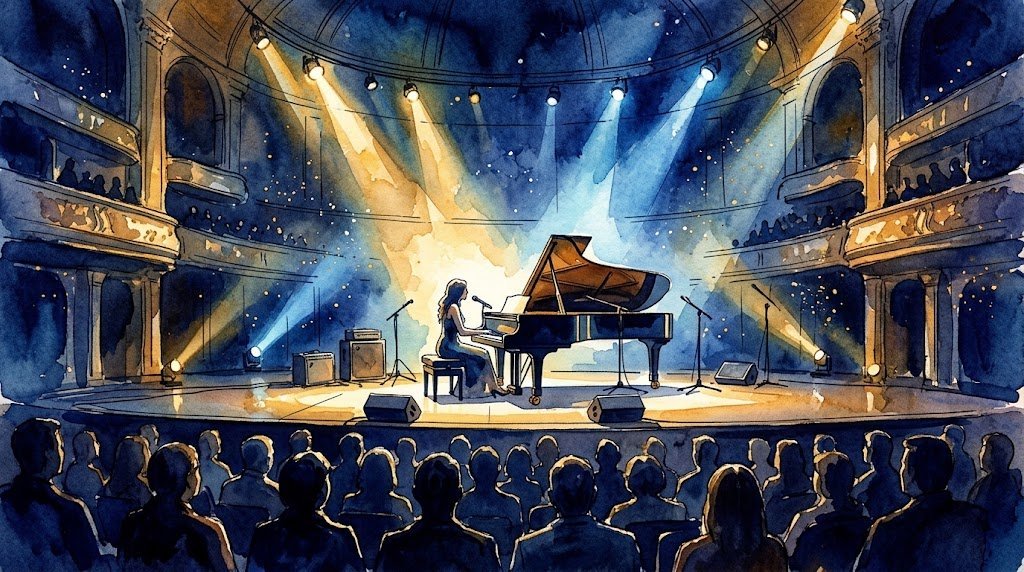 Illustrazione generata con intelligenza artificiale: non è una fotografia dell’Auditorium Parco della Musica né dell’evento.
Fiorella Mannoia brings "Fiorella canta Fabrizio e Ivano: Anime salve" to Sala Santa Cecilia at Auditorium Parco della Musica Ennio Morricone, Viale Pietro de Coubertin 30, Rome, on Sunday, May 30, 2027 at 20:30. The title recalls "Anime salve", the album Fabrizio De André and Ivano Fossati released in 1996. Tickets go on sale at 18:00 on October 19, 2026 on the online box office, starting at €49 plus fees. To get to Flaminio and the entrance, use the ATAC journey planner, which takes line changes into account.
The concert
The available source is short: it announces new dates and the start of ticket sales at 18:00 on October 19, 2026. The title of the show is "Fiorella canta Fabrizio e Ivano: Anime salve", Fiorella sings Fabrizio and Ivano.
What we know
Mannoia's 2026 tour is listed under this title in published profiles of the singer. The title names two songwriters: Fabrizio De André and Ivano Fossati, the two artists behind the album "Anime salve" (1996).
What hasn't been published
The set list, the musicians and the length haven't been published. This page therefore tells the story of the people involved and of the album that inspires the evening, without guessing what will be sung. It covers Mannoia's career, the stories of De André and Fossati, the songs on the album and the hall that hosts the concert.
Fiorella Mannoia in brief
Fiorella Mannoia started her career in 1968 and stood out on the Italian scene for her distinctive voice and her interpretations of songs by other artists. She has appeared six times on the Sanremo stage, winning the Critics' Award twice.
Targhe Tenco
With six Targhe Tenco she holds, tied with four other artists, the record for Club Tenco awards, and among women she is the singer who has won the most.
Honors
On June 2, 2005 President Carlo Azeglio Ciampi made her an Officer of the Order of Merit of the Italian Republic. In Benin she received the title of Knight of the Order of the World Council of Pan-Africanism, for introducing Italy to the figure of Thomas Sankara.
A contralto voice
Her voice is in the contralto range and at times almost masculine: for this reason, as published profiles put it, she has always been seen as the voice and the countermelody of an Italian songwriting tradition historically told in the masculine.
From her start to stunt work
The daughter of Sicilian stuntman Luigi Mannoia and of a mother from the Marche, Maria Gabrielli, Fiorella took up her father's trade with her brother Maurizio Stella and her sister Patrizia, working in film as a stunt double, above all for Monica Vitti.
Castrocaro, 1968
She debuted at the 1968 Castrocaro Festival with Gino Santercole's "Un bimbo sul leone". She didn't win, but she got a contract with Carisch and in two years recorded her first singles. The first was "Ho saputo che partivi" backed with "Le ciliegie".
The 1970s
In 1972 she signed with RCA and recorded her first LP with Memmo Foresi, "Mannoia Foresi e co.". In 1976 she moved to Dischi Ricordi.
Film
In the early 1970s she played minor roles in a few spaghetti westerns. She returned to the screen in 2003 and in 2015, in Michele Placido's "7 minuti".
The 1980s: Sanremo and the first Fossati songs
In 1981 she took part in Sanremo for the first time with "Caffè nero bollente". In 1984 she presented "Come si cambia", one of the most important songs of her career, finishing 14th.
The Critics' Award
In 1987 she won the Critics' Award with "Quello che le donne non dicono": the song became the most popular in her repertoire, despite finishing 8th at the Festival. In 1988 she won the Critics' Award for the second year running with "Le notti di maggio", a song by Ivano Fossati.
The album Canzoni per parlare
The album "Canzoni per parlare" (1988) earned her the first of her six Targhe Tenco as best performer. The title comes from the opening line of "Le notti di maggio".
The album Di terra e di vento
At the end of 1989 came "Di terra e di vento": Fossati wrote the opening track "Baia senza vento" and the Italian lyrics of Chico Buarque's "O que será", sung as a duet with her.
The 1990s: Bubola and Fossati
In 1992 came "I treni a vapore", named after the song written by Fossati. The singles "I venti del cuore" and "Il cielo d'Irlanda" are both by Massimo Bubola.
The anthologies and "Gente comune"
On November 18, 1993 the anthology "Le canzoni" came out, and on October 20, 1994 the album "Gente comune", with songs by Bubola ("Camicie rosse", "Che vita sarai"), De Gregori and Fossati ("Piccola, piccola").
Belle speranze and Certe piccole voci
On November 20, 1997 came "Belle speranze", with emerging songwriters like Avion Travel, Pacifico, Daniele Silvestri and Gianmaria Testa. On January 14, 1999 she released her first live album, "Certe piccole voci", double platinum, with a cover of Vasco Rossi's "Sally".
A bond with De André
In 2000 she was a special guest at Sanremo and sang De André's "Il pescatore" and "Oh che sarà". In 2001 she recorded a more mature version of "Il pescatore" on the album "Fragile".
From 2000 to today
In 2006 came "Onda tropicale", a tribute to Brazilian music with duets with Gilberto Gil, Chico Buarque, Carlinhos Brown, Chico César, Djavan, Lenine, Jorge Ben Jor, Adriana Calcanhotto and Milton Nascimento.
"Sud" and "A te"
The album "Sud" came out on January 24, 2012, inspired above all by Pino Aprile's book "Terroni". On October 29, 2013 came "A te", a tribute to Lucio Dalla recorded live in the studio with the Sesto Armonico orchestra.
Combattente and Sanremo 2017
The single "Combattente" came out on September 23, 2016 and previewed the album of the same name, released on November 4. In February 2017 she finished second at Sanremo with "Che sia benedetta". The "Combattente" tour ran to 101 concerts, ending in New York on February 23, 2018.
From 2019 to 2026
"Personale" came out in 2019 and "Padroni di niente" in 2020. In February 2024 she took part in Sanremo with "Mariposa" and won the Sergio Bardotti Award for best lyrics. Her tours include "La versione di Fiorella" (2022), "Luce" (2023), "Fiorella Sinfonica" (2024 and 2025) and, in 2026, this one.
"Anime salve", the album
"Anime salve" is Fabrizio De André's 13th and last studio album. It came out on September 19, 1996 on BMG Ricordi, made with Ivano Fossati, who wrote most of the music.
Reception
Critics gave it the 1997 Targa Tenco. It debuted at No. 1 on the FIMI chart and went triple platinum in Italy. "Smisurata preghiera" won the Premio Lunezia for musical and literary quality.
Four hands at work
Fossati told Riccardo Bertoncelli: "The end result is that Fabrizio wrote 90% of the lyrics, which do contain some ideas and insights of mine, and I wrote 90% of the music, here too with some contributions from him. But it was never planned. It was instinctive."
The artistic legacy
Many consider it De André's artistic and spiritual legacy, although at the time he didn't yet know about the illness that would take his life just over two years later.
Solitude as freedom
Through the songs the songwriter takes a journey into the world of the humble, the outcast and the forgotten. The main theme is solitude in all its forms. The title comes from the etymology of "anime" and "salve", which together mean "solitary spirits".
In praise of solitude
The whole album can be seen as a praise of solitude, understood as a condition that lets you be free and not shaped by society. At his 1998 concert at Teatro Brancaccio in Rome, De André called "Anime salve" a "speech about freedom".
South American and Mediterranean sounds
The arrangements by Piero Milesi, also coproducer, draw on rhythms and themes of South American music, dear to Fossati and De André, and on Caetano Veloso's Tropicália, with echoes of Balkan and Mediterranean atmospheres.
Different languages
The closing choruses of "Princesa" are in Brazilian Portuguese, those of "Dolcenera" and the entire lyric of "Â cúmba" in Genoese, the finale of "Khorakhané" in Romani, and "Disamistade" is a Sardinian word.
The songs, one by one
A few notes on the tracks, drawn from published accounts of the album.
"Princesa" and "Khorakhané"
"Princesa" is based on the autobiographical book by Fernanda Farias de Albuquerque. "Khorakhané (a forza di essere vento)" is a slow ballad about the way of life and the freedom of the Romani people. The final verse in Romani is by Giorgio Bezzecchi and is sung on the album by Dori Ghezzi.
"Anime salve" and "Â cúmba"
The title track is a duet with Fossati, who also appears on "Â cúmba", a dialogue in Genoese between a young man in love (Fossati) and the girl's father (De André).
"Dolcenera" and "Le acciughe fanno il pallone"
In "Dolcenera" the theme is played on accordion by Gianni Coscia, and it was used from 2011 to 2013 as the theme of the TV show "Che tempo che fa". The singer Dolcenera took her stage name from this song. "Le acciughe fanno il pallone" tells the story of an anchovy fisherman. The title is a Ligurian saying.
"Disamistade", "Ho visto Nina volare" and "Smisurata preghiera"
"Disamistade" is a feud between families, in Sardinia. "Ho visto Nina volare" recalls De André's first childhood love. "Smisurata preghiera", drawn from a book by Álvaro Mutis, runs just over seven minutes, with the lyrics sung only in the first three, and closes the album with Riccardo Tesi's diatonic accordion.
Fabrizio De André
Fabrizio De André was born in Genoa, in the Pegli neighborhood, on February 18, 1940. He was known as Faber, a nickname given by his friend Paolo Villaggio for his fondness for Faber-Castell pastels. He belongs to the Genoese school with Bruno Lauzi, Gino Paoli, Umberto Bindi and Luigi Tenco.
The songwriter of the outcasts
He is also called "the songwriter of the outcasts" or "the poet of the defeated". In almost 40 years of activity he recorded 14 albums, and many of his songs tell stories of outcasts, rebels and prostitutes.
Language
With anarchist and pacifist ideas, he championed the Ligurian language and, to a lesser extent, Gallurese and Neapolitan.
His death
He died at 02:30 on January 11, 1999 at Istituto Nazionale dei Tumori in Milan. Two months after his death the De Fabula award was created, later renamed the Premio Fabrizio De André.
Ivano Fossati
Ivano Fossati was born in Genoa in 1951 and is considered one of the most important Italian songwriters. In more than 40 years he has ranged from progressive rock to a rock phase, through to the cultured introspection of his mature work.
The early years
After hearing two Beatles singles he left the piano for the guitar. In 1967 he founded the beat group I Poeti in Genoa, and in 1971 he joined the Sagittari, later Delirium, with whom he presented "Jesahel" at Sanremo 1972.
The collaboration with De André
Their paths crossed when De André took part in "La pianta del tè". Fossati then cowrote with him two Genoese lyrics on "Le nuvole", "Mégu megún" and "Â çímma". "Anime salve" got started in Longiano, in Romagna, in 1995.
Retirement
On October 2, 2011 he announced his retirement from the stage on "Che tempo che fa". His last TV appearance was on January 23, 2012, with his friends Zucchero Fornaciari and Fiorella Mannoia. On March 19, 2012 he closed his tour at Piccolo Teatro di Milano. In November 2019 he came back with "Mina Fossati".
A quip from Faber
De André said of him: "the colleague I respect most, he has only two flaws: he's a friend of mine, and sadly he's a Sampdoria fan".
Fossati: the records
La mia banda suona il rock (1979) was recorded at Criteria Studios in Miami with musicians from the circle of Eric Clapton and Stephen Stills. The title track made Fossati known to the general public, even though he tried in many ways to disown it.
Panama and beyond
The next album revisits the ballad "La costruzione di un amore", written in 1978 for Mia Martini, and has arrangements by keyboardist Steve Robbins.
For Loredana Bertè
In 1982 he wrote "Non sono una signora", from Loredana Bertè's album "Traslocando", which won the Festivalbar and went platinum.
The album "La pianta del tè", 1988
This is the album with "Questi posti davanti al mare", sung with Fabrizio De André and Francesco De Gregori, which won the Targa Tenco for song of the year.
"Discanto" and "Lindbergh"
After a long trip to Portugal came "Discanto", on which Fiorella Mannoia sings the countermelody of "Piumetta". Fossati wrote "I treni a vapore", "Le notti di maggio" and "L'amore per l'amore" for her. "Lindbergh, Lettere da sopra la pioggia" is from 1992.
Off the stage
Since 2012 he hasn't released new albums or toured. He came back with "Mina Fossati" in November 2019.
De André after "Rimini"
In 1984 came "Creuza de mä", an album devoted to the Mediterranean world, made with Mauro Pagani. In 1990 "Le nuvole" marked a partial return to his most typical style, with songs in dialect and an ethnic inspiration.
Forgiveness
His kidnapping in Sardinia gave rise to songs on the 1981 album known as "L'indiano": at the trial De André confirmed that he forgave his captors.
Collaborations
Over his career he worked with the New Trolls, Mina, Nicola Piovani, Premiata Forneria Marconi, Tazenda, Ivano Fossati, Mauro Pagani, Massimo Bubola, Fernanda Pivano and Francesco De Gregori.
Tours
Between 1975 and 1998 he made 12 tours, only one of them in Europe. On the second he was backed by Premiata Forneria Marconi, who handled all the new arrangements.
Mannoia, concerts and friends
On October 27, 2014, for her 60th birthday, the two-disc anthology "Fiorella" came out, with duets with Laura Pausini, Enrico Ruggeri, Daniele Silvestri, Massimo Bubola, Adriano Celentano, Claudio Baglioni, Frankie HI-NRG, Franco Battiato, Dori Ghezzi, Pino Daniele, Ivano Fossati and many others.
The song for Perfetti sconosciuti
In 2016 she wrote and sang the title song of Paolo Genovese's film "Perfetti sconosciuti", which earned her the Nastro d'argento for best original song.
Friends at the Arena
On September 19, 2016 she was artistic director of the closing night of "Amiche sì" at Arena di Verona, a concert supporting the fight against femicide, with Patty Pravo, Gianna Nannini, Elisa, Emma, Noemi and other artists.
Philanthropy
She has supported Emergency, and in 2006 she won the Premio simpatia, Rome's award for solidarity.
Arena di Verona 2015
On September 7, 2015 she closed the "Fiorella" tour at Arena di Verona, in an evening for AIRC, the Italian cancer research association.
Who played on "Anime salve"
The lineup listed for "Princesa" includes Fabrizio De André on vocals, Ellade Bandini on drums, Pier Michelatti on bass, Michele Ascolese on classical guitar, Massimo Gatti on mandolin and mandola, Sàndor Kuti on cimbalom, Vladimir Denissénkov on bayan, Giancarlo Porro on clarinet and Piero Milesi on cello.
The voices
On backing vocals are Dori Ghezzi, Luvi De André, Silvia Paggi, Beppe Gemelli and others. In the spoken parts, Neusinha Escorel, Patricia Figueredo and Rosa Emilia.
Naco
Percussionist Naco, born Giuseppe Bonaccorso, died in a road accident a few months before the release. He plays on every track with many instruments, some of them unconventional, and the album is dedicated to him in the credits.
A tribute after 1996
In 2005 the collection "In direzione ostinata e contraria" dedicated the song "Anime salve" to the memory of bassist Stefano Cerri. In 2007 Antonella Ruggiero sang it on the album "Genova, la Superba".
An address for a song
In 2021 in Aulla the first square in Italy named after a song was dedicated to "Smisurata preghiera", on the initiative of the Premio Lunezia. In 2025 in Sanremo, during the renovation of the Hotel Europa Palace, an installation inspired by "Le acciughe fanno il pallone" was commissioned.
Sala Santa Cecilia
Sala Santa Cecilia has 2,756 seats and is the largest of the three concert halls. It stands at the most visually striking point as seen from the parking lot.
The ceiling
The ceiling is made of 26 shells in American cherry wood, each about 180 square meters, and the whole hall works as a sounding board. The reverberation time is 2.2 seconds, a feature unique in Italy.
The gallery
Around the stage, including behind it, there's a gallery with more seats, perhaps not the best acoustically.
A hall for classical music
It was designed specifically for classical music, but it also hosts other genres, like this songwriter concert. It was inaugurated on December 21, 2002 with Accademia di Santa Cecilia orchestra conducted by Chung Myung-whun.
A curious fact: the thread that runs through Fossati
In Mannoia's story Fossati's name keeps coming back: "Le notti di maggio" in 1988, "Baia senza vento" and the duet "O que será" in 1989, "I treni a vapore" in 1992 and "Piccola, piccola" in 1994.
A show title
In January 2021 Mannoia hosted "La musica che gira intorno" on Rai 1, a title that's also the name of a Fossati song.
A guest in 2012
Mannoia was among the friends at his last TV appearance, on January 23, 2012.
Something nobody tells you about this title
The title "Fiorella canta Fabrizio e Ivano" is the formula of a tribute, but the source doesn't say if you'll hear only songs from "Anime salve" or other songs by the two songwriters too.
How to read the subtitle
The subtitle "Anime salve" is the title of the 1996 album. The set list hasn't been published.
What to do
If you want to arrive prepared, listen to the album before the concert: it's the length of a record, and the songs are the ones described above.
My tip for visiting Sala Santa Cecilia
For a songwriter concert, where the lyrics matter, choose a seat where you can hear the voice well. Published acoustic descriptions of the hall say that sound intensity decreases up to the 10th row and then seems to stay constant.
The gallery behind the stage
Avoid, if you can, the seats in the gallery that surrounds the stage, because the acoustics, according to the same descriptions, may not favor them.
Arrive early
There are only two elevators to reach the galleries, and published accounts report inadequate facilities at the busiest times.
A well-known fact: Faber and Rome
In 1998 De André gave a concert at Teatro Brancaccio in Rome, during which he called "Anime salve" a speech about freedom. The concert was later released on the album "Ed avevamo gli occhi troppo belli".
His songs in school
Some of his songs, for their poetic value, made it into school anthologies as early as the 1970s, and the poet Mario Luzi praised him.
A 2019 tribute
In 2019 Vasco Brondi recorded a cover of "Smisurata preghiera" on the tribute album "Faber nostrum".
The right photo at Auditorium
The classic subject is the outside: the beetle-shaped halls, clad in lead over a brick base, around the cavea. Santa Cecilia is the hall you see right away from the parking lot.
The terrace
From the terrace that runs around the buildings, between Santa Cecilia and Sinopoli, you can see the remains of the Roman villa discovered during construction.
The museum
The finds are in the small museum under the cavea.
Some important events that happened here in history
Sala Sinopoli opened on April 21, 2002. On December 21 of the same year the rest of the complex opened, with Santa Cecilia.
2003 and 2006
Since 2003 Auditorium has been the permanent home of Accademia Nazionale di Santa Cecilia season, and since 2006 it has hosted the Rome Film Fest.
2020
The City Council approved naming it after Ennio Morricone.
Who has passed through here
Live recordings made here include albums by Keith Jarrett, Mark Knopfler, Vinicio Capossela, Tuxedomoon and William Parker.
Live records
Fennesz and Sakamoto (2005), Enrico Rava and Joe Lovano (2014), The National (2024).
Accademia
Auditorium is home to Accademia Nazionale di Santa Cecilia: the 2026 and 2027 season.
Renzo Piano and Parco della Musica
The design is by Renzo Piano, winner of the 1993 invited competition. The complex is in Parioli, between Villa Glori, the Olympic Village and the Corso di Francia viaduct.
The excavations
The remains of a Roman villa discovered during construction led to changes in the design: two of the beetles were moved west and Viale De Coubertin was closed to traffic.
Management
Fondazione Musica per Roma, founded on July 19, 2004, runs Auditorium, granted for use by the City for 99 years. More information on the Auditorium Parco della Musica page.
The criticism
Published accounts mention the acoustics in the first months, expensive parking, a troubled construction site and the lack of a pipe organ in the hall.
The Ministry
The building is listed in the Census of Italian Architecture from 1945 to Today, meeting all seven criteria.
In the area
Ponte della Musica, 190 meters long, connects Flaminio to Foro Italico. In the area are MAXXI and the park of Villa Glori.
The bridge
It was inaugurated on May 31, 2011 and has been named after Armando Trovajoli since 2013.
Practical information
- Date and time: Sunday, May 30, 2027, at 20:30.
- Venue: Sala Santa Cecilia, Auditorium Parco della Musica Ennio Morricone, Viale Pietro de Coubertin 30, 00196 Rome.
- Tickets: on sale from 18:00 on October 19, 2026 on the online box office.
- Price: from €49 plus fees (according to the online box office, October 23, 2026).
- Set list and length: not published.
How to get there
Lines 910, 982, 168 (weekdays only) and 53 stop in front of the entrance. The nearest metro is at Piazzale Flaminio. Use the ATAC journey planner.
Frequently asked questions about Fiorella Mannoia and Anime salve
When and where is the concert?
Sunday, May 30, 2027 at 20:30, Sala Santa Cecilia, Auditorium Parco della Musica Ennio Morricone, Viale Pietro de Coubertin 30, Rome.
When do tickets go on sale?
Tickets are on sale from 18:00 on October 19, 2026 on the online box office, starting at €49 plus fees.
What is Anime salve?
Fabrizio De André's last studio album, released on September 19, 1996 and made with Ivano Fossati, who wrote most of the music.
Who is Ivano Fossati?
A songwriter from Genoa born in 1951, retired from the stage in 2012, who wrote songs for Mannoia like "Le notti di maggio" and "I treni a vapore".
Which songs will be performed?
The set list hasn't been published. The title points to "Anime salve" and to the two songwriters.
How many seats does Sala Santa Cecilia have?
It has 2,756 seats and is the largest of the three concert halls at Auditorium.
Who designed Auditorium?
Renzo Piano, winner of the 1993 invited competition. The three beetle-shaped halls are clad in lead and arranged around the cavea. Santa Cecilia was inaugurated on December 21, 2002 with the Accademia orchestra conducted by Chung Myung-whun.
What has Mannoia won at Sanremo?
She has won the Critics' Award twice, in 1987 with "Quello che le donne non dicono" and in 1988 with "Le notti di maggio". In 2017 she finished second with "Che sia benedetta".
How do you get there by public transit?
Several bus lines stop in front of the entrance. The nearest metro is at Piazzale Flaminio. Check your route with the ATAC journey planner.
Final tip on Fiorella Mannoia
Listen to "Anime salve" in full, at least "Smisurata preghiera" and "Â cúmba", and listen again to "Le notti di maggio" in Mannoia's version. In a hall with 2,756 seats, choose your seat well in advance.
Article written by the editorial team of Tour Leader Pro, contact them for Private/Corporate/V.I.P. Tours and Experiences.
Planning a trip to Rome? The English-language guides for visiting the city are on ItalyPlanner.com.