Et in Arcadia ego at Casa di Goethe, December 2, 2026 to April 4, 2027
https://www.estateromana.com/en/rome/trip-planner/et-in-arcadia-ego-at-casa-di-goethe-december-2-2026-to-april-4-2027/
Et in Arcadia ego. Goethe in dialogue with Guercino, Raphael and Poerio is the exhibition that Casa di Goethe opens from December 2, 2026 to April 4, 2027 in the apartment at Via del Corso 18, a stone's throw from Piazza del Popolo, with an opening on Tuesday, December 1, 2026. The museum is open Tuesday to Sunday from 10:00 to 18:00, with last entry at 17:30, and is closed on Monday. During the holidays it stays closed from December 24 to 26 and from December 29 to January 1. The nearest metro stop is Flaminio, on Line A. For buses the museum refers to the ATAC route planner, and those arriving by car can leave it in the Villa Borghese parking lot. The full ticket costs €6, the reduced €5, the family card €17. Children up to age 10 get in free. Tickets are bought at the museum's cashier, and all conditions are published on the official Casa di Goethe website.
Et in Arcadia ego at Casa di Goethe: the exhibition in brief
Et in Arcadia ego is the exhibition that, for the first time, systematically explores Goethe's encounter with Italian art during the 1786-1788 journey.
The theme
The point of view is that of the German poet who came to Italy to find himself again and to quench what he himself called the thirst for “true art.” The path puts at the center the works and artists who shaped his way of looking at art, nature and culture: Guercino, Raphael, Giovanni Battista Piranesi. The official presentation insists on a precise point: Goethe found true art above all in three seasons, antiquity, the Renaissance and the Baroque, and the exhibition follows precisely this triple thread.
The dates
The exhibition is open from December 2, 2026 to April 4, 2027, that is, four full months that cross the year-end holidays, Carnival and spring. The opening is set for Tuesday, December 1, 2026, the evening before opening to the public.
The partners
The project is carried out by Casa di Goethe together with the Klassik Stiftung Weimar, the Istituto Italiano di Studi Germanici and the Bibliotheca Hertziana, the Max Planck Institute for art history based in Rome. The exhibition is part of the celebrations for the 75th anniversary of the resumption of diplomatic relations between Germany and Italy.
What you see in the Et in Arcadia ego exhibition
The exhibition brings paintings, prints, historic objects and manuscripts into dialogue with Goethe's letters and writings, so that the poet's Italian experience becomes concrete, room after room.
Guercino's painting
The starting point of the story is Et in Arcadia ego, the painting by Giovanni Francesco Barbieri known as Guercino. In the canvas the motif of Arcadia, the ideal land of shepherds and poetry, is intertwined with the thought of transience and death: the beauty of the happy place and the awareness of the end live together in the same image. On the date the museum's indications do not coincide: the presentation text speaks of a work made around 1620, the caption of the official image gives 1618. The same caption specifies the measurements, 82 by 91 centimeters, and the location of the canvas, which belongs to Palazzo Barberini in Rome.
The motto of the Italian Journey
For Goethe Rome was the place of a “true rebirth,” his personal Arcadia. The exhibition recalls it through the motto that the poet placed as an epigraph to the Italian Journey, published in 1816-1817: “I too in Arcadia!” It is the thread that links the title of the exhibition, taken from Guercino's painting, to the writer's human and literary story.
Raphael and the skull cast
A central place is reserved for Raphael, whom Goethe venerated as the greatest of all artists. Copper engravings from his works are placed beside a historic plaster cast that the poet believed to be the cast of Raphael's skull, and which he admired in Rome in 1787. It is one of the most curious objects of the path, because it measures Goethe's devotion to the painter from Urbino.
Rome and antiquity according to Piranesi
A section shifts the gaze to the city and to the ancient. Views of Rome and rare engraved plates by Giovanni Battista Piranesi convey the perception Goethe had of the Eternal City. The works are accompanied by quotations from the poet's letters and writings, so that the visitor can read his words next to the images that had inspired them.
The manuscript of Alessandro Poerio
Another chapter concerns the reverse path: Goethe's fortune in Italy. His works were translated several times into Italian, and the exhibition presents for the first time the manuscript of the first Italian translation of Iphigenia in Tauris, made in 1826 by the Neapolitan writer and patriot Alessandro Poerio (1802-1848). The manuscript was found only recently in the Duchess Anna Amalia Library in Weimar.
The travel cloak
Among the most evocative objects is Goethe's travel cloak, displayed in a faithful copy of the original lent by the Klassik Stiftung Weimar. It is the symbol of the journey that was decisive for the poet's personal growth and that left a deep mark on all his production.
Who was Johann Wolfgang von Goethe
Johann Wolfgang von Goethe was born in Frankfurt am Main on August 28, 1749 and died in Weimar on March 22, 1832: he was a poet, novelist, playwright, essayist, scientist, art critic, and also a draftsman.
Studies and the young writer
Goethe's education passes through Leipzig, where he studied from 1765 to 1768, and Strasbourg, where he stayed in 1770-1771. In the following years came the drama Götz von Berlichingen and the stay in Wetzlar in 1772, from which came the experience the writer turned into a novel. The Sorrows of Young Werther, from 1774, tells of the unhappy love of a young intellectual for Charlotte, betrothed to another, and made him famous across Europe.
Weimar before Italy
From 1775 to 1786 Goethe lived in Weimar, where he held public offices. In those years he met, among others, the poet Klopstock, the Swiss theologian Johann Caspar Lavater, a passionate physiognomist, and the philosopher Jacobi, who pushed him to deepen his study of Spinoza. From Rome, in a letter to Duke Carl August of January 25, 1788 cited by the museum, he wrote that the main purpose of the journey was to heal the physical and moral ills that tormented him in Germany and to quench the thirst for true art.
The journey in Italy
The journey in Italy lasted from September 3, 1786 to June 18, 1788. Goethe arrived in Trento on September 10, continued to Rovereto and Torbole. In Malcesine he was stopped on suspicion of being a spy while he was drawing the castle, and freed as soon as his identity was clarified. Lake Garda won him over, Verona and its Arena thrilled him. In Vicenza he studied the architecture of Andrea Palladio and admired Villa Valmarana ai Nani with the Tiepolo frescoes. On September 28 he arrived in Venice, where he stayed 16 days and where, at the Lido, he saw the sea for the first time.
Rome, Naples, Sicily
In Rome he lived at Via del Corso 18 and rewrote Iphigenia in Tauris in verse. Between February and June 1787 he was in Naples, where he met the painter Jakob Philipp Hackert and the jurist Gaetano Filangieri, climbed Vesuvius twice while erupting, visited Pompeii, Herculaneum, Paestum. Then Sicily: Palermo, Segesta, Selinunte, Agrigento, Catania, Taormina, Messina. It is from that journey that comes the phrase that Italy without Sicily leaves no image at all in the spirit, because in Sicily lies the key to everything. After a second stay in Naples he returned to Rome, where he stayed more than a year, commissioned the sculptor Alexander Trippel to make his marble bust and developed the Roman Elegies. In Italy he also completed the drama Torquato Tasso.
The return to Weimar and the final years
On his return to Weimar he found a cold reception. He gave up almost all his offices and bound himself to Christiane Vulpius, with whom he had five children: only August survived. The Roman Elegies caused scandal for their sensuality. Goethe also devoted himself to anatomy and optics. From 1794 his friendship with Friedrich Schiller pulled him out of a long creative crisis. In 1808 he met Napoleon, who addressed to him the famous phrase “Voilà un homme” and made him a knight of the Legion of Honor on October 14 of that year.
Casa di Goethe: the apartment at Via del Corso 18
Casa di Goethe is the museum that occupies the apartment where Goethe lived during his Roman stay, together with his friend the painter Johann Heinrich Wilhelm Tischbein, on the first floor of the building at Via del Corso 18, in the Campo Marzio district.
The only German museum abroad
The museum opened on May 30, 1997 and is the only German museum outside Germany. It belongs to AsKI, the German association of autonomous cultural institutes based in Bonn, and is financed by the Federal Government Commissioner for Culture and the Media. Since its opening it has commemorated with exhibitions and cultural events the most famous guest of this address. From 1997 to 2013 it was directed by Ursula Bongaerts, today the director is Gregor H. Lersch.
The history of the building
For more than a century, from 1824 to 1948, the building was owned by the Bracci family, descendants of the sculptor Pietro Bracci. In 1948 the last heir left the building to the Mensa Vescovile of Civita Castellana. The building's story is reconstructed in Dorothee Hock's volume Via del Corso 18. Storia di un indirizzo, published by the museum in 2013.
The permanent collection
The rooms of the permanent collection tell the poet's Italian journey and Roman stay with letters, paintings, drawings, books and documents. There are original drawings by Jakob Philipp Hackert, Tischbein and Christoph Heinrich Kniep. Alongside these, modern works that dialogue with the poet's myth: the portrait of Goethe by Andy Warhol, a work by Luigi Ontani, a sculpture by Andreu Alfaro.
Temporary exhibitions and the library
Four rooms are intended for temporary exhibitions, usually dedicated to cultural relations between Italy and Germany and to the tradition of the journey to Italy up to the present day: this is where Et in Arcadia ego is set up. One room houses the library with the Richard W. Dorn collection, which includes first editions of Goethe's works. On the second floor are the other holdings of the specialized library and the historic library of the Deutscher Künstlerverein, the association of German artists founded in 1848. The library can be consulted by appointment only.
How to get to Casa di Goethe
Casa di Goethe is at Via del Corso 18, at the end of the Corso toward Piazza del Popolo, and the metro stop indicated by the museum is Flaminio, on Line A.
By metro
From the Flaminio stop on Line A you reach Piazza del Popolo through the Porta del Popolo. From the square you take Via del Corso, where number 18 is on the first stretch of the street, on the side of the square.
By bus
The museum does not list specific lines and refers to the ATAC website: the advice is to use the company's route planner, entering Via del Corso 18 as the destination, to get the lines valid on the day of your visit.
By car
Via del Corso is in the historic center and the museum gives the Villa Borghese parking lot as a reference. From there you walk down toward Piazza del Popolo. In any case it's best to consider the car as a last choice: the metro brings you practically to the door.
Times and tickets for Et in Arcadia ego
Et in Arcadia ego is visited during the museum's hours: Tuesday to Sunday from 10:00 to 18:00, with last entry at 17:30. On Monday the museum is closed to the public, while the offices stay open.
Closures during the exhibition
During the exhibition period the fixed closures published by the museum apply: December 24 to 26 and December 29 to January 1. Anyone planning to visit the exhibition during the holidays must therefore choose between December 27 and 28 or the days from January 2 onward.
The rates
The full admission costs €6. The reduced rate, €5, is for students, people over 65, journalists and members of several associations and circuits, including ACI, ARCI, Bibliocard, FAI, Touring Club Italiano and Roma Pass holders. The family card, for two adults with at most three children up to 18, costs €17. Children up to 10, people with disabilities together with whoever assists them, and ICOM members get in free.
Discount with the Keats-Shelley House
Those who visited the Keats-Shelley House in the previous three days are entitled to a €1 discount. It is a small incentive that links two houses of foreign poets in Rome, and suggests dedicating a morning to both.
During re-installations
The museum specifies that, during periods of exhibition re-installation work, admission is reduced for everyone. In the days close to the December 2 opening it's therefore best to check the official website, to know which rooms can be visited.
Accessibility and visiting with children
Casa di Goethe is on the first floor of the building at Via del Corso 18 and is reached by an elevator, 59 centimeters wide, which limits access for wheelchair users.
Elevator and facilities
The museum notes the presence of an elevator and a restroom for people with disabilities. The elevator's measurement, 59 centimeters wide, is however a fact to consider carefully: wheelchair users do well to contact the museum before the visit, at 06 326 504 12 or at info@casadigoethe.it.
With children
For families the best-value ticket is the €17 family card, and children up to 10 get in free. The museum is compact and the visit is not long: for the youngest, the easiest objects to tell about are the travel cloak and the cast that Goethe believed to be Raphael's skull.
What to see around Casa di Goethe
Casa di Goethe is a few steps from Piazza del Popolo, and the visit to the exhibition combines easily with other places in the Tridente and Villa Borghese.
Piazza del Popolo and its churches
Leaving the museum toward the north you arrive in the square, where Santa Maria del Popolo and the twin churches that mark the start of Via del Corso face onto it.
The Pincio and Villa Borghese
From the square you climb to the Pincio and from there you enter Villa Borghese: a walk that completes the visit with greenery and a wide view of the city.
Guercino at Palazzo Barberini
Those who want to go deeper into the exhibition's theme can plan a visit to Palazzo Barberini, where the exhibition's official caption places Guercino's canvas Et in Arcadia ego.
Toward Piazza di Spagna
Walking along Via del Babuino you reach Piazza di Spagna and the Keats-Shelley House: with the reciprocal ticket discount, the two house museums form a compact literary itinerary.
Where to eat near Casa di Goethe
The area between Piazza del Popolo, Via del Corso and the Tridente offers bars, historic cafés and restaurants in every price range, for a break before or after the exhibition.
A quick break
For a coffee or a snack, the side streets of Via del Corso are quieter than the main axis. If you visit the exhibition in the morning, you can arrive at the 10:00 opening and stay for lunch in the area.
Dinner after the visit
The museum closes at 18:00: in winter it is already dark, and the Tridente lends itself to an aperitivo or a dinner. On weekends and around the holidays it's best to book.
A curiosity about Et in Arcadia ego at Casa di Goethe, December 2, 2026 to April 4, 2027
The most surprising curiosity of the exhibition is an object that, strictly speaking, is not what Goethe believed: the plaster cast that the poet considered the cast of Raphael's skull. Goethe admired it in Rome in 1787, and the exhibition displays it next to the copper engravings from the works of the painter from Urbino. The wording chosen by the museum is precise: it is a cast that Goethe believed to be that of Raphael's skull. In that caution lies all the distance between eighteenth-century devotion to great artists and historical verification.
For Goethe Raphael was the greatest of all artists, and contact with an object tied to his body had the value of a secular relic. The poet, who in the same Rome had rediscovered his enthusiasm for art, saw in the Renaissance painter the highest point of a balance between nature and form that he also sought in his own writing.
There is also a second curious element, tied to the title. In Guercino's painting, as the museum explains, Arcadia as an ideal place is intertwined with the experience of transience and death. Goethe reversed the meaning of that motto and turned it into a declaration of personal happiness, “I too in Arcadia!,” placed as an epigraph to the Italian Journey. The exhibition plays precisely on this shift: from Baroque melancholy to the joy of a man who in Rome feels reborn.
Something nobody tells you about Et in Arcadia ego at Casa di Goethe, December 2, 2026 to April 4, 2027
What is rarely remembered is that Casa di Goethe is a small museum, on the first floor of a private building, with an elevator just 59 centimeters wide. It does not have the scale of the big Roman exhibition venues: the temporary exhibition rooms are four, and the path is visited calmly in a short time. For those who arrive used to the big museums, this size is an advantage: you see the works up close, you read Goethe's letters without hurry, you go back when you want.
A second little-known thing concerns the ticket. The museum applies the reduced rate to everyone during exhibition re-installation work, and offers a €1 discount to those who visited the Keats-Shelley House in the previous three days. They are minimal details, but they say a lot about the spirit of the place, which considers itself part of a network of foreign writers' houses in Rome.
Finally, the museum is also a study center. On the second floor, in an apartment bought in 2009 and inaugurated in 2012, there are the library of the Deutscher Künstlerverein, a guesthouse for fellows and a room for meetings. The scholarship program, now supported by the Karin und Uwe Hollweg Stiftung of Bremen, funds cultural exchange projects between Italy and Germany. The exhibition on Goethe and Italian art is, in this sense, the showcase of a research effort that continues all year.
My advice for visiting Et in Arcadia ego at Casa di Goethe, December 2, 2026 to April 4, 2027
My advice is to arrive at Casa di Goethe after having read a few pages of the Italian Journey, in particular the letters from Rome. The exhibition works precisely on the encounter between the works and the poet's words: the quotations from the letters and writings accompany paintings, prints and objects, and the effect is much stronger if those phrases already sound familiar.
On the practical side it's best to choose a weekday, in the morning, at the 10:00 opening. The museum closes on Monday and during the holidays it stays closed from December 24 to 26 and from December 29 to January 1: anyone planning a Christmas visit must keep this in mind. The last entry is at 17:30.
A second tip concerns the itinerary. The exhibition lends itself to a literary morning: first the Keats-Shelley House at Piazza di Spagna, then Casa di Goethe, taking advantage of the €1 discount the museum offers to those who visited Keats's house in the previous three days. Alternatively, after the exhibition you can climb to the Pincio and continue to Villa Borghese.
Finally, in our view it is worth spending a few minutes also on the permanent collection, with the drawings by Hackert, Tischbein and Kniep and the portrait of Goethe by Andy Warhol: they complete the story of the exhibition and help understand why this very apartment became the place of Goethe's memory in Rome.
Another well-known fact, yet rarely mentioned
It is known that Goethe loved Italy. Much less cited is the fact that Italy returned the feeling by translating him very early, and that the first Italian translation of Iphigenia in Tauris stayed hidden for two centuries. It was made in 1826 by Alessandro Poerio, a writer and patriot who lived between 1802 and 1848, and the manuscript was found only recently in the Duchess Anna Amalia Library in Weimar. Et in Arcadia ego presents it to the public for the first time.
The link between the work and Rome is direct. Iphigenia in Tauris had been born in prose. It was during the Italian stay, and in particular in Rome, that Goethe rewrote it in verse, giving it its definitive form. The drama, judged the gospel of modern humanism, tells of a protagonist who with her moral strength saves her brother from madness and King Thoas from injustice. That the first Italian version came from a patriot of the Risorgimento says a lot about how that figure of dignity and freedom could speak to Italian readers of the nineteenth century.
The exhibition devotes a whole section to this round-trip path: the Italian experience changes Goethe's writing, and his works return to Italy through translations. It is the least told side of the myth of the journey to Italy.
The right photo to take at Et in Arcadia ego at Casa di Goethe, December 2, 2026 to April 4, 2027
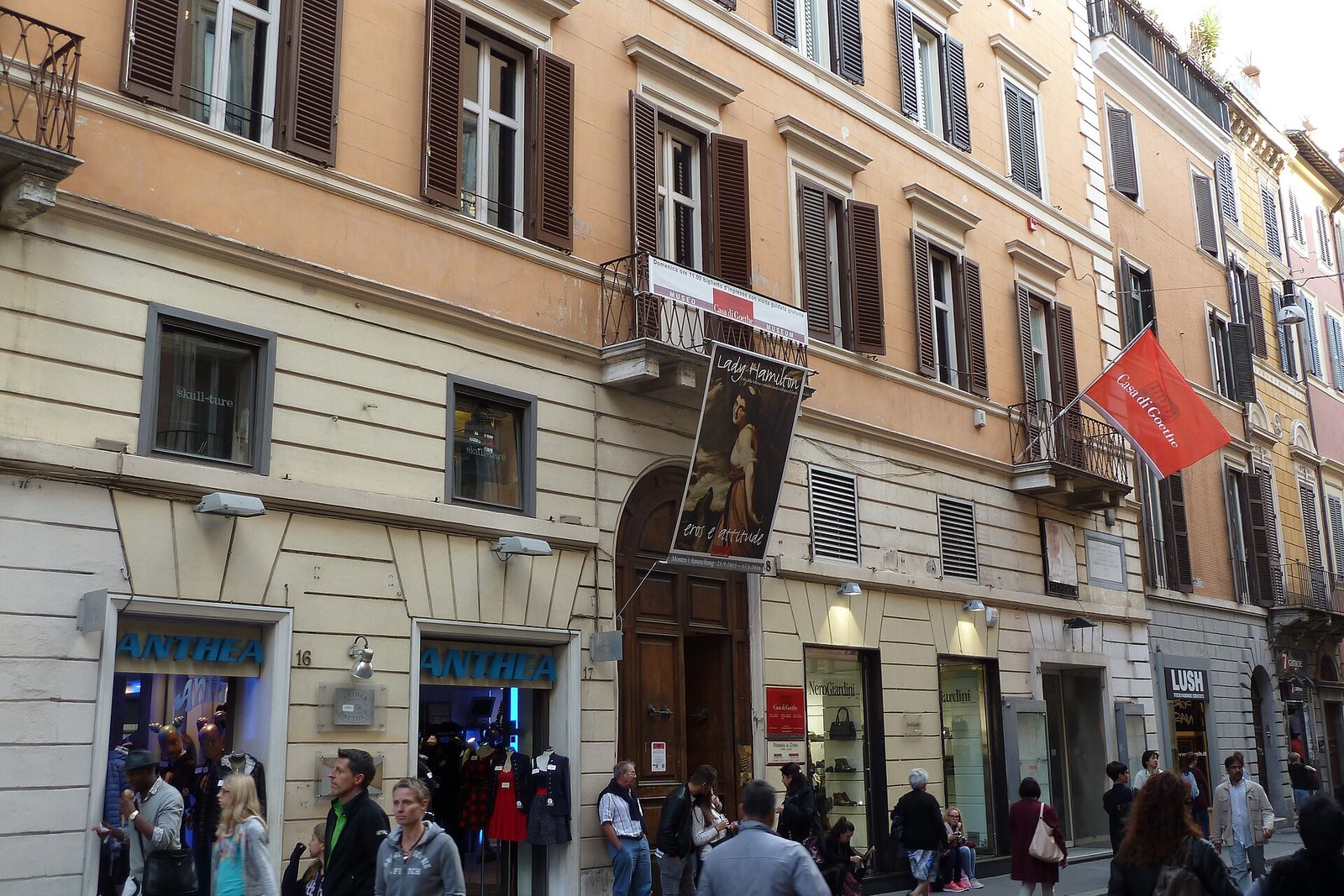
The most recognizable photo to take is the facade of the building at Via del Corso 18, with the museum entrance, before going up: it is the exact address where Goethe lived in Rome, and the image of the main door on the most famous street of the center tells the relationship between the poet and the city better than any caption.
A second image concerns the windows. In 1787 Tischbein, who shared the apartment with Goethe, portrayed his friend leaning out of the window of the Roman house: it is one of the most famous portraits of the poet. A photo from the street toward the first-floor windows recalls that scene.
For the exhibition rooms, the rules on photography must be asked of the museum staff at the entrance, because in temporary exhibitions lenders may set different conditions. If photography is allowed, the travel cloak and the cast of the alleged skull of Raphael are the strongest subjects.
Finally, outside the museum, the late-afternoon winter light on Piazza del Popolo, seen from the start of Via del Corso, closes the visit with a wide shot, on the side of the square from which Via del Corso starts.
Some important events that happened here in history
The first event that makes Via del Corso 18 special is Goethe's stay, who lived here during the journey to Italy, between 1786 and 1788, together with the painter Johann Heinrich Wilhelm Tischbein. In these rooms the poet rewrote Iphigenia in Tauris in verse. In Rome he commissioned the marble bust from Alexander Trippel and developed the experience that would give rise to the Roman Elegies.
The building then passed to the Bracci family, descendants of the sculptor Pietro Bracci, who owned it from 1824 to 1948. In 1948 the last heir left it to the Mensa Vescovile of Civita Castellana.
On October 29, 1973 a first museum dedicated to Goethe was inaugurated, in some rented rooms on the second floor. It was a private institution with little public funding and from the summer of 1982 it was no longer accessible. A few years later AsKI was commissioned to found a new museum: in 1990 it bought the entire first floor and important restorations followed.
On May 30, 1997 Casa di Goethe opened. In 2009, with the support of the German Parliament, AsKI bought an apartment on the second floor, inaugurated in 2012: by coincidence it was the same one that had housed the first Goethe museum in 1973. The exhibition Et in Arcadia ego, tied to the 75th anniversary of the resumption of diplomatic relations between Germany and Italy, fits into this long story.
Who has come through Et in Arcadia ego at Casa di Goethe, December 2, 2026 to April 4, 2027
The first name is obviously that of Johann Wolfgang von Goethe, who lived in this apartment during his Roman stay. With him lived Johann Heinrich Wilhelm Tischbein, the German painter who portrayed his friend in 1787 leaning out of the window of the house and who also signed the famous portrait of Goethe in the Roman Campagna.
Through their works, other protagonists of Goethe's journey have passed through the museum's rooms. Jakob Philipp Hackert, the painter the poet met in Naples, is present with original drawings in the permanent collection, and so is Christoph Heinrich Kniep. Alongside them, the collection hosts Andy Warhol's portrait of Goethe, a work by Luigi Ontani and a sculpture by Andreu Alfaro.
With Et in Arcadia ego, the great names Goethe admired also arrive at Via del Corso: Guercino, with the painting that gives the exhibition its title, Raphael, with engravings from his works, Giovanni Battista Piranesi, with views and rare engraved plates. And Alessandro Poerio arrives, the Neapolitan translator of Iphigenia in Tauris, whose manuscript is displayed for the first time.
Finally, among the people who made the museum's history, Ursula Bongaerts, director from 1997 to 2013, and Dorothee Hock, author of the volume devoted to the history of the address at Via del Corso 18, should be remembered.
Rome between December and April: the exhibition period
Et in Arcadia ego covers winter and the start of spring, from December 2, 2026 to April 4, 2027, and this changes the way to organize the visit.
The year-end holidays
December brings many visitors to Rome, and the historic center around Via del Corso is particularly lively. The museum's closures from December 24 to 26 and from December 29 to January 1 narrow the possibilities: it's best to set the visit before December 24 or after January 2.
January and February
The central months of winter are the quietest for a compact exhibition like this one. The days are short, and a morning visit lets you use the light also for a walk to the Pincio.
The last weeks
The exhibition closes on Sunday, April 4, 2027. Those who want to see it calmly would do well not to leave it to the last days, when spring visitors begin to arrive in Rome.
Frequently asked questions about Et in Arcadia ego at Casa di Goethe
When is the Et in Arcadia ego exhibition open at Casa di Goethe?
The Et in Arcadia ego exhibition is open at Casa di Goethe from December 2, 2026 to April 4, 2027, with an opening on Tuesday, December 1, 2026. The museum is open Tuesday to Sunday from 10:00 to 18:00, with last entry at 17:30, and is closed on Monday.
How much does a ticket to the Goethe exhibition in Rome cost?
Admission to Casa di Goethe costs €6 full and €5 reduced for students, over 65 and members of several associations. The family card costs €17. Children up to 10 get in free, and those who visited the Keats-Shelley House in the previous three days get a €1 discount.
Where is Casa di Goethe?
Casa di Goethe is at Via del Corso 18, in Rome, a few steps from Piazza del Popolo, on the first floor of the building where Goethe lived during his Roman stay. The metro stop indicated by the museum is Flaminio, on Line A.
Is Casa di Goethe open at Christmas?
Casa di Goethe stays closed from December 24 to 26 and from December 29 to January 1. During the holidays the Et in Arcadia ego exhibition can therefore be visited on December 27 and 28 and, after New Year's Day, from January 2, always Tuesday to Sunday.
Is Guercino's painting on display in the exhibition?
Guercino's painting Et in Arcadia ego is the starting point of the exhibition at Casa di Goethe, which makes it its symbolic image. The official caption states that the canvas belongs to Palazzo Barberini: to find out if the original is on display at Via del Corso it's best to ask the museum.
Is Casa di Goethe wheelchair accessible?
Casa di Goethe is on the first floor, with an elevator 59 centimeters wide and a restroom for people with disabilities. The elevator's narrow width limits access: it's best to contact the museum before the visit, at 06 326 504 12.
How long does the visit to the Et in Arcadia ego exhibition take?
The duration of the visit to the Et in Arcadia ego exhibition is not stated by the museum. Casa di Goethe is compact, with four rooms for temporary exhibitions and the permanent collection: in any case it's best to arrive by 17:00, to have time before the last entry at 17:30.
Can you come to Casa di Goethe with children?
Casa di Goethe welcomes families with a dedicated €17 card, valid for two adults and at most three children up to 18, while children up to 10 get in free. Goethe's travel cloak is one of the objects best suited to the youngest.
Final advice on Et in Arcadia ego
My advice is not to treat Et in Arcadia ego as a minor exhibition just because the venue is small. It is a rare chance to see Goethe's journey told in the exact place where the poet lived it, with a manuscript displayed for the first time, the travel cloak that came from Weimar and the dialogue with Guercino, Raphael and Piranesi. In our view the visit is at its best on a winter morning, with the Italian Journey freshly read and a walk to the Pincio right after: it is the simplest way to understand what Goethe meant when he called Rome his Arcadia.
Article written by the editorial team of Tour Leader Pro. Contact them for Private/Corporate/V.I.P. Tours and Experiences.
Planning a trip to Rome? The English guides to visiting the city are on ItalyPlanner.com.