Dialoghi sinfonici – Dietro l’ascolto at La Nuvola, October 4, 2026 to March 14, 2027
https://www.estateromana.com/en/rome/trip-planner/dialoghi-sinfonici-dietro-lascolto-at-la-nuvola-october-4-2026-to-march-14-2027/
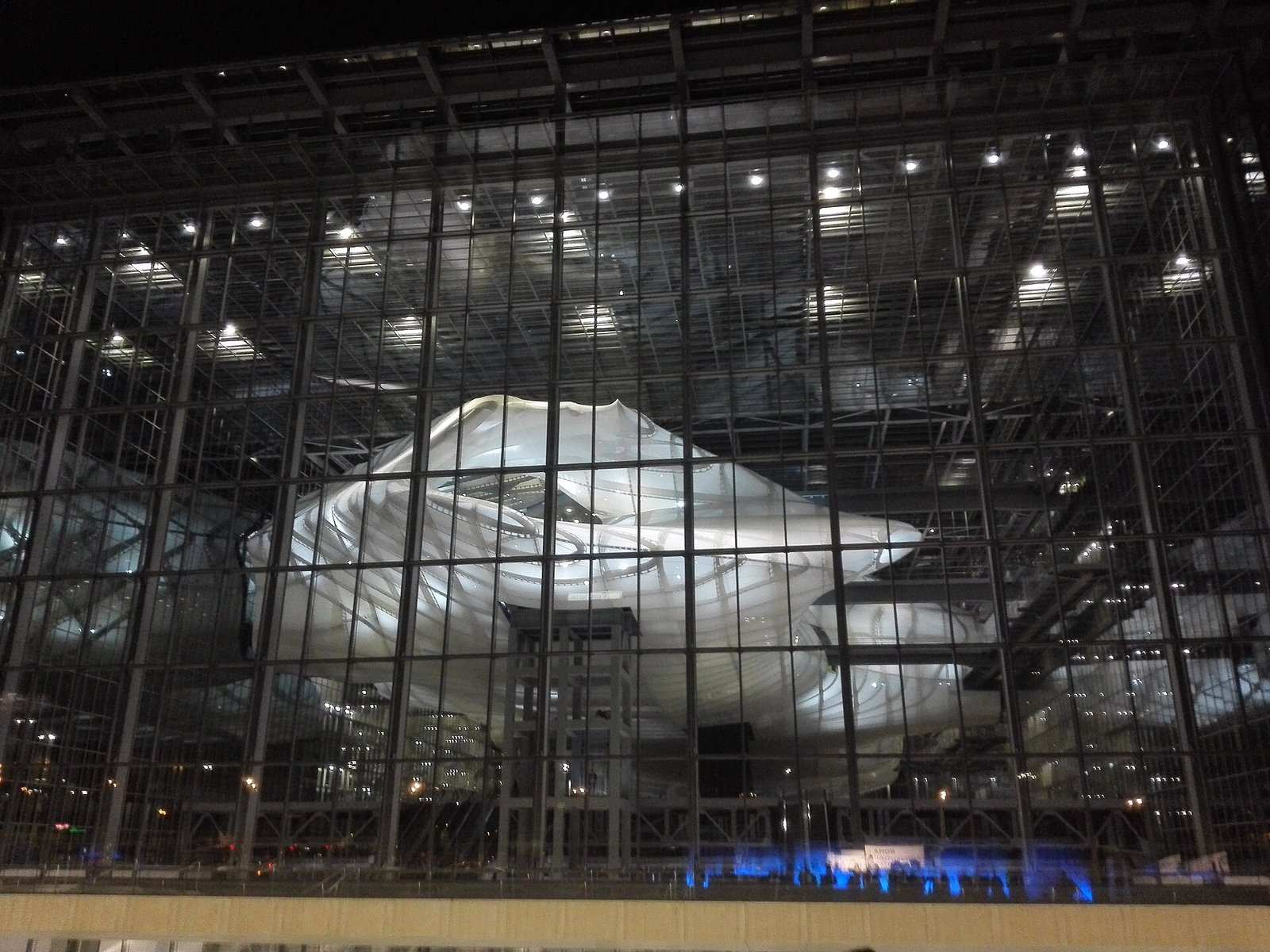 La Nuvola di Fuksas vista attraverso la teca di vetro del Roma Convention Center, all’EUR. Foto: Raptchatre, Public domain, via Wikimedia Commons
"Dialoghi sinfonici - Dietro l'ascolto" is a series of five Sunday concerts scheduled at the Roma Convention Center La Nuvola, at Viale Asia 40, in the EUR neighborhood of Rome (the entrance is also listed as Viale Asia 40/44), from October 4, 2026 to March 14, 2027. According to the Turismo Roma portal the dates are October 4, December 13, 2026, January 10, February 14 and March 14, 2027, always at 11:00. The organizer is the Europa InCanto association, which entrusts the EICO orchestra to the direction of maestro Germano Neri. For the December 13, 2026 concert the online ticket office lists prices from €21 plus fees. For the other dates the price isn't published. Tickets are bought online on the official circuit indicated by the organizer. To reach the venue it's best to use the ATAC route planner, because lines and stops can change. The program may change, as the same official portal warns.
Dialoghi sinfonici in brief
The format is simple to describe and less common to find: a complete symphonic concert, but interrupted by explanations that tell the audience how the music they're about to hear is made. The Europa InCanto website presents the series as a cycle of interactive concerts that connects the audience with the orchestra and tells the musical, biographical, historical, scientific and even culinary context of the great symphonic composers of the last 250 years. That is why the title speaks of listening with a "behind": the idea is to show what's behind the notes even before they are played.
The audience addressed is twofold. The article with which Sky TG24 reported on the March 29, 2026 event stresses that the format is designed both for those who already go to concert halls and for those who walk into one for the first time. Sunday morning at 11:00 is, besides, a time that suits families and spectators who prefer not to get home late in the evening.
The title of the series
The full name, as it appears on the Turismo Roma portal and on the online ticket office, is "Dialoghi sinfonici - Dietro l'ascolto". In the text the short form "Dialoghi sinfonici" is often used, which is also the one under which the organizer titles the page dedicated to the series.
One listing for five concerts
This page gathers the whole series: each date has its own program and its own theme, but venue, time, organizer and format stay the same, and it's best to read them just once.
The calendar of the five concerts
The official Rome tourism portal lists five Sundays, all at 11:00. The text table that follows takes up that calendar with the theme listed for each event.
Sunday, October 4, 2026
Opening of the series with Beethoven's Symphony No. 5 in C minor, Op. 67.
Sunday, December 13, 2026
Concert dedicated to Tchaikovsky on the theme of the "modern tradition". The online ticket office titles it "Pyotr Ilyich Tchaikovsky - Una moderna tradizione". The works on the program aren't indicated.
Sunday, January 10, 2027
Mussorgsky's Pictures at an Exhibition.
Sunday, February 14, 2027
Mendelssohn's Symphony No. 4 "Italian", with pieces taken from A Midsummer Night's Dream.
Sunday, March 14, 2027
Concluding concert titled "Il suono dei gesti", dedicated to the relationship between music and dance, produced with CRDL LAB.
Sources that don't match on the calendar
The sources don't agree on the whole calendar: Turismo Roma lists five dates, while the organizer's page today shows as the next event at the venue only the December 13 concert, with the October 4 one already in the archive, and the online ticket office for now offers only December 13, next to a subscription for two events (October 4 and December 13) marked as unavailable. For the dates in January, February and March 2027 the reference therefore remains the Turismo Roma portal.
How a concert-dialogue works
The format mixes performance and commentary. According to the organizer's website, the interventions touch on different aspects: how the key of a piece affects emotions, why rhythm pushes listeners to tap the beat, how the brain responds to different sound frequencies. To these explanations are added biographical and historical notes on the composers.
The role of maestro Neri
The orchestra is conducted by maestro Germano Neri, who speaks directly to the audience during the concerts. In the Sky TG24 report on the March 29, 2026 concert the maestro leads the spectators through the musical path and talks with the musicians between one piece and the next, in an exchange that makes the orchestra's work visible.
What to expect in the hall
Anyone who has never attended a symphonic concert may find this pacing useful: the word prepares the ear, then the whole piece or a large excerpt of it arrives. The overall duration of the individual mornings isn't published, so it's best not to schedule commitments too close right after the concert.
A route through keywords
The archive of the organizer's website shows that the earlier installments had titles such as Timbro, Melodia, Ritmo, Armonia and Interpretazione: each morning takes an element of the musical language and illustrates it through the works. The titles of the 2026-2027 season published today indicate instead one composer or one work at a time.
Who organizes: Europa InCanto and the EICO orchestra
Europa InCanto is a music association based in Rome, at Via Merulana 110, founded in 2012. Its website declares the goal of creating artistic projects and cultural initiatives that bring a new audience closer to music and opera, described as a complete art form that unites theater, dance, music and literature. Among the projects listed are the school Scuola InCanto, the theater in schools Ars InCanto, the Percorsi Creativi, the auditions and competitions and, precisely, the Dialoghi sinfonici.
EICO, Europa InCanto Orchestra
The acronym EICO stands for Europa InCanto Orchestra, the ensemble that performs the concerts. On the makeup of the ensemble, the number of musicians and their biographies, the information isn't published in the pages consulted.
Who produced the concerts at the Nuvola
In the Sky TG24 article of March 25, 2026 the concert is listed as a production of EUR SpA, the company that owns the congress center. For the 2026-2027 season the Turismo Roma portal lists EICO as the organizer, under the direction of maestro Neri.
October 4: Beethoven, Fifth Symphony
The first event of the series, scheduled for Sunday, October 4, 2026, is dedicated to Symphony No. 5 in C minor, Op. 67. Beethoven wrote it between 1804 and 1808, with a gestation that the Italian Wikipedia entry defines as the longest and most troubled among his symphonies: the first sketches date to about four years before completion, when he was still working on the Third, and the work overlapped with the Sixth.
The first performance
The first performance was held on December 22, 1808 at the Theater an der Wien in Vienna, in a concert that wasn't particularly successful. The source attributes this in part to the cold and the length of the program. The dedication goes to Princes Andrey Kirillovich Razumovsky and Joseph Franz Maximilian von Lobkowicz, friends and supporters of the composer.
The four-note motif
The opening is famous: three short notes and one long, from which the entire first theme of the first movement derives. Tradition links it to the image of fate knocking at the door, a phrase attributed to Beethoven, and to the composer's progressive deafness. The motif returns in varied form in the scherzo and runs through the finale.
Structure in four movements
The movements are an Allegro con brio in C minor, an Andante con moto in A-flat major built as a theme with variations, an Allegro in scherzo form with a trio in fugato and a finale in C major. The third and fourth movements are joined without a pause, an unusual choice for the time. In the finale Beethoven enlarges the ensemble with piccolo, an extra trombone and contrabassoon.
A signal in the Second World War
The same source recalls that the Italian-language broadcasts of Radio London during the Second World War used the opening of the symphony as a signature tune: the rhythm matches the letter V of the Morse alphabet, three dots and a dash, read as the initial of "Victory".
December 13: Tchaikovsky, a modern tradition
The second concert brings Tchaikovsky into the hall under the title "Una moderna tradizione". The works on the program aren't indicated either by the Turismo Roma portal or by the ticket office page, so here we limit ourselves to framing the composer and the theme.
The composer
Pyotr Ilyich Tchaikovsky was born on May 7, 1840 in Votkinsk, in present-day Udmurtia, and died on November 6, 1893 in Saint Petersburg. He studied at the Imperial School of Jurisprudence, where he graduated on June 10, 1859, and worked for three years at the Ministry of Justice before enrolling in 1862 in the first course of the Saint Petersburg Conservatory, which he finished in 1865 with a silver medal for a cantata on Schiller's Ode to Joy.
From the Moscow Conservatory to the ballets
In 1865 Nikolay Rubinstein offered him the chair of music theory at the Moscow Conservatory, then about to open. Among his works the source consulted cites six symphonies and the ballets Swan Lake and Sleeping Beauty, the latter made with the choreographer Marius Petipa. An important chapter of his life was the relationship with the widow Nadezhda von Meck, who supported him financially for 13 years. The two agreed never to meet.
Why "modern tradition"
The meaning the organizer gives to this formula isn't explained in the pages consulted. It's reasonable to expect maestro Neri to talk about it during the morning, but on the precise content the information isn't published.
January 10: Mussorgsky, Pictures at an Exhibition
The third event, Sunday, January 10, 2027, stars Mussorgsky with Pictures at an Exhibition. The work was born for solo piano in 1874, a few weeks after the memorial exhibition dedicated to Viktor Hartmann, artist and architect, a close friend of the composer, who died suddenly in 1873 of an aneurysm at 39.
Hartmann's exhibition
The exhibition was held between February and March 1874 at the Imperial Academy of Arts in Saint Petersburg, on the initiative of the critic Vladimir Stasov, and gathered about 400 works. Mussorgsky lent some pieces from his own collection and came away deeply struck.
10 pictures and five Promenades
The suite alternates 10 pictures and five Promenades, the theme that represents the spectator walking from one painting to another. Among the pictures you meet the gnome, the old castle, the Tuileries gardens, the Polish oxcart, the ballet of the chicks in their shells, the market at Limoges, the catacombs, the witch Baba Yaga and the great gate of Kiev. The opening theme recalls Russian folk songs and uses an asymmetrical meter.
Publication and orchestration
The score was published only in 1886, five years after Mussorgsky's death, with the revision by Rimsky-Korsakov. The edition based on the original manuscript, edited by Pavel Lamm, dates to 1930 and came out in 1931. The most famous orchestration is Maurice Ravel's, written between May and September 1922 on commission from Sergei Koussevitzky and presented on October 19, 1922 at the Palais Garnier in Paris with great success. Which version will be performed at the Nuvola isn't published.
February 14: Mendelssohn, the Italian and the Dream
The fourth concert, Sunday, February 14, 2027, pairs Felix Mendelssohn's Symphony No. 4 in A major, Op. 90 "Italian" with some pieces from A Midsummer Night's Dream. Which pages of the Dream will be performed isn't published.
The Italian symphony
The basic ideas were born during the 1829-1831 trip through Europe, inspired by the atmosphere of the Italian cities that Mendelssohn began to visit in 1830. The score was completed in Berlin on March 13, 1833 and presented on May 13 of the same year in London by the Royal Philharmonic Society under the direction of the author.
Revision and late printing
Despite the success obtained, the composer remained dissatisfied and revised it in 1834. He never published it in his lifetime, and it came out in print only in 1851. It carries the number four although it is the third symphony he wrote.
The four movements
The first movement is an Allegro vivace in sonata form. The second, an Andante con moto in D minor, recalls according to the source a funeral procession seen in Naples. A minuet with trio follows and a Saltarello Presto in a minor key closes, incorporating the dances heard in Rome and Naples, saltarello and tarantella. The performance lasts about 30 minutes.
A Midsummer Night's Dream
Mendelssohn finished the Op. 21 overture on August 6, 1826, at 17 years and six months, after reading Schlegel's German translation of Shakespeare's comedy. It wasn't intended for a staging. The first performance took place in Stettin on February 20, 1827 under the direction of Carl Loewe. The incidental music, Op. 61, was written in 1842 on commission from King Frederick William IV of Prussia and was staged on October 14, 1843 in Potsdam. The Wedding March is the intermezzo between the fourth and fifth acts and is in all likelihood the composer's most popular piece.
March 14: Il suono dei gesti, music and dance
The closing of the series, Sunday, March 14, 2027, is a concert dedicated to the relationship between music and dance, titled "Il suono dei gesti" and produced together with CRDL LAB. On the pieces, the dancers and the choreography the information isn't published.
Why the finale changes register
After four mornings dedicated to single composers, the final program shifts the focus from the repertoire to the movement of the body. It's consistent with the spirit of the series, which in the titles of earlier installments took rhythm, melody and interpretation as themes.
The earlier installments at the Nuvola
The archive of the organizer's website, which doesn't indicate the years, lists for La Nuvola: Timbro, the art of orchestral color (Stravinsky and Ravel), Melodia, Giulietta e Romeo (Tchaikovsky and Prokofiev), a Dialoghi Sinfonici Young event on Disney enchantments and animation fantasies, Ritmo, dances and passions (from Rimsky-Korsakov to Bizet), Armonia, the elegance of symphonic jazz (Gershwin) and Interpretazione, between past and present. Of the latter, on Sunday, March 29, 2026 at 11:00, Sky TG24 lists in the program Liszt, Borodin, De Falla and Albéniz, in particular Liszt's Second Rhapsody, the Polovtsian Dances, the Ritual Fire Dance and the orchestral version of Asturias.
Other venues of the series
Again according to the archive, the organizer has also offered concerts in places other than the Nuvola, among them the Cavea of Parco Aldo Moro in Ciampino, the Parco della Pace in Marino and the Pineta di Pianillo in Segni, as well as the Ex Cartiera Latina at Via Appia Antica 42. The website also lists an "Operette" event on October 11 at the Ex Cartiera Latina, with no year and with a time that doesn't look reliable: the information isn't clearly published and isn't part of this series.
La Nuvola: the concert venue
The Roma Convention Center La Nuvola is the congress center designed by Massimiliano Fuksas in the EUR neighborhood, owned by EUR SpA. For more on the building you can also read the entry on the Fuksas Cloud.
The Teca and the Nuvola
The complex is made up of two elements: the Teca, a large glass box about 40 meters high, and the Nuvola proper, an organic form at the center with a structure of steel ribs covered by a transparent fabric of about 15,000 square meters. Wanted in Rome specifies that the skin of the cloud is made of 700 individual pieces, in fiberglass and silicone.
The auditorium
The concerts of the series are held in the auditorium, housed inside the Nuvola. The number of seats varies depending on the source: the FAI lists 1,850 seats, Turismo Roma 1,800 (1,200 in the stalls and 600 in the gallery), the FCA magazine 1,760 and Wanted in Rome 1,700. The sources don't agree, and the actual capacity for the Sunday concerts isn't published.
The dimensions
The total area is about 55,000 square meters according to the FAI. The underground parking has a capacity of 600 spaces according to the FCA magazine, 800 according to Wanted in Rome. Here too the sources don't agree.
A curiosity about the Nuvola
Fuksas's project came out of a very long period of study: in 2008 the architect said he had devoted seven years to the project and had drawn over 6,500 preparatory drawings. The skin of the Nuvola, 15,000 square meters in 700 pieces, is suspended inside the glass box and reached by walkways and escalators: anyone going up toward the auditorium therefore crosses a building inside the building.
The name
The name comes from the light and almost impalpable look of the central form, which the FAI describes as a cloud suspended inside the Teca.
One thing nobody tells you about the Nuvola
A building that cost €380 million, according to what Artribune reported in December 2020, was in use only 120-130 days a year, because its main function was to host congresses. The chief executive of EUR SpA, Antonio Rosati, argued that a building with that cost couldn't stay open so little, and the plan at the time included concerts, cinema, a bookstore, a bistro and opening the fence to create a public square. The Dialoghi sinfonici are part of this idea of a building open to the city.
The auditorium lining
On the auditorium materials too the sources differ: Wanted in Rome speaks of American red cherry panels, chosen for the acoustics, while the FCA magazine describes polyethylene panels with mesh inside and wooden boards outside. The sources don't agree and the information can't be taken as certain.
My advice for visiting the Nuvola
My advice is to arrive with time to spare, because the complex is very large and the entrance to the auditorium requires finding your way among the different levels. Before the concert it's worth listening at home to the piece of the date you've chosen: with the symphony already in your ear, the maestro's comments turn out much richer. After the morning, the rest of Sunday can be devoted to the EUR neighborhood, with its great avenues, or to the Laghetto dell'EUR. For public transport schedules the reference is the ATAC route planner.
How to choose the date
Those who don't know the symphonic repertoire find an entry point in Beethoven's Fifth on October 4 or in Pictures at an Exhibition on January 10, very recognizable works. Those looking for a less obvious theme can choose the concert on music and dance on March 14.
Another well-known fact, yet rarely mentioned
Everyone knows the opening of Beethoven's Fifth, but few remember that its rhythm is the same as the letter V in Morse code and that for this reason it was used as a signature tune by Radio London. Equally well known, but rarely mentioned, is that Pictures at an Exhibition was written for piano and that the most performed orchestral version, Ravel's, omits the fifth Promenade.
Mendelssohn's numbering
Another forgotten detail: the Italian symphony carries the number four, but it's the third one written by Mendelssohn, and it was printed only 18 years after its first performance.
The right photo to take at the Nuvola
The most suitable photograph is the one that shows the relationship between the two parts of the building: the glass box of about 40 meters and, inside it, the suspended cloud. A page dedicated to the building observes that the Teca captures light and reflections, which are the natural subject of the shot. Outside, the great travertine staircase that the FCA source describes on the main front offers a foreground for the people lining up for the concert.
Inside the auditorium
The rules on photography during the performance aren't published. It's best to shoot before or after the concert and respect the staff's instructions.
Some important events that happened here in history
The history of the Nuvola is a long and at times tormented story. In 1998 Rome and EUR SpA called an international competition for the site between Viale Cristoforo Colombo, Viale Asia, Viale Shakespeare and Viale Europa. The jury, chaired by Norman Foster, chose Fuksas's project. The foundation stone was laid in 2007.
The years of delays
Wanted in Rome recounts that between 2008 and 2013 the work stopped because of rising costs, bureaucratic delays and disputes among the original partners. The project piled up debts. In 2013 a state loan and the sale of properties by EUR SpA allowed work to restart. The goal of opening to coincide with Expo 2015 in Milan was missed.
The October 29, 2016 inauguration
The official inauguration was held on October 29, 2016. The FCA magazine speaks of 18 years between design and construction.
From the congress to the city
In December 2020 Artribune reported on EUR SpA's plan to open the building to residents, with concerts and cinema hosted for the first time, and recalled the postponement to 2021 of the Roma Arte in Nuvola fair, planned for May 2020. Il Sole 24 Ore then announced "Riemergere", a cultural program of over 100 events with about 600 artists, from September to June, with artistic direction by Oscar Pizzo. The vaccination hub set up in the center, again according to the newspaper, had administered 600,000 doses to 400,000 people.
The neighborhood around
The context is that of the Universal Exposition: the E42 body was established on December 26, 1936 and on April 26, 1937 Mussolini planted a pine tree at the center of the future neighborhood. The 1942 exposition didn't take place because of the war. The area was completed in the 1950s and 1960s and was almost entirely finished for the 1960 Olympics. For the history of the neighborhood see the page on EUR and the Universal Exposition.
Who has passed through the Nuvola
Among the names announced by Il Sole 24 Ore for "Riemergere" were Patti Smith, Bill Viola with his video installations, the Orchestra di Piazza Vittorio, Luca Zingaretti with a tribute to Camilleri, Federico Rampini, Emma Bonino as narrator of a Werner Herzog film, Romeo Castellucci, Janet Echelman and Gianluigi Toccafondo. A page dedicated to the building also describes it as an important venue for Formula E in Rome, which entered the international championship in 2018, and among the corporate clients Audi, Unilever and RAI are cited.
Other events on the program
The congress center continues to host fairs and events: among the site's entries are Roma Arte in Nuvola 2026 and Più libri più liberi 2026. In the same neighborhood there are also the Palazzo dei Congressi and the Palazzo dello Sport.
The Square Colosseum
The architectural symbol of the neighborhood is the Palazzo della Civiltà Italiana, the Square Colosseum: designed by Guerrini, La Padula and Romano, started in July 1938, inaugurated unfinished in 1940 and completed after the war, it has 54 arches per facade and is 60 meters high. Since 2013 it has been leased to Fendi for 15 years.
Tickets and practical information
Tickets are on sale online on the official circuit indicated by the organizer. On December 13, 2026 the price starts at €21 plus fees, with maximum fees of €1.75 plus any shipping costs. For the other dates the price isn't published. The opening hours of the hall and the entry rules aren't published.
Where
Roma Convention Center La Nuvola, Viale Asia 40, 00144 Rome. For the route by public transport use the ATAC planner.
When
Sundays October 4, 2026, December 13, 2026, January 10, February 14 and March 14, 2027, at 11:00.
Changes
The program may change. Before setting out it's best to check the organizer's page and the ticket office.
Portal contacts
The Turismo Roma portal lists the Contact Center at the number 06 06 08.
Frequently asked questions about Dialoghi sinfonici
When are the Dialoghi sinfonici held at the Nuvola?
The series runs from October 4, 2026 to March 14, 2027, with five concerts on Sunday morning at 11:00: October 4, December 13, January 10, February 14 and March 14. The full calendar is given by the Turismo Roma portal. The online ticket office today shows only the December 13 concert, and the program may change.
Where are the concerts held?
They are held at the Roma Convention Center La Nuvola, at Viale Asia 40, in the EUR neighborhood of Rome, inside the auditorium of the building designed by Massimiliano Fuksas. The entrance is also listed as Viale Asia 40/44. For the route by public transport it's best to use the ATAC planner, because lines and stops can change.
How much do the tickets cost?
For the December 13, 2026 concert the online ticket office lists prices from €21 plus fees, which can reach €1.75, plus any shipping costs. For the other dates the price isn't published. Before buying it's best to check the official event page, because price lists and availability can change.
Who conducts the orchestra?
The EICO orchestra, Europa InCanto Orchestra, is conducted by maestro Germano Neri according to the organizer's website. In the concerts the maestro speaks directly to the audience and talks with the musicians between one piece and the next. On the makeup of the ensemble and the musicians' biographies the information isn't published.
Do you need to know classical music to attend?
No. According to the Sky TG24 report on the March 29, 2026 event, the format is designed both for those who go to concert halls and for those going for the first time. The explanations on history, composers and how music works come before the listening to the works.
What do you hear in the five concerts?
On October 4, Beethoven's Fifth. On December 13, a concert on Tchaikovsky on the theme of the modern tradition. On January 10, Mussorgsky's Pictures at an Exhibition. On February 14, Mendelssohn's Italian symphony with pieces from A Midsummer Night's Dream. On March 14, the concert on music and dance Il suono dei gesti.
How long does a concert last?
The overall duration of the mornings isn't published. For reference, Mendelssohn's Italian symphony lasts on average about 30 minutes according to Wikipedia, but the series alternates performances and commentary, so the real time depends on the program. Best to avoid commitments right after 11:00 plus the expected duration.
Is the entrance accessible to people with disabilities?
The Turismo Roma portal lists accessibility for people with disabilities among the congress center's services. The specific arrangements for the auditorium and for reserved seats aren't published, so it's best to ask the organizer for confirmation before buying tickets, stating your needs, so as to choose the most suitable seat with enough advance notice.
The final advice on Dialoghi sinfonici
The advice is to choose the Sunday based on the piece you want to understand better, even before the convenience of the calendar: the formula works above all with the most famous works, the ones you think you know everything about. Then, before leaving, check the organizer's page: updates and changes are expected. Anyone who wants to know symphonic music in Rome better can also consult the entry for the Auditorium Parco della Musica.
Article written by the editorial team of Tour Leader Pro, contact them for Private/Corporate/V.I.P. Tours and Experiences.
Planning a trip to Rome? The English guides for visiting the city are on ItalyPlanner.com.