Charles Dutoit and Martha Argerich at Auditorium Parco della Musica, March 18, 19 and 20, 2027
https://www.estateromana.com/en/rome/trip-planner/charles-dutoit-and-martha-argerich-at-auditorium-parco-della-musica-march-18-19/
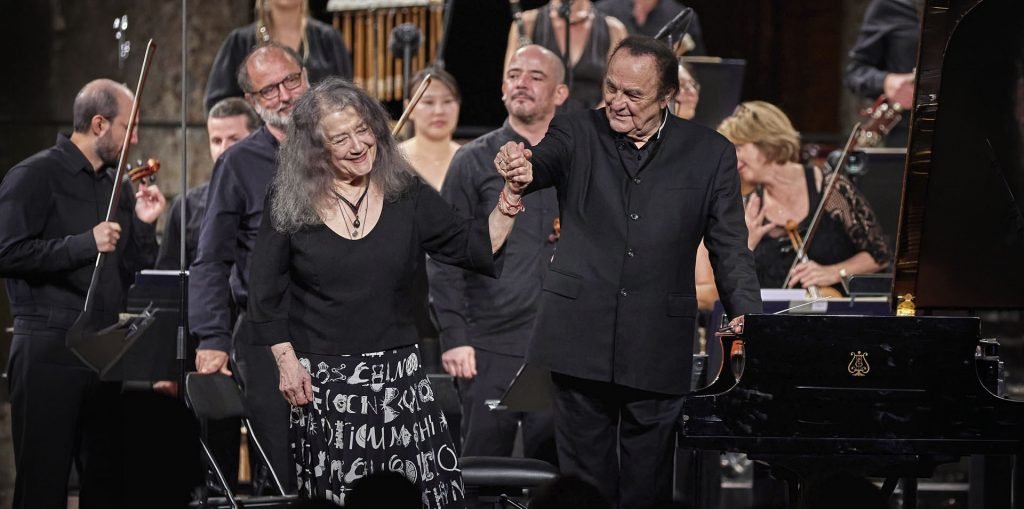
Dutoit and Argerich at Santa Cecilia: Charles Dutoit conducts the Orchestra of the Accademia Nazionale di Santa Cecilia with Martha Argerich at the piano on Thursday, March 18, 2027 at 19:30, Friday, March 19 at 20:00 and Saturday, March 20 at 18:00, in the Sala Santa Cecilia of the Auditorium Parco della Musica Ennio Morricone, at Viale Pietro de Coubertin 30. The program is Barber's Adagio, Beethoven's Piano Concerto No. 1 and Dvořák's Symphony No. 9, From the New World. You get there by Metro Line A to Flaminio and then tram 2 to the Flaminia/Reni or Apollodoro stops, or by buses 910 from Termini, 53, 982 and 168. Tickets cost from €28 to €65 depending on the section and are bought at the Auditorium box office, at the box office at Via Vittoria 6 and on the ticketing network authorized by the organizers, reachable from the official concert page.
A pianist who marked the history of 20th-century interpretation, a conductor who accompanied her the first time he stepped onto a podium, in 1959, and a program that brings together three beloved pieces. Few pairs of musicians have 60 years of shared work behind them, and in Rome you can hear them three times in three days. Our opinion is simple: of the whole 2026/2027 symphonic season, this is the concert to plan for furthest in advance.
Dutoit and Argerich at Santa Cecilia: the program
The concert by Charles Dutoit and Martha Argerich at Santa Cecilia lines up Samuel Barber's Adagio for Strings, Ludwig van Beethoven's Concerto for Piano and Orchestra No. 1 and Antonín Dvořák's Symphony No. 9, From the New World. The Accademia places it within the celebrations for the 200th anniversary of Beethoven's death, 1827-2027.
Barber, the Adagio
The opening is entrusted to Samuel Barber's Adagio, a piece many have heard at least once, perhaps without knowing its title. Slow, inward music that asks for silence. For a hall as big as the Santa Cecilia it's a test of concentration for the orchestra and the audience: you listen in absolute silence, and the silence of almost 3,000 people is part of the experience.
Beethoven, the First Concerto
The heart of the evening is Beethoven's Piano Concerto No. 1, entrusted to Martha Argerich. It's the concerto that opens the Beethoven catalog for piano and orchestra, chosen by the Accademia for the bicentennial year. Argerich has known it for decades: she recorded it for Deutsche Grammophon with Giuseppe Sinopoli and the Philharmonia Orchestra, on a disc that pairs the First and Second Concertos. Hearing it live with the conductor who knows her better than anyone else is the main reason to buy the ticket.
Dvořák, the Symphony From the New World
The closer is Dvořák's Symphony No. 9, From the New World, one of the symphonies most loved by audiences. The title itself evokes America, and closes the circle opened by Barber: the evening begins and ends with the New World, and puts Beethoven in the middle. For Dutoit, who spent much of his career between Montréal and Philadelphia, it's home repertoire.
Three evenings, three series
The concert is repeated three times, according to the series of the symphonic season: Thursday at 19:30 for the G-G1 series, Friday at 20:00 for the V-V1 series, Saturday at 18:00 for the S-S1 series. The program is identical on the three evenings. Only the time changes, and with it the way you organize the day.
Martha Argerich: the pianist's biography
Martha Argerich is an Argentine pianist, a naturalized Swiss citizen, born in Buenos Aires on June 5, 1941. She won the Chopin Competition in Warsaw in 1965 and is considered one of the most authoritative interpreters of her time. The Accademia Nazionale di Santa Cecilia counts her among its honorary academicians.
Buenos Aires and Vincenzo Scaramuzza
She started studying with her mother, a piano teacher. From age 5 to 15 she trained with Vincenzo Scaramuzza, a pianist from Crotone of the Neapolitan school and a teacher of great value, who taught her with a personal method: tackle technical problems inside the music, without technical exercises for their own sake. She made her concert debut at 8. It's an Italian origin rarely remembered, and it says a lot about her freedom at the keyboard.
Gulda and Benedetti Michelangeli
In 1955 the family moved to Europe and Martha studied in Austria with Friedrich Gulda. In 1960 she attended the advanced courses of Arturo Benedetti Michelangeli in Arezzo and Moncalieri, although with the maestro she actually had only four lessons. When it was pointed out to Benedetti Michelangeli how little time he had given her, he replied that he had taught her the music of silence.
Two competitions in a few weeks
In 1957, at 16, she won the Ferruccio Busoni Competition in Bolzano and the Geneva International Competition within a few weeks of each other. Her career took off from there. In 1965 came the first prize at the Chopin Competition in Warsaw, the recognition that established her worldwide.
The chamber musician
From her earliest years she has accompanied other instrumentalists in sonatas and chamber music. Her recordings with Mischa Maisky, Gidon Kremer, Yuri Bashmet, Mstislav Rostropovich, Nelson Freire, Mikhail Pletnev and Daniel Barenboim are a chapter of their own in her discography. For many years she has preferred working with colleagues to the solo recital, and audiences have learned to follow her wherever she plays.
Deutsche Grammophon
Her tie with Deutsche Grammophon spans more than half a century. Among the best-known recordings are the Tchaikovsky and Prokofiev concertos with Claudio Abbado, the Ravel Concerto, the Chopin Preludes, Schumann's Kreisleriana and Kinderszenen, and Bach's Toccata and Partita. With Abbado and the Mahler Chamber Orchestra she recorded Beethoven's Second and Third Concertos. With Abbado and the Orchestra Mozart, live in Lucerne in 2013, Mozart's Concertos No. 20 and 25.
Awards and honors
She has won three Grammys: in 2000 with Charles Dutoit for the Prokofiev and Bartók concertos, in 2005 with Pletnev for chamber music, in 2006 with Abbado for Beethoven. In 2005 she received the Praemium Imperiale for music in Tokyo, in 2016 the Kennedy Center Honors in Washington. France named her commander of the Order of Arts and Letters in 2004.
Lugano and young musicians
Through the Martha Argerich Project in Lugano and her festivals in Beppu, Japan, and in Buenos Aires she has for years promoted young pianists and emerging composers, among them Giovanni Sollima. On June 23, 2010, the Lugano City Hall granted her honorary citizenship. In 2013 her daughter Stephanie directed Bloody Daughter, a film about her life.
Charles Dutoit: the conductor's biography
Charles Dutoit is a Swiss conductor born in Lausanne on October 7, 1936, known above all for his interpretations of 20th-century French and Russian music. For 25 years he led the Orchestre symphonique de Montréal. In his career he has won more than 40 international awards, including two Grammys.
Lausanne, Geneva, Siena
He studied in Lausanne and then at the Geneva Conservatory, where he won first prize in conducting. Alceo Galliera invited him to the Accademia Chigiana in Siena. As a young man he attended Ernest Ansermet's rehearsals, worked with Herbert von Karajan in Lucerne as a member of the youth orchestra and studied with Charles Münch at Tanglewood. He started in 1957 as a violist in several European and South American orchestras.
The debut with Martha Argerich
In January 1959 he made his conducting debut leading the Lausanne Radio Orchestra. At the piano was Martha Argerich. From 1959 he was guest conductor of the Orchestre de la Suisse Romande and of the Lausanne Chamber Orchestra, then conductor of the Zurich Radio orchestra from 1967 to 1971 and of the Bern Symphony Orchestra for 11 years, succeeding Paul Kletzki.
The 1970s
While in Bern he also conducted the National Symphony Orchestra of Mexico from 1973 to 1975 and the Gothenburg Symphony Orchestra from 1976 to 1979. In 1964 he had conducted Swan Lake at the Vienna State Opera with Rudolf Nureyev. In the early 1980s he was principal guest conductor of the Minneapolis Symphony Orchestra.
Montréal
In 1977 he succeeded Otto Klemperer and Zubin Mehta at the head of the Orchestre symphonique de Montréal and over the next 25 years transformed it into one of the best orchestras in the world. With it he recorded more than 80 discs for Decca: Ravel, Debussy, Berlioz, Holst, Saint-Saëns, Rossini, Bizet. Berlioz's Les Troyens earned him the 1996 Grammy for best opera recording. He left Montréal in April 2002.
Paris, Tokyo, Philadelphia, London
From 1991 to 2001 he was conductor of the Orchestre national de France, and from 1996 to 2003 principal conductor of the NHK Symphony Orchestra in Tokyo. From 1990 he led the Philadelphia Orchestra's summer festival at Saratoga Springs, and from September 2008 he was its principal conductor. From 2009 he was also principal conductor of the Royal Philharmonic Orchestra of London and of the Verbier Festival Orchestra.
Opera
At Covent Garden he conducted Faust with Alfredo Kraus in 1983 and Les contes d'Hoffmann in 1986. At the Metropolitan he made his debut in December 1987 with the same title, and returned in 1990 with Faust and with Samson et Dalila, starring Plácido Domingo and Shirley Verrett. In 2012 he conducted Pelléas et Mélisande at the Verbier Festival. In Milan, at the Teatro alla Scala, he conducted four concerts with Salvatore Accardo in 1980.
Honors
He is an honorary officer of the Order of Canada and an honorary grand officer of the National Order of Québec, one of the few non-Canadians to receive it. Philadelphia granted him honorary citizenship in 1991. From his marriage to Martha Argerich, between 1969 and 1973, their daughter Annie was born. The two have kept playing and recording together all their lives.
The Santa Cecilia Orchestra and the 2026/2027 season
The Orchestra of the Accademia Nazionale di Santa Cecilia drives the Accademia's season at the Auditorium Parco della Musica and has been led since the 2024/2025 season by music director Daniel Harding. Before him the Accademia had among its principal and music directors Igor Markevitch, Giuseppe Sinopoli, Daniele Gatti, Myung-Whun Chung and Antonio Pappano.
March at Santa Cecilia
The Dutoit and Argerich concert falls in the middle of a very rich March. Two weeks earlier, on March 4, 5 and 6, Daniel Harding conducts with Beatrice Rana at the piano. Right after, from March 25, Manfred Honeck conducts a Beethoven program. At the end of February Fabio Luisi brings the Missa Solemnis to the hall. It's the heart of the celebrations for the Beethoven bicentennial.
Argerich twice in the season
In the same season Martha Argerich also returns to Santa Cecilia with the Orchestre de Chambre de Lausanne conducted by Renaud Capuçon, in an all-Beethoven program: the Coriolan overture, Piano Concerto No. 2 and Symphony No. 7, with tickets from €30 to €60. Anyone who wants to hear her in two different Beethoven programs has the chance to do it in the same hall.
The museum and the patron saint
The Auditorium is the Accademia's main home, which keeps there the Bibliomediateca and the Museo degli Strumenti Musicali, with over 140 instruments on display. The patron saint of music is venerated in the Basilica of Santa Cecilia in Trastevere, worth a daytime visit for those staying in Rome.
The Sala Santa Cecilia, where Dutoit and Argerich play
The Sala Santa Cecilia is the largest of the three concert halls of the Auditorium Parco della Musica Ennio Morricone: 2,756 seats, designed by Renzo Piano for symphonic music and inaugurated on December 21, 2002. Since 2003 it has been the permanent home of the Accademia's season.
A great wooden instrument
The ceiling is made of 26 American cherry shells and the hall works like a big sound box, with a reverberation time of 2.2 seconds. For Barber's Adagio this means the strings' pianissimo reaches the last rows. For Argerich's Beethoven, it means the piano's sound stays crisp even in the fastest passages.
Where to sit for a concert with piano
Regulars of the hall know that sound intensity seems to drop up to the tenth row and then stay constant: you don't need the orchestra seats right up against the stage. For the piano the side also matters: the open lid projects the sound toward the left side of the hall, looking at the stage, and from that side you see the soloist's hands.
Renzo Piano's beetles
Seen from outside, the halls are three big volumes clad in lead on a brick base, arranged in a fan around the open-air arena named after Luciano Berio. Piano won the invitation-only competition in 1993 and worked with the acoustician Jürgen Reinhold of the Müller-BBM firm and with the landscape architect Franco Zagari. The full profile of the complex is the one for the Auditorium Parco della Musica.
Tickets for Dutoit and Argerich: prices and how to buy
Tickets for the Charles Dutoit and Martha Argerich concert cost from €28 to €65 depending on the section of the Sala Santa Cecilia, for all three dates. With two artists of this draw, the central sections are the first to sell out.
Where to buy
The Accademia lists as authorized sellers its own website, the box office of the Auditorium Parco della Musica and the box office at Via Vittoria 6, a short walk from Via del Corso and from Piazza del Popolo, as well as the points of the ticketing network linked to the concert page. The Auditorium box office is open every day from 11:00 to 20:00. The one on Via Vittoria is open Monday to Friday from 11:00 to 19:00 and Saturday from 11:00 to 14:00.
Youth and subscriptions
The Accademia collects youth discounts on a dedicated page of its website. For under-26s there is the Fun Club Card, which lets you hear the listed concerts for €10. For those who want to follow several evenings there is Invito alla Musica, a subscription of 10 concerts of your choice among seven symphonic ones of the Friday series and three chamber ones. Conditions and included concerts should be checked at the time of purchase.
Information
For ticket questions the Accademia answers at info@santacecilia.it and on 06 8082058. The gift card, with two tickets of your choice for the symphonic or chamber season, is bought at the two box offices: for music lovers it's a sensible gift.
How to get to the Auditorium for Dutoit and Argerich
The Auditorium Parco della Musica Ennio Morricone is reached by Metro Line A to Flaminio and then tram 2, stops Flaminia/Reni or Apollodoro, or by buses 910, 53, 982 and 168. The metro doesn't go all the way to the entrance.
Metro Line A and tram 2
From Piazzale Flaminio, tram 2 goes up Via Flaminia toward Piazza Mancini. You get off at Flaminia/Reni or at Apollodoro and walk a few minutes toward Viale Pietro de Coubertin, through the Villaggio Olimpico. It's the simplest solution from the center, passing by the Flaminio Obelisk.
The 910 from Termini
The 910 leaves from Piazza dei Cinquecento, in front of Termini station, and reaches the Auditorium with no changes. For those sleeping near the station, or arriving by train for the Saturday afternoon concert, it's the line to choose.
The other lines
The 53 connects Piazza Mancini and the center, the 982 comes from Viale XVII Olimpiade area, the 168 from Tiburtina station. Evening times and frequencies change, especially on Saturday: it's best to check them on the transit agency's route planner before heading out.
By car
The stretch of Viale Pietro de Coubertin in front of the Auditorium is closed to traffic. The complex has paid parking with limited spaces. On concert nights cars flood the streets of the Villaggio Olimpico. Come by car only if there's no alternative, and early.
How to plan the concert evening
For the Dutoit and Argerich concert the rule is to arrive at the Auditorium at least 40 minutes before the start: the Accademia warns that concerts begin on time and that latecomers don't get into the hall.
The doors close
Latecomers can follow the concert in the listening rooms, until seats run out. With an Adagio of a few minutes opening the program, the risk is missing the start of the Beethoven concerto, which is the moment you bought the ticket for. Half an hour of margin for the Flaminio traffic isn't excessive caution.
Before the concert
The foyer shared by the halls has a bar, a cafeteria and a large bookstore with records and music books. From the terrace that runs around the buildings you can see the remains of the Roman villa discovered during construction. It's the right place to wait for the doors to open.
Which evening to choose
Thursday at 19:30 is the evening for people leaving work who eat dinner afterward. Friday at 20:00 leaves time for an aperitivo. Saturday at 18:00 is the best choice for those coming from outside Rome or who want to have a relaxed dinner after the concert.
Accessibility and kids at the concert
For people with disabilities who can walk, holders of the Disability Card, the Accademia offers a discount on two tickets. For wheelchair users, a dedicated ticket with a free companion, while seats last. Updated conditions are on the notices page of the Accademia's website.
Reservations
For people who cannot walk, reservation is mandatory, from 15 days before the concert until the day before, on 06 8082058 or at biglietteria@santacecilia.it. For the March 18 concert the window therefore opens on March 3.
Arriving early
The hall is raised above ground level, because the remains of a Roman villa emerged in the subsoil, and the galleries have only two elevators: arriving with an hour of margin and asking staff for the route right away avoids the bottleneck of the minutes before the start.
With kids
For a kid who studies piano, seeing Martha Argerich live is a lifelong memory. The program helps: Beethoven's First Concerto is brilliant and short, and the From the New World Symphony has themes you recognize on first hearing. Saturday at 18:00 is the best time for a family.
The neighborhood around the Auditorium
The Auditorium occupies an area of about 55,000 square meters between Villa Glori, the Villaggio Olimpico, the Corso di Francia viaduct and Viale Maresciallo Pilsudski: a piece of 20th-century Rome where contemporary architecture lives alongside greenery.
The MAXXI and the Villaggio Olimpico
A few minutes on foot, toward Via Guido Reni, is Zaha Hadid's MAXXI: with the Auditorium it forms the most important pair of contemporary buildings in the city. If you have a free afternoon before the Saturday concert you can visit an exhibition and walk to the hall.
Toward the Tiber
From the Auditorium you go down to the Ponte della Musica, the footbridge that connects the Flaminio to the Foro Italico. Farther north is Milvian Bridge, in the evening one of the busiest meeting points in north Rome.
Toward the center
With tram 2 you return to Piazzale Flaminio, at the gates of Villa Borghese and the Tridente. Along Via Flaminia, halfway, is the Museo Etrusco di Villa Giulia, a good match for the Saturday concert.
Where to eat before or after the concert
Inside the Auditorium there are a bar and cafeteria in the foyer and a bar and restaurant with an entrance from the street too: the most convenient solution for those coming from work on Thursday.
In the neighborhood
Between the Villaggio Olimpico, Via Flaminia and Piazza Mancini there are pizzerias, trattorias and neighborhood bars, frequented more by residents than by tourists. For Thursday and Friday it's best to book early and have dinner at leisure afterward.
Ponte Milvio and the center
For dinner after the Saturday concert the widest choice is at Ponte Milvio, where places stay open late. In the opposite direction, toward Piazzale Flaminio and Piazza del Popolo, the choice is that of the historic center, with historic center prices.
A curiosity about Charles Dutoit and Martha Argerich at Auditorium Parco della Musica, March 18, 19 and 20, 2027
The best curiosity is about where it all began. Charles Dutoit made his conducting debut in January 1959, leading the Lausanne Radio Orchestra, and the soloist of that first concert was Martha Argerich, then 17, fresh from winning the Busoni and Geneva competitions. 68 years later, the two meet again on the same stage with a Beethoven concerto. Pairs of performers who have spanned so long a stretch of time together are extremely rare.
Second curiosity, a Roman one. The Beethoven First Concerto that Argerich plays in this hall she recorded for Deutsche Grammophon with Giuseppe Sinopoli, who was conductor of the Santa Cecilia Orchestra and after whom one of the Auditorium's three halls, the Sala Sinopoli, is named. Anyone entering Renzo Piano's complex to hear Argerich walks past the hall that bears the name of the conductor of that record.
Third curiosity: the pair's most awarded record is not Beethoven but Prokofiev and Bartók. With the Orchestre symphonique de Montréal, the orchestra Dutoit led for 25 years, Argerich recorded Prokofiev's First and Third Concertos and Bartók's Third, which in 2000 won the Grammy for best solo performance with orchestra.
Something nobody tells you about Charles Dutoit and Martha Argerich at Auditorium Parco della Musica, March 18, 19 and 20, 2027
What is rarely said is that Martha Argerich has an Italian root. Her decisive teacher, from age 5 to 15, was Vincenzo Scaramuzza, a pianist from Crotone trained in the Neapolitan school, who taught in Buenos Aires. His method had no technical exercises separate from the music: every difficulty was solved inside the piece. Anyone who hears the ease with which Argerich tackles the fastest passages of Beethoven's First Concerto hears that school too.
Second thing rarely said: in Rome Dutoit has already appeared in a different theater. In 2013 he conducted Samson et Dalila at the Teatro dell'Opera, a title he knew well from conducting it at the Metropolitan in New York in 1990 with Plácido Domingo and Shirley Verrett. French repertoire remains his home ground. Dvořák and Barber, on this evening, show the other half of his career, the American one.
Third: the Accademia warns that concerts begin on time and that latecomers stay outside the hall. With a short Adagio opening the program, 10 minutes late can cost you the Beethoven concerto. Nobody will repeat it to you at the entrance.
My advice for visiting Charles Dutoit and Martha Argerich at Auditorium Parco della Musica, March 18, 19 and 20, 2027
The first piece of advice is to buy right away. A concert by Martha Argerich with orchestra has become rare, and in Rome you can hear it for only three evenings. With tickets from €28 to €65, the difference between a good seat and an uncomfortable one is made by the purchase date more than by the price.
Second piece of advice: choose your seat according to what you want to take home. For the overall sound, central orchestra seats beyond the tenth row or the front gallery. For the pianist, the left side looking at the stage: you see Argerich's hands on the keyboard and the piano's sound, projected by the open lid, arrives directly.
Third: listen first to Beethoven's First Concerto, perhaps on the very record Argerich made with Sinopoli. Anyone who arrives in the hall knowing its breath will better catch every liberty the soloist takes live, years later.
Finally, stay for Dvořák. You sometimes see spectators leaving after the soloist. With Dutoit on the podium, the From the New World Symphony is the evening's second reason, and tram 2 and the 910 run 10 minutes later too.
Another well-known fact, yet rarely cited
It's known that Martha Argerich is one of the most famous pianists in the world. It's less remembered how much she has also weighed in competitions as a juror, with a reputation as a stubborn-tempered judge. In 1980, at the Chopin Competition in Warsaw, the same one she had won 15 years earlier, she resigned from the jury in protest at the elimination in the second round of the Croatian pianist Ivo Pogorelić. A clear-cut gesture, consistent with her way of being in music: without compromise.
It's also known that Dutoit and Argerich were married. It's less remembered that the marriage lasted a few years, from 1969 to 1973, and that the artistic collaboration never stopped: concerts, records, festivals, for half a century. Their daughter Annie Dutoit was born of their union. It's one of the best-known cases in which a musical partnership has survived everything else, and perhaps the longest.
In a season full of big names, this is the only evening in which two musicians who have known each other for almost 70 years step on stage together. The audience feels it.
The right photo to take at Charles Dutoit and Martha Argerich at Auditorium Parco della Musica, March 18, 19 and 20, 2027
During the concert the phone stays off: in such a sensitive hall every shot is audible, and Barber's Adagio lives on pianissimos that the slightest noise ruins. You take the photo before and after.
Before the concert, from the top of the arena you frame Renzo Piano's three beetles with the lead reflecting the lights, and the entrance to the Sala Santa Cecilia with the audience going in. It's the image that tells the evening better than any portrait.
In the hall, before the lights go down and if staff allows it, the shot to take is the grand piano at the center of the stage, with the lid open and the hall filling up, and above it the cherry shells of the ceiling. The empty piano, a few minutes before Argerich walks in, is an image of waiting.
After the concert, the final applause is the only moment to take out the phone, without flash. Outside, the volumes of the halls seen from below, on Viale Pietro de Coubertin side, give an almost abstract image: the most beautiful of all.
Some important events that happened here in history
The ground the Auditorium stands on has a much longer history than the complex. During construction the remains of a Roman villa from the 3rd century BC emerged, built on the site of a small archaic farm from the 6th century BC. The discovery forced Renzo Piano to change the design, moving two of the three beetles westward. The finds are displayed in a small museum under the arena.
Modern history begins with a demolition. In 1936 the Augusteo, the great Roman concert hall, was torn down, and for over 60 years the capital was left without an auditorium built for symphonic music. Only in 1992 did the city council choose the Villaggio Olimpico area, and in 1993 Piano won the competition.
On April 21, 2002, the Sala Sinopoli opened. On December 21, 2002, the Sala Santa Cecilia, with the Accademia Orchestra conducted by Myung-Whun Chung. Since 2003 the Auditorium has been the permanent home of the Accademia's season, since 2006 it has hosted the Rome Film Festival, and in 2020 the city council approved naming it after Ennio Morricone. In 2027 the hall devotes a substantial part of the season to the Beethoven bicentennial, and the Dutoit and Argerich concert is one of its central moments.
Who has performed at Charles Dutoit and Martha Argerich at Auditorium Parco della Musica, March 18, 19 and 20, 2027
The Sala Santa Cecilia has had weighty guests from day one. The inaugural concert of December 21, 2002, was conducted by Myung-Whun Chung. A few months earlier, at the opening of the Sala Sinopoli, Goffredo Petrassi wanted to be present to hear the first performance in the new hall of his 1931 Ouverture da concerto. Luciano Berio, then head of the Accademia, gave his name to the arena.
Since then the hall has been the home of the Santa Cecilia Orchestra and its music directors, from Antonio Pappano to Daniel Harding. In the 2026/2027 season the same stage hosts, among others, Kirill Petrenko, Jakub Hrůša with Daniil Trifonov, Fabio Luisi with the Missa Solemnis, Daniel Harding with Beatrice Rana and Manfred Honeck, as well as the recitals of Mikhail Pletnev and Grigory Sokolov and the duo of Evgeny Kissin and András Schiff.
Martha Argerich, an honorary academician of Santa Cecilia, has belonged to this history for a long time. Charles Dutoit brings with him another history, that of Montréal, Philadelphia, Tokyo and London. In mid-March the two worlds meet on the stage of the Auditorium's largest hall.
Frequently asked questions about Dutoit and Argerich at Santa Cecilia
When does Martha Argerich play in Rome in 2027?
Martha Argerich plays in Rome with the Santa Cecilia Orchestra conducted by Charles Dutoit on Thursday, March 18, 2027 at 19:30, Friday the 19th at 20:00 and Saturday the 20th at 18:00, in the Sala Santa Cecilia of the Auditorium Parco della Musica. The program is the same on the three evenings.
What do Dutoit and Argerich play at Santa Cecilia?
The Dutoit and Argerich program at Santa Cecilia includes Barber's Adagio, Beethoven's Piano Concerto No. 1 with Argerich as soloist and Dvořák's Symphony No. 9, From the New World. The concert is part of the celebrations for the 200 years since Beethoven's death.
How much do tickets for Dutoit and Argerich cost?
Tickets for the Dutoit and Argerich concert at Santa Cecilia cost from €28 to €65, depending on the section of the Sala Santa Cecilia. Youth discounts are collected by the Accademia on a dedicated page of its official website.
Where do you buy tickets for Martha Argerich in Rome?
Tickets for Martha Argerich with the Santa Cecilia Orchestra are bought at the box office of the Auditorium Parco della Musica, open every day from 11:00 to 20:00, at the box office at Via Vittoria 6 and online from the official concert page on the Accademia's website.
Who is Charles Dutoit?
Charles Dutoit is a Swiss conductor born in Lausanne in 1936, for 25 years head of the Orchestre symphonique de Montréal and then principal conductor of the Philadelphia Orchestra and the Royal Philharmonic Orchestra. He made his podium debut in 1959 with Martha Argerich at the piano.
How do you get to the Auditorium Parco della Musica?
The Auditorium Parco della Musica, at Viale Pietro de Coubertin 30, is reached by Metro Line A to Flaminio and tram 2 to the Flaminia/Reni or Apollodoro stops, or by bus 910 from Termini and lines 53, 982 and 168. Parking is limited and paid.
What happens if I'm late to the concert?
The Accademia di Santa Cecilia warns that concerts start on time: latecomers don't get into the hall and can follow the concert in the listening rooms, until seats run out. It's best to arrive at the Auditorium at least 40 minutes before the start.
In closing
At Santa Cecilia concerts the evenings you remember are those where something happens on stage that won't be repeated. This one has all the makings: a pianist who made history, the conductor who accompanied her at her first concert with him, a Beethoven that both have known all their lives. Buy early, take a seat on the left side, arrive with half an hour of margin and stay until the last note of Dvořák.
Article written by the Tour Leader Pro editorial team, contact them for Private/Corporate/V.I.P. Tours and Experiences.
Planning a trip to Rome? The English guides to visiting the city are on ItalyPlanner.com.