Cent’anni a Roma: The Abbey Awards at the British School at Rome, November 4 to December 18, 2026
https://www.estateromana.com/en/rome/trip-planner/centanni-a-roma-the-abbey-awards-at-the-british-school-at-rome-november-4-to-dec/
The exhibition Cent'anni a Roma: The Abbey Awards, 1926-2026 opens on Wednesday, November 4, 2026 at the British School at Rome, the British Academy at Via Antonio Gramsci 61 (00197 Rome), and according to the official poster it stays up until December 18, 2026. The opening evening runs from 18:00 to 21:00. From 18:00 to 18:30, in the Lecture Theatre, the painters Danny Rolph and Vanessa Jackson and the critic Sacha Craddock talk with the artists in the show. The event is in person only. The exhibition brings together new works on paper by artists who have received the Abbey Awards from the 1950s to today, along with archive materials on the 100 years of the scholarships. The British School is in Valle Giulia, next to the Galleria Nazionale d'Arte Moderna. The tram stops at Galleria Arte Moderna and Belle Arti, and the Flaminio station on Metro A is the nearest. Visiting hours after the opening and the access arrangements are published on the British School at Rome's official website, on the event page.
A hundred years of British and American painters in Rome, told with new works and archive documents in one of the city's most discreet foreign academies. The Abbey Awards were born in 1926 from a private gesture, that of the widow of a great American illustrator, and have become one of the most coveted scholarships for a young painter in the English-speaking world. In our view the exhibition is a rare chance to enter Lutyens's building in Valle Giulia and see what Rome has meant to generations of artists.
Cent'anni a Roma at a glance
Cent'anni a Roma: The Abbey Awards, 1926-2026 celebrates the centenary of the scholarships founded by Gertrude Abbey with recent works on paper by former scholars, from the 1950s to today, and archive materials on their history.
The dates
The British School's official page announces the opening on Wednesday, November 4, 2026 from 18:00 to 21:00. The exhibition poster gives the period from November 4 to December 18, 2026. Visiting hours in the following weeks should be checked on the institute's website.
The introduction
The evening starts at 18:00 in the Lecture Theatre with a half-hour conversation: Danny Rolph, Vanessa Jackson and Sacha Craddock talk with the exhibited artists. Then the exhibition stays open until 21:00.
In person only
The British School specifies that the event takes place in person only, with no remote connection. Anyone who wants to hear the conversation has to go up to Valle Giulia.
What you see
The heart of the exhibition is new works on paper, made by artists who received the Abbey Awards in different eras, from the 1950s to today. Alongside, the archive materials reconstruct the history of the scholarships and the relationship with the British School.
The Abbey Awards: 100 years of scholarships for painters
The Abbey Awards were born in 1926 as the Incorporated Edwin Austin Abbey Memorial Scholarships, founded by Gertrude Abbey to support British and American painters. Since 1937 a formal agreement has linked them to the British School at Rome.
The founding
Gertrude Abbey founded the scholarships in 1926 in memory of her husband, the painter and illustrator Edwin Austin Abbey, who died in London in 1911. The original name, Incorporated Edwin Austin Abbey Memorial Scholarships, already states the purpose: a memorial fund to help painters develop their practice.
The 1937 agreement
The link with Rome became institutional in 1937, with a formal agreement between the scholarship body and the British School at Rome. Since then many Abbey scholars have lived and worked in the studios of the Academy in Valle Giulia, and the British School describes that relationship as long and fruitful.
Today's scholarships
Among the awards the British School lists for the visual arts are the Abbey Fellowship in Painting, a three-month residency, and the Abbey Scholarship in Painting, a nine-month residency. The scholars live in the building, use the specialist library and have studios and workshops available.
Some scholars
Among the painters who received the Abbey scholarship are Chantal Joffe, Abbey Scholar at the British School in 1998-99, and John Copnall, who won the E. A. Abbey Scholarship in 1970. The centenary exhibition brings to Rome recent works by former scholars of different generations.
Edwin Austin Abbey, the painter where it all begins
Edwin Austin Abbey, born in Philadelphia on April 1, 1852 and died in London on August 1, 1911, was an American muralist, illustrator and painter, famous for his Shakespearean and Victorian subjects and for the painting of the coronation of Edward VII.
The illustrator
Abbey studied at the Pennsylvania Academy of the Fine Arts under Christian Schussele and began as an illustrator for Harper's Weekly, before the age of 20, and for Scribner's Magazine. He illustrated Dickens's Christmas stories, the poems of Robert Herrick, Goldsmith's She Stoops to Conquer and Shakespeare's comedies in four volumes for Harper and Brothers.
England
In 1878 he moved to England at the request of his publishers, to gather material for the Herrick illustrations, and settled there for good in 1883. He was elected to the Royal Academy as an associate in 1896 and as a full member in 1898. He spent summers in Broadway, Worcestershire, painting next to John Singer Sargent at the house of Francis Davis Millet.
The great commissions
For the Boston Public Library he painted the cycle The Quest and Achievement of the Holy Grail, on which he worked for 11 years in his English studio. In 1902 he was chosen to paint the coronation of Edward VII, an official painting now at Buckingham Palace. In 1904 he made a mural for the Royal Exchange in London, and from 1908 he worked on the great decorative program of the Pennsylvania State Capitol in Harrisburg.
The last years
In 1911, while working on the Reading of the Declaration of Independence for the Pennsylvania Senate, his health worsened. He died in London on August 1. His assistant William Simmonds completed the murals, with small contributions from Sargent, and installed them in Harrisburg with the widow Gertrude. 15 years later, Gertrude Abbey founded the scholarships that bear her husband's name.
The guests of the opening evening
The opening conversation on November 4 brings together Danny Rolph, Vanessa Jackson and Sacha Craddock with the artists in the show, from 18:00 to 18:30 in the British School's Lecture Theatre.
Sacha Craddock
Sacha Craddock, born in 1955, is an art critic, writer and independent curator based in London. She is a member of the board of the Abbey Awards in Painting at the British School at Rome, cofounder of Artschool Palestine and of the Contemporary Art Award, and president of the British section of the International Association of Art Critics. From 1996 to December 2021 she chaired the board of New Contemporaries and its selection process.
Danny Rolph and Vanessa Jackson
The British School presents Danny Rolph and Vanessa Jackson as introducers of the evening together with Sacha Craddock. Their biographies and their relationship with the Abbey Awards are given by the institute in the exhibition materials.
The artists in the room
The conversation takes place with the artists in the show, that is, with the former Abbey scholars who made the new works on paper. For people who paint or study art it's a chance to hear from the protagonists what a residency in Rome meant.
The British School at Rome, the British Academy in Valle Giulia
The British School at Rome was founded in 1901, received the Royal Charter in 1912 and since 1916 has been based in Valle Giulia in the building adapted by Sir Edwin Lutyens from the British pavilion of the 1911 International Exhibition.
The mission
The British School is a British interdisciplinary research center for the arts, the humanities and architecture, with history and archaeology at its core. Its mission is to promote knowledge of the art, history and culture of Italy among scholars and artists from Great Britain and the Commonwealth.
Lutyens's pavilion
After the 1911 Exhibition the land of the British pavilion was granted to the United Kingdom on condition that it be used only as a British research center for archaeology, history and fine arts. Lutyens adapted the building and in 1916 the British School moved in.
The Lecture Theatre
In 2002 a Lecture Theatre and new exhibition spaces designed by Hugh Petter and supported by the Sainsbury family were inaugurated, opened by Princess Alexandra. It's in that hall that the opening conversation takes place on November 4.
The 125 years
In 2026 the British School celebrates 125 years since its founding with a program of events. On October 15 the evening 125 years of archaeology at the British School at Rome was held. On November 18 a roving performance by Holly Davey and Eloise Fornieles in the fine arts archive is announced, with time slots to book online.
The British School's artists: a century of residencies
The British School at Rome awards residential scholarships from three to 12 months to artists and scholars, who live in the building in Valle Giulia. For painters, the Abbey scholarships are among the oldest.
The 1920s
In the 1920s the first great scholar artists arrived at the British School: Winifred Knights lived there from 1920 to 1923, Colin Gill in the early years of the decade. The Abbey scholarships, founded in 1926, fit into this season.
The names of the 20th century and today
Among the artists who passed through the British School, the institute recalls Gillian Ayres, Joe Tilson, Cornelia Parker, Mark Wallinger, Julian Opie, Cerith Wyn Evans, Elizabeth Price, Laure Prouvost, Richard Billingham and Chantal Joffe. In 2023 Bridget Riley left the British School a painted ceiling.
Life in residence
The scholars live under the same roof: painters next to archaeologists, architects next to historians. This coexistence is what makes the British School different from a simple art school, and the centenary exhibition tells a piece of it through painting.
A curiosity about Cent'anni a Roma: The Abbey Awards at the British School at Rome, November 4 to December 18, 2026
The nicest curiosity concerns the man to whom the scholarships are dedicated. Edwin Austin Abbey was American, born in Philadelphia, and became famous as an illustrator of Shakespeare and Dickens. Yet his most official work is English: in 1902 he was chosen to paint the coronation of Edward VII, and that painting is still at Buckingham Palace today. An American painter who paints the King of England, and who gives his name to scholarships for British and American painters to go to Rome: the Abbey Awards carry in their very origin the interweaving of the two shores of the Atlantic and Italy.
The second curiosity concerns Gertrude Abbey. When her husband died, in 1911, she was the one who brought his unfinished murals from England to Harrisburg, Pennsylvania, with the assistant William Simmonds who had completed them. 15 years later she founded the scholarships in his name. The 2026 centenary is therefore also the anniversary of a gesture of private memory that became an institution. Third curiosity: the exhibition doesn't show historical works by the scholars, but new works on paper. A hundred years told with works just made: a choice that looks forward more than back.
Something nobody tells you about Cent'anni a Roma: The Abbey Awards at the British School at Rome, November 4 to December 18, 2026
What few know is that the event page on the British School's website talks only about the evening of November 4, from 18:00 to 21:00, while the exhibition's duration until December 18 appears on the official poster. Anyone who can't go to the opening must therefore check on the institute's website the days and hours of visits in the following weeks, which are not given on the event page. The foreign academies of Valle Giulia don't work like museums with fixed hours: it's always best to find out before going up.
The second little-known thing is that the land on which the British School stands was granted to the United Kingdom with a precise clause: it had to remain a British research center for archaeology, history and fine arts. A painting exhibition, for the 100 years of a scholarship for painters, is therefore one of the ways the institute honors that promise. The third: the opening conversation lasts only half an hour, from 18:00 to 18:30. Anyone arriving at 18:45 finds the exhibition, but misses the moment when the artists explain their work.
My advice for visiting Cent'anni a Roma: The Abbey Awards at the British School at Rome, November 4 to December 18, 2026
The advice is to go to the opening on Wednesday, November 4 and to arrive at 18:00 sharp. The half hour of conversation in the Lecture Theatre, with Sacha Craddock, Danny Rolph and Vanessa Jackson together with the artists, is the key to reading the works: understanding who got the scholarship, in what year, what they found in Rome. Then, with the works on paper in front of you, the archive materials become a story. Anyone who paints, or studies at a fine arts academy, will also find in the evening a practical piece of information: what the Abbey Fellowship and the Abbey Scholarship are today, and how a residency at the British School works.
Second piece of advice: complete the evening with the Galleria Nazionale d'Arte Moderna, the British School's next-door neighbor. November 4 is a Wednesday. Anyone coming back to see the exhibition on a Thursday in the following weeks can take advantage of the Galleria's evening opening, which according to its schedule stays open on Thursdays from 19:00 to 23:00 until December 17, 2026. Third: in our view the British School deserves a photo from outside too, from the Valle Giulia steps, before dark.
How to get to the British School at Rome
The British School at Rome, at Via Antonio Gramsci 61, is reached by tram with the Galleria Arte Moderna and Belle Arti stops, a few minutes on foot, or from the Flaminio station on Metro A across Villa Borghese.
By tram
The tram that runs along Viale delle Belle Arti stops at Galleria Arte Moderna, in front of the museum, and at Belle Arti. From there Via Gramsci is a few minutes away. The lines in service change with roadworks: before leaving, it's best to check with the ATAC route planner.
By metro
The Flaminio station on Metro A is the nearest. From Piazza del Popolo you go up toward Valle Giulia through Villa Borghese: a lovely walk in the afternoon light, less pleasant at 21:00, when the park is dark. On the way back, better take the tram or a taxi.
By car
Via Gramsci is a residential neighborhood and quiet in the evening. Street parking in the Pinciano is possible but not guaranteed. A taxi remains the simplest solution.
Valle Giulia: what's around
The British School is in Valle Giulia, in the Pinciano district, next to the Galleria Nazionale d'Arte Moderna e Contemporanea and a few steps from the National Etruscan Museum of Villa Giulia and Villa Borghese.
The Galleria Nazionale
The National Gallery of Modern and Contemporary Art was also born for the 1911 Exhibition, like Lutyens's pavilion. It's the natural complement to a painting exhibition: from British art in residence in Rome to 20th-century Italian art, within a single block.
Villa Giulia
A few steps away is the National Etruscan Museum of Villa Giulia, which until January 3, 2027 also hosts Dayanita Singh at Villa Giulia. Two very different exhibitions, a few minutes from each other.
Villa Borghese
Behind Via Gramsci opens Villa Borghese, with the Galleria Borghese and the Bioparco a few minutes away.
How to organize the visit
For the November 4 opening it's best to arrive a few minutes before 18:00, to find a seat in the Lecture Theatre and get your bearings in the building.
Before
An hour at the Galleria Nazionale or at Villa Giulia, in the afternoon, prepares the eye. Or a walk in Villa Borghese, as long as the November light allows.
During
After the conversation there is time until 21:00 to look at the works on paper and the archive materials. The academies' evenings are also made of conversations among artists, scholars and the public.
In the following weeks
Anyone who prefers a quieter visit can come back in the weeks up to December 18, after checking the hours on the British School's website. A daytime visit also lets you see Lutyens's building better.
Where to eat near the British School
Next to the British School, inside the Galleria Nazionale, is the Caffè delle Arti, open Tuesday to Sunday from 8:00 to 20:00, with an entrance also at Via Gramsci 73.
Before the evening
For a coffee or an aperitivo before 18:00 the Caffè delle Arti is the most convenient solution, a few yards from the British School.
After 21:00
In Valle Giulia, in the evening, the offer is scarce. For dinner it's best to head down toward the Flaminio or up toward the Parioli, where you find neighborhood bars, trattorias and pizzerias.
Accessibility and practical information
The British School at Rome does not publish accessibility information on the event page: if you have specific needs, contact the institute through the official website before your visit.
Language
The British School communicates in English, and the event page is in English. The language of the conversation is not specified. The works on paper, in any case, are read without translation.
For art students
For an academy or art-high-school student the exhibition is a concrete opportunity: to understand what artist residencies are, who awards them, what they produce. Information on the current scholarships is on the institute's website.
Another well-known fact, yet rarely cited
People know that Rome hosts many foreign academies. It's less often remembered that the British School was born with archaeology at its center, and that alongside scholars it has always hosted artists. The Abbey Awards, founded in 1926 and formally tied to the institute since 1937, have brought generations of painters to Valle Giulia, next to archaeologists and historians. Today the British School lists the Abbey Fellowship and the Abbey Scholarship in Painting among its scholarships for the contemporary visual arts, together with others such as the Bridget Riley Fellowship.
The second fact concerns Edwin Austin Abbey. His name is remembered for the scholarships, but his work little: the Holy Grail murals at the Boston Public Library, on which he worked for 11 years, and the great program for the Pennsylvania State Capitol, left unfinished at his death in 1911. One of the rooms he didn't manage to finish was entrusted to Violet Oakley, who completed the commission with her own designs. The third fact concerns the critic who opens the evening: Sacha Craddock sits on the board of the Abbey Awards in Painting, and from 1996 to 2021 chaired the board and the selection of New Contemporaries.
The right photo to take at Cent'anni a Roma: The Abbey Awards at the British School at Rome, November 4 to December 18, 2026
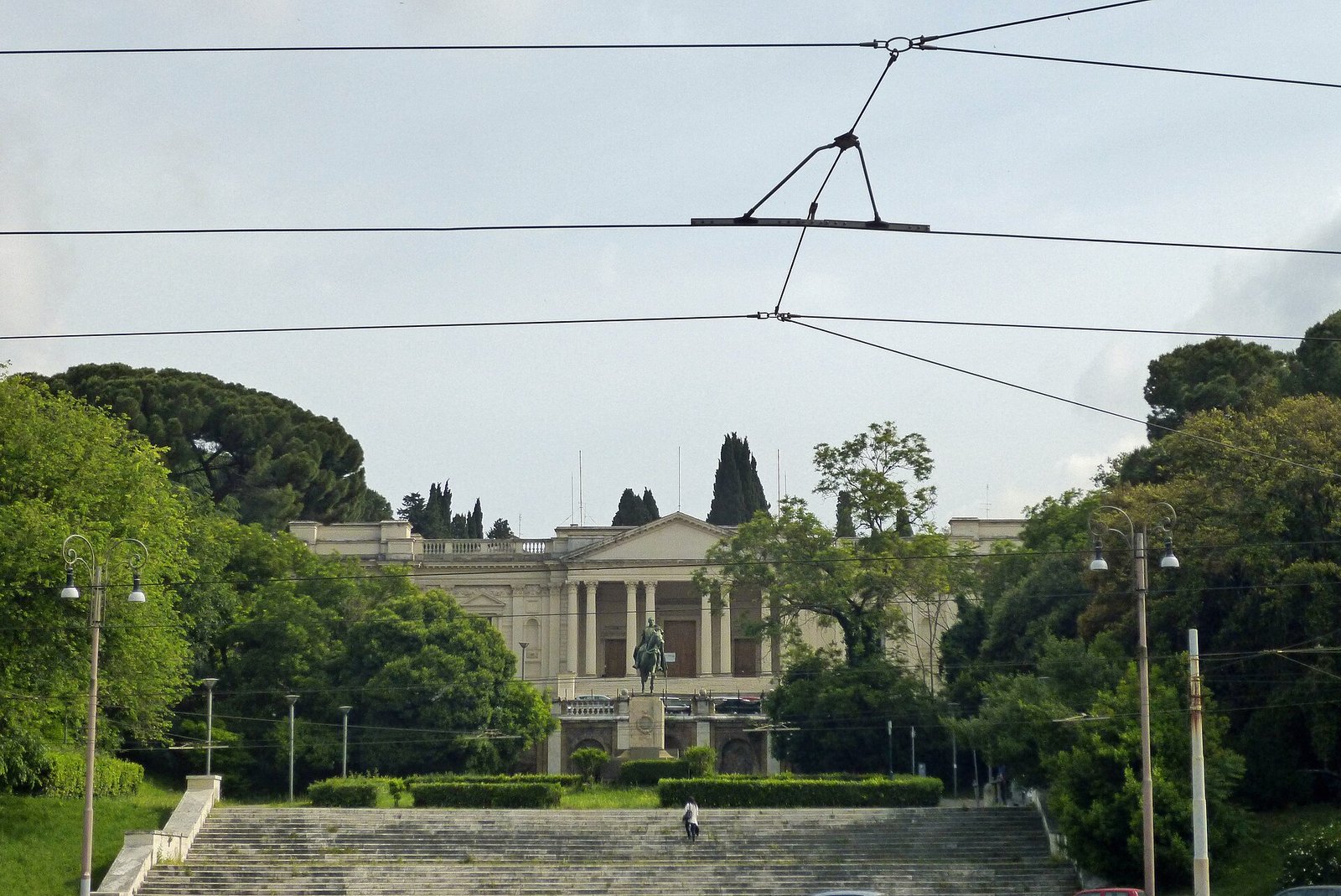
The right photo is the facade of the British School seen from the Valle Giulia steps, with Lutyens's portico high up, beyond the gardens and the equestrian statue. It's the framing that shows the building born in 1911 as an Exhibition pavilion and which became the institute's home in 1916. On November 4 the sun sets early: to get it in natural light you have to arrive in the early afternoon, or accept an evening photo with the portico lit.
Inside, before photographing the works, ask if it's allowed: they are new works, protected by copyright, and archive materials, and the rules are set by the institute. If yes, look for a work on paper next to a historical document of the scholarships: in a single image, 100 years. The third photograph is of the exhibition poster, with the Italian title Cent'anni a Roma: a title in Italian chosen by a British institution, which already says the relationship between the painters and the city.
Some important events that happened here in history
The history of the British School begins in 1901, with the founding in Rome of a British institute for the study of Italian art, history and archaeology. In 1911 the International Exhibition of Art brings the national pavilions to Valle Giulia, and the British one is designed by Edwin Lutyens. In the same year, on August 1, Edwin Austin Abbey dies in London. In 1912 the institute receives the Royal Charter, and after the Exhibition the land is granted to the United Kingdom on condition that it remain a research center. In 1916 the British School moves into the home adapted by Lutyens. In the 1920s Winifred Knights and Colin Gill arrive. In 1926 Gertrude Abbey founds the scholarships in memory of her husband.
In 1937 a formal agreement ties the Abbey scholarships to the British School. From 1939 to 1945, during the war, the institute is without a director. In 1946 the long directorship of John Bryan Ward-Perkins begins, lasting until 1974. In 1970 John Copnall wins the E. A. Abbey Scholarship, and in 1998-99 Chantal Joffe is Abbey Scholar. In 2002 Princess Alexandra inaugurates Hugh Petter's Lecture Theatre. In 2023 the ceiling painted by Bridget Riley is unveiled. In 2026 the British School celebrates its 125 years, and on November 4 the exhibition opens for the 100 years of the Abbey Awards.
Who has come through Cent'anni a Roma: The Abbey Awards at the British School at Rome, November 4 to December 18, 2026
Some of the most important names in British art of the 20th century and today have passed through the British School. The institute recalls among its scholar artists Winifred Knights and Colin Gill in the 1920s, then Gillian Ayres, Joe Tilson, Cornelia Parker, Mark Wallinger, Julian Opie, Cerith Wyn Evans, Elizabeth Price, Laure Prouvost, Richard Billingham and Chantal Joffe, the latter precisely with the Abbey scholarship. John Copnall, Abbey Scholar in 1970, passed through here. Bridget Riley left a painted ceiling, and met the winners of the scholarship that bears her name.
Among scholars, the British School has hosted historians such as David Abulafia and Nicholas Purcell, and curators such as Penelope Curtis and Nicholas Cullinan. Among the directors have been Thomas Ashby, Bernard Ashmole, Ian Richmond, John Bryan Ward-Perkins, Graeme Barker, Richard Hodges, Andrew Wallace-Hadrill, Christopher Smith and Chris Wickham, up to the current director Abigail Brundin. The building bears the signature of Edwin Lutyens, the Lecture Theatre that of Hugh Petter. On November 4, 2026 Sacha Craddock, Danny Rolph, Vanessa Jackson and the former Abbey scholars who show their new works on paper pass through Valle Giulia, in the name of Edwin Austin and Gertrude Abbey.
November and December in Rome: the exhibition period
The exhibition covers the six weeks from the beginning of November to the eve of the holidays: a quiet period for Rome's museums, before the arrival of Christmas visitors.
November
In November the days get shorter and the afternoon light disappears early. To see Lutyens's building in natural light too, a visit in the early afternoon is best, if the institute allows it.
December
In the first weeks of December the city starts to fill up for the holidays. Anyone who wants to see the exhibition at leisure should choose November. Closing is given as December 18.
Frequently asked questions about Cent'anni a Roma: The Abbey Awards
When can you see the Abbey Awards exhibition at the British School at Rome?
The exhibition Cent'anni a Roma: The Abbey Awards, 1926-2026 opens at the British School at Rome on Wednesday, November 4, 2026, with an opening evening from 18:00 to 21:00. The official poster gives the duration until December 18, 2026. Later hours are on the institute's website.
Where is the British School at Rome?
The British School at Rome, or British Academy, is at Via Antonio Gramsci 61, 00197 Rome, in Valle Giulia, next to the Galleria Nazionale d'Arte Moderna and Villa Borghese. The tram stops at Galleria Arte Moderna and Belle Arti. The nearest metro is Flaminio.
What are the Abbey Awards?
The Abbey Awards are scholarships for painters founded in 1926 by Gertrude Abbey in memory of her husband, the American painter Edwin Austin Abbey, under the name Incorporated Edwin Austin Abbey Memorial Scholarships. Since 1937 they have been tied to the British School at Rome.
What do you see in the exhibition?
The exhibition Cent'anni a Roma presents new works on paper by artists who have received the Abbey Awards from the 1950s to today, along with archive materials that reconstruct the history of the scholarships and the relationship with the British School at Rome.
Can you follow the opening online?
No, the opening of the exhibition Cent'anni a Roma on November 4 takes place in person only, as the official page of the British School at Rome specifies. The conversation with the artists is held from 18:00 to 18:30 in the Lecture Theatre.
Who speaks at the opening evening?
At the opening evening of Cent'anni a Roma, Danny Rolph, Vanessa Jackson and Sacha Craddock take part, in conversation with the artists in the show. Sacha Craddock is a London critic and curator and sits on the board of the Abbey Awards in Painting at the British School.
What is there to see near the British School at Rome?
Next to the British School at Rome are the Galleria Nazionale d'Arte Moderna e Contemporanea, the Etruscan Museum of Villa Giulia, Villa Borghese with the Galleria Borghese and the Bioparco. The Galleria Nazionale's Caffè delle Arti is open Tuesday to Sunday.
The final advice on Cent'anni a Roma: The Abbey Awards
Cent'anni a Roma is a small exhibition in a rare place, and it tells a story few people know: that of an American widow who in 1926 decided to send painters to Rome in her husband's name. The advice is to be there on the evening of November 4, on time at 18:00 for the conversation with the artists, and to combine the visit with the Galleria Nazionale d'Arte Moderna. In our view, for anyone who loves painting, it's one of the best ways to understand why Rome continues to be a stop in the training of artists from all over the world.
Article written by the editorial team of Tour Leader Pro, contact them for Private/Corporate/V.I.P. Tours and Experiences.
Planning a trip to Rome? The English-language guides to visiting the city are on ItalyPlanner.com.