CDJO Casa del Jazz Orchestra conducted by Mario Corvini, Bob Brookmeyer at Casa del Jazz, November 27 and 28, 2026
https://www.estateromana.com/en/rome/trip-planner/cdjo-casa-del-jazz-orchestra-conducted-by-mario-corvini-bob-brookmeyer-at-casa-d/
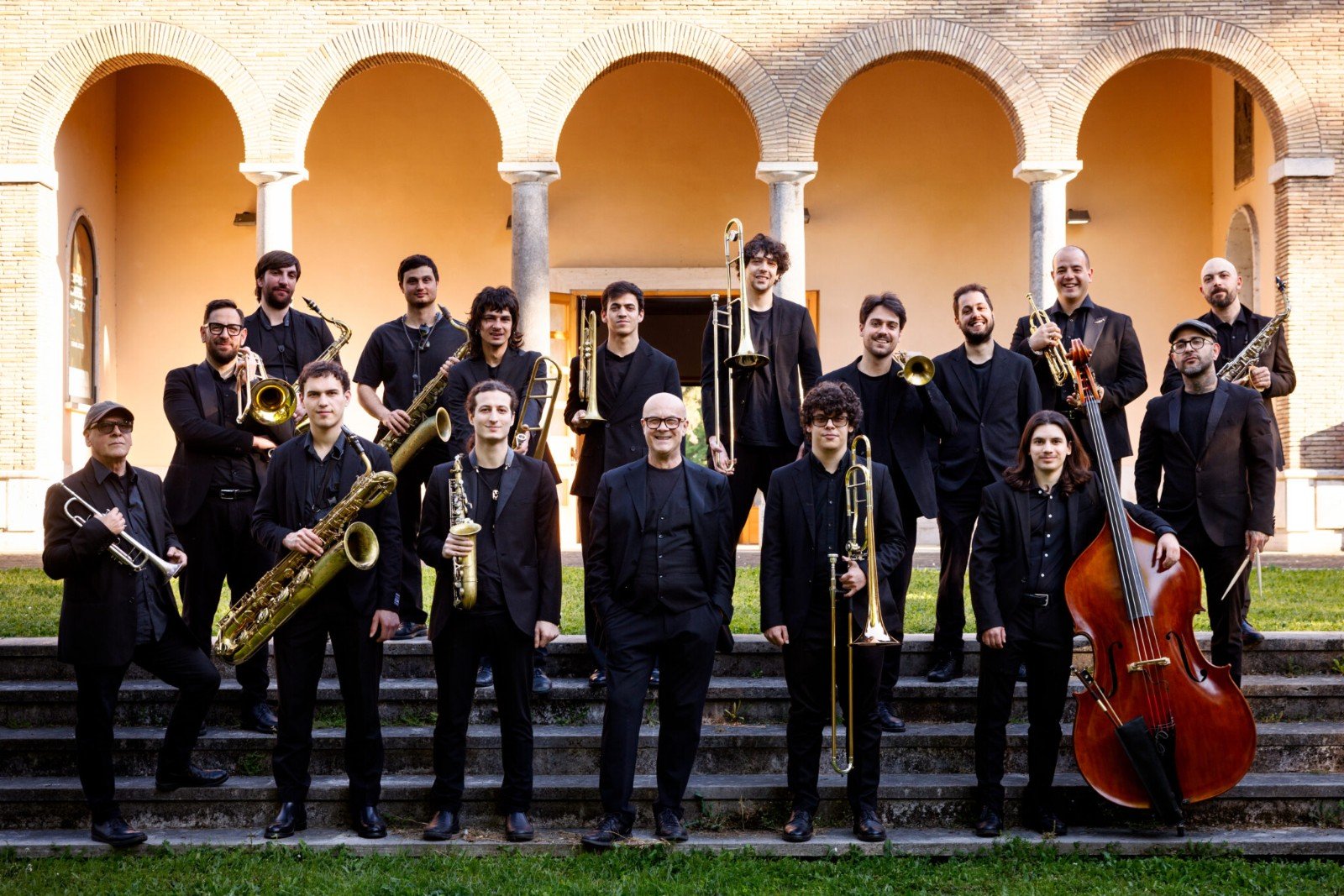 Foto dal sito ufficiale della Casa del Jazz
The CDJO Casa del Jazz Orchestra, the venue's resident orchestra conducted by Mario Corvini, devotes the fourth event of its season to the music of Bob Brookmeyer with the program "Bob Brookmeyer, Evolution of the jazz composer", so it is CDJO and Bob Brookmeyer at Casa del Jazz on two dates: Friday, November 27, and Saturday, November 28, 2026, both at 19:30, in the "Armando Trovajoli" concert hall of Casa del Jazz, at Viale di Porta Ardeatina 55, 00154 Rome. There's a single ticket price of 15 euros, according to the official listing. The two evenings are bought separately. Tickets are sold online through the link given on the Casa del Jazz website and at the venue's box office, open on show days from 19:00 until 40 minutes after the start. For public transportation the venue suggests metro B to Piramide station and bus 714 to Colombo/Marco Polo. If you come by car there's a parking lot next to the villa, toward Via Cristoforo Colombo. A personalized route is available on ATAC's journey planner. For ticket questions Fondazione Musica per Roma gives 06 80241281 and info@musicaperroma.it.
Evolution of the jazz composer: the program
The title chosen by Casa del Jazz for this concert puts the emphasis on one precise word: composer. Many people remember Bob Brookmeyer as a trombonist, but the official presentation describes him above all as a major figure in writing for jazz, able to combine the African American tradition with the most advanced compositional techniques of the 20th century.
According to the same presentation, Brookmeyer absorbed influences from contemporary European music without giving up the purity of swing and improvisation. The concert therefore sets out to rediscover a musician through his sound architectures, in a program in which innovation, research into tone color, expressive depth and the freedom of the jazz language find a point of balance.
Why a single-composer program
Devoting a whole evening to one composer lets you follow the evolution of a writing style. For a composer like Brookmeyer, who went through about 60 years of jazz, from the small groups of the 1950s to the European orchestras of the 1990s and 2000s, the single-composer journey is also a journey through the history of orchestral jazz.
The repertoire isn't published
The official listing doesn't give the pieces on the program or the exact lineup of the orchestra and any soloists: the information isn't published. Anyone who knows Brookmeyer's discography can only imagine which pieces will be chosen. The setlist will be discovered in the hall.
Who Bob Brookmeyer was
Robert Edward Brookmeyer, known as Bob, was born in Kansas City, Missouri, on December 19, 1929. He died on December 15, 2011, in New London, New Hampshire. He was a trombonist, pianist, arranger and composer.
The valve trombone
The instrument that made him recognizable is the valve trombone, which replaces the slide of the traditional trombone with a valve system similar to that of the trumpet. Brookmeyer took up this instrument in the early 1950s, when he was playing in Claude Thornhill's orchestra. The Casa del Jazz presentation indeed calls him a valve trombonist.
The years with Gerry Mulligan
International fame came with Gerry Mulligan's pianoless quartet, of which he was a member from 1954 to 1957. He joined the group as the first replacement for Chet Baker. Later he returned alongside Mulligan in the Concert Jazz Band, as arranger and player. With Mulligan he also recorded Jazz Concerto Grosso, from 1958.
Getz, Giuffre, Jim Hall
In the same years he worked with Stan Getz, in a musical relationship that lasted about 15 years, and with Jimmy Giuffre and Jim Hall, with whom he recorded Western Suite in 1958. In 1959 he recorded The Ivory Hunters with Bill Evans, in which he played piano.
From the American big band to Europe
The transition that the CDJO program puts at the center is the one from player to composer. In the 1960s Brookmeyer worked with the Thad Jones/Mel Lewis Orchestra, and he became its music director in 1979. In the early 1960s he also co-led a successful group with Clark Terry, with whom in February 1965 he appeared on the BBC television program Jazz 625.
A pianist too
There's an often forgotten detail: after moving to New York, Brookmeyer joined Mel Lewis's orchestra as pianist and worked with musicians such as Coleman Hawkins, Ben Webster and Charles Mingus. The piano, the composer's instrument, stayed with him throughout his career.
Cologne, Stockholm, the Netherlands
From 1981 he worked intensely in Europe as a composer and conductor, writing many works for Cologne and Stockholm. From 1991 he settled in the Netherlands, where he founded a school devoted to improvisation and composition. Worth remembering is his collaboration with the Metropole Orchestra, documented by the albums Out of This World (1998) and Music for String Quartet and Orchestra (2008).
Teaching and the New Art Orchestra
Back in the United States, he taught jazz composition at the New England Conservatory in Boston. In his last years he led the New Art Orchestra, with which he recorded Get Well Soon (2003) and Spirit Music (2006).
Recognition
Brookmeyer received eight Grammy nominations over his career, including those for Impulsive! (2001), Spirit Music (2006) and, for an arrangement, Nasty Dance (2011). In 2006 the National Endowment for the Arts named him an NEA Jazz Master.
Listening to Brookmeyer before the concert
If you want to arrive prepared you can start from his discography. You don't need to listen to everything: two or three albums from different periods are enough to understand the journey the CDJO program sets out to tell.
The 1950s
His early work includes Bob Brookmeyer Quartet (1954) and The Dual Role of Bob Brookmeyer (1956). From 1958 come Jazz Concerto Grosso, with Gerry Mulligan, and Western Suite, with Jimmy Giuffre and Jim Hall. From 1959 The Ivory Hunters with Bill Evans, in which Brookmeyer sits at the piano.
The 1960s
Gloomy Sunday and Other Bright Moments (1961) and Trombone Jazz Samba (1962) complete the picture of the decade: the second, as the title suggests, looks to Brazilian music.
The European maturity
For Brookmeyer the composer, the most useful references are the albums with the Metropole Orchestra, Out of This World (1998) and Music for String Quartet and Orchestra (2008), and those with the New Art Orchestra, Get Well Soon (2003) and Spirit Music (2006). This is where you hear the fusion of jazz and contemporary writing the Casa del Jazz presentation talks about.
The valve trombone
The valve trombone is an uncommon instrument in jazz, where the slide trombone dominates. Instead of the long moving slide, it has a valve system that lets you change notes with your fingers, as on the trumpet. The sound remains the warm sound of the trombone, but the agility changes, and with it the way of phrasing.
An instrument as a signature
For Brookmeyer, the valve trombone was a choice of identity, adopted in the early 1950s. In the CDJO program, devoted above all to the composer, the instrument may or may not appear: the listing doesn't say if a soloist from the orchestra will play it, and the information isn't published.
The CDJO Casa del Jazz Orchestra
The official website presents the CDJO as the venue's new permanent ensemble, born as an original project of the Centro di Produzione Musica Jazz, part of Fondazione Musica per Roma. It's led by Mario Corvini. The official pages don't give the year the ensemble was founded, the list of musicians or the conductor's biography, which is cut off on the dedicated page.
The 2026 season
Casa del Jazz lists the Brookmeyer concert as the fourth event of the CDJO conducted by Corvini. A few weeks earlier, on October 23 and 24, 2026, the orchestra presented "The fabulous Thad Jones", also at 19:30 in the same hall.
A numbered program
The numbering of the events, which Casa del Jazz states explicitly, suggests a cycle planned over time, in which each evening adds a piece to a broader story about orchestral jazz.
A thread between Thad Jones and Brookmeyer
The sequence of the two programs has a historical logic. Thad Jones is the first of the two names of the Thad Jones/Mel Lewis Orchestra, and Brookmeyer became its music director in 1979. Anyone who followed the October concert thus finds, at the end of November, another central figure of the same orchestral story.
Hearing a big band in a small hall
One of the particular features of this concert is the size of the hall. The Sala Trovajoli has about 150 seats according to the venues page of the official website, which elsewhere gives 134 seats. A jazz orchestra in a space this size makes for a very physical listening experience: the horn sections reach the audience with direct impact, without the distance of a large auditorium.
The sections
In writing for big band, the composer works by sections: trumpets, trombones, saxophones, rhythm. Brookmeyer's music, which according to the official presentation absorbed techniques from contemporary European music, often uses these sections less predictably than classic orchestral jazz, with combinations of tone colors and overlaps worth following closely.
The conductor's role
At a big band concert the conductor isn't just the one who counts in. He chooses the tempos, balances the sections, decides how much room to leave the soloists and how to let the written pages breathe. For a complex repertoire like Brookmeyer's, Mario Corvini's work in bringing it together will be decisive in making the layers of the writing readable in a small hall.
Swing as a foundation
The same presentation stresses that Brookmeyer never gave up swing and improvisation. Even in the most complex pages, then, the audience can expect moments of recognizable jazz pulse and room for solos by the orchestra's musicians.
Two evenings, which to choose
The program is identical on the two dates. The choice between Friday the 27th and Saturday the 28th therefore depends mostly on your own plans.
Friday, November 27
Friday evening calls for a little attention to traffic: the 19:30 start coincides with people leaving work, and Via Cristoforo Colombo is one of the busiest arteries in the city. Public transportation is the simplest solution.
Saturday, November 28
Saturday lets you spend the afternoon in the area and arrive at a relaxed pace. If you choose the 28th you can also come back to Casa del Jazz the next day, Sunday the 29th, when the venue offers Le frontiere dell'arpa with Lucia Bova at 12:00 for the Junctions Beyond Jazz series and the concert by Beatrice Gatto at 18:00.
Who the concert is for
The concert is meant first of all for lovers of orchestral jazz and big band writing. But the modest price and the intimate hall also make it a good way in for anyone who has never heard a jazz orchestra live.
For musicians and students
Brookmeyer was a composer and a teacher of jazz composition, and his music is a reference point for anyone studying arranging. Conservatory students and musicians will find in the program a concrete opportunity to hear live pages that are usually known only on record.
For those who followed Thad Jones
Anyone who was in the hall for the October program devoted to Thad Jones has one more reason to come back: the two concerts form an ideal diptych on the same era of American orchestral jazz.
The last weekend of November
The CDJO's two evenings open a very full weekend at Casa del Jazz. After the concerts on Friday the 27th and Saturday the 28th, Sunday the 29th offers two events: at noon harpist Lucia Bova for Junctions Beyond Jazz, a series devoted to the avant-garde, memory and experimentation, and at 18:00 the concert by Beatrice Gatto.
A whole weekend
If you live in Rome or are in town for a few days you can put together three days of listening at the same venue, going from jazz orchestra to contemporary harp to song. It's a way to get to know the variety of Casa del Jazz's program.
Practical information, date by date
Friday, November 27
At 19:30, Sala Trovajoli. Box office from 19:00. Single ticket 15 euros.
Saturday, November 28
Same program, same time and same price. Tickets for the two evenings are separate.
Where
Casa del Jazz, main villa of the complex, number 55 on Viale di Porta Ardeatina, postal code 00154.
Contacts
Fondazione Musica per Roma, 06 80241281, info@musicaperroma.it. The box office rules and FAQs are available on the venue's website.
Why two performances matter
The choice to present the same program on two consecutive evenings isn't just a question of seats. For an orchestra, the second performance is often the one where the music settles: the hardest passages have already been tackled in front of an audience, the soloists know the hall better, the ensemble breathes more naturally. For the dedicated listener, following both evenings lets you catch how the improvised solos change, which by definition are never the same twice.
A 150-seat hall for two evenings
With a capacity of about 150 seats, two performances mean a few hundred spectators in all: a small audience, which makes the event more like a meeting of enthusiasts than a big concert. That's another reason to buy tickets early.
Casa del Jazz, from villa to music venue
Three buildings inside a park open to the public, between the avenue named after Porta Ardeatina and the Colombo: that's Casa del Jazz, run by Fondazione Musica per Roma, the organization that also runs Auditorium Parco della Musica. The main villa houses the concert hall. A second building has rehearsal and recording rooms and guest quarters. The third a restaurant. Our general page on the venue is here.
The size
The official website says the main building covers about 2,500 square meters, while the green space around it reaches 25,240. It's a park of about two and a half hectares.
The hall
The name of the hall honors Armando Trovajoli, a musician born in Rome, who in 1949 represented Italy at the Paris Jazz Festival and in 1958 founded the RAI's Orchestra Stabile di Musica Leggera: an illustrious precedent for a jazz orchestra that today plays in the hall bearing his name.
A curious fact about Casa del Jazz
Casa del Jazz doesn't live only inside the villa. The autumn 2026 calendar includes concerts in the park too: the venue lists a series called I Concerti nel Parco Autunno 2026, from October 17 to November 6, and the concert by Elective Lines with Andrea Colella on November 15 is announced precisely in the "Parco di Casa del Jazz". The garden designed in the 1930s by Pietro Porcinai thus becomes, in autumn too, a space for music.
A park created for a family
That park was designed for the private residence of Arturo Osio, a founding partner of Banca Nazionale del Lavoro. Today it's a public green area of more than two hectares, open to concertgoers.
Something nobody tells you about Casa del Jazz
Casa del Jazz doesn't just host concerts: it produces its own music. The CDJO, the official website explains, was born within the Fondazione's Centro di Produzione Musica Jazz, and the same organization has a record label. In the villa, a recording system also makes it possible to document events and produce records.
A house orchestra
Having a resident orchestra means being able to build a path over time: single-composer programs like those devoted to Thad Jones and Brookmeyer, numbered events, an audience that finds the same musicians at every concert. It's a different model from a simple hall hosting touring artists, and it explains why the venue is called a "house".
My advice for visiting Casa del Jazz
My advice is to take advantage of the modest price, 15 euros, to follow both of the season's CDJO concerts, if there's a chance, or at least to come to this program with a little preparation. Listening at home to one or two Brookmeyer albums, from the Mulligan period to the one with the European orchestras, makes the experience in the hall much richer: you recognize the ideas and understand how the writing changed over time.
Arrive early
Entry to the hall normally begins 30 minutes before the start, and once the concert has begun entry isn't guaranteed. For 19:30 it's best to show up at the villa around 19:00, when the box office opens.
Accessible seats
For wheelchair users, the dedicated seats are booked by phone, at 06 8024 1281, from 11:00 to 18:00 every day. There are few seats available, so it's best to call well in advance.
Another well-known fact, yet rarely mentioned
Casa del Jazz is known as the villa confiscated from Enrico Nicoletti, the cashier of the Banda della Magliana. It's rarely remembered whom Nicoletti bought it from: in the 1980s the villa belonged to the Vicariate of Rome, and it was Nicoletti who bought it. From church property to a criminal's residence, and then to a public asset: few Roman buildings have changed hands so tellingly.
The illegal alterations
During Nicoletti's ownership, works and illegal building alterations were carried out that profoundly changed the interiors and facades of the villa designed by Cesare Pascoletti. The venue you visit today is the result of the restoration after the confiscation.
The right photo to take at Casa del Jazz
For an orchestra evening, the most meaningful photo is taken before the concert, of the empty stage with the music stands and instruments ready, if the staff allow it. A big band seen before the start, with the chairs arranged by section, tells the collective nature of this music well. During the performance, on the other hand, it's good practice not to take photos.
Outside, the villa at night
At the end of November darkness comes early. The lit facade of the villa, seen from the park's paths, is the image that stays with you from an evening at Casa del Jazz, together with the stele dedicated to the victims of the mafia at the entrance.
Some important events that happened here in history
Before the villa
The area had a 17th-century farmhouse, on whose ruins Arturo Osio's residence was built.
1936-1939
Construction of the villa designed by Cesare Pascoletti, a student of Marcello Piacentini, and landscaping of the park entrusted to Pietro Porcinai.
The 1980s
The Vicariate of Rome sells the villa to Enrico Nicoletti, who transforms it with illegal works.
1996-2001
Seizure on November 14, 1996, final confiscation on February 20, 2001, assignment to the City of Rome on September 26, 2001, under law 109 of 1996.
2005
In April Casa del Jazz opens, directed by Luciano Linzi and initially managed by the special agency Palaexpo.
2025
The Prefecture of Rome orders surveys in the park for the possible presence of the remains of magistrate Paolo Adinolfi, who disappeared in 1994.
2026
The CDJO conducted by Mario Corvini, the resident orchestra, devotes two consecutive programs to Thad Jones (October) and Bob Brookmeyer (November).
Who has passed through Casa del Jazz
Among the names that have made the venue's history, the official website mentions the then mayor Walter Veltroni, who promoted the project, and Don Luigi Ciotti, president of Libera, the association with which the plaque bearing the names of mafia victims was made. The first director, in 2005, was Luciano Linzi.
The resident orchestras
Today the venue hosts two permanent ensembles: Corvini's professional orchestra and, alongside it, the youth ensemble led by Massimo Nunzi, the Jazz Campus Orchestra, which according to the website is aimed at children and young people between 7 and 14 to bring them closer to jazz. In the same villa, then, a professional orchestra and a workshop for the youngest live side by side.
The festivals
In 2026 Casa del Jazz also hosts some of the concerts of the Roma Jazz Festival, now in its 50th edition, and the soloists of the PMCE ensemble, guests of the Junctions Beyond Jazz series, running from March 15 to December 13.
Around Casa del Jazz
The venue is in an area where ancient monuments and modern neighborhoods sit side by side. If you have time before the concert, especially on Saturday, you can choose between several destinations.
Piramide and the Non-Catholic Cemetery
From Piramide metro station you immediately see the Pyramid of Cestius, next to which is the Non-Catholic Cemetery. Opening hours should be checked on the official websites.
Ostiense
Beyond the Pyramid begins the Ostiense neighborhood, with its industrial archaeology and its bars and restaurants. It's a good area for dinner after the concert.
The Aurelian Walls
The avenue of Casa del Jazz runs near the Aurelian circuit, which at this point preserves the small Porta Ardeatina, a gateway already closed in the early Middle Ages. If you arrive while it's still light you can give it a few minutes. Our feature on the Aurelian Walls covers the whole circuit.
Other jazz venues
If you want to extend the evening with more live music you can check the programs of Roman clubs, like Alexanderplatz Jazz Club, verifying dates and times on the venue's official channels.
Frequently asked questions about the CDJO concert devoted to Bob Brookmeyer
When is the concert?
On two dates with the same program: Friday, November 27, and Saturday, November 28, 2026, both at 19:30, in the Armando Trovajoli concert hall of Casa del Jazz. The online box office indicated by the venue lists both evenings, with tickets that can be bought separately, so you're free to choose the most convenient date.
How much is the ticket?
The single ticket costs 15 euros, according to the official listing. The rules provide discounts for people with a certified disability and for blind people, obtainable by presenting documentation at the central box office of Auditorium Parco della Musica, run by the same Fondazione Musica per Roma.
Who's playing?
The CDJO Casa del Jazz Orchestra, the venue's resident orchestra, conducted by Mario Corvini. The official listing doesn't publish the list of musicians or any guest soloists, so the exact lineup will be known in the hall. The orchestra is a production of the Centro di Produzione Musica Jazz of Fondazione Musica per Roma.
Who was Bob Brookmeyer?
An American valve trombonist, pianist, arranger and composer born in Kansas City in 1929 who died in December 2011. He was a member of Gerry Mulligan's quartet from 1954 to 1957, was music director of the Thad Jones/Mel Lewis Orchestra, worked for a long time in Europe and in 2006 was named an NEA Jazz Master.
Is it suitable for people who don't know orchestral jazz?
Yes, with a little curiosity. The official presentation points out that Brookmeyer, while using 20th-century European compositional techniques, never gave up swing and improvisation. If you're hearing a big band for the first time you'll find moments of great energy and room for solos, in a hall small enough to hear every section.
How do you get to Casa del Jazz?
The official directions mention metro B to Piramide and bus 714 to the Colombo/Marco Polo stop. If you drive there's a parking lot near the villa, on Via Cristoforo Colombo side. The route from your area and the evening transit times can be checked on ATAC's journey planner.
What time should you arrive?
The box office opens at 19:00 and entry to the hall normally begins half an hour before the concert, until five minutes before the start. Once the show has begun entry isn't guaranteed and latecomers, if admitted, may be seated in different places. Arriving at 19:00 is the safest choice.
Are there other CDJO concerts?
The Brookmeyer concert is the fourth event of the orchestra's season. The previous one, "The fabulous Thad Jones", was scheduled for October 23 and 24, 2026. Later dates should be checked on the official Casa del Jazz calendar, which publishes the new programs as they come.
Final advice on the CDJO concert devoted to Bob Brookmeyer
Two evenings at 15 euros to hear a jazz orchestra in a hall of about 150 seats are a rare opportunity, and the program devoted to Bob Brookmeyer lets you travel in one evening through the history of orchestral jazz, from Mulligan's quartet to the great European orchestras. Choose your date, buy your ticket on the official channel, listen at home to a few pages of Brookmeyer to arrive prepared and, if you can, pair Saturday evening with the concerts the following Sunday: at Casa del Jazz, the last weekend of November is a small festival.
Article written by the editorial team of Tour Leader Pro, contact them for Private/Corporate/V.I.P. Tours and Experiences.
Planning a trip to Rome? English guides for visiting the city are on ItalyPlanner.com.