Brother Sun, Sister Moon at Teatro Olimpico, December 4 to 6, 2026
https://www.estateromana.com/en/rome/trip-planner/brother-sun-sister-moon-at-teatro-olimpico-december-4-to-6-2026/
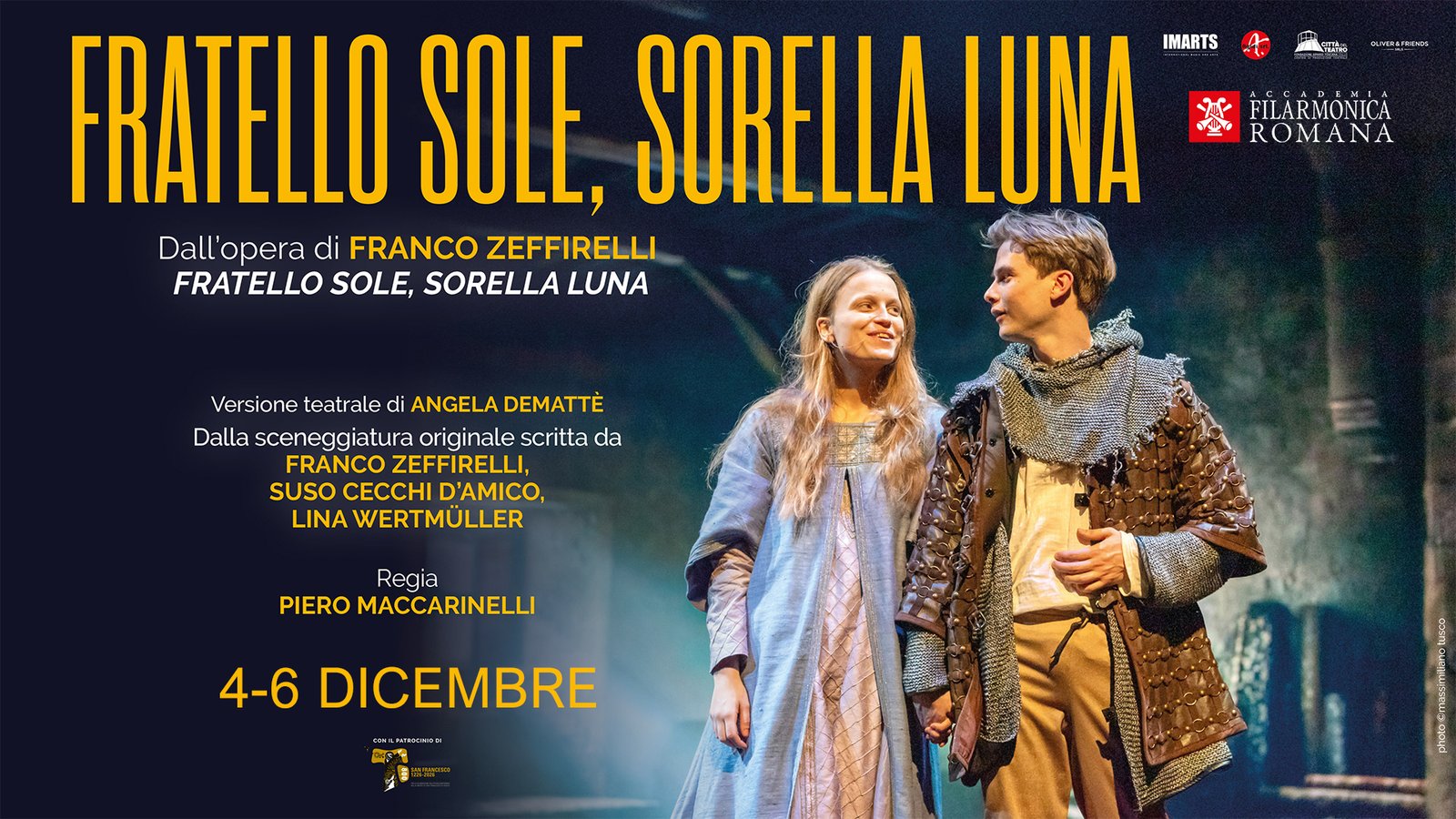
Brother Sun, Sister Moon (Fratello Sole, Sorella Luna), the show based on Franco Zeffirelli's film and directed by Piero Maccarinelli, is on stage at Teatro Olimpico in Rome, at Piazza Gentile da Fabriano 17, from December 4 to 6, 2026: Friday the 4th at 20:30, Saturday the 5th at 16:30 and 20:30, Sunday the 6th at 17:30. Giulio Pranno is Francis, Ksenia Borzak is Clare. You get there with Metro A to Flaminio and then tram 2 to Piazza Mancini terminus, from where you walk about 500 meters along Viale del Pinturicchio. Alternatively, bus 910 from Termini to the Pannini stop. Prices published by the theater range from 22 euros (side balcony with balustrade) to 34.80 euros (gold premium stalls), plus booking fees, with reduced rates for under-12s in almost all sections. Tickets are sold on the venue's official website and at the theater box office, as well as on the presale circuit authorized by the organizers.
Language: performed in Italian. No English version or English surtitles are announced.
The show is produced in collaboration with the Accademia Filarmonica Romana and comes in the year of the 800th anniversary of the death of St. Francis. Here's what convinces: behind it there's a serious theater team, a veteran director, an award-winning playwright and a young actor whom film has already put to the test. It's not a nostalgia exercise. It's an attempt to make a story speak again that Rome, in a way, saw happen.
Brother Sun, Sister Moon at Teatro Olimpico in brief
There are four performances of Brother Sun, Sister Moon at Teatro Olimpico, concentrated over one weekend: an evening one on Friday, an afternoon and an evening one on Saturday, an afternoon one on Sunday. It's a season show, in collaboration with the Accademia Filarmonica Romana.
The performance calendar
Friday, December 4, 2026, 20:30. Saturday, December 5, 16:30 and 20:30. Sunday, December 6, 17:30. The two afternoon performances are the best suited to families and catechism groups, and very likely the first to fill up.
The cast
Giulio Pranno as Francis, Ksenia Borzak as Clare, with the special participation of Massimo Wertmüller and Fabrizia Sacchi. With them Gabriele Cicirello (Deodato), Antonio Iorio (Paolo), Edoardo Raiola (Bernardo), Andrea Galasso (Giocondo) and Eduardo Sacchi (Silvestro).
The artistic team
From the work of Franco Zeffirelli, stage version by Angela Demattè from the original screenplay by Zeffirelli, Suso Cecchi D'Amico and Lina Wertmüller, directed by Piero Maccarinelli. Original songs by Riz Ortolani and Donovan, original music and arrangements by Alessandro Nidi, sets by Francesco Sereni, costumes by Daniele Gelsi, lighting by Javier Delle Monache, with the friendly contribution of Tullio Solenghi. Dramaturgy assistant Lea Paiella, assistant director Alessandro Gorgoni.
The show: St. Francis 800 years after his death
Brother Sun, Sister Moon is a theater project dedicated to the human and spiritual story of St. Francis of Assisi, created for the 800th anniversary of his death. The theater presents it as a choral and poetic story addressed to everyone, a universal story of peace, simplicity and brotherhood.
The plot
Francis, son of a wealthy merchant family, gives up the privileges of his position to embrace poverty. Against the backdrop of an Italy torn by conflicts between cities and commercial struggles, his choice causes scandal in his family and rejection by the religious authorities. Only Clare stands by him, a young woman of the same social background, who shares the radical choice with concrete gestures toward the poor and the sick. Barefoot and in a habit, Francis builds a church open to all. His example wins over other well-off young men and gives rise to a movement that shakes the society and the Church of the time.
The journey to Rome
The story culminates in Rome, where the Pope recognizes the revolutionary scope of Francis's choice and is moved by his vision of an essential, bare faith. It's the point where the show speaks directly to the city hosting it: the story seen on stage at the Olimpico has its decisive moment a few kilometers from the hall.
A contemporary language
The Accademia Filarmonica Romana describes the production as staging, in a contemporary theatrical language, the parable of Francis and his message of brotherhood and peace. The risk of a glossy hagiography is always there with this subject, and choosing a playwright like Demattè, used to exploring the relationship between intimate space and political space, is the best guarantee the theater could give itself.
Zeffirelli's 1972 film
Brother Sun, Sister Moon is a 1972 film directed by Franco Zeffirelli, loosely inspired by the life of St. Francis from his calling to the approval of the rule. It won the 1972 David di Donatello for best director and was nominated for the Oscar for best art direction in 1974.
A screenplay written by three
Story and screenplay bear the names of Suso Cecchi D'Amico, Lina Wertmüller and Zeffirelli himself. It's from that text that Angela Demattè's stage version starts. The curious detail: in the show's cast, in a special appearance, is Massimo Wertmüller, who bears the same surname as one of the three writers of the original screenplay.
The film's cast
Francis was Graham Faulkner, Clare Judi Bowker. Alec Guinness played Pope Innocent III, Valentina Cortese the mother, Pica, Adolfo Celi the consul. In the Italian version Francis had the voice of Giancarlo Giannini and the Pope that of Gino Cervi. Cinematography was by Ennio Guarnieri, costumes by Danilo Donati, art direction by Lorenzo Mongiardino.
Where it was shot
Shooting began on February 7, 1971, and lasted all summer. Several scenes were shot on the Piani di Castelluccio di Norcia, others at the Abbey of Sant'Antimo, in San Gimignano, Montalcino and Gubbio. The final scene of the meeting with the Pope was shot in the Cathedral of Monreale. The film came out in Italy on March 3, 1972.
The songs: Ortolani, Donovan, Baglioni
The score is by Riz Ortolani, but one of the songs has music by Donovan, and in the Italian version three songs are sung by Claudio Baglioni. There are two versions of the film: the international one with the music performed by Donovan and the Italian one with Ortolani and Baglioni. In March 2024 the restored 4K international version was presented at the Quirinale Palace. The show at the Olimpico uses the original songs by Ortolani and Donovan, rearranged by Alessandro Nidi, who also wrote some original pieces.
Piero Maccarinelli, the director
Piero Maccarinelli, born in Brescia in 1957, is a theater director and artistic director. He graduated in directing from the Piccolo Teatro di Milano in 1979 and lives and works in Rome. In 2023 he was named Commander of the Order of Merit of the Italian Republic.
Training and film
After starting architecture at the Politecnico di Milano, he chose theater directing. He was assistant to Maurizio Scaparro for the Venice Biennale and La Scala, assistant director on Scaparro's Don Chisciotte in 1984 and casting director and assistant director on Ermanno Olmi's The Legend of the Holy Drinker in 1988. With Tullio Kezich he published a book on that film.
Rome and the big projects
With Walter Veltroni and Maria Ida Gaeta he conceived the festival Letterature at the Basilica of Maxentius, which he directed from 2002 to 2008. In 2004 he founded the association Artisti Riuniti with, among others, Cristina Comencini, Roberto Cicutto and Riccardo Tozzi. He has brought the Aeneid to Trajan's Markets and the Basilica of Maxentius, the Iliad to Trajan's Forum, the Odyssey to Parco della Musica. From 2021 he ran Teatro Parioli for three seasons, reopened after the pandemic.
An actors' director
In his career he has directed Elena Zareschi, Umberto Orsini, Valeria Moriconi, Mariangela Melato, Stefania Sandrelli, Giovanna Mezzogiorno, Michele Placido and Moni Ovadia, among others. He has staged Greek tragedy at the Greek Theater of Syracuse and Teatro Olimpico in Vicenza, Bernhard, Stoppard, Zeller, Tabucchi, Carofiglio. He has taught at the Accademia nazionale d'arte drammatica Silvio D'Amico and at the Centro sperimentale di cinematografia.
From Assisi to Rome
In his list of productions, Brother Sun, Sister Moon appears tied to Lyric Assisi, for the 800 years of St. Francis. It comes to Rome with a team the director knows: Giulio Pranno had already worked with him in Florian Zeller's The Son, on stage for the whole 2023/2024 season.
Giulio Pranno and the cast of Brother Sun, Sister Moon
Giulio Pranno, a Roman born in 1998, is the actor who plays Francis. He was discovered by Gabriele Salvatores with Tutto il mio folle amore, in 2019, and received the Premio Biraghi at the 2020 Nastri d'Argento.
Film
In Tutto il mio folle amore he played Vincent, an autistic 16-year-old, alongside Claudio Santamaria. For that role he also won the best actor award at Cinema Meno di Trenta in 2019. Salvatores cast him again in Comedians. Then came Peter Chelsom's Security and Stefano Mordini's La scuola cattolica, all in 2021. In 2024 he was the archangel Gabriel in Paolo Zucca's Vangelo secondo Maria.
Television and theater
On TV he worked on the series Noi siamo leggenda, directed by Carmine Elia, and on the D'Innocenzo brothers' miniseries Dostoevskij. He started in theater at 12. He reached the finals of the Premio Hystrio in 2018 and played in Zeller's The Son with Cesare Bocci and Galatea Ranzi, directed by Maccarinelli. He also appeared in Måneskin's music video L'altra dimensione, in 2019.
Clare and the special appearances
Ksenia Borzak is Clare, the only one who in the story stands by Francis from the start. Massimo Wertmüller and Fabrizia Sacchi make special appearances. The theater doesn't give their roles. Alongside them, five young actors play Francis's first companions, Deodato, Paolo, Bernardo, Giocondo and Silvestro: the same names as the characters in the film.
Angela Demattè and the stage version
Angela Demattè, born in Trento in 1980, is a playwright and actress. She graduated in modern literature from the Università Statale di Milano and trained at the Accademia dei Filodrammatici. In 2009, with Avevo un bel pallone rosso, she won the 50th Premio Riccione and the Premio Golden Graal.
The partnership with Carmelo Rifici
Avevo un bel pallone rosso was staged by Carmelo Rifici, with whom Demattè later created L'officina. Storia di una famiglia, Chi resta scritto, Clitennestra o la morte della tragedia, Il compromesso, Ifigenia, liberata. She has also worked with Andrea Chiodi and Sandro Mabellini.
Awards and international tours
Mad in Europe earned her the 2015 Premio Scenario. The French version of her first play, J'avais un beau ballon rouge, ran for four seasons in France, Switzerland, Belgium and Luxembourg, directed by Michel Didym with Richard and Romane Bohringer. Her Sarfatti, about the relationship between art and power under Fascism, was staged at Teatro Belli in Rome.
From film to stage
The theater presents Demattè as one of the most interesting voices in Italian playwriting, and entrusts her with the most delicate step: bringing to the stage a film made of landscapes, light and wide open spaces. It's the right choice: in a theater you can't show Castelluccio and Monreale, and you need writing that can make you feel them.
A curious fact about Brother Sun, Sister Moon at Teatro Olimpico, December 4 to 6, 2026
Zeffirelli's film, which tells of Francis meeting the Pope in Rome, shot that scene very far from Rome: in the Cathedral of Monreale, in the province of Palermo. The Teatro Olimpico show brings the story back to the city where that meeting really took place.
It's one of those geographic revenges a Roman guide appreciates. In the film Assisi is rebuilt across Umbria, Tuscany and the Marche: Gubbio with its alleys and the Palazzo dei Consoli, San Gimignano with the rooftops Francis runs across, the Rocca di Montalcino for the scene where he strips himself, the Abbey of Sant'Antimo, the Piani di Castelluccio. For the little church of San Damiano a reproduction of the crucifix was used, because the original is kept in the church of Santa Chiara in Assisi. Rome isn't in the film: Monreale, with its mosaics, stands in as the papal court.
A second curiosity, a family one. The original screenplay was also signed by Lina Wertmüller, and the show's cast includes, in a special appearance, Massimo Wertmüller. A third, about music: the film's costumes, designed by Danilo Donati, are preserved by the Fondazione Cerratelli in San Giuliano Terme, while the songs had two different lives, the international one with Donovan and the Italian one with the voice of Claudio Baglioni. The show brings them back together, Ortolani and Donovan, in Alessandro Nidi's arrangements.
The Accademia Filarmonica Romana and the show
Brother Sun, Sister Moon is on the program in collaboration with the Accademia Filarmonica Romana, which holds most of its performances at Teatro Olimpico. The Filarmonica is based at Via Flaminia 118, a short distance from the theater.
A historic presence
The bond between the Accademia and the Olimpico dates back to the postwar years, when the Filarmonica rented the hall for its music season. In 1980 its president, Adriana Panni, promoted the subscription through which a group of citizens bought the theater.
Live or recorded music?
The official sources mention original songs by Ortolani and Donovan and music and arrangements by Alessandro Nidi, without saying if there are musicians on stage. If it matters to you, ask the box office before buying.
Something nobody tells you about Brother Sun, Sister Moon at Teatro Olimpico, December 4 to 6, 2026
In the foyer and corridors of Teatro Olimpico there are sets made by great 20th-century artists for Filarmonica productions, the same institution co-producing Brother Sun, Sister Moon. Most of the audience walks past them without noticing.
There are the gilded shapes Corrado Cagli made for Stravinsky's Mass, performed at the Olimpico from October 29 to 31, 1975. There's the backdrop Giacomo Manzù painted for the Histoire du soldat, from October 11 to 14, 1966. There's Mirko's sculpture for Chordination, from Niccolò Castiglioni's Tre misteri, from 1968. And Alfred Silbermann's set for another performance of the Mass, in 2001.
The practical tip: arrive 20 minutes early and take a walk around the foyer. With the afternoon performances full of families and parish groups the foyer will be crowded, but just look up. And a second thing: the theater's price list has an under-12 rate almost halved in six sections out of seven, but not in the gold premium stalls. If you're bringing children, choose the side premium stalls: for a family of four, the difference is significant.
Tickets and prices for Brother Sun, Sister Moon
Tickets for Brother Sun, Sister Moon at Teatro Olimpico cost from 22 to 34.80 euros plus the booking fee, which the theater always charges when the ticket is issued. For online purchases there's a commission of 1.50 euros per ticket.
Full prices
Gold premium stalls: 34.80 euros plus 5.20 booking fee. Side premium stalls: 30 euros plus 4.50. Stalls: 27.50 euros plus 4.10. Balcony: 25 euros plus 3.80. Balcony with balustrade: 24 euros plus 3.60. Side balcony: 24 euros plus 3.60. Side balcony with balustrade: 22 euros plus 3.30.
Under-12 prices
Side premium stalls: 17.50 euros plus 2.50. Stalls: 16.50 euros plus 2.50. Balcony: 15 euros plus 2.30. Balcony with balustrade and side balcony: 14.40 euros plus 2.20. Side balcony with balustrade: 13.20 euros plus 2. No under-12 rate is listed for the gold premium stalls.
Where to buy them
Tickets are sold through the online box office linked to the official Teatro Olimpico website and at the box office on Piazza Gentile da Fabriano, open every day from 10:00 to 19:00. The theater answers at biglietti@teatroolimpico.it and at 349 2378200. The show is also sold on the presale circuit authorized by the organizers and from the Accademia Filarmonica Romana page.
Groups, parishes and schools
Teatro Olimpico has a promotion office for groups and company recreation clubs, at ufficiopromozione@teatroolimpico.it. For a subject like this there will be many groups, parishes, youth clubs, schools: writing before buying lets you seat the group together.
My tip for Brother Sun, Sister Moon at Teatro Olimpico, December 4 to 6, 2026
My tip for Brother Sun, Sister Moon is the Friday, December 4, evening performance at 20:30, in the central stalls, if you're going as adults. If you're bringing children or teenagers, the Saturday the 5th matinee at 16:30, in the side premium stalls with the under-12 rate.
The reason for adults: the first night has an audience of theater and film lovers, curious to see how Maccarinelli's team tackled Zeffirelli's film, and a hall less crowded with families. The stalls, at 27.50 euros plus booking fee, are the best value in the Olimpico's orchestra level, which is built like an amphitheater rising toward the back: even from the rear rows you can see over the heads of those in front.
For families the Saturday matinee is the most convenient: you come out toward evening, there's time for an unhurried dinner and Sunday stays free. The side premium stalls with the under-12 rate cost kids less than half the full price. Sunday at 17:30 is the alternative, but it's the performance that will sell out first.
And a tip from someone who's been there: come by public transit. On show nights parking around Piazza Gentile da Fabriano is a problem, and a story of poverty and simplicity is best enjoyed without having circled for half an hour to find a parking spot.
Teatro Olimpico: from movie theater to home of the Filarmonica
Teatro Olimpico on Piazza Gentile da Fabriano has been active as Cine-Teatro Olimpico since 1936 and as Teatro Olimpico since 1981. It stands on Lungotevere Flaminio, near the Ponte della Musica, and hosts most of the Accademia Filarmonica Romana's performances.
The construction
The block was built in 1935 and 1936 for the Società Generale Immobiliare, in the years when the Flaminio neighborhood and the Foro Italico were taking shape. Until the 1950s the hall worked mainly as a movie theater, and between screenings variety performers took the stage: that's why it had dressing rooms and stage equipment from the start.
The hall
There are 1,410 seats: 966 in the stalls, arranged as a sloping amphitheater, and 444 in the horseshoe-shaped gallery, which corresponds to the balcony sections in the box office. The stage is about 10 meters deep and 12 wide, with an orchestra pit. The building is reinforced concrete with a travertine base and cornices, in late Rationalist style.
Broadway on the Tiber
The theater reports a judgment attributed to Orson Welles: the Olimpico would be the only place in Rome able to recall the atmosphere of Broadway theaters. For the full profile there's our page on Teatro Olimpico.
How to get to Teatro Olimpico for Brother Sun, Sister Moon
Teatro Olimpico can be reached with Metro A to Flaminio and then tram 2 to Piazza Mancini terminus, from where it's about 500 meters on foot along Viale del Pinturicchio. These are the theater's own directions.
Metro and tram
From Flaminio station on line A take tram 2 to Piazza Mancini, then five minutes on foot. From Termini the pattern is the same. If you arrive on the Roma Viterbo railway, get off at Flaminio and follow the same route.
Bus
The lines stopping near the theater are 220, 232, 233, 280, 301, 446, 48, 910 and 911, plus tram 2. The 910 leaves from Termini: get off at the Pannini stop and walk about 300 meters on Viale del Pinturicchio. Lines 200, 201, 53 and the night bus n24 also reach Piazza Mancini terminus.
By car
From the center take Viale del Muro Torto toward Piazzale Flaminio, then Via Luisa di Savoia and the Lungotevere embankments to Lungotevere Flaminio. On show nights parking is the real problem: leave early or leave the car at home.
Another well-known fact, yet rarely mentioned
Teatro Olimpico doesn't belong to a public body or a big group: it's owned by a joint-stock company created in 1980 through a citizens' subscription, promoted by the Accademia Filarmonica Romana. Many people in Rome know it. Few mention it.
In the late 1970s the company that owned the building and the film company that ran it had gone bankrupt, and the theater was for sale. Adriana Panni, president of the Filarmonica, organized a capital drive among professionals, business owners, intellectuals and enthusiasts: Teatro Olimpico spa was born, which in 1980 bought the building from the Società Generale Immobiliare and still owns it. Panni was its president until 1994.
For a show about St. Francis the detail speaks for itself. In the story, Francis builds a church open to all with the hands of the poor and his companions. The Olimpico is a hall saved by a group of citizens who pooled their resources so it would remain a shared place. It's not a comparison to force, but remember it when you take your seat: you're the guests of a community more than of an owner.
The right photo to take at Brother Sun, Sister Moon at Teatro Olimpico, December 4 to 6, 2026
The right photo, if you're going to see Brother Sun, Sister Moon at the Olimpico, is taken outside the theater, on the Ponte della Musica, across from Piazza Gentile da Fabriano. For a show named after the sun and the moon, the sky over the Tiber is the natural set.
The tip is meant for the matinees. In early December the sun sets early, in the late afternoon: if you arrive for the Saturday 16:30 performance half an hour early, or for the Sunday 17:30 one an hour early, you'll find on the Ponte della Musica the low sunset light on the river, and on a clear evening, with a bit of luck, the moon. It's the only photo that brings together the two characters in the title.
The second image is the theater's Rationalist facade, with the travertine base and the lit sign, taken from the opposite side of the square about 20 minutes before the start. Inside, during the show, no photos or videos: photograph instead the historic sets in the foyer, with the lights on, before the doors to the stalls open.
Some important events that happened here in history
On March 4, 1965, Pierre Boulez conducted a concert at Teatro Olimpico with the Italian premiere of Stravinsky's Abraham and Isaac and the European premiere of his Elegy for J.F.K. It's perhaps the most important date in the hall's musical history, and it bears the signature of the Accademia Filarmonica Romana.
Productions followed where art and music met: the Histoire du soldat with Manzù in 1966, Castiglioni's Tre misteri with Mirko in 1968, Stravinsky's Mass with Cagli in 1975. In 1980 Teatro Olimpico spa was founded, and in 1981 the hall changed its name and opened up to drama, dance and comedy. Moses Pendleton's Momix debuted here in April 1982, the Lindsay Kemp Company brought A Midsummer Night's Dream in February 1989, Mikhail Baryshnikov arrived with the White Oak Dance Project in October 1995, the Bolshoi Ballet in September 1996, the Béjart Ballet Lausanne in 2004. In the 2009/2010 season the Agis rankings placed the Olimpico second in Rome and seventh in Italy for attendance.
One date directly concerns this show: on January 15, 2009, Piero Maccarinelli directed Freud, Freud, I love you, a musical scherzo by Luca Mosca, at the Olimpico. The director of Brother Sun, Sister Moon is therefore returning to a hall he knows, nearly 18 years later.
Who has passed through Brother Sun, Sister Moon at Teatro Olimpico, December 4 to 6, 2026
Musicians such as Arturo Benedetti Michelangeli, Jessye Norman, Zubin Mehta, Giuseppe Sinopoli, Luigi Dallapiccola and Pierre Boulez, linked to the history of the Accademia Filarmonica Romana, have performed on the Teatro Olimpico stage. It's the same institution co-producing Brother Sun, Sister Moon today.
The theater's memory holds names of every kind. For songwriting, Lucio Dalla with Henna in April 1994, Giorgio Gaber in January 1998, the Pooh, the Nomadi, Marillion. For dance, Baryshnikov, Joaquín Cortés, Lindsay Kemp, Maurice Béjart, the Bolshoi, Antonio Gades, Momix. For drama and comedy, Dario Fo, Nicola Piovani, Gigi Proietti with A me gli occhi in 1996, Vincenzo Salemme, Enrico Brignano, Massimo Ranieri.
Among the names returning with this show are Tullio Solenghi, listed in the credits for a friendly contribution, and Piero Maccarinelli, who had already directed here in 2009. And there are the young ones: Giulio Pranno, a Roman, in his Francis, and the five actors playing the saint's first companions. In the same week the Olimpico hosts Umberto Galimberti on December 2 and Alessandro Cattelan on the 7th: a program that goes from the philosopher to the saint to the TV host within six days, as only this hall can.
The Flaminio neighborhood around Teatro Olimpico
Teatro Olimpico is in the Flaminio neighborhood, north of Piazza del Popolo, in an area that over the last 20 years has become one of the city's cultural hubs, with Auditorium Parco della Musica, MAXXI and the Ponte della Musica.
Auditorium and MAXXI
A short distance away are Auditorium Parco della Musica and MAXXI, where St. Francis was the subject of the exhibition Creature, Creatori. San Francesco e l'arte contemporanea. If you want to devote a whole day to the saint, pairing museum and theater is the most natural idea: the exhibition dates are on our page.
Foro Italico and Ponte Milvio
Beyond the bridge lies the Foro Italico, built in the same years as the theater. Going up the Tiber you reach Milvian Bridge, with bars open late.
Toward the center
Along Via Flaminia you come to the Museo Etrusco di Villa Giulia and then Piazza del Popolo, next to Piazzale Flaminio, where tram 2 starts.
On Francis's trail in Rome
If you want to round out the day with a Franciscan site, you can go as far as Trastevere, to the church of San Francesco a Ripa, which bears his name. It's a long detour from the Flaminio, but for a group coming specifically for the show it's the stop that gives the trip its meaning.
Where to eat before or after the show
Around Teatro Olimpico, between Piazza Mancini, Via Flaminia and Piazza Gentile da Fabriano, there are pizzerias, trattorias and bars frequented by the theater and Auditorium audiences. It's a neighborhood offer, with no tourist pretensions.
Before evening shows
For the 20:30 performances a quick dinner at 19:00 is the most practical solution. Avoid arriving in the hall at the last minute with the check still to pay.
After matinees
After the Saturday 16:30 performance you come out toward evening, the perfect time for an unhurried trattoria dinner. After the evening shows, Ponte Milvio is a few minutes away. I won't name places: with a group, book ahead, because the nearest spots all fill up in the same half hour.
Brother Sun, Sister Moon for families, teens and parishes
The theater presents Brother Sun, Sister Moon as a choral and poetic story addressed to everyone, and the price list has an under-12 rate in six sections out of seven. It's a show designed with families in mind too.
With children
The theater doesn't state a minimum age. From age eight up, the story of Francis giving up his wealth, talking to animals and rebuilding a church with his friends is understandable and engaging. For the youngest, choose a matinee and an aisle seat.
With teenagers
For teenagers the hook is Giulio Pranno, an actor of their generation they may have seen in a movie or a series. Francis's choice, a rich boy breaking with his father, is a theme that needs no explanation at that age.
With parish groups
In the year of the 800th anniversary of the saint's death, many groups will look for this show. The tip is to write to the theater's promotion office well in advance.
Accessibility at Teatro Olimpico
If you have reduced mobility and want to see Brother Sun, Sister Moon at Teatro Olimpico, contact the box office before buying, at biglietti@teatroolimpico.it or at 349 2378200, to learn about suitable seats and access arrangements.
The stalls are arranged as a sloping amphitheater, and the gallery is on the upper floor: keep this in mind when choosing a section. The box office is open every day from 10:00 to 19:00, and a phone call settles in a few minutes doubts that stay unanswered online.
Frequently asked questions about Brother Sun, Sister Moon in Rome
When is Brother Sun, Sister Moon on stage at Teatro Olimpico?
Brother Sun, Sister Moon is on stage at Teatro Olimpico in Rome from December 4 to 6, 2026: Friday the 4th at 20:30, Saturday the 5th at 16:30 and 20:30, Sunday the 6th at 17:30. There are four performances in all, in collaboration with the Accademia Filarmonica Romana, directed by Piero Maccarinelli.
How much are tickets for Brother Sun, Sister Moon?
Tickets for Brother Sun, Sister Moon at Teatro Olimpico range from 22 euros in the side balcony with balustrade to 34.80 euros in the gold premium stalls, plus a booking fee of 3.30 to 5.20 euros. Under-12s pay from 13:20 to 17.50 euros plus booking fee, except in the gold premium stalls. Online there's an extra commission of 1.50 euros.
Who plays St. Francis in the show?
In Brother Sun, Sister Moon at Teatro Olimpico St. Francis is played by Giulio Pranno, the Roman actor discovered by Gabriele Salvatores in Tutto il mio folle amore. Clare is Ksenia Borzak. Massimo Wertmüller and Fabrizia Sacchi make special appearances, and Piero Maccarinelli directs.
Is the show based on Zeffirelli's film?
Yes: Brother Sun, Sister Moon at Teatro Olimpico comes from Franco Zeffirelli's 1972 work. The stage version is by Angela Demattè, from the original screenplay by Zeffirelli, Suso Cecchi D'Amico and Lina Wertmüller. The songs by Riz Ortolani and Donovan are rearranged by Alessandro Nidi.
Is Brother Sun, Sister Moon suitable for children?
Teatro Olimpico presents Brother Sun, Sister Moon as a choral story addressed to everyone, and the price list has reduced rates for under-12s in almost all sections. The Saturday the 5th matinee at 16:30 and the Sunday the 6th one at 17:30 are the performances best suited to families.
How do you get to Teatro Olimpico?
Teatro Olimpico, at Piazza Gentile da Fabriano 17, can be reached with Metro A to Flaminio and then tram 2 to Piazza Mancini, from where you walk about 500 meters on Viale del Pinturicchio. From Termini there's also bus 910 to the Pannini stop.
Where do you buy tickets for Brother Sun, Sister Moon?
Tickets for Brother Sun, Sister Moon are sold through the online box office of the official Teatro Olimpico website and at the box office at Piazza Gentile da Fabriano 17, open every day from 10:00 to 19:00. For groups there's the theater's promotion office. For information: biglietti@teatroolimpico.it and 349 2378200.
To close, a tip for those going as a group. Go on the day of the weekend that suits you, Friday evening as adults, Saturday afternoon with the kids. Come by public transit, stop first on the Ponte della Musica to look at the sky and then in the foyer to look at Manzù and Cagli. A show about Francis in Rome, in the year of the 800th anniversary, deserves to be enjoyed at a relaxed pace. If you want to build a Franciscan itinerary between Rome and Assisi around the show, with a guide who knows both cities, you can contact Tour Leader Pro.
Article written by the editorial team of Tour Leader Pro, contact them for Private/Corporate/V.I.P. Tours and Experiences.
Planning a trip to Rome? English-language guides for visiting the city are on ItalyPlanner.com.