Belle e la Bestia, the Musical at Teatro Olimpico, December 26, 27 and 28, 2026
https://www.estateromana.com/en/rome/trip-planner/belle-e-la-bestia-the-musical-at-teatro-olimpico-december-26-27-and-28-2026/
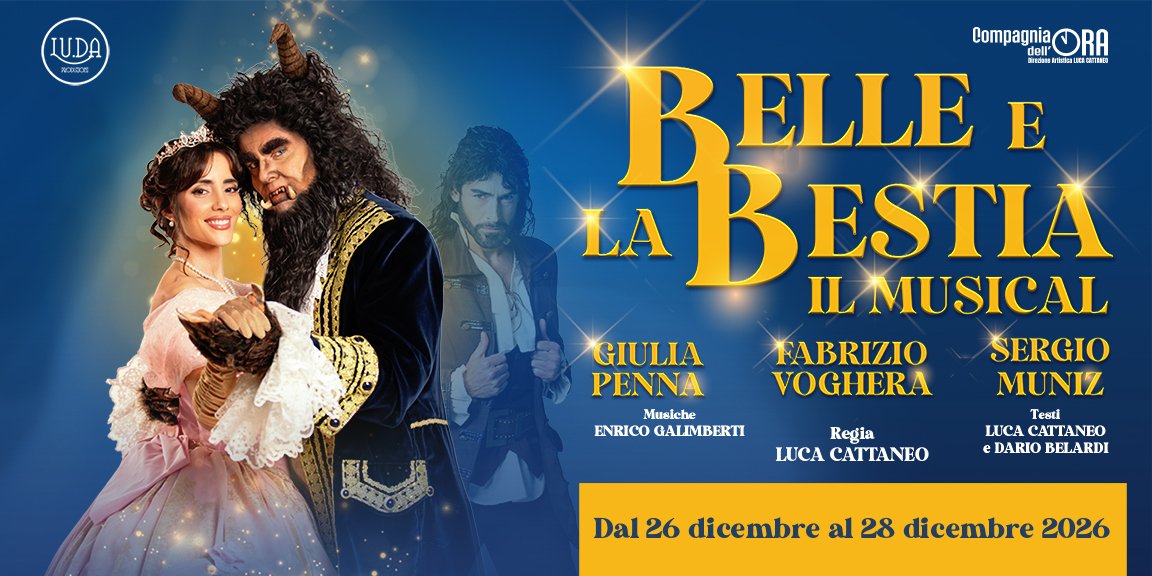
Belle e la Bestia, the musical by the Compagnia dell'ORA with Giulia Penna, Fabrizio Voghera and Sergio Muniz, is on stage at the Teatro Olimpico in Rome, at Piazza Gentile da Fabriano 17 (00196 Rome), from December 26 to 28, 2026, with six performances. On Saturday 26 and Monday December 28 the shows are at 16:30 and 20:30, on Sunday 27 at 15:30 and 18:30. You get there on metro line A to Flaminio and then tram 2 to the terminus at Piazza Mancini, from where you walk about 500 meters along Viale del Pinturicchio. Alternatively, take bus 910 from Termini to the Pannini stop, about 300 meters away. The prices published by the theater range from 29 euros (side balcony with railing) to 42.50 euros (poltronissima gold), plus the presale fee. For children under 12 there are reduced prices, from 20:30 to 29.80 euros plus the presale fee. Tickets are bought on the online box office linked to the official website of Teatro Olimpico or at the box office at Piazza Gentile da Fabriano.
Language: performed in Italian. No English version or English surtitles are announced.
It is the Olimpico's Christmas musical, scheduled over the three days when Roman families look for an outing together after the holiday lunches. One clarification first of all: it is not the Disney musical. It is an original, entirely Italian production, with music by Enrico Galimberti and lyrics by Luca Cattaneo and Dario Belardi, which tells the fairy tale in its own way, with an antagonist named Miguel. For a family with kids, six performances, half of them in the afternoon, in a sloping hall where even the little ones see the stage, are a hard combination to beat in Christmas week.
Belle e la Bestia, the musical: what kind of show it is
Belle e la Bestia, the musical is an original Italian production by the Compagnia dell'ORA, with orchestral music by Enrico Galimberti, text and lyrics by Luca Cattaneo and Dario Belardi, and artistic direction and staging by Luca Cattaneo. After the previews of 2022 and 2023, the show officially debuted in October 2026 in a new version, with the national tour stopping in Rome for Christmas.
The story
The company's synopsis is this. In a distant castle a young prince, punished for his arrogance, is condemned to live as a prisoner in the body of a beast. The memory of the past and of lost love blurs like a dream, and only a sincere feeling, a person able to love him more than her own life, can break the spell. When Belle, a young woman with a kind soul, happens to cross the castle's door, the Beast feels a dormant emotion resurface and the memory of a face that the curse had erased. But love will have to face deceit, envy and the greed of Miguel, determined to win Belle at any cost.
A fairy tale reread
Teatro Olimpico presents the show as a story that keeps intact the charm of the collective imagination while also introducing new elements, able to surprise even those who have always known it. The most evident novelty is in the characters: Belle's rival here does not have the name the public expects, and the production describes him as a magnetic and overbearing unrequited suitor.
Sets, costumes, choreography
Fabrizio Cattaneo's sets are designed for continuous visual change: from the village to the enchanted castle, from a country inn to a dark forest, with a fluidity that the theater calls cinematic. Laura David's costumes number over 80, in 17th- and 18th-century taste, according to the company. The choreography is by Ilenia De Rosa, the makeup and hairstyling by Benedicta Bosco. The theater also underlines the work on lights and colors, which accompany the characters' inner conflicts.
For all ages
The official presentation says it plainly: it is a show designed for an audience of all ages, accessible to families but with enough intensity to interest the adult spectator. It is the formula of the well-made family musical, and the presence of reduced prices for under-12s confirms who it is aimed at.
The cast: Giulia Penna, Fabrizio Voghera, Sergio Muniz
Giulia Penna is Belle, Fabrizio Voghera is the Beast, Sergio Muniz is Miguel. These are the three names the company presents as special guest appearances, and each comes to the musical from a different road.
Giulia Penna, Belle
Giulia Penna is a singer, presenter and creator. The company recalls her participation in hit shows such as Tale e Quale Show and her hosting of television programs. In Belle e la Bestia she plays the protagonist, the young woman with a pure heart and a free spirit. For the younger audience, who know her from social media, she is the face that draws them to the hall. For the show, she is the voice that has to carry the role most present on stage.
Sergio Muniz, Miguel
Sergio Muniz is an actor and performer, and the Roman public has seen him at Teatro Sistina in Mamma Mia. The company underlines that with Miguel he plays the villain of the story for the first time in his career. For a performer used to positive roles, the part of the overbearing rival is a challenge, and in musicals it is often the most fun role to watch.
Who is Fabrizio Voghera, the Beast
Fabrizio Voghera, born in Turin on August 3, 1968, is a singer and actor, among the best-known voices of Italian musical theater for the roles of Quasimodo and Frollo in Riccardo Cocciante's Notre-Dame de Paris. In Belle e la Bestia he is the male lead, the prince imprisoned in the body of the Beast.
A mother who was an opera singer
The son of an opera singer, as a child he followed his mother to performances, and on some occasions even appeared as an extra. He began performing at 17, singing in holiday villages. In 1992 he joined Piero Billeri's band, with whom he recorded an album of new songs and performed in many Italian venues.
Paolo Limiti and television
In 1997 Paolo Limiti noticed him and wanted him in the cast of Ci vediamo in tivù on Rai 2, as the regular solo singer. Alle due on Rai Uno followed. In the same period he took part in Cantaestate and the Castrocaro festival. In 1999 he released his first solo album, Sotto la pelle.
Notre-Dame de Paris
The following year he was chosen for the popular opera by Riccardo Cocciante and Pasquale Panella, Notre-Dame de Paris, where he alternated in the roles of Quasimodo and Frollo, and then, from 2008, in that of Frollo, for more than 250 performances. With Notre-Dame he took part in Cocciante's concert at the Arena di Verona in 2009 and in the international tour of 2013 and 2014, with stops at the Kremlin Theater in Moscow, in Singapore, in Istanbul and in Luxembourg.
Metropolis, Giulietta e Romeo, Otello
In 2005 he is Freder in the musical Metropolis, inspired by Fritz Lang's film, with music by Queen. In 2006 and 2007 he is Friar Laurence in Giulietta e Romeo, the new opera by Cocciante and Panella, with which he also performs in China in 2010. In 2012 he tours with Cocciante canta Cocciante, with a stop at the Baths of Caracalla. In 2017 and 2018 he writes music and lyrics and plays Otello, l'ultimo bacio. Murder Ballad, La storia della mia vita and Bernadette de Lourdes followed, between 2019 and 2025. He was a guest at the Sanremo Festival in 2007 and 2010, and since 2011 he has taught modern singing.
From the Beast of Notre-Dame to the Beast of the fairy tale
There is an evident continuity in his career: Quasimodo, the deformed bell ringer who loves Esmeralda, is a close relative of the Beast who loves Belle. Voghera has spent years giving voice to a character marked in appearance and noble in spirit, and the part of the Beast comes to him as a return. For audiences who remember him in Notre-Dame, it is the main reason to choose this show.
The Compagnia dell'ORA and the creative team
The Compagnia dell'ORA is the theater company that produces Belle e la Bestia, the musical, through LU.DA Produzioni, after the success of Aladin, il musical by Stefano D'Orazio with music by the Pooh. Teatro Olimpico presents it as a company recognized for its high quality standard and for its ability to take on big titles.
Luca Cattaneo, direction and text
Luca Cattaneo signs the artistic direction and staging, and writes the text and lyrics together with Dario Belardi. He is responsible for the reading of the fairy tale, and for the changes from the version the public has in mind.
Enrico Galimberti, music
Enrico Galimberti is the author of the original music and the arrangements, and handles the musical direction. The company speaks of a staging enriched by new orchestrations, and the theater of high-impact orchestral music.
A new staging
Compared with the previews of 2022 and 2023, the company announces new choreographic solutions and latest-generation stage technology, with an imposing set design and a lighting rig able to transform the scene from castle to village to forest. Rome therefore sees the definitive version, not a trial run.
Dates and times of Belle e la Bestia at Teatro Olimpico
Belle e la Bestia, the musical is at Teatro Olimpico for six performances over three days, from December 26 to 28, 2026. The calendar published by the theater is this:
- Saturday, December 26, at 16:30 and 20:30.
- Sunday, December 27, at 15:30 and 18:30.
- Monday, December 28, at 16:30 and 20:30.
The afternoon performances
Three performances out of six begin in the early afternoon: at 16:30 on Saturday and Monday, at 15:30 on Sunday. They are the best suited to small children, who are still awake at the end of the show, and you get to dinner without rushing.
The evening performances
The 20:30 shows on Saturday and Monday and the 18:30 show on Sunday are the performances for those going without kids or with older kids. Sunday at 18:30 is an in-between option, convenient also for those returning to places outside Rome.
Tickets and prices for Belle e la Bestia
Tickets for Belle e la Bestia at Teatro Olimpico cost from 29 to 42.50 euros at full price, and from 20:30 to 29.80 euros for children under 12, plus the presale fee. The theater specifies that the presale fee is always required when the ticket is issued.
The sections and full prices
- Poltronissima gold: 42.50 euros, presale fee 6.50 euros.
- Side poltronissima: 38 euros, presale fee 5.70 euros.
- Poltrona: 35 euros, presale fee 5.30 euros.
- Balcony: 34 euros, presale fee 5 euros.
- Balcony with railing: 33 euros, presale fee 5 euros.
- Side balcony: 30 euros, presale fee 4.50 euros.
- Side balcony with railing: 29 euros, presale fee 4.40 euros.
Prices for under-12s
- Poltronissima gold: 29.80 euros, presale fee 4.50 euros.
- Side poltronissima: 26.60 euros, presale fee 4 euros.
- Poltrona: 24.50 euros, presale fee 3.70 euros.
- Balcony: 23.80 euros, presale fee 3.60 euros.
- Balcony with railing: 23.10 euros, presale fee 3.50 euros.
- Side balcony: 21 euros, presale fee 3.20 euros.
- Side balcony with railing: 20.30 euros, presale fee 3 euros.
Where to buy
The purchase button on the official Teatro Olimpico website leads to the hall's online box office. Alternatively there is the box office at Piazza Gentile da Fabriano, and the theater answers at biglietti@teatroolimpico.it. For groups, dance and singing schools, associations and Cral there is the promotion office, ufficiopromozione@teatroolimpico.it. The bill for a family of four, two adults and two children in poltrona, presale fee included, is a little over 130 euros.
A curiosity about Belle e la Bestia, the Musical at Teatro Olimpico, December 26, 27 and 28, 2026
The Compagnia dell'ORA's Belle e la Bestia is not the stage version of the Disney film: it is an original Italian production, with its own music, lyrics and characters, starting with the antagonist, who here is called Miguel. Those who enter the hall expecting the songs of the animated film will find something else, and do well to know it beforehand.
The fairy tale of beauty and the beast is much older than any film: it belongs to the European tradition and has been told in many versions. This lets a company build its own show on the story, with new music and words. The choice of the title, Belle e la Bestia, holds together the pull of the fairy tale and the freedom of a different reading.
The second curiosity concerns the cast. For years Fabrizio Voghera played Quasimodo and Frollo in Notre-Dame de Paris, that is, the monster in love and his antagonist. In Belle e la Bestia he is once again the character with the terrible appearance and the noble soul. Sergio Muniz, on the contrary, plays the villain for the first time. A game of reversed roles that the adult audience, in the stalls with their kids, can enjoy spotting.
Teatro Olimpico: from 1930s cinema to families' hall
Teatro Olimpico at Piazza Gentile da Fabriano was Cine-Teatro Olimpico from 1936 and Teatro Olimpico from 1981. It stands on the Lungotevere Flaminio, level with the Ponte della Musica, and is home to most of the shows of the Accademia Filarmonica Romana.
The construction
The block of which the theater is part was built between 1935 and 1936 by the firm Garbarino, Sciaccaluga and Mezzacane for the Società Generale Immobiliare. Those were the years when the Flaminio district and the Foro Italico were born.
Cinema and vaudeville
Until the 1950s the hall worked mainly as a cinema, with vaudeville artists in the intervals. For this reason it had dressing rooms and theatrical equipment from the start. Family audiences have been at home at the Olimpico for almost 90 years: first for the afternoon films, today for the holiday musicals.
From the 1980 subscription to today
After the war the Accademia Filarmonica Romana rented the hall for its concerts. At the end of the 1970s the owner and the operator went bankrupt, and Adriana Panni, president of the Academy, promoted a subscription among citizens: in 1980 Teatro Olimpico spa bought the building. From 1981 the program opened up to drama, dance, comedy and shows for everyone.
What the hall is like and where to sit with kids
The hall of Teatro Olimpico has 1,410 seats: 966 in the stalls, arranged as a sloping amphitheater, and 444 in the gallery, in a horseshoe. The stage measures about 10 meters in depth by 12 in width, with an orchestra pit.
The sloping stalls
For a family with kids the slope of the stalls is the decisive merit: the rows rise toward the back, and even a child sitting behind a tall adult sees the stage. In many historic Roman theaters, with a flat stalls floor, this is not so.
Where to sit for a musical
For a musical with changing sets and ensemble choreography, the central poltrona and the central balcony are the best positions: you see the whole stage, lights included. The poltronissima gold, closer, is for those who want the protagonists' faces. The sections with railing penalize more in a musical than in a spoken-word show, because they cover the lower part of the scene, where the choreography takes place. With small children I advise against them.
Value for money
The central balcony costs 34 euros plus the presale fee, 23.80 for under-12s, and offers a frontal view. It is the choice I recommend to families who want to spend the right amount without giving up the view.
Something nobody tells you about Belle e la Bestia, the Musical at Teatro Olimpico, December 26, 27 and 28, 2026
In the foyer and corridors of Teatro Olimpico are kept sets created by great 20th-century artists for shows staged in that hall. The public walks past them looking for their row, with kids by the hand, without looking.
There are the golden shapes that Corrado Cagli made for Igor Stravinsky's Mass, performed at the Olimpico in October 1975. There is the backdrop painted by Giacomo Manzù for the Histoire du soldat, also by Stravinsky, in October 1966. There is Mirko's sculpture for Niccolò Castiglioni's Tre misteri, from 1968, and Alfred Silbermann's set for another performance of the Mass, in December 2001.
For a child going to see a musical, they are a small hidden treasure to discover before going in: real sets, made for a stage, left hanging in a corridor. A Manzù backdrop, by the way, is a piece of Italian art history. The practical advice is to arrive 20 minutes early, tour the foyer and turn the wait into a treasure hunt. With kids it works better than any explanation, and it makes the time pass quickly before the hall doors open.
The advice I give you for visiting Belle e la Bestia, the Musical at Teatro Olimpico, December 26, 27 and 28, 2026
The advice, for a family with kids, is the afternoon show on Monday, December 28 at 16:30, in poltrona or central balcony, bought well in advance. For a couple or a group of adults, the evening show of the same day at 20:30.
Why the 28th. Santo Stefano, the 26th, is the day when everyone looks for an outing, and the performances fill up first. Sunday the 27th has early times, convenient but with the hall full of families. Monday the 28th is a weekday on the calendar but a holiday for schools: many parents work, and the hall is usually a little less crowded. With kids, a less chaotic afternoon is worth a lot.
Why the center. In a musical with transforming sets, lights that tell the story and ensemble choreography, the frontal view is half the show. The sides and the sections with railing save a few euros and take away part of the scene.
Why in advance. Six performances in three days, in a hall of 1,410 seats, near Christmas, for a title with three familiar faces: the good seats go quickly. And a ticket for Belle e la Bestia is also a Christmas gift to put under the tree.
Another well-known fact, yet rarely mentioned
Teatro Olimpico does not belong to a public body or a large group: it belongs to a joint-stock company born in 1980 from a subscription among citizens. Many people in Rome know it, but it is rarely recalled.
At the end of the 1970s the theater was at risk of disappearing. The owning company and the film body that ran it had gone bankrupt, and the building was for sale. Adriana Panni, president of the Accademia Filarmonica Romana, raised capital from professionals, entrepreneurs, intellectuals and enthusiasts. Teatro Olimpico spa, also held in part by the Academy, bought the building and still owns it today.
The consequence is seen in the December program. A private theater that lives on full houses lines up in the same week Lo Schiaccianoci by the Balletto di Roma, Maccio Capatonda's theater debut, a family musical and Maurizio Battista's Speciale Capodanno. The theater calls itself everyone's home, and during the holidays it truly is: from grandparents to grandchildren, every generation finds its evening.
In the end, this too is a fairy tale with a happy ending: a hall destined to close, saved by the affection of those who frequented it. The happy ending of Belle e la Bestia, at the Olimpico, has a precedent.
How to get to Teatro Olimpico for Belle e la Bestia
Teatro Olimpico is reached by metro line A to Flaminio and then tram 2 to the terminus at Piazza Mancini, from which it is about 500 meters on foot along Viale del Pinturicchio. These are the theater's own directions.
Metro A and tram 2
From Flaminio station, in Piazzale Flaminio, tram 2 takes you to the terminus at Piazza Mancini. From there, walk along Viale del Pinturicchio to Piazza Gentile da Fabriano: five minutes, a bit more with small children. From Termini the scheme is the same.
Buses
The theater lists lines 220, 232, 233, 280, 301, 446, 48, 910 and 911, besides tram 2. The 910 leaves Termini toward Mancini: get off at Pannini and walk about 300 meters on Viale del Pinturicchio. Lines 200, 201, 53 and the night line n24 also arrive at Piazza Mancini terminus. On holidays in late December frequencies may be reduced: it is best to check before going out.
Roma Viterbo railway
Those arriving on the Roma Nord line get off at Flaminio and take tram 2 to Piazza Mancini.
By car
From the center take Viale del Muro Torto toward Piazzale Flaminio, then Via Luisa di Savoia and the lungotevere to the Lungotevere Flaminio. From the north, the Lungotevere Maresciallo Diaz, the Ponte Duca d'Aosta and then right to Piazza Gentile da Fabriano. From outside Rome, from the Raccordo take the Salaria or the Flaminia toward Foro Italico. With kids the car is convenient, but at performance times the neighborhood fills up: leave with a margin.
The right photo to take at Belle e la Bestia, the Musical at Teatro Olimpico, December 26, 27 and 28, 2026
The right photo, for a family going to see Belle e la Bestia at the Olimpico, is the one of the kids in front of the lit facade of the theater, with the show's poster, before going in. It is the photo that 10 years from now will recall the first musical seen together.
The best moment is about 20 minutes before the start. For the afternoon performances, at 16:00 at the end of December the light begins to fade and the signs are already lit: the ideal combination. Shoot from the opposite side of Piazza Gentile da Fabriano, to get the whole rationalist facade, with its high travertine base.
The second photo is taken on the Ponte della Musica, opposite the theater, with the Tiber below and the lights of the opposite bank. After the afternoon show, on the way out, it is already dark: a five-minute walk on the bridge rounds off the day well.
In the hall, during the show, no photos and no video. It applies to everyone, and should be explained to the kids too: the glow of a screen in the dark disturbs those sitting behind and the artists on stage. The foyer with the historic sets, on the other hand, can happily be photographed before going in.
Some important events that took place here in history
On March 4, 1965 Pierre Boulez conducted at Teatro Olimpico a concert with the Italian premiere of Igor Stravinsky's Abraham and Isaac and the European premiere of his Elegy for J.F.K. It is perhaps the most important date in the hall's musical history.
In the following years the Olimpico hosted stagings in which art and music met: the Histoire du soldat with Giacomo Manzù's backdrop, in October 1966. Niccolò Castiglioni's Tre misteri with Mirko's sculpture, in October 1968. Stravinsky's Mass with Corrado Cagli's golden shapes, in October 1975.
In 1980 Teatro Olimpico spa was born, which bought the building. From 1981 dance entered the program permanently: Moses Pendleton's Momix debuted at the Olimpico in April 1982 and became regular guests. The Lindsay Kemp Company brought A Midsummer Night's Dream in February 1989, and its theater of costumes, makeup and fable somehow anticipates the taste of today's shows.
In the 1990s came Mikhail Baryshnikov with the White Oak Dance Project, from October 10 to 15, 1995, and the Bolshoi Ballet, from September 23 to 26, 1996. In the 2009/2010 season the Agis rankings put the Olimpico second in Rome and seventh in Italy by audience.
Who has passed through Belle e la Bestia, the Musical at Teatro Olimpico, December 26, 27 and 28, 2026
On the stage of Teatro Olimpico have passed musicians such as Arturo Benedetti Michelangeli, Jessye Norman, Zubin Mehta and Giuseppe Sinopoli, dancers such as Baryshnikov and Antonio Gades, and popular music artists such as Lucio Dalla, the Pooh and Giorgio Gaber. It is one of the Roman halls with the most varied list of guests.
For pop music, the Marillion in February 1988, Lucio Dalla with Henna in April 1994, the Pooh with Musica dentro in October 1994, Giorgio Gaber in January 1998. The link with the Pooh has a curious echo: the Compagnia dell'ORA, which stages Belle e la Bestia, had its previous success with Aladin, il musical by Stefano D'Orazio with music by the group.
For dance, besides the Momix, Joaquín Cortés, Lindsay Kemp, Maurice Béjart, the Bolshoi. For comedy, Gigi Proietti with A me gli occhi in 1996, Enrico Brignano, Vincenzo Salemme, Aldo, Giovanni e Giacomo, Lillo e Greg, Maurizio Battista. The theater also recalls Dario Fo and Nicola Piovani among the protagonists of its history.
And then there is the audience, which in this story counts as much as the artists. Generations of Romans have seen at the Olimpico the first show of their lives, from the afternoon films of the 1940s to the Momix of the 1980s. Belle e la Bestia, for many kids, will be the next.
The Flaminio district around Teatro Olimpico
Teatro Olimpico is in the Flaminio district, north of Piazza del Popolo, in an area that in the last 20 years has become one of Rome's cultural hubs. For a holiday day with kids it offers more than it seems.
The Ponte della Musica and the Foro Italico
In front of the theater the Ponte della Musica leads to the bank of the Foro Italico. It is a good place to let kids walk before two hours seated in the hall, away from cars.
Auditorium and MAXXI
A short distance away are the Auditorium Parco della Musica, which has a family program during the holidays, and the MAXXI, with its open square in front of the museum.
Villa Borghese and Piazza del Popolo
In the direction of the center, along Via Flaminia, you meet the National Etruscan Museum of Villa Giulia and the avenues of Villa Borghese, where you can spend the morning before an afternoon show. Then Piazza del Popolo, next to Piazzale Flaminio where tram 2 starts. Toward the north, Milvian Bridge is the destination for dinner after the evening show.
Where to eat before or after the show
Around Teatro Olimpico, between Piazza Mancini, Via Flaminia and Piazza Gentile da Fabriano, there are pizzerias, trattorias and neighborhood bars that suit families too.
With kids
For the afternoon shows, the simplest solution is a late lunch or a hearty snack beforehand, and pizza after the show, when you come out at dinner time. Two hours of musical are long on an empty stomach for a child, and the theater bar is not dinner.
For the evening shows
With a start at 20:30, a quick dinner around 19:00, or dinner afterward in Ponte Milvio, a few minutes by taxi, where the places stay open late.
The holidays
Between Christmas and New Year's many restaurants in the neighborhood have reduced hours or close for vacation, and those open fill up. Reservations are essential, especially for a large family wanting a table when the afternoon show lets out.
Accessibility at Teatro Olimpico
Those with reduced mobility who want to see Belle e la Bestia at Teatro Olimpico should contact the box office before buying, at biglietti@teatroolimpico.it. It is the surest way to learn about suitable seats, access arrangements and conditions for companions.
The stalls are an amphitheater, sloping, and the gallery is on the upper floor. For families with strollers, it is best to ask the box office where to leave it: it does not go into the hall, and knowing beforehand how to handle it avoids lines at the entrance.
Belle e la Bestia with kids: practical tips
Belle e la Bestia, the musical is presented by Teatro Olimpico as a show for an audience of all ages, with reduced prices for children under 12. Among the Olimpico's December titles, it is the one designed most explicitly for families.
From what age
The theater does not state a minimum age. From experience, a child from five or six up follows a two-act sung fairy tale without difficulty, especially if they already know the story. With the youngest, the afternoon show and a seat near the aisle let you step out for a moment without disturbing anyone.
Preparing them for the story
A tip: tell the kids beforehand that this Belle e la Bestia is not the cartoon. The songs are different and the villain is called Miguel. A forewarned child enjoys the surprise. One waiting for the songs of the film may be disappointed.
The intermission
Use the intermission for the restroom and to stretch your legs in the foyer, and maybe to look for the Manzù and Cagli sets in the corridors. For house rules and possible admission of the very youngest, the reference is the box office.
Christmas at Teatro Olimpico: the holiday program
Belle e la Bestia closes the Christmas week of Teatro Olimpico, after Lo Schiaccianoci by the Balletto di Roma, December 17 to 20, and Maccio Capatonda's Spettacolo Teatrale, December 21 and 22. On December 31 there is Maurizio Battista's Speciale Capodanno, who in November brings Se non vinco... imparo to the Olimpico.
In the new year, for those who with kids have taken a liking to the hall, Slava's Snowshow arrives, and the Momix with Botanica. For ideas about the holidays in the city there are our guides to Christmas in Rome and New Year's Eve in Rome.
Frequently asked questions about Belle e la Bestia at Teatro Olimpico
When is Belle e la Bestia the musical on stage in Rome?
Belle e la Bestia, the musical is at Teatro Olimpico in Rome from December 26 to 28, 2026, with six performances: Saturday 26 and Monday 28 at 16:30 and 20:30, Sunday 27 at 15:30 and 18:30. The theater is at Piazza Gentile da Fabriano 17.
How much do tickets for Belle e la Bestia in Rome cost?
Tickets for Belle e la Bestia at Teatro Olimpico range from 29 to 42.50 euros at full price and from 20:30 to 29.80 euros for children under 12, plus the presale fee. The poltrona costs 35 euros, 24.50 for under-12s. The central balcony costs 34 euros, 23.80 for under-12s.
Who is in the cast of Belle e la Bestia the musical?
In Belle e la Bestia, the musical by the Compagnia dell'ORA, Giulia Penna is Belle, Fabrizio Voghera is the Beast and Sergio Muniz is Miguel, the antagonist. Direction and artistic direction are by Luca Cattaneo, the music by Enrico Galimberti, the sets by Fabrizio Cattaneo, the costumes by Laura David.
Is it the Disney musical?
No, the Compagnia dell'ORA's Belle e la Bestia is an original, entirely Italian production, with music by Enrico Galimberti and text and lyrics by Luca Cattaneo and Dario Belardi. The story is the traditional fairy tale, told with its own songs and characters: Belle's rival, for example, is called Miguel.
Is Belle e la Bestia suitable for children?
Yes, Teatro Olimpico presents Belle e la Bestia as a show for an audience of all ages, accessible to families, and offers reduced prices for children under 12. The performances best suited to little ones are the afternoon ones: at 16:30 on December 26 and 28, at 15:30 on the 27th.
How do you get to Teatro Olimpico by public transport?
Teatro Olimpico is reached by metro line A to Flaminio and then tram 2 to the terminus at Piazza Mancini, from which you walk about 500 meters on Viale del Pinturicchio. From Termini there is also bus 910 to the Pannini stop, about 300 meters from the theater.
Where do you buy tickets for Belle e la Bestia at the Olimpico?
Tickets for Belle e la Bestia are bought on the online box office linked to the official website of Teatro Olimpico or at the box office at Piazza Gentile da Fabriano 17. For information the theater answers at biglietti@teatroolimpico.it. For groups and associations there is the promotion office.
One last word. A child's first musical stays in memory longer than many gifts, and a hall with sloping stalls, a story everyone knows told in a new way and a Beast with the voice of Notre-Dame are good premises. Choose an afternoon show, a central seat, arrive 20 minutes early for the tour of the foyer and let the fairy tale do the rest.
Article written by the editorial team of Tour Leader Pro, contact them for Private/Corporate/V.I.P. Tours and Experiences.
Planning a trip to Rome? The English-language guides to visiting the city are on ItalyPlanner.com.