B-Folk
https://www.estateromana.com/en/rome/trip-planner/b-folk-rome/
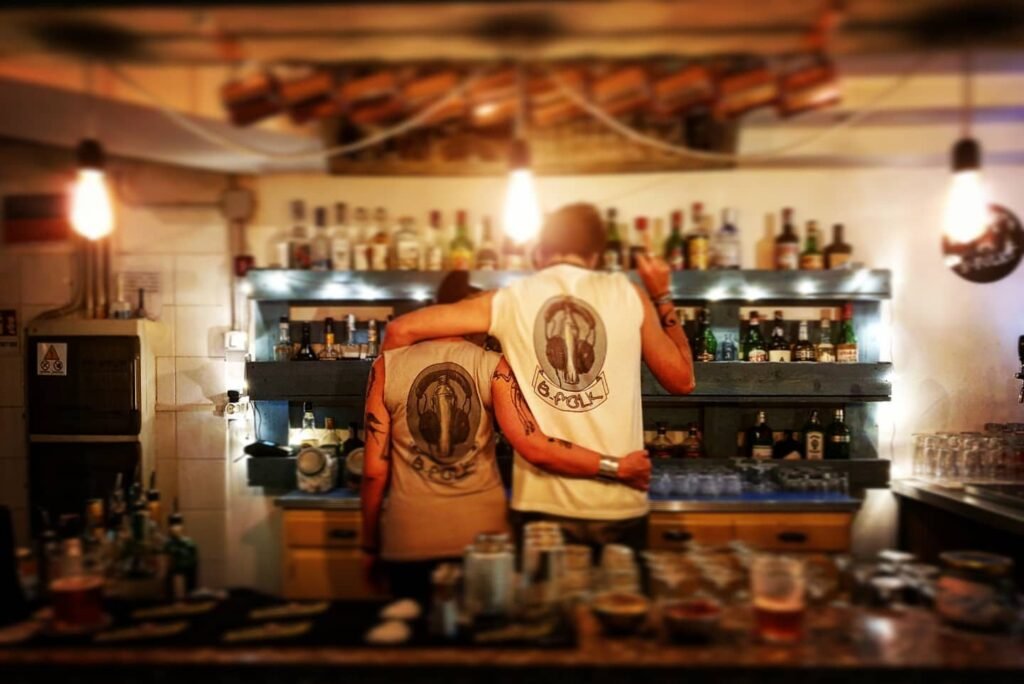 B-Folk
 is a cultural association in east Rome, at Via dei Faggi 129/A, inside that grid of streets with the names of trees and flowers that runs from the heart of Centocelle toward the Alessandrino and, farther on, toward Torre Maura. Exhibitions, concerts, book presentations, screenings of independent films and a well-stocked bar where people chat: that is the description that has circulated for years, and it is an honest description, because it captures in one line what really happens inside a neighborhood hall that has decided to make culture instead of just serving drinks.
The interesting point, and the reason it is worth spending a few thousand words on an address that no printed tourist guide will ever name, is precisely that double status. B-Folk is not a theater, not a gallery, not a cinema, not just a recreational club. It is all these things put together, held up by a legal formula that in Italy has a long history and that almost nobody bothers to explain properly: the cultural association with a membership card. Those who walk in for the first time and are asked to sign up often don't understand why, think it is a commercial trick, and instead it is exactly the opposite: it is the mechanism that allows a small place to program things that a purely commercial venue would never program, because they would not earn enough.
In the pages that follow I try to tell everything: where exactly it is, how to get there without going crazy, what happens inside, how the membership card really works, what is around within a radius of one kilometer (and there is quite a lot: an imperial villa buried under a park of 120 hectares, the first airfield in Italy, a 3rd-century aqueduct, one of the most written-about borgate in 20th-century Italian literature), and why this piece of the city deserves an evening even for those who live on the other side of the river and never set foot in east Rome.
Where B-Folk is and how to get there
The address, and what that street number means
The address is Via dei Faggi 129/A, Rome. It seems trivial information, and yet it already says three things. The first: Via dei Faggi belongs to the botanical street naming of the neighborhood, the one by which in Centocelle and in the neighboring urban zone of Alessandrina the streets are called Via delle Gardenie, Via dei Castani, Via dei Narcisi, Via dei Mirti, Via dei Glicini, Via delle Camelie, Via degli Aceri, Via dei Platani, Via delle Robinie, Via dei Tigli. When someone from the neighborhood gives you an appointment, they name a plant. It is a system that disorients those who arrive from outside and that for those who live there is a mental map as precise as a chessboard.
The second thing: number 129/A is a high number. Via dei Faggi is long, and the low and high street numbers tell of two slightly different pieces of the neighborhood, one closer to the historic core of Centocelle with its low apartment buildings of the 1930s and 1940s, the other fading toward more recent and denser construction in the direction of Alessandrino. B-Folk is in the part where the street has already changed character: fewer villas, more apartment blocks, shutters of neighborhood shops, workshops, a couple of historic bars, and in the middle one street number that lights up at night.
The third thing: the letter A after the number. In neighborhoods built by successive additions, like this whole strip of east Rome, street numbers with a letter are almost always the sign of a building added later, or of a space carved out on the ground floor of a building that originally did not provide for it. It is a nothing of a detail that however explains why certain addresses in this area are hard to find the first time: the main door has a number, the space you are looking for has the same number with a letter attached, and the two can be a few meters apart.
By metro
Metro line C has changed life in this quadrant, and it is worth recalling how it arrived, because it is an exemplary Roman story. The first stretch, from Monte Compatri-Pantano to Parco di Centocelle station, was opened to the public on November 9, 2014, after a pre-service period that began in December of the previous year. On June 29, 2015 the next stretch entered service, from Mirti to Lodi, which is the one that finally put Centocelle in direct connection with the inner part of the city. On May 12, 2018 it was the turn of San Giovanni, the first real interchange with line A. On December 16, 2025 Porta Metronia and Colosseo were inaugurated, the latter the current provisional terminus and second interchange, this time with line B.
To reach Via dei Faggi the useful stations are those that serve the botanical grid: Gardenie and Mirti on the more inner side, Parco di Centocelle and Alessandrino going outward. All four leave a walk, because line C runs along the Casilina axis and the tree streets develop perpendicular to that axis. None of these stops drops you in front of the door, and anyone who tells you otherwise doesn't know the area. Count on a good quarter of an hour on foot, in a flat urban fabric, lit and full of people until late, which makes the walk more than doable even in the evening.
A technical warning that few remember: the stated frequency of line C is around nine minutes. That is not very frequent, and if you go out after midnight it's best to have looked at the time of the last run before settling in comfortably. The line is automatic, driverless, and the trains are modern, but the service hours remain those of a Roman metro, not those of a Berlin one.
By surface transport
The neighborhood is served by a dense surface network and by three tram lines that run along Via Prenestina: the 5, which goes from Piazza dei Gerani to Termini station. The 14, which starts from Viale Palmiro Togliatti and also arrives at Termini. The 19, which goes from Piazza dei Gerani to Piazza Risorgimento, that is, to the Vatican. The latter is probably the most useful tram in Italy for anyone who wants to cross Rome from east to northwest without ever going underground, and for those staying near the Vatican it is the simplest answer to the question of how to reach this quadrant.
The forgotten railway
Then there is a means that almost no tourist considers and that the residents know very well: the Roma-Giardinetti railway, today limited to the Centocelle station, which runs along Via Casilina and arrives at Laziali station, a stone's throw from Termini. It is the last remnant of the old narrow-gauge railway system that connected Rome to the Castelli and to the Ciociaria. It has small cars, a slow pace and the charm of a moving museum. It is not the quickest way to get to B-Folk, but it is by far the most interesting, and if you are the kind of person who travels also for the pleasure of the journey, that half hour stays in your head more than the evening.
By car and by scooter
You can arrive by car, but parking is another matter. We are in a dense area, with rows of cars on both sides of almost all the streets and a demand for parking that spikes in the evening hours. There are no big park-and-ride lots within reach once you are inside the grid. Those coming from the Grande Raccordo Anulare typically enter from Via Casilina or Via Prenestina and then slip into the side streets, and from that moment the long hunt for a space begins. The scooter, in east Rome as in the rest of the city, remains the solution that works best.
What a cultural association with a membership card really is
This is the part most worth explaining, because it is the one on which the most misunderstandings circulate and because without understanding it you understand nothing about places like B-Folk. Those who arrive for the first time and find a person sitting at a little table asking for first name, last name and a small membership fee tend to react in two opposite ways: either they think it is a somewhat snobbish form of exclusivity, or they think it is an excuse to charge admission by calling it something else. Neither reading is correct.
The principle: you don't sell, you share
A cultural association is a non-profit body. This is not a rhetorical formula: it means that any surplus cannot be distributed among the members, but must be reinvested in the activities of the association itself. If at the end of the year the accounts close well, that money goes back in the form of a new sound system, a slightly more decent fee for those who play, an exhibition set up better, a lighting system that doesn't make everyone look pale.
From this principle follows the logic of the card. The association does not carry out commercial activity toward the undifferentiated public: it carries out activity toward its own members. The member is not a customer, he is a person who becomes part of a collective body, and in theory has the right to vote in the assembly that approves the budget and elects the board. In practice, let's be honest, the vast majority of members of any Italian cultural association will never set foot in an assembly. But the right exists, and it is that right which legally distinguishes the member from the patron.
The fee, and why it is low
The membership fee is not the price of a ticket. It is the contribution with which you take part in the life of the body for a set period, usually a season or a calendar year or an association year that runs from September to September. In neighborhood realities this fee is almost always modest, because the aim is not to make money on enrollment but to build a broad social base. No figure here, because fees change from year to year and a number written today would be false in six months: ask at the door, or look at the association's channels.
What I can tell you with certainty is the mechanism. You pay once, you are issued a personal card (cardboard, plastic, or today more and more often digital, with a code on your phone), and from that moment for the whole period of validity you enter without paying the enrollment again. Individual evenings may have a separate contribution, especially concerts, and that is yet another thing: it is the way those who play get paid.
The promotion bodies and why that acronym is on the card
Those who get a card at a neighborhood club often notice on it an acronym that apparently has nothing to do with the place where they are. That's normal. In Italy a great many grassroots cultural associations are affiliated with national social or sports promotion bodies, recognized by the State, which work as a network of guarantee, training, insurance and administrative cover. The local association pays a contribution to the national network, and the national network provides it with the model statute, the insurance coverage of the members, tax consulting and the actual membership card system. That is why a card made in a club in east Rome sometimes opens the doors of a club affiliated with the same network in another city.
Which affiliation network a given club belongs to can be read on the card when you receive it, and it is one of those pieces of information that at the door they gladly explain if you ask. It is worth asking, because very concrete things depend on that acronym: the insurance coverage while you are inside, the mutual validity of the membership in other clubs of the same network, and the kind of training the volunteers have behind them.
The Third Sector reform, in brief and without the headache
Since 2017 the world of Italian associations has been regulated by the Third Sector Code, which reorganized a matter that before was scattered among different laws and established practices. The Code introduced a single national register in which bodies enroll, defined the categories more precisely (social promotion associations, volunteer organizations, philanthropic bodies and so on) and established transparency obligations on budgets proportionate to the size of the body.
For a neighborhood club this has meant more paperwork and more forms, but also a clearer legal position. The practical point that concerns you as a visitor is very simple: being asked to join is not a whim of the manager, it is the condition for that hall to be able to do what it does. Without that framework, a venue of that size would have to choose: either become a pure bar and stop programming series that don't pay, or close.
What changes, for you, in practice
Four things change. The first is the first time: allow two extra minutes at the entrance to fill out the form. Bring an ID, it is needed for the personal registration. The second is the feel of the place: a hall of members behaves differently from a hall of customers, there is less turnover, everyone knows each other, and if you are new it shows right away, which depending on your character is a nuisance or an enormous advantage, because within 20 minutes someone will have spoken to you.
The third is the programming: since there is no obligation to fill the hall every night to pay the rent with drinks alone, you can program evenings that wouldn't pay off for a commercial venue. A poetry book presentation in front of 25 people is an economic disaster for a bar and a perfectly sensible evening for an association. The fourth is that, in principle, you are co-responsible for the place. If you behave badly you are not a customer to be managed, you are a member who is bothering the other members, and the reaction is different.
The bar, without rhetoric
Yes, there is a bar, and it is the part of the story that usually gets inflated out of proportion. A cultural club has a food and drink service reserved for members because that is how a good part of the fixed costs is covered: the rent, the utilities, SIAE, the insurance. It is a piece of the mechanism, not the center of the evening. Those who go for the programming use it the way you use the foyer of a theater, that is, to stand and talk in the 20 minutes before things start and in the hour after they end, and you do very well there even ordering a water or a coffee. There are thousands of places in Rome where the bar is the center of the evening, and this is not one of them.
What happens inside B-Folk
The formula stands on five legs: exhibitions, concerts, book presentations, screenings of independent films and the bar. It is worth taking them one by one, because each of these activities has its own logic and none is filler for the others.
The exhibitions
Exhibitions in a neighborhood club work differently from those in a gallery. In a gallery there is a market, there are collectors, there is a gallerist who selects with commercial criteria as well as aesthetic ones. In a club the display is almost always free for those who exhibit, which radically changes the kind of work that ends up on the walls: documentary photography, illustration, comics, engraving, small format, works by those who teach and those who study, solo shows by local artists who at 30 already have a serious body of work and no channel to show it.
There is an enormous practical advantage in this formula, and it is the duration of the gaze. In a gallery you go in, do the round in seven minutes and go out. In a club the exhibition stays in front of you the whole evening, because you are there for another reason and the images look at you while you talk to someone. It is a way of enjoying art that seems distracted and instead works very well: after two hours in that room, you remember those photographs better than an exhibition seen properly in a museum.
The concerts
Here a premise on scale is needed. In a neighborhood hall the acts that play arenas don't play, nor those of big clubs. Projects play that have an audience between 30 and 150 people: singer-songwriters, folk in all its drifts, trio jazz, Roman author song, blues, popular tradition of central and southern Italy reworked, and everything that is born from the crossing of these things.
The name of the place itself declares a direction. Whoever calls a concert hall folk is signaling an attention to traditional music and its contemporary grafts, which in Lazio means tarantella and saltarello, but also the great reservoir of Roman popular song and the contaminations with the Mediterranean and the Balkans that in Rome have a tradition at least 40 years long. It is a signal, not a constraint: in neighborhood halls the programming is always broader than the label they wear.
What changes in a small hall is the relationship with those who play. There is no pit, there is no real backstage, there is no distance. Whoever plays crosses the audience to get on stage and then goes back to sit at the table. The volume is right for a room, which means you hear the instruments and not just the sound system. For those used to big concerts, the first time is a kind of hearing rehabilitation: you remember that live music is made of strings and winds and not of watts.
The book presentations
Book presentations are the item that more than any other explains why the associative form is needed. A presentation brings 30, 40, on a lucky evening 70 people into the hall. No commercial venue would organize such an evening, because the numbers never add up. An association does, because the bill is not the only criterion.
The result is that in Roman neighborhood halls books are presented that do not reach the bookshops of the center: small publishers, militant essays, poetry, debut fiction, local historical research, oral memoirs of the neighborhood. East Rome has a very strong tradition precisely of oral history and research on the borgate, and there is a serious bibliography on this, from the studies on the archaeological investigations of Centocelle to the oral history works on the Roman periphery. A club on Via dei Faggi is exactly the place where these books meet their natural readers, who are often the people those books talk about.
The screenings of independent films
The fourth leg is cinema. Not first-run programming, obviously, but the documentary, the short, the self-production, the film that did two festivals and then vanished, the work of someone who finished film school and found no distribution. In Rome this kind of programming has a network of small halls and clubs that does a job the multiplexes don't do and that not even the art-house cinemas manage to do fully anymore.
The screening in a club has a quality that real cinema does not have: discussion. At the end the lights don't come on and you leave. At the end you stay, and if the person who made the film is there you talk with them. In a city where cinema has been produced for a century and where the most important studios in Europe are a few kilometers from here as the crow flies, this is less trivial than it seems: it means the Roman film chain has a ground floor, and the ground floor is these rooms.
Stand-up comedy
There is a fifth item that in recent years has taken an important space, and that is worth pointing out because it did not appear in the historical description of the place: live comedy. The B-Folk calendar published on the zero.eu listing, the source from which the classic description of the venue comes, reports for the autumn 2026 season a weekly stand-up comedy appointment, scheduled on Wednesdays in the early evening, with dates running from mid-September to mid-December.
This says two things. The first is that in September 2026 the place is alive and programs regularly, which for a neighborhood club is never a given. The second is that Italian stand-up, which 10 years ago was an imported niche phenomenon, now has a widespread scene that rests precisely on halls like this one: small, with the audience close, where a comedian can try new material without the terror of failing in front of a thousand people. Neighborhood halls are the laboratory of contemporary Italian comedy, exactly as small clubs are the laboratory of music.
A curiosity about B-Folk
The curiosity I prefer concerns the name of the street, and it seems silly until you think about it. Via dei Faggi is part of a street-naming system that is, without exaggeration, one of the most extensive and coherent in all of Rome: hundreds of streets named after plants, from abelias to clematis, in alphabetical order spread over square kilometers. Alongside this system there is a second, less known, in the strip north of the neighborhood between Via delle Palme and Via delle Rose: there the streets do not bear the names of plants, they bear the names of botanists. Federico Delpino, Filippo Parlatore, Michele Tenore, Giovanni Passerini, Pietro Romualdo Pirotta, and even Theophrastus, the Greek of the 4th century BC to whom the birth of botany as a discipline is traced.
The result is that an evening at B-Folk takes place inside a great urban herbarium, where the plants are the street names and the scholars who classified them have the street next door. When you leave the door and head back toward the metro, you are walking inside an index of a botany manual drawn on the asphalt. It is the kind of detail that serves no purpose and that makes a neighborhood suddenly interesting.
There is then a second curiosity, smaller, concerning how local people give directions. In a neighborhood with themed streets, nobody says the full name. They say ai Faggi, ai Castani, alle Gardenie, ai Mirti. The article and the plant, period. If you ask someone from the neighborhood where Via dei Faggi is and they answer with a gesture and the word Faggi, they're not being curt: they are speaking the local language, and you have just learned a word of it.
The neighborhood around: Centocelle, Alessandrino, Torre Maura
To understand where you are you need a mental map of the quadrant, because the names used in conversation and the administrative ones never fully coincide, and this generates confusion even among Romans.
The three Chinese boxes of Centocelle
Centocelle is three things at once. It is an urban zone, the 7A of Municipio Roma V, and this is the strict administrative perimeter. It is the popular name of a much larger piece of the city, which in common use goes well beyond that perimeter. And it is a piece of the name of the official quarter Q. XIX Prenestino-Centocelle, which is yet another thing. When someone tells you B-Folk is in Centocelle, they use the second meaning, the popular one, and it is the right meaning for getting oriented.
East of urban zone 7A begins 7B, which is called Alessandrina and which in everyday use becomes the Alessandrino. That is where the botanical street naming continues, because the grid of the tree streets does not stop at the administrative boundary. Farther east still, beyond the Grande Raccordo Anulare at one point and on this side of it at another, is Torre Maura, which administratively is the 15th zone of the Agro romano and which has its own entirely different street naming, dedicated to birds. Going from plants to birds, walking, is the most precise way to notice you have changed neighborhood.
The name that comes from an imperial villa
The place name Centocelle has nothing to do with monastic or prison cells, as some still tell. It derives from the Roman villa called ad duas lauros, that is, at the two laurels, which occupied the plateau south of Via Casilina and was of such size that in popular speech it gave rise to the name Centum Cellae, the 100 rooms, to indicate the extent of the ruins when they were still well visible in the countryside. The English historian and topographer Thomas Ashby, who traveled the Agro romano on foot and photographed it like no one before, called that name a popular exaggeration born when those ruins were preserved much better than now.
The imperial property to which the villa belonged is identified as the residence of the empress Helena, mother of Constantine, and the complex was still in use in the 5th century: the sources indicate this very place as the one where Valentinian III died. After the donation to the Church, the suburbicarian diocese of Subaugusta was established here, later dissolved at the time of the invasions. The name Centocelle is attested from 1523, together with the Torre di Centocelle, built already in the 12th century to control the consular road.
I am telling you all this because it has a practical consequence. When you are on Via dei Faggi you are not in a periphery without history built in the 1950s. You are above the third mile of Via Labicana, inside a landscape that was imperial countryside, then church property, then Agro romano with towers and farmhouses, then airfield, then borgata, then neighborhood. None of these layers has been erased entirely.
The borgate of east Rome
The word borgata, in Rome, has a technical meaning before a literary one. It indicates the nuclei of public housing, sometimes planned by the Fascist regime and sometimes born spontaneously through self-building, sprung up between the 1920s and the postwar period along the great consular roads, often to house the populations cleared out of the historic center during the demolitions. East Rome is full of them: Quarticciolo, Tor Sapienza, Pietralata, Torpignattara in its oldest part, Tor Tre Teste, Torre Maura.
Centocelle has a slightly different and better-off history than that of nearby Quarticciolo. In the 1940s its center was Piazza dei Mirti and its main street was Via dei Castani, lined with low houses of one or two floors. Around them were dirt roads that ran into the countryside toward a marrana that flowed in a small valley, and little houses laid out haphazardly on slightly rolling ground. Living there were workers of Roman industry, craftsmen, small shopkeepers, farmers and tram drivers, and the best houses were theirs.
This past has left a mark on the character of the place. Centocelle is a neighborhood with a strong collective identity, with a long associative and political tradition, and with a density of social spaces, clubs, people's gyms, self-managed libraries and cultural associations that few other areas of Rome have. B-Folk is not an exception in a desert: it is a piece of an ecosystem.
The Casilina, the road that explains everything
Via Casilina is the axis around which this piece of the city formed. It is the modern route that largely follows the ancient Via Labicana, the consular road that left from Porta Maggiore and headed toward Labico and then toward Casilinum, that is, present-day Capua. For almost two millennia it was the road of carts, then the road of the narrow-gauge railways, then the road of trucks, and today it is the road under which the metro runs.
The Casilina acts as a boundary and a hinge: it separates the urban zone of Centocelle from the archaeological park that bears its name, and lines up, one after the other, all the nuclei that made the history of east Rome. If you take half a day and walk it or bike it from Porta Maggiore to the Raccordo, you cross Pigneto, Torpignattara with its late antique mausoleum, Quadraro, Centocelle, Alessandrino, Torre Maura, and you understand the urban planning of this city better than you would reading 10 books.
Something nobody tells you about B-Folk
What nobody tells you is that the value of a place like this is not measured on the best evening, it is measured on any ordinary Tuesday. Everyone, when they tell about a neighborhood club, tells about the memorable concert or the presentation with the hall full. But the real function of a hall like this is another: it is to be open even when there is nothing special, and to offer a neighborhood of east Rome a covered, lit, usable place where you can sit without having to keep consuming and without having to shout to be heard.
Those who live in the center have no idea how rare this is outside the railway ring. In the zones built by addition between the 1930s and the 1970s ground floors are few, covered public spaces are almost nonexistent, libraries close early, shopping malls are elsewhere and are not a place. The result is that after 20:00, in entire quadrants of this city, there is no place where a person can walk in and sit down. Cultural associations were also born to answer this void, and the cultural programming, however excellent, remains in a certain sense the most visible part of a more elementary function.
The second thing nobody tells you concerns the numbers. A neighborhood hall stands on a very thin margin and on an enormous amount of unpaid work. Whoever keeps the door, whoever sets up the lights, whoever lays out the poster, whoever handles relations with the bands, whoever writes the posts and whoever the next morning mops the floor are often the same three or four people, and almost never do they do it as their main job. When you walk in and find everything in order, what you see is the result of an afternoon of work that nobody will invoice you for.
The third thing, and I say it because it is the one that really changes the experience of those who arrive from outside: in a place like this information does not circulate on the channels you use. The program is not on a ticketing portal, it is on the association's social profiles, on printed flyers and by word of mouth. If you look for the week's program the way you look for the program of a permanent theater, you won't find it. If instead you follow the association's page, the program comes to you by itself.
The advice I give you for visiting B-Folk
The advice is only one and it is worth more than all the others put together: don't arrive at the start time, arrive 40 minutes earlier. Not to grab the best seat, which in a hall of 100 people matters little, but because the 40 minutes before are the part of the evening in which the thing happens that these places exist for. People arrive in a trickle, whoever organized is still going around the hall and has time to talk, whoever plays or exhibits is there and not yet in performance mode, and if you are a stranger it is exactly in that window that someone asks you where you're from.
To this main advice I add four secondary ones, all practical.
First: bring an ID. The card is personal and the registration must be done with real data. Not having an ID with you means risking being left outside, or in any case losing time at the door.
Second: send a message before leaving home. Neighborhood clubs change their program, skip an evening, close for a long weekend, open at different hours in summer. A message or a phone call avoids a wasted trip, and if you come from outside east Rome the wasted trip is the kind that hurts.
Third: don't come in a rush between one commitment and another. These are not half-hour places. The curve of the evening is slow, it starts with the hall half empty and picks up later, and whoever walks in and out within 40 minutes carries away the worst part.
Fourth, and the most important for those not from the neighborhood: take the long way around. Arrive an hour early for the neighborhood, not for the hall. Walk along Via dei Castani, pass through Piazza dei Mirti, look at the low apartment buildings, step into a bakery, and then reach Via dei Faggi. This way the evening inside gains a context, and you understand what it means that that place is there and not elsewhere.
The Centocelle Archaeological Park, a step away and unknown
A short distance from Via dei Faggi, on the other side of Via Casilina, is one of the largest and least frequented green areas in Rome. The Centocelle Archaeological Park covers 120 hectares, bounded to the west by Via di Centocelle, to the north by the Casilina, to the east by Viale Palmiro Togliatti and to the south by Via Papiria and by the military ground that still belongs to Defense. It was established in the 2000s, inaugurated in 2006, on land that the Air Force returned to the Municipality.
What is under the grass
The park stands on a plateau frequented since the 6th century BC. The excavations of the late 20th century, carried out within the project for the Sistema Direzionale Orientale, brought to light three villas of the Roman era: the villa della Piscina, the villa delle Terme and the already mentioned villa ad duas lauros. Alongside these, two deposits have been identified, one of the Republican age and one of a cultic nature.
The villa ad duas lauros has several building phases, from the full Republican age to late antiquity, that is, between the 5th and 6th centuries. The oldest remains belong to a building of the middle Republican age, with walls in opus quadratum and tuff floors, oriented differently from the later great layout. To this building was attached an agricultural installation of which traces remain of vine cultivation arranged in rows. Put in simple words: under the lawn where the neighborhood kids play soccer there is a vineyard from 2,200 years ago.
The airfield
The second life of this plateau begins on April 15, 1909, when Wilbur Wright arrives in Rome for a series of demonstrations of the Flyer, the first powered heavier-than-air aircraft that had ever flown. From those demonstrations was born the first Italian airport, and also the first flight school in the country: the first Italian pilot trained by Wright was Mario Calderara, an officer of the Regia Marina, who in turn became instructor of the first generation of national pilots.
On April 24, 1909, again at Centocelle, with Wilbur at the controls of the Model A, the first footage in history shot aboard an airplane in flight was filmed. It is a record that nobody remembers and that is worth keeping in mind: the first live aerial filming in the history of cinema was shot above these meadows, just under a kilometer from where you will spend the evening.
The neighborhood grew around the airfield. Many of the villas still seen were the homes of military personnel, officers and non-commissioned officers of the airport. Precisely because of the presence of that military target, during the Second World War the area was hit by many Allied air raids, with civilian victims and heavy damage to the built-up area. The military installation still exists, named after Francesco Baracca, but is no longer used for flight activity.
The Alessandrino aqueduct
The third ancient layer of this quadrant is the Alessandrino aqueduct, the last of the great aqueducts built for ancient Rome, built in the 3rd century under Alexander Severus to feed the baths the emperor had built in the Campus Martius. It gives its name to the Alessandrino area and its brick arches emerge here and there among the apartment buildings, in some points isolated in the middle of a condominium garden, in others incorporated into the built-up area.
It is one of the least photographed ancient monuments in Rome, and for a reason that has little to do with its value: it is located in a part of the city where tourists don't go. Seeing it pop up between two buildings of the 1960s, with laundry hanging beside it and a little soccer field in front, is an experience that sums up the whole city better than any postcard of the Colosseum.
Another well-known fact, yet rarely mentioned
The well-known fact is that Centocelle has the gold medal for civil merit. Everyone in the neighborhood knows it, it is written on the posters every year, and outside the neighborhood almost nobody knows it. The honor was granted on November 22, 2017, and the official citation deserves to be summarized because it is a document of local history written in institutional prose.
The citation recalls that after the armistice the local community distinguished itself for the commitment shown, alongside the Italian soldiers, in the defense of the airfield, later occupied by German paratroopers, and that precisely because of that military presence the neighborhood became the target of many violent Allied bombings, with many civilian victims and heavy damage to the built-up area. It adds that during the nine months of the occupation the population took an active part in the partisan struggle, with acts of sabotage against the German troops, suffering the reprisals that followed: arrests, torture, executions, and many young people deported to labor camps. The period indicated is September 1943, June 1944.
Behind that prose are precise episodes. In the first months of 1944 Centocelle was in fact a liberated zone, with the partisan command of the area housed in an osteria with a pergola overlooking Piazza dei Mirti, that is, in the heart of the neighborhood, a few blocks from the street where B-Folk is located. The partisan Paolo Renzi, arrested in his home in Via Valmontone, was shot at Forte Bravetta on January 31, 1944, and in 1975 he was awarded the silver medal for military valor. A stumbling stone commemorating him has been laid in Via Valmontone.
The reason this is rarely cited is almost mechanical: when people speak of the Roman Resistance they name the Fosse Ardeatine, Via Rasella, Quadraro with the roundup of 1944, and Centocelle stays in the background. Yet the neighborhood you will enter for an evening is one of the few pieces of Rome with an honor for valor pinned on it as a community, and not as an individual. When a place like B-Folk programs the presentation of a book of local history or a concert of songs of struggle, it is not doing folklore: it is continuing a thread.
The right photo to take at B-Folk
I'll tell you the wrong one first, because everyone takes it. The wrong photo is the one of the stage during the concert, taken from the back of the hall with the phone held up over the heads. It almost never works: the light in a small hall is low and colored, the phone's sensor understands little, whoever plays comes out grainy and blurred, and the result is a dark rectangle with three red and blue spots that will remind you of a wonderful evening and will say nothing to anyone else. If you really want to document the music, record 20 seconds of audio and forget the image.
The right photo is another, and it is taken outside. Leave the door on Via dei Faggi around 23:00, cross the street, stand on the opposite sidewalk and photograph the facade with the entrance light on and the people smoking or talking on the sidewalk. Frame wide, take in also the windows of the floors above, the streetlight, two parked cars, the street sign if you can fit it in. That photo tells exactly what a neighborhood club in Rome is: a lit door in a residential street, with above it the homes of people sleeping and in front a knot of people who have just seen something.
Technically: don't use the flash, because it flattens everything and you will make enemies of the people on the sidewalk. Rest the phone or camera on a pole or on the roof of a car, keep the exposure long, accept that a figure will move and be blurred. The blur of a person gesturing under a streetlight is exactly the point of the photograph, not a flaw.
Inside, if you want a second image, aim at the walls during an exhibition, when the hall is still almost empty. You arrive early, the light is on for the works and not yet for the concert, there is nobody in front of the paintings, and that is the good half hour: wall, hung works, chairs still lined up, a microphone on a stand in the middle. A room waiting photographs better than a full room, and it is also the most honest photo of what these places really are.
Last rule, which holds everywhere but here more than elsewhere: ask before photographing people. In a hall of members you are not at a festival, and the face of someone sitting at the table is not public material. A glance and a nod are enough, and nine times out of 10 they will say yes.
Some important events that happened here in history
This corner of east Rome has crossed centuries with a density of events that its present look does not let you imagine. Here are the documented ones, in chronological order, because walking these streets you have them all under your feet.
6th century BC. On the plateau south of the future Casilina there is already stable presence. The archaeological excavations carried out in the park area say so.
Middle Republican age. A building arises with walls in opus quadratum and tuff floors, with an attached agricultural installation in which the vine is grown in rows. It is the first core of what will become the great villa.
Imperial age. The villa ad duas lauros is part of a vast imperial property, identified as the residence of the empress Helena, mother of Constantine. Some parts of the complex change use and become baths.
3rd century. The Alessandrino aqueduct is built, commissioned by Alexander Severus, the last of the great Roman aqueducts. Its arches cross the territory that today bears its name, and are still standing among the apartment buildings.
4th century. Helena donates the property to the Church, as reported in the Liber Pontificalis in the part dedicated to Pope Sylvester I. The suburbicarian diocese of Subaugusta is then established here, which will be dissolved at the time of the invasions.
455 AD. The sources indicate this place as the one where the emperor Valentinian III dies. The property is still fully in use.
12th century. The Torre di Centocelle is built, to control the consular road. It is one of the many towers of the Agro romano, and its name begins to identify the locality.
1523. The place name Centocelle is attested for the first time in documents.
Late 19th century. Forte Prenestino is built, today on Via Federico Delpino, part of the system of forts built for the defense of the capital of the Kingdom.
April 15, 1909. Wilbur Wright begins at Centocelle the series of Flyer demonstrations from which the first Italian airport was born. In the following months the country's first flight school forms here, and the first Italian pilot, Mario Calderara, becomes instructor of the next generation.
April 24, 1909. Again at Centocelle, with Wilbur Wright at the controls, the first footage in history shot aboard an airplane in flight is filmed.
1926. The construction of the airport obliterates part of the archaeological installations of the plateau.
1930s and 1940s. The neighborhood grows around the airfield. Piazza dei Mirti and Via dei Castani are the center and the main axis, with low houses of one or two floors and dirt roads that vanish toward the countryside.
September 1943, June 1944. The population takes part in the defense of the airfield and then in the partisan struggle during the nine months of occupation. The area suffers heavy Allied bombing, with many civilian victims.
January 31, 1944. Paolo Renzi, arrested at his home in Via Valmontone, is shot at Forte Bravetta.
First months of 1944. Centocelle becomes a liberated zone. The partisan command of the area is based in an osteria with a pergola overlooking Piazza dei Mirti.
Postwar. The Borgo Ragazzi don Bosco is born on Via Prenestina, an educational and recreational center with a vocational school, athletics track, cinema and play spaces for the neighborhood's boys.
April 1951. The future Queen Elizabeth II visits the Borgo Ragazzi don Bosco to observe the model of training and integration of the neighborhood boys. It is one of the most remarkable short circuits in the history of east Rome.
1950s. Pier Paolo Pasolini cites the neighborhood in Ragazzi di vita, with references to Via Tor de' Schiavi, and shoots his first film, Accattone, in the surroundings: one scene takes place in Piazza di San Felice da Cantalice.
2000s. The Air Force returns part of the ground to the Municipality, and the Centocelle Archaeological Park is born, inaugurated in 2006 on 120 hectares.
April 23, 2007. Claudio Baglioni, who spent his adolescence in Centocelle, appears on the balcony of the apartment on Via dei Noci where his family had lived and sings for the residents of the neighborhood.
November 9, 2014. The first stretch of line C opens to the public, from Monte Compatri-Pantano to Parco di Centocelle.
June 29, 2015. The stretch from Mirti to Lodi enters service, finally connecting the neighborhood to the inner part of the city.
November 22, 2017. The Centocelle neighborhood is awarded the gold medal for civil merit.
May 12, 2018. The San Giovanni station of line C opens, the first interchange with line A and the first archaeo-station of the Roman metro, with finds displayed in cases along the passengers' route.
2021. For Claudio Baglioni's 70th birthday, a mural with his portrait as a young man is dedicated to him, painted on the walls of the family home Casa San Felice.
December 16, 2025. The Porta Metronia and Colosseo stations of line C are inaugurated, with the latter becoming the provisional terminus and second interchange.
Who has passed through B-Folk
I answer honestly, because this is the question on which it is easiest to tell fibs. A neighborhood club does not keep a roll of honor and does not publish the historical list of who has played there. Halls like this do not produce written memory: they produce evenings. Anyone who wants a list of famous names to show off has the wrong address, and anyone who supplied one would be making it up.
What can be said with certainty is that categories of people have passed through and keep passing through, and there are four.
The first are the comedians. The public calendar of the autumn 2026 season reports a weekly stand-up comedy appointment on Wednesday evening, from mid-September to mid-December. That means dozens of evenings in three months, and in a stand-up evening on average five or six different people go on stage. Do the math: over one season, a sizable slice of the Roman comedy scene passes through that stage, the one you don't yet see on television and that in three years you might see on it.
The second are the musicians. In halls of 100 seats play projects that have released real records and that the general public does not know, and also musicians with a long career behind them who in reduced lineups tour the clubs because that is where you really play. The Roman scene has worked like this for decades, and it is the reason many of the best concerts you hear in this city happen in rooms of a few dozen people.
The third are the authors. Presenting a book in a neighborhood club means speaking to an audience that does not buy out of habit but out of interest, and that asks uncomfortable questions. Debut authors pass through, researchers of local history, small publishers who bring their catalog in a suitcase.
The fourth, and the most important, are the residents. The stable audience of a place like this is made of people who live within a radius of five blocks, who come back every week, who know the name of whoever keeps the door and who notice when someone is missing. They are, much more than any famous name, the reason the place is still open.
And then, to widen the gaze to the whole neighborhood, it is worth recalling who really did pass through these streets, with sources to back it up: Pier Paolo Pasolini, who shot scenes of Accattone here and cited the streets of the area in Ragazzi di vita. Claudio Baglioni, who spent his adolescence in Centocelle and who in 2007 sang from the balcony on Via dei Noci for his old neighbors. And, in one of the most improbable scenes in the history of east Rome, the future Queen Elizabeth II, who in April 1951 visited the Borgo Ragazzi don Bosco on Via Prenestina.
What else there is to do in the area, the same evening or the next day
An evening on Via dei Faggi fits well with other things, if you feel like building an itinerary instead of going back and forth.
By day, the most sensible thing is the Centocelle Archaeological Park: 120 hectares, entrance from Via Casilina, wide meadows, rows of cypresses, and the awareness of walking above three Roman villas. Don't expect an archaeological park equipped with routes and captions everywhere: it is above all a large green space with archaeology underneath, and it should be taken for what it is.
If you are interested in the green of east Rome in general, in the same strip of the city there are other areas that few visit and that are worth a morning: the Castagneto Prenestino, the Cervelletta Park with its fortified farmhouse, the Parco di Aguzzano, and farther south the Aqueducts Park, which is the place where the Roman arches are seen in their most spectacular form.
In the evening, if after the concert you still have energy, the same strip of the city has other addresses with serious live programming: the Monk in the Portonaccio area, the Largo Venue in Prenestino, the Traffic on Via Prenestina, and, heading toward San Lorenzo, the Wishlist. They are halls of different sizes from ours, but they are part of the same circuit of people.
On the neighborhood cultural side it is worth keeping an eye on the Casa della Cultura di Villa De Sanctis, which is not far away toward Torpignattara, and the summer festivals that every year enliven this quadrant, from the Casilino Urban Fest to the Cinema on the Roof evenings at the Casilino Sky Park, up to the Roma Borgata Festival, which is the festival that more than any other takes seriously the idea that the culture of this city is made also outside the walls.
Frequently asked questions
Do I have to be a member to get in? Yes, by the very logic of the cultural association. The first time you sign up at the door, with an ID, and the card is valid for the current association period.
Do I have to book? For normal evenings usually not. For concerts with a name that draws, yes, and it's best to do so, because in a small hall the sellout comes early.
Can I come alone? Yes, and it is in fact one of the few situations in which coming alone is an advantage. In a hall of 100 people who know each other, whoever arrives alone is noticed and involved much more easily than whoever arrives in a group.
Can you eat? The food and drink service of clubs is the typical one of a bar counter. If you are hungry, eat beforehand: the neighborhood is full of places where you can have a good dinner without spending a fortune, and it is part of the pleasure of the evening.
Is it suitable for those who don't speak Italian? In part. A concert or an exhibition can be taken in without problems, a book presentation or a stand-up evening much less, because they are made of language. If you are accompanying foreign friends, choose the right evening.
Can you get there on foot from the center? No. We are several kilometers from the walls, and the only sensible way is the metro, the tram or the scooter.
Frequently asked questions about B-Folk
Where is B-Folk?
B-Folk is at Via dei Faggi 129/A, in Rome, in the Centocelle area that follows the botanical street naming of the neighborhood, with streets like Via delle Gardenie and Via dei Castani nearby.
Do you need a membership card to get into B-Folk?
Yes, you need the card to get into B-Folk, because it is a cultural association: you sign up directly at the door the first time, with an ID, and the card is valid for the current association period.
Do you need to book to go to B-Folk?
For normal evenings at B-Folk you usually don't need to book. For concerts with a name that draws a bigger audience it's best instead to book, because in a small hall the sellout comes early.
Can you go to B-Folk alone?
Yes, you can go to B-Folk alone, and it is in fact one of the few situations in which arriving without company works well, because the 40 minutes before the start are the moment in which the hall naturally favors sociability among those who arrive.
What happens at B-Folk on a typical evening?
At B-Folk the formula stands on five activities: exhibitions, concerts, book presentations, screenings of independent films and the bar, each with its own logic, and the advice is to arrive 40 minutes before the start to experience the informal part of the evening too.
What is there to see near B-Folk?
Near B-Folk, on the other side of Via Casilina, is the Centocelle Archaeological Park, 120 hectares of meadows and rows of cypresses that preserve the remains of three Roman villas, one of the largest and least frequented parks in Rome.
Before you leave the house
If this evening is a piece of a longer trip, and you are lining up days in Rome or Italy without wanting to rebuild everything from scratch, on ItalyPlanner you find itineraries and guides built by people who live in Italy, designed precisely to fit things together one after another without losing half days in transfers. And if instead your problem is professional, that is, if you are a guide, a tour leader or an organizer who brings groups to the city and needs serious tools to manage itineraries, quotes and clients, the right place is TourLeaderPro.
For the rest, the final advice is the same I would give anyone who comes to Rome with the idea of seeing something real: one evening, forget the center. Take line C, get off at any of the stops named after a flower, walk a quarter of an hour among low apartment buildings and neighborhood shops, and stop in front of a lit door on Via dei Faggi. What you find inside resembles nothing of what you saw during the day, and for that very reason it is the part that will stay with you.
Source
Contact Information
Via Dei Faggi, 129/A
Roma Roma Città, Roma Città