Anna Oxa at Teatro Italia, January 28, 2027
https://www.estateromana.com/en/rome/trip-planner/anna-oxa-at-teatro-italia-january-28-2027/
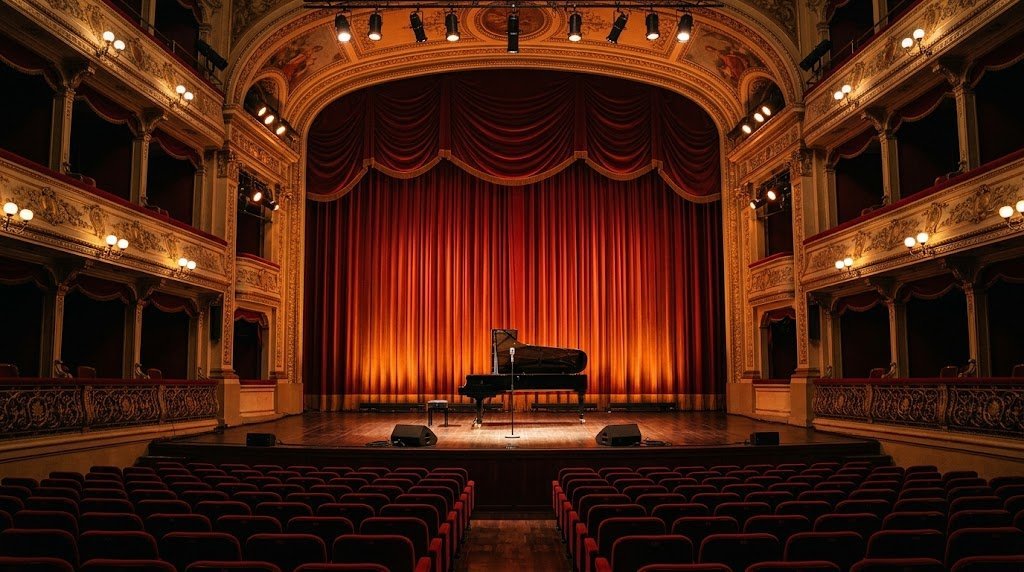
Anna Oxa sings at Teatro Italia in Rome on Thursday, January 28, 2027, starting at 21:00. The theater is at Via Bari 18, in the Nomentano district, outside the limited traffic zones: the Policlinico stop on Metro B is about 450 meters away, the Bologna stop about 600 meters. The prices published on the presale circuit authorized by the organization are 45 euros for the VIP poltronissima, 40 euros for the orchestra poltronissima, 35 euros for the first balcony and 33 euros for the second balcony, plus service fees. The evening is organized by PG Production. Tickets are bought on the presale circuit authorized by the organization, with the option of choosing your seat on the hall map, for information on the hall and the box office you can refer to the theater's official website.
Anna Oxa in Rome: date, time and tickets
Anna Oxa's concert at Teatro Italia is set for Thursday, January 28, 2027 at 21:00, in a hall of about 800 seats divided between orchestra and two balconies.
Four sectors, four prices
The VIP poltronissima costs 45 euros, the orchestra poltronissima 40 euros, the first balcony 35 euros and the second balcony 33 euros. These prices include the presale fee set by the organizer, but not the service fees of the sales circuit, which are added at the time of purchase. The difference between the most expensive seat and the cheapest is 12 euros: in a theater of this size it is worth thinking about what you are looking for, closeness or an overall view, more than about the savings.
Choosing your seat on the map
The sales circuit allows two modes: the best available seat for the chosen category, assigned automatically, or direct choice on the hall map. For an evening with a single Rome date, choosing on the map makes the most sense, especially in the first weeks, when the central rows are still free.
Who organizes it
The evening is organized by PG Production, a company based in the province of Naples. In case of changes or cancellation, refund procedures depend on the organizer: it is best to keep the purchase confirmation until the day of the concert.
What to expect from Anna Oxa's concert
The title of the program and the setlist of the January 28 evening are not published, the repertoire of Anna Oxa, built over almost 50 years of career, includes however some of the best-known songs of Italian music.
The songs the audience knows
Among the best-known songs of her repertoire are "Un'emozione da poco", "È tutto un attimo", "Donna con te", "Quando nasce un amore", "Senza di me", "Storie", "Senza pietà", "Tutti i brividi del mondo" and "Ti lascerò". They are songs that span four decades and have marked festivals, charts and television programs: whoever goes to an Anna Oxa concert usually expects to hear at least some of them again.
The voice as an instrument
In the last 20 years Anna Oxa has worked a great deal on the voice as an instrument: after 2006 she brought to Italian churches shows built on medieval sacred chants, pieces in ancient Sanskrit, Tibetan mantras and moments of African music. Her most recent tours, titled Voce Acustica and Voce sorgente, revisited the best of her repertoire in stripped-down versions. It is reasonable to expect, at Teatro Italia too, a concert in which the voice is at the center, more than stage effects.
A hall for listening
Teatro Italia is a medium-sized hall, with the orchestra close to the stage and two compact balconies. For a singer who has made the voice her signature it is a fitting setting: you hear the breath, you see the expressions, and the audience is not lost in the distance of an arena.
Who Anna Oxa is
Anna Oxa, whose real name is Anna Hoxha, was born in Bari on April 28, 1961 to an Albanian father, originally from Kruja, and an Italian mother: a singer and television host, she has taken part 15 times in the Sanremo Festival and won it twice, in 1989 and 1999.
Childhood in Bari
She grew up in the San Pasquale district of Bari and graduated from the Giuseppe De Nittis art high school. As a child she performed in the piano bars of the city, accompanied on the piano by the Bari maestro Sabino Sciannelli, at 15 she recorded her first 45 rpm single for a Bari label, with "Fiorellin del prato", a song written 36 years earlier.
The 1978 debut
On January 26, 1978 she debuted at the Sanremo Festival, produced by Ivano Fossati, with "Un'emozione da poco", written for her by Fossati with the bassist Guido Guglielminetti. She appeared dressed as a punk, with an androgynous look created by Ivan Cattaneo. She came second, behind Matia Bazar, and first in the performers' category. The single reached the top of the Italian chart, the same year her debut album, Oxanna, came out.
The 1980s
After her period with RCA she moved to CBS, changed her image and worked for a long time with the producer Mario Lavezzi. In 1983 "Senza di me" was chosen as the soundtrack of a Christmas film by Carlo Vanzina, in 1985 the collaboration with Roberto Vecchioni brought "A lei" to Sanremo and "Parlami" to the top of the Azzurro event. Her 1986 Sanremo entry, "È tutto un attimo", performed live, became one of her biggest hits. In 1988 came "Quando nasce un amore", on the album Pensami per te, the first also released on CD.
Two Sanremo victories
In 1989 she won the Sanremo Festival as a duo with Fausto Leali with "Ti lascerò", the two then represented Italy at the Eurovision Song Contest with "Avrei voluto", finishing ninth. The album Tutti i brividi del mondo, released the same year, reached second place on the Italian chart. 10 years later, in 1999, she won again, as a soloist, with "Senza pietà", in an edition also remembered for the look designed by Tom Ford for Gucci.
Television
Alongside records, Anna Oxa hosted the Saturday-night variety show on Rai 1 Fantastico, in the 1988-1989 season with Enrico Montesano and in the following one with Massimo Ranieri, in 1994 she presented the Sanremo Festival with Pippo Baudo and Cannelle. In 2001 she hosted with Giorgio Panariello the show Torno sabato, in 2016 she was a judge in the evening phase of Amici.
Anna Oxa's career, from the 1990s to today
Anna Oxa's career after 1990 is a series of changes of direction: albums of covers of songwriters, research albums, spiritual tours, returns to the festival.
The live album with the New Trolls
In 1989 and 1990 Anna Oxa took Tutti i brividi del mondo on tour together with the New Trolls, the historic Genoese band, alternating with them on stage, the double live album Oxa, Live con i New Trolls reached the top of the chart. Her 1990 Sanremo single, "Donna con te", came in at seventh place among singles.
The songwriters and Do di petto
Between 1993 and 1994 two albums of interpretations of songs by the great Italian songwriters came out, Cantautori and Cantautori 2, with songs by Pino Daniele, Fabrizio De André and Claudio Baglioni. In 1993 she also released Do di petto, with her hits rearranged. The show that went with it was taken to the main Italian theaters, among them the Teatro Sistina in Rome, with an excellent reception, after a delicate operation on her vocal cords.
The singer-songwriter of 2003
In 2003, with the album Ho un sogno and the single "Cambierò", Anna Oxa presented herself for the first time as a singer-songwriter, winning the Premio Lunezia as best female author of the year, the album earned a gold record. In 2004 she toured theaters with Fabio Concato, in an unusual format in which the two performed each other's songs in turn.
Proxima and the comeback
In 2006 she brought "Processo a me stessa" to Sanremo, with lyrics by Pasquale Panella. In 2010 Proxima came out, independently produced, with authors such as Pacifico and Francesco Bianconi and the single "Tutto l'amore intorno", written and sung with Ivano Fossati: the album reached second place on the chart.
Sanremo 2023
In 2023, after 12 years away, Anna Oxa returned to the Festival with "Sali (canto dell'anima)", co-written with Fio Zanotti, Kaballà and Francesco Bianconi, on duets night she reinterpreted "Un'emozione da poco" with the Albanian cellist Iljard Shaba, 45 years after her debut. With 15 appearances she is among the five artists with the most entries in competition, together with Milva, Toto Cutugno, Peppino di Capri and Al Bano. In the same year the Voce sorgente tour also stopped in Rome.
Anna Oxa albums to listen to before the concert
To arrive prepared at Teatro Italia, four or five albums are enough, chosen from the 18 studio albums Anna Oxa released from 1978 to 2010.
Oxanna, 1978
The debut, with "Un'emozione da poco" and "Fatelo con me", both written by Ivano Fossati. It is the record of the 17-year-old punk girl who surprised Sanremo, and it also contains "Questa è vita", a cover of a song by the Electric Light Orchestra.
1986: "It All Happens in a Moment"
The record of the Sanremo hit of the same name, considered one of the most appreciated of her discography and reissued several times. It contains "Aspettando Qazim", dedicated to her father.
Tutti i brividi del mondo, 1989
The album of the victory with Fausto Leali, second on the chart, with "Avrei voluto", the duet taken to Eurovision.
Senza pietà, 1999
The record of the second Sanremo victory, seventh on the albums chart, with the duet "Camminando camminando" sung with the Puerto Rican singer Chayanne.
Proxima, 2010
The comeback album, with original songs by top authors and the voice of Ivano Fossati closing "Tutto l'amore intorno". For those who know only the Anna Oxa of the 1980s it is the best way to understand how her voice has changed.
A curiosity about Anna Oxa at Teatro Italia, January 28, 2027
The curiosity concerns a thread that ties the January 28 concert to another name on the Rome winter schedule. In 1989, after the Sanremo victory, Anna Oxa took her album on tour with the New Trolls, the Genoese progressive and pop-rock band, from that tour came the double live album that went to the top of the charts. With the band's drummer, Gianni Belleno, Anna Oxa had a long relationship, from 1989 to 1998, from which her two children were born.
24 days after the Teatro Italia concert, on February 21, 2027, Gianni Belleno will be on the stage of the Sala Santa Cecilia at the Auditorium with the Of New Trolls, together with Banco del Mutuo Soccorso and Le Orme, in the concert Una Storia Unica. Two different evenings, two different halls, a piece of shared musical history: whoever remembers the 1990 live album can find in Rome both halves of that story a few weeks apart.
Then there is a curiosity about the name. Anna Oxa is the stage name of Anna Hoxha: her father's Albanian surname, with the spelling simplified. In 2020 the singer also obtained Albanian citizenship, and in 2023, for the duets night at Sanremo, she chose precisely an Albanian musician, the cellist Iljard Shaba.
Teatro Italia, the railway workers' hall
Teatro Italia at Via Bari 18 is a period building in the Nomentano district, built starting in 1928 to a design by the architect Angiolo Mazzoni, with the engineer Efisio Vodret and the sculptor Attilio Selva, and financed by the railway administration.
Liberty and Déco
The building's language mixes Liberty and Déco elements. The work lasted a little over two years: the hall was born as a place of leisure and culture for Rome's railway workers, and was inaugurated with a concert.
The halls
The theater declares 772 seats divided among three halls. The main hall has an orchestra of 486 seats, a first balcony of 173 seats and a second balcony, two multipurpose rooms, of about 80 and about 45 seats, host conferences, seminars and lessons.
The foyer
In the foyer there is a bar also set up for food service: for those coming from work on a Thursday evening, it is the simplest way to eat something before 21:00.
A wide-ranging program
Since the 2006 reopening Teatro Italia has hosted drama, dance, concerts, musicals, experimental work and foreign-language theater, as well as conferences and university lectures. In the same season the schedule includes, among others, tribute concerts and comedy shows: the hall lives on a popular and varied program.
One thing nobody tells you about Anna Oxa at Teatro Italia, January 28, 2027
The thing few people say is that the published prices are not the final price. The sales circuit lists 45, 40, 35 and 33 euros, and specifies that the figure includes the presale fee set by the organizer but not the service fees, nor any additional charges. Whoever compares the sectors should do so knowing that a fee is added to each ticket, for a couple the difference between first and second balcony remains a few euros, and the choice of seat counts for more than the savings.
The second thing concerns the second balcony. The theater does not publish the exact number of its seats, and the view from above in a hall built in the 1920s is not that of a modern theater: the orchestra and the first balcony are, in our opinion, the safest choices for those who want to see the singer's face and not only her figure.
Third point, the day. January 28, 2027 is a Thursday, and the concert starts at 21:00. If you come by car from work you will find rush-hour traffic on the Nomentana and around the Policlinico, if you take Metro B you arrive more relaxed. The affiliated parking lot on Via Como, about 200 meters away, stays open until 1 a.m., and this takes away the anxiety of the ride home.
How to get to Teatro Italia
Teatro Italia is at Via Bari 18, outside the limited traffic zones, and is reached by Metro B: the Policlinico stop is about 450 meters away, the Bologna stop about 600 meters.
By metro
From Termini station, Metro B toward Rebibbia reaches Policlinico in a few minutes, from there you walk about 450 meters to Via Bari. Alternatively you get off at Bologna, with a few more minutes of walking through the streets of the district.
From the train stations
The theater presents itself as easily reachable by public transport from both Termini and Tiburtina. For the exact bus route, and for the evening return, it is best to use the route planner of the Rome transit company.
By car
The affiliated parking lot is at Via Como 60, about 200 meters from the theater, open until 1 a.m., with a discounted rate of 3 euros an hour for spectators, the phone number is 06 4958320.
The ride home
The concert starts at 21:00 and the running time is not published. Before leaving it is best to check the time of the last Metro B run and keep the number of a taxi service handy.
The advice I give you for visiting Anna Oxa at Teatro Italia, January 28, 2027
The advice is to arrive at the concert with ears prepared for a singer who does not repeat herself. Anna Oxa has changed image and sound many times: the punk girl of 1978, the sensual voice of the 1980s, the interpreter of the songwriters, the singer-songwriter of Ho un sogno, the sound researcher of the church shows. Whoever expects a jukebox of hits risks being thrown off, whoever expects a concert of voice, built on her songs but free in the arrangements, usually comes out satisfied.
On the practical side, the advice is to choose the orchestra, if the budget allows. The difference between the orchestra poltronissima and the first balcony is 5 euros, and in a hall with 486 orchestra seats, closeness to the stage changes the experience. The VIP poltronissima makes sense for those who want the first rows and live the concert as an event, the second balcony is the choice of those who want to be there while spending the least.
Finally, the time. With the start at 21:00 on a Thursday, it is best to have dinner early in the district or at the foyer bar, arrive at the theater around 20:30 and take your seat unhurriedly. Metro B, a few minutes on foot away, makes the ride home easy for those who sleep near Termini.
Another well-known fact, yet rarely mentioned
It is well known that Anna Oxa won the Sanremo Festival twice. It is less often remembered that her first Sanremo, in 1978, was almost a victory: "Un'emozione da poco" came second, behind Matia Bazar, but first in the performers' category, and the 45 rpm single went to the top of the chart. And in 1997, with "Storie", she came second again, behind Jalisse. In total, between victories and second places, Anna Oxa climbed four times onto the top podium step or the one just below.
A second well-known and little-told fact concerns the authors. In the list of those who wrote for her are Ivano Fossati, Rino Gaetano, Roberto Vecchioni, Amedeo Minghi, Fabio Concato, Mario Lavezzi, Pasquale Panella, Enrico Ruggeri, Ron, Pacifico and Francesco Bianconi. Few Italian performers can claim such a varied list of signatures, from songwriter music to pop, and in few repertoires does the same voice pass from Fossati to Vecchioni to Panella with the same naturalness.
And a third fact: in 1979 Anna Oxa starred in a musical film, Maschio, femmina, fiore, frutto, directed by Ruggero Miti, in which she performed all the songs of her second album. The film was reissued on DVD in 2008.
Nomentano, the district of Teatro Italia
Via Bari is in the Nomentano district, between Piazza Bologna, the Policlinico Umberto I and Via Nomentana: an early twentieth-century residential district, close to the university and the stations.
Villa Torlonia
Along Via Nomentana opens Villa Torlonia, with the Casino Nobile and the Casina delle Civette. If you arrive in the afternoon you can devote a couple of hours to the park and the museums, checking the winter opening hours.
Porta Pia and Coppedè
Going down Via Nomentana toward the center you reach Porta Pia. On the other side, toward Via Salaria, the Coppedè district offers one of the most singular ensembles of twentieth-century Roman architecture, at a distance you can cover on foot.
San Lorenzo
To the south, beyond the Policlinico and the university city, is the San Lorenzo district, with the basilica of San Lorenzo fuori le Mura and the Verano Cemetery. In the evening it is one of the districts most frequented by students.
The right photo to take at Anna Oxa at Teatro Italia, January 28, 2027
The right photo, for an evening like this, starts outside. The facade of Teatro Italia on Via Bari, with its Liberty and Déco elements, is the portrait of a hall born in 1930 for railway workers: photographed in the evening, with the sign lit and the audience going in, it tells of a place with almost 100 years of history hosting a singer with almost 50 years of career.
Inside, the rule is discretion. No flash, no phone held up for the length of a song: one photo when the stage lights come on, and then you listen to the concert. Anna Oxa is a voice performer, and the most intense passages get lost behind a screen. Whoever sits in the first balcony has the best perspective for an overall image, with the full orchestra in the foreground and the lit stage in the background.
The best moment, in our opinion, is the final bow, when the hall rises to its feet: it is the only photo that truly tells the relationship between the singer and her audience, and it is also the moment when photographing disturbs those listening the least.
Some important events that took place here in history
The history of Teatro Italia begins in 1928, when construction of the building starts to a design by Angiolo Mazzoni, with Efisio Vodret and Attilio Selva, financed by the railway administration.
1930, the inauguration with Mascagni
According to the theater's website, Teatro Italia was inaugurated on June 1, 1930 with a concert by Pietro Mascagni, in a solemn ceremony in the presence of the leaders of the national railway workers' association. The sources do not agree on the month: other sites give October 1930, again with Mascagni.
1950s, the Universal cinema
In the 1950s the theater closes and becomes a cinema, the Universal. For decades the railway workers' hall lives on screenings, like many Roman halls born for live performance.
2006, the reopening
In February 2006 Teatro Italia is renovated and reopened as a theater, under the direction of Pietro Longhi. Since then it has hosted drama, dance, concerts, musicals, foreign-language theater and university lectures.
2027, a voice of Sanremo
On January 28, 2027 the stage inaugurated by a composer hosts one of the most recognizable voices of the Sanremo Festival, on a late-January evening: the month in which, in 1978, Anna Oxa debuted at the Ariston.
Who has played at Anna Oxa at Teatro Italia, January 28, 2027
Through Teatro Italia passed, on inauguration day, Pietro Mascagni, with a concert in front of the leaders of the railway workers' association. Behind its construction are the names of Angiolo Mazzoni, engineer of the Italian State Railways, the engineer Efisio Vodret and the sculptor Attilio Selva. After the decades of the Universal cinema, with the 2006 reopening actors, dancers, musicians and companies of every kind returned to the stage.
Through Anna Oxa's career have passed many of the most important names in Italian music: Ivano Fossati, who produced her debut and sang with her in 2010, Rino Gaetano and Lucio Dalla, with whom she collaborated in the late 1970s, Mario Lavezzi, producer of her 1980s records, Roberto Vecchioni, Fausto Leali, partner in the 1989 victory, Giorgio Gaber, with whom she recorded "Si può" in 1993, Fabio Concato, partner on the 2004 tour, the New Trolls, companions on the 1989 and 1990 tour.
From television, alongside her have passed Enrico Montesano, Massimo Ranieri, Pippo Baudo, Cannelle and Giorgio Panariello. On January 28, 2027 all these names remain in the songs: on the stage on Via Bari is the voice that held them together.
Angiolo Mazzoni, the architect of Teatro Italia
Angiolo Mazzoni del Grande, born in Bologna in 1894 and died in Rome in 1979, was one of the leading designers of public buildings, stations and railway and postal buildings of the first half of the twentieth century, Teatro Italia is one of his Roman works.
The railway engineer
Mazzoni worked for a long time as an engineer for the Italian State Railways, with projects in Florence, Messina, Milan and Rome, and designed many post office buildings. That the theater of Rome's railway workers bears his signature is the natural consequence of that role.
A style hard to classify
His language moves from Futurism to Rationalism and Constructivism, depending on the building and its function. Teatro Italia, with its combination of Liberty and Déco, adds another register to this variety, and the facade on Via Bari is one of the rare Mazzoni examples devoted to the performing arts.
How to organize the evening of January 28
A concert at 21:00 on a late-January Thursday is organized in three beats: dinner, arrival, ride home.
Dinner
The foyer bar at Teatro Italia also offers food service. Alternatively, around Piazza Bologna and along the streets of Nomentano you find pizzerias, trattorias and neighborhood bars: booking for 19:15 or 19:30 leaves time to reach the theater without hurry.
Arrival
It is best to be on Via Bari around 20:30. Picking up any tickets, the coat check and finding your seat take a few minutes, and with an audience of mixed ages the lines at the entrance can be slow.
The ride home
If you came by metro, check the time of the last Line B run, if you came by car, the parking lot on Via Como is open until 1 a.m. For those staying downtown, a taxi booked in advance is the most comfortable solution.
Orchestra or balcony: how to choose your seat
For Anna Oxa at Teatro Italia there are four sectors: VIP poltronissima at 45 euros, orchestra poltronissima at 40 euros, first balcony at 35 euros and second balcony at 33 euros, plus fees.
The orchestra
The orchestra at Teatro Italia has 486 seats. For a concert of voice it is the choice of those who want to see the performer up close: the expressions, the gestures, the dialogue with the musicians. The VIP poltronissima designates the rows closest to the stage.
The first balcony
The first balcony has 173 seats and offers a view from above of the stage and the lights. It is a balanced choice, saving 5 euros compared to the orchestra.
The second balcony
The second balcony is the cheapest. In a period theater it is also the farthest and the steepest: fine for those who want to be there at minimum cost and listen more than watch.
Where to eat before or after the concert
Teatro Italia has a bar in the foyer, also set up for food service: the most comfortable solution for those arriving shortly before 21:00.
In the district
Around Piazza Bologna and along the streets of Nomentano you find pizzerias, trattorias and bars frequented mostly by residents and students. On Thursday evening the pressure is lower than on the weekend, but booking remains prudent.
After the concert
San Lorenzo, a short distance away, has places open late even on weekdays. If you prefer to go straight back downtown, Metro B is the fastest link to Termini.
Accessibility and practical information
Teatro Italia does not publish detailed information on the accessibility of the hall: those with special needs can contact the theater at 06 44239286 before the concert.
With kids
The organization indicates no age limits. An Anna Oxa concert is an evening many families share across generations: parents who remember Sanremo, children who discovered her with the 2023 comeback. The 21:00 start on a Thursday should be weighed against school the next day.
Rome in late January
In late January the Roman evenings are cold, often damp. The walk from the metro to the theater is short, but a heavy coat and an umbrella are useful for the exit, which happens late at night. It is a low tourist season: if you come from out of town you will find lodging more easily among Nomentano, Piazza Bologna and San Lorenzo, within walking distance of Via Bari.
Frequently asked questions about Anna Oxa in Rome
When does Anna Oxa sing in Rome?
Anna Oxa sings in Rome on Thursday, January 28, 2027 at Teatro Italia, at Via Bari 18, starting at 21:00. It is the only Rome date published for the season. It is best to arrive at the theater around 20:30, to have time to enter and take your seat without hurry.
How much do tickets for Anna Oxa at Teatro Italia cost?
Tickets for Anna Oxa at Teatro Italia cost 45 euros for the VIP poltronissima, 40 euros for the orchestra poltronissima, 35 euros for the first balcony and 33 euros for the second balcony. The service fees of the presale circuit are added to the prices.
Where do I buy tickets for Anna Oxa's concert?
Tickets for Anna Oxa's concert are bought on the presale circuit authorized by the organization, which lets you choose your seat on the hall map. The organizer of the evening is PG Production, refund conditions in case of changes depend on the organizer.
How do I get to Teatro Italia by public transport?
Teatro Italia is reached by Metro B: the Policlinico stop is about 450 meters from Via Bari 18, the Bologna stop about 600 meters. The theater is also reachable by public transport from Termini and Tiburtina stations, for the bus, it is best to use the route planner of the Rome transit company.
Is there parking near Teatro Italia?
Teatro Italia has an affiliated parking lot at Via Como 60, about 200 meters away, open until 1 a.m., with a discounted rate of 3 euros an hour for spectators. The theater is outside the limited traffic zones.
What songs will Anna Oxa sing?
The setlist of Anna Oxa's concert at Teatro Italia is not published. Her repertoire includes songs such as "Un'emozione da poco", "È tutto un attimo", "Quando nasce un amore", "Donna con te", "Storie", "Senza pietà" and "Ti lascerò", but on recent tours the singer has worked a great deal on stripped-down arrangements, centered on the voice.
How many times has Anna Oxa won Sanremo?
Anna Oxa has won the Sanremo Festival twice: in 1989 with "Ti lascerò", as a duo with Fausto Leali, and in 1999 as a soloist with "Senza pietà". In total she has taken part 15 times, the last in 2023, and is among the five artists with the most entries in competition.
The final advice on Anna Oxa
Anna Oxa at Teatro Italia is, in our opinion, a concert to choose for the voice rather than the memories. The songs that marked Sanremo are all in her repertoire, but the singer who steps onto the stage on Via Bari is the one from the tours of recent years, used to stripping songs down to the essential. The advice is to take a seat in the orchestra or the first balcony, have dinner early in Nomentano or at the foyer bar, arrive at 20:30 and listen closely: in a hall of 800 seats, built for railway workers and inaugurated by Mascagni, a voice like this is heard as it is, without filters and without distance.
Article written by the editorial team of Tour Leader Pro, contact them for Private/Corporate/V.I.P. Tours and Experiences.
Planning a trip to Rome? The English guides to visiting the city are on ItalyPlanner.com.