11 plus Rooms at MAXXI, November 27, 2026 to February 7, 2027
https://www.estateromana.com/en/rome/trip-planner/11-plus-rooms-at-maxxi-november-27-2026-to-february-7-2027/
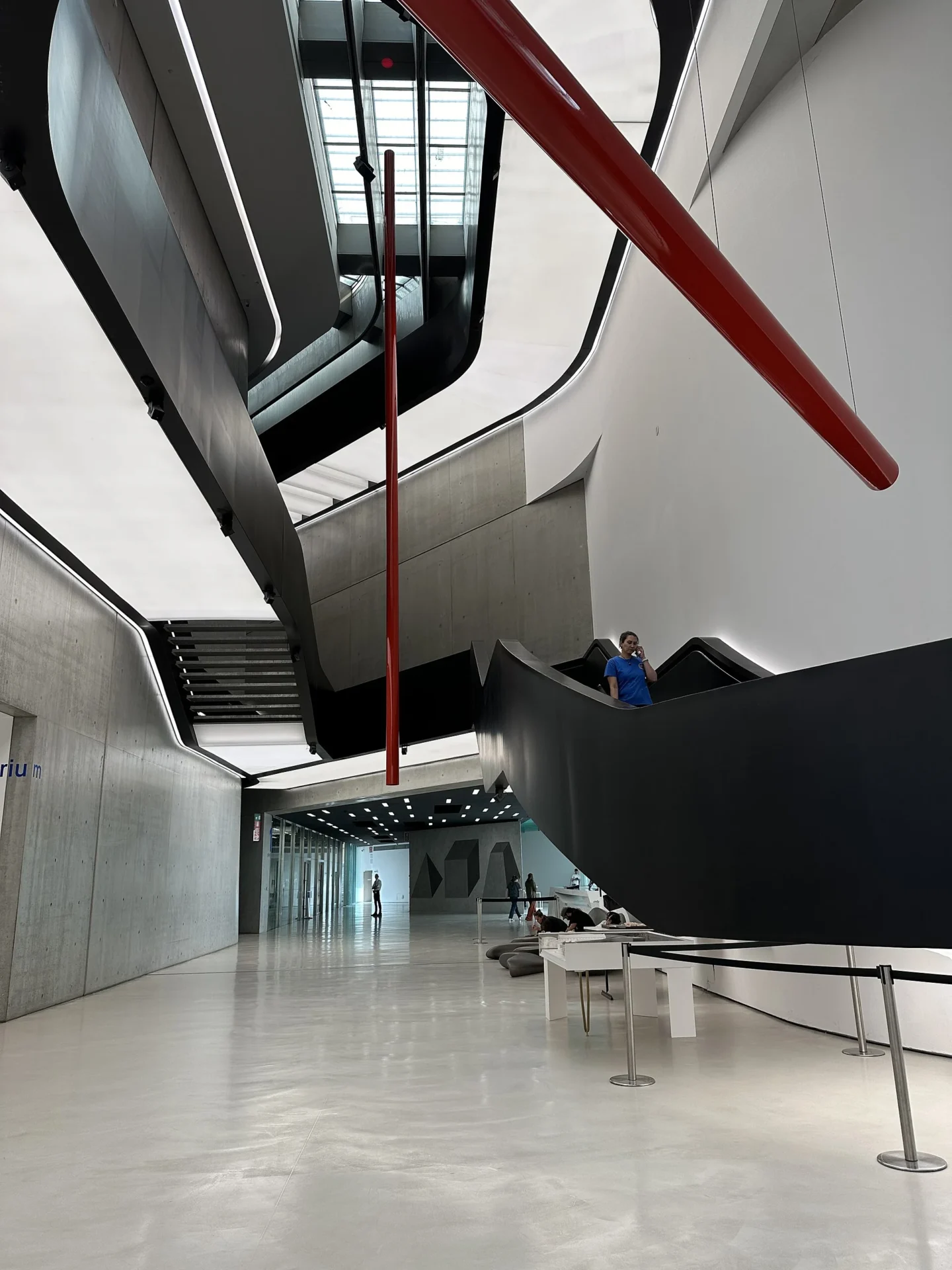
11 plus Rooms is open at MAXXI, the National Museum of 21st Century Arts at Via Guido Reni 4a, in the Flaminio neighborhood, from November 27, 2026 to February 7, 2027, in Gallery 3. It is curated by Hans Ulrich Obrist, Klaus Biesenbach and Francesco Stocchi. The museum is closed on Monday. Last entry is at 18:00 from Tuesday to Friday and at 17:30 on Saturday and Sunday. You get there by metro A to Flaminio and then tram 2 toward Piazza Mancini, or by buses 910, 53, 168 and 982. On Via Guido Reni there is a stop that carries the museum's name. Prices are published on the official MAXXI website, and tickets are bought at the museum's ticket office or on the venue's official website.
11 internationally known artists, 11 rooms, and inside each one a flesh-and-blood person: it's the formula of one of the most discussed exhibitions of the last 15 years, which arrives in Rome for its Italian stop. One thing to say right away: this is not an exhibition to look at, it's an exhibition you step into, and anyone not willing to be looked at in return should know it beforehand.
11 plus Rooms at MAXXI in brief: dates, hours, curators
11 plus Rooms stays open for more than 10 weeks, from Friday, November 27, 2026 to Sunday, February 7, 2027, and so runs through all the end-of-year holidays. MAXXI hosts it in Gallery 3.
The dates
Opening Friday, November 27, 2026, closing Sunday, February 7, 2027: these are the dates published by the official tourism portal of Roma Capitale. On December 25, which in 2026 is a Friday, MAXXI is closed. For the other holidays it's best to check the museum's website.
The hours
MAXXI is closed on Monday. Last entry is at 18:00 from Tuesday to Friday and at 17:30 on Saturday and Sunday. In an exhibition made of living presences, the rooms' hours can depend on the performers' shifts: if there's a room you absolutely want to see, ask at the entrance.
The curators
The exhibition is curated by Hans Ulrich Obrist, Klaus Biesenbach and Francesco Stocchi. Obrist and Biesenbach are the creators of the series since the first edition in 2011. Stocchi joins for the Roman stop.
Where it is
Via Guido Reni 4a, 00196 Rome, in Flaminio, between Via Flaminia and the Tiber. For information the museum answers at 06 3201954.
What 11 plus Rooms is: the exhibition of living sculptures
11 plus Rooms is an exhibition in which the body and performance become, in the museum's words, a "living sculpture": each artist has a room at their disposal, and inside the room there's a work made of people. The visitor enters, and becomes in turn spectator, voyeur and participant.
11 rooms, 11 artists
The MAXXI presentation speaks of 11 internationally known artists who invite the public into the spaces dedicated to each of them, to live the works and interact with them. The museum's 2026 program describes it as an exhibition of living sculptures made by 11 artists. The "plus" in the title says that the formula, born with 11 rooms, widens here.
The human being and the object
The declared theme is the relationship between the human being and the object. In a traditional exhibition we are the subjects and the works the objects: we look at them, we walk around them, we move on. Here the work looks back at us, breathes, sometimes speaks, sometimes stays still for hours. The visitor is challenged, writes the museum, through the physical presence of the body. It's a reversal that is simple to say and surprisingly strong to experience.
An art made of time
The exhibitions in the series have been defined by their own creators as time-based group exhibitions. A work that lives only as long as someone performs it can't be hung on a nail or shut in a case: it exists in the moment you meet it. For this reason, in our view, 11 plus Rooms should be seen slowly and, if possible, twice: the same room, on another day or at another hour, can be a different experience.
From Manchester to Rome: the history of the Rooms series
11 plus Rooms is the Italian stop of a series that began in 2011 in Manchester with 11 Rooms, commissioned by the Manchester International Festival, by the International Arts Festival Ruhrtriennale for the years 2012-2014 and by the Manchester Art Gallery. It is one of the most imitated exhibition formulas of the last decade.
11 Rooms, Manchester 2011
The first edition was held at the Manchester Art Gallery in 2011, in a series of 11 identical white rooms, curated by Hans Ulrich Obrist and Klaus Biesenbach. The curators explained that they started from the impression that the traditional way of setting up exhibitions, based on the static relationship between a person and an object, had something reductive about it. Their formula was: 11 artists, 11 spaces, and time as material.
The works of the first edition
In Manchester there were Mirror Check by Joan Jonas, from 1970. Revolving Door by Allora and Calzadilla, from 2011. Unrealized Proposal for Cadaver Piece by John Baldessari, from 1970, realized in 2011. Man=Flesh/Woman=Flesh, Flat by Laura Lima. Luminosity by Marina Abramović. The work by Santiago Sierra with veterans of the wars in Northern Ireland, Afghanistan and Iraq facing the corner of the room. Playing the Martyr by Simon Fujiwara. A work by Lucy Raven. In Just a Blink of an Eye by Xu Zhen, from 2005. A man who seems to float, a naked woman, a revolving door made of people: that's how the press described the exhibition.
From 12 to 15 rooms
After Manchester the series grew by one room at each stop: 12 Rooms at the Ruhrtriennale, 13 Rooms in Sydney in April 2013 with Kaldor Public Art Projects, 14 Rooms at Art Basel in 2014, 15 Rooms at the Long Museum in Shanghai in 2015. At each edition the list of artists changed in part. The Roman stop, with its "plus", takes up the number of the first one and opens it up.
The artists in Rome
MAXXI announces 11 internationally known artists. The list of names and works for the Roman stop is published by the museum. Those who know the earlier editions know that some rooms come back from one stop to the next and others are new: it's part of the series' appeal, and the reason why even someone who saw 14 Rooms in Basel will find something new here.
Hans Ulrich Obrist, Klaus Biesenbach, Francesco Stocchi: who the curators are
11 plus Rooms bears the signature of two of the most influential curators in the world, Hans Ulrich Obrist and Klaus Biesenbach, joined by Francesco Stocchi. They are the pair who invented the series in 2011 and who have since taken it to four continents.
Hans Ulrich Obrist
Born in Switzerland in 1968, a curator, critic and art historian, Hans Ulrich Obrist is artistic director of the Serpentine Galleries in London, where he lives and works. He is the author of The Interview Project, a vast interview project that has been going on for years, and co-director of the magazine Cahiers d'Art. In 2011, when 11 Rooms debuted in Manchester, the press presented him as co-director of the Serpentine.
Klaus Biesenbach
Born in 1966, German and American, Klaus Biesenbach today directs the Neue Nationalgalerie in Berlin, with the Museum Berggruen and the Scharf-Gerstenberg Collection, and the future berlin modern under construction. Previously he was director of the Museum of Contemporary Art in Los Angeles from 2018 to 2021, chief curator at large of the Museum of Modern Art in New York and director of MoMA PS1. He is the founding director of the Kunst-Werke Institute for Contemporary Art in Berlin and of the Berlin Biennale.
Francesco Stocchi
Francesco Stocchi completes the curatorial trio of the Roman stop, and ties the exhibition to the Italian context in which it arrives.
Why their signature matters
A performance exhibition depends on curation more than any other: you have to choose artists, performers, shifts, rules of behavior, and make everything work for weeks without the energy dropping. Obrist and Biesenbach have been doing it with this formula since 2011. It's the guarantee that the Roman stop won't be an experiment, but an already well-run machine.
A curiosity about 11 plus Rooms at MAXXI, November 27, 2026 to February 7, 2027
The most interesting curiosity about 11 plus Rooms concerns the place where it all began. The first edition, in 2011, was held at the Manchester Art Gallery, a museum that, as the press of the time noted, the public associated above all with Pre-Raphaelite paintings. 11 identical white rooms, full of living people, in a museum of nineteenth-century paintings: the contrast was part of the work.
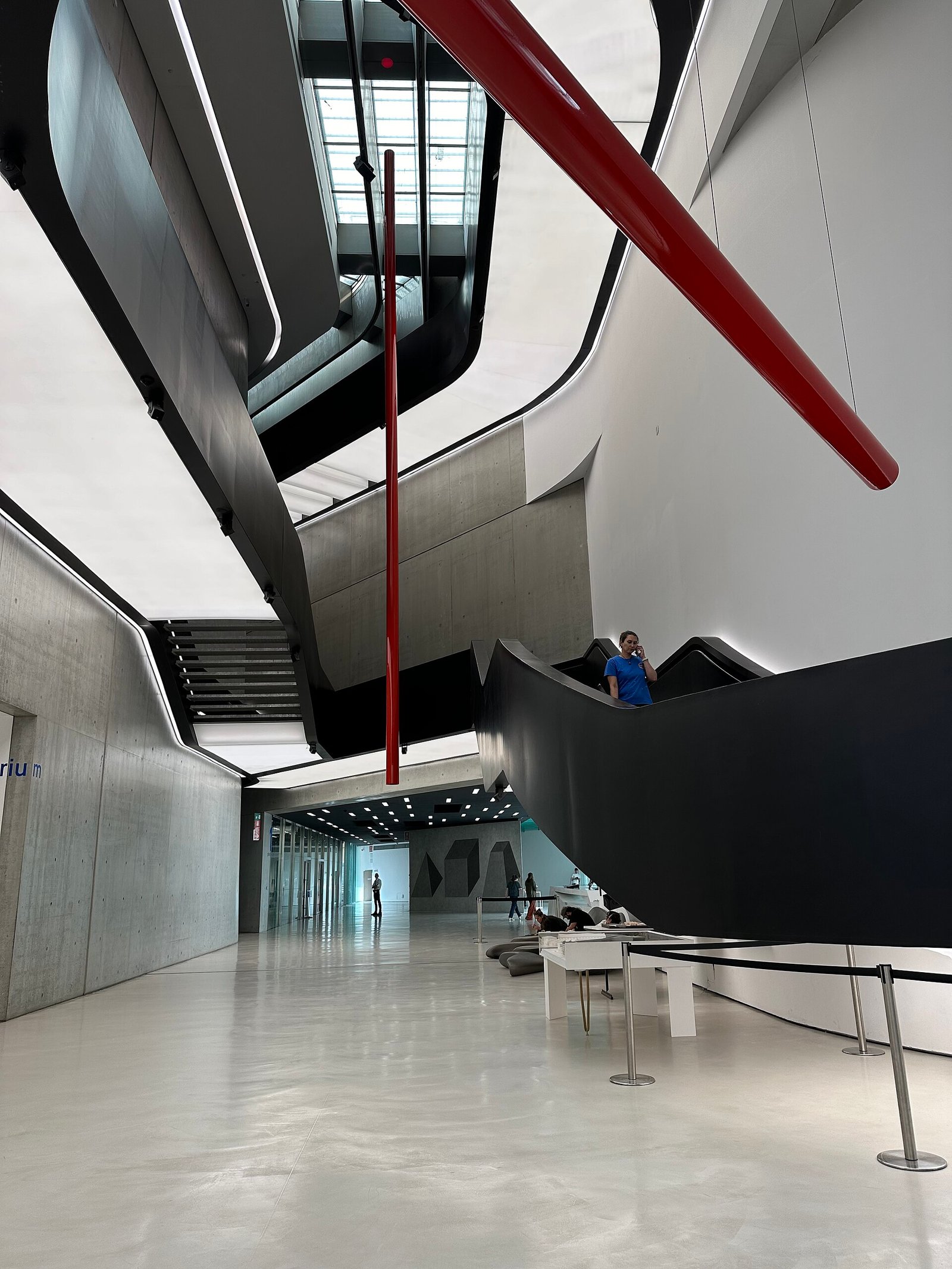
In Rome the contrast is reversed. MAXXI is not a museum of old paintings but Zaha Hadid's building, made of curves, ramps and walls that are never truly parallel. Here the surprise is not finding contemporary art in a traditional place, but finding 11 closed, almost domestic rooms inside an architecture that does everything it can not to have rooms. Anyone who knows MAXXI knows how rare it is, in its galleries, to feel inside an intimate space.
Second curiosity: the series has always changed its number. 11, 12, 13, 14, 15 Rooms. For the Roman stop the curators chose to go back to the starting number and add a "plus". It's a small statement: the original formula, plus something. What that something is, you find out inside.
Third curiosity, for those who love coincidences: at MAXXI, in the autumn of 2026, the exhibition by Sophie Calle, an artist who for 40 years has worked on the presence and absence of people, stays open until the same day, February 7, 2027. Two exhibitions on the body and on the relationship with the other, in the same museum, for the same weeks.
Zaha Hadid's MAXXI, the venue of 11 plus Rooms
MAXXI was inaugurated in 2010 and is the first Italian national museum dedicated to contemporary arts and architecture. The project is by Zaha Hadid, winner of the international competition announced in 1998.
From barracks to museum
In 1997 the Ministry for Cultural Heritage obtained from the Ministry of Defense a large area in Flaminio, occupied by workshops and pavilions of the former Caserma Montello, long unused. The museum is thus born on military ground, in a residential neighborhood, far from the traditional places of Roman art.
The competition and the project
The 1998 competition drew 273 applications from all over the world. The brief asked for a museum for architecture and one for the arts, a space for experimental productions, the library, the auditorium, spaces for live events and for education. Zaha Hadid won, with a project extending over 29,000 square meters around a large open square.
Piazza Alighiero Boetti
The square, named after Alighiero Boetti, is part of the museum: works are displayed in it, and on the occasion of scheduled events it stays open free of charge even outside the regular hours. It's the first thing to cross on arrival.
The always-visible works
The collections are displayed on rotation, but three installations always remain visible: those by Anish Kapoor, Sol LeWitt and Maurizio Mochetti. After 11 rooms of living bodies, looking for them is the best way to change register. The museum also has a cloakroom, café, bar and restaurant, audio guides and guided tours. The full entry is on the page for MAXXI.
One thing nobody tells you about 11 plus Rooms at MAXXI, November 27, 2026 to February 7, 2027
What almost nobody says is that in an exhibition like 11 plus Rooms the visitor's behavior is part of the work. The rules that apply in a museum of paintings (don't touch, don't speak loudly, photograph without flash) have to be rethought here room by room, because inside each room there's a person at work, sometimes for hours, who deserves the respect owed to a performer on stage.
This has practical consequences. In some rooms you enter one at a time, in others you stay standing, in others you're invited to do something. The museum staff give the instructions, and it's best to follow them without arguing: a living work is ruined in an instant by a wrong gesture. The advice is never to photograph the face of the person performing the work without asking the staff if it's allowed.
The second thing few people mention concerns discounts. MAXXI publishes a long and precise list of discounts and free admissions: reduced price for young people between 18 and 25 not yet turned, for groups of 15 people and up, for those with the ticket of the Galleria Nazionale or the Jewish Museum of Rome and for holders of cards from many institutions, among them the Teatro dell'Opera di Roma, the Teatro di Roma, the Teatro Olimpico, the Accademia di Santa Cecilia and the Biblioteche di Roma. Free admission for those under 18, for holders of the myMAXXI card, for people with disabilities and their companion, and, a curiosity that always makes groups smile, for those visiting the museum on their own birthday, with an ID.
Third thing: the birthday really works. If yours falls between November 27 and February 7, note it down: getting into an exhibition for free where the others look at you while you look at them is an original gift.
Tickets for 11 plus Rooms at MAXXI: discounts and free admission
Tickets for 11 plus Rooms are bought at the MAXXI ticket office or online on the museum's official website, where the prices are also published. The list of discounts and free admissions is long and it's best to read it before paying.
Discounts
Reduced price for young people from 18 to 25 not yet turned, for groups of 15 people and up, for those who present the ticket of the Galleria Nazionale or the Jewish Museum of Rome, for those who show a card or badge of a long list of institutions, among them Accademia Costume e Moda, Centro Sperimentale di Cinematografia, FAI, Feltrinelli, Gruppo FS, Sapienza and Tor Vergata, Palazzo delle Esposizioni, Accademia di Santa Cecilia, Teatro Olimpico, Teatro dell'Opera, Teatro di Roma and Youthcard.
Free admission
Free admission for those under 18, for myMAXXI holders, on one's own birthday with an ID, for people with disabilities and a companion, for Ministry of Culture employees, for journalists documenting the activity, for licensed tour guides, for one teacher for every 10 students, for AMACI, CIMAM and ICOM members. From Tuesday to Friday, excluding holidays, European Union university students and researchers in art history and architecture and students of the fine arts academies also get in free.
The myMAXXI card
The myMAXXI card is valid for one year from the date of purchase. Anyone planning to come back several times, for example to see 11 plus Rooms again on different days and add the other exhibitions of the season, would do well to consider it.
My advice for visiting 11 plus Rooms at MAXXI, November 27, 2026 to February 7, 2027
The advice for 11 plus Rooms is simple: go on a weekday, get in by 15:30, and give yourself at least an hour and a half for the 11 rooms, plus time to go back into the ones that struck you. An exhibition made of people is seen badly in a crowd and even worse in a rush.
Let me explain the reasoning. In an exhibition of paintings, 10 people in front of the same painting share the space. In a room with a performer, 10 people change the work: they make it a show, they remove the intimacy the series is built on. Tuesday and Wednesday, away from the holidays, are the days when the exhibition is experienced as it was conceived. Saturday afternoon and the Christmas weeks, when the museum fills with families on vacation, are the days to avoid.
Second piece of advice: go in without prejudice and without rushing to understand. Some rooms seem empty until you notice the person. Others make you uncomfortable, and the discomfort is intended. Stay a minute longer than comes naturally: often that's where the work begins.
Third piece of advice, for groups: split up. 11 rooms crossed by 20 people become a procession. With groups, a short introduction in the museum's square works, then total freedom for an hour and a half, then a meeting at the MAXXI bar to tell each other about the rooms. The discussions that come out of this exhibition last well beyond the exit.
How to get to MAXXI for 11 plus Rooms
You reach MAXXI from the center by metro A to Flaminio and then tram 2, which goes from Piazzale Flaminio to Piazza Mancini. It's the simplest route from Termini, from Spagna or from the Vatican.
Metro A and tram 2
From Flaminio station tram 2 leaves, with its terminus at Piazza Mancini: you get off at the stop closest to Via Guido Reni and walk toward the Tiber. It's the combination that the Auditorium Parco della Musica too, about 650 meters from MAXXI, gives as the main route by public transport.
The buses
The 910 goes from Termini to Piazza Mancini. The 53 from Piazza Mancini to Largo Chigi, a stone's throw from Via del Corso. The 168 from Largo Maresciallo Diaz to Tiburtina station. The 982 from Viale XVII Olimpiade to Quattro Venti station. On Via Guido Reni, about 130 meters from the entrance, there's the MAXXI stop, marked as wheelchair accessible.
On foot from the Ponte della Musica
The Ponte della Musica, dedicated to Armando Trovajoli, connects Flaminio with Lungotevere Cadorna at the level of the Foro Italico and is pedestrian and bicycle only. Those staying in Prati or Vittoria reach MAXXI on foot by crossing the Tiber.
By car
You arrive from Via Flaminia or from the Lungotevere, but parking in the area is hard on weekdays and almost impossible on concert evenings at the Auditorium or match evenings at the Olimpico. The Auditorium has two paid parking lots, about 10 minutes on foot away, with spaces reserved for people with disabilities.
Another well-known fact, yet rarely mentioned
Whoever goes to MAXXI knows it's a Zaha Hadid museum. Few remember that it stands on the area of the former Caserma Montello, a military complex of workshops and pavilions long left unused, passed to the Ministry for Cultural Heritage in 1997. The fact is known to architects, but it's rarely cited, and it explains a lot.
It explains why the museum is in a residential neighborhood and not in a monumental area: the land was available because it was military state property. And it explains the character of a whole piece of city, Flaminio, where in recent decades marginal areas have become places of culture. A few hundred meters away the same happened with Renzo Piano's Auditorium Parco della Musica, built in a zone between the Villaggio Olimpico and the Flaminio stadium that its own managers describe as run-down and abandoned. Between 2002 and 2010 Flaminio received two of the most discussed contemporary buildings in Rome.
There's a second well-known and rarely cited fact, this time about the series. The first edition of 11 Rooms, in Manchester, came after the Manchester International Festival had already produced, in earlier editions, live shows of great appeal. The Rooms exhibitions were thus born in a festival of performing arts and not in a museum: that's why at MAXXI, which has always alternated exhibitions, theater and dance, they find a natural home. The museum, after all, presents itself as a place that produces and hosts art, architecture, design, photography, fashion, cinema, theater and dance. An exhibition made of living bodies is the meeting point of all these souls.
How to organize the visit to 11 plus Rooms
A visit to 11 plus Rooms is organized in half a day, and can be finished in the neighborhood, among the Auditorium, the Ponte della Musica and Villa Glori. Here is a recommended plan.
How much time it takes
An hour and a half for the 11 rooms, half an hour for the square and for the permanent installations by Kapoor, LeWitt and Mochetti. With transport from the center, count four hours.
Two exhibitions in one day
Until February 7 there is also the Sophie Calle exhibition at MAXXI. The two exhibitions are in dialogue, but both are demanding: Calle is an exhibition to read, 11 plus Rooms one to live. It's best to do them on two different days. If time is short, start with 11 plus Rooms in the morning, take a long break at the museum's restaurant and save Calle for the early afternoon.
Museum services
MAXXI has a cloakroom, services also for people with disabilities, a café, bar and restaurant, audio guides also in foreign languages, guided tours and workshops. Leave your coat before going in: in the rooms you stand, and with a coat in your hands you feel clumsy.
Private and corporate visits
For corporate groups, schools and private guided visits, Tour Leader Pro organizes tailor-made routes at MAXXI and in the neighborhood.
The right photo to take at 11 plus Rooms at MAXXI, November 27, 2026 to February 7, 2027
The right photo of 11 plus Rooms is not taken inside the rooms but outside, on Piazza Alighiero Boetti, with Zaha Hadid's building behind you and a small human figure in the emptiness of the square. In an exhibition dedicated to the body as sculpture, it's the photo that captures its meaning.
Inside the rooms, the rules are set by the museum, and in an exhibition of living people they have to be respected with more scruple than usual. Someone performing a work for hours is not a photographic subject at the public's disposal, and a phone raised in front of their face changes the relationship the room wants to create. Always ask the staff before shooting, and if the answer is no, don't insist.
On the square, instead, MAXXI lends itself. Step back, pick a strong line of the building and wait for someone to cross the square: a single, small person gives the scale of the architecture. Between December and January the afternoon light fades early, and around 16:30 the surfaces of the building take on a warm tone that lasts a few minutes. It's the moment to wait for.
Second photo, for those with time: from the Ponte della Musica, toward Flaminio, at the hour when the sky turns dark blue. You don't see the whole museum, but you understand the relationship between the neighborhood and the river.
Third photo, the one the exhibition itself suggests: photograph your companions on the way out, as they tell each other about the rooms. They, that day, are the most interesting living sculptures.
Some important events that happened here in history
The history of the place where 11 plus Rooms is visited today begins with a military area and arrives at a national museum in a little more than a decade. Around it, the neighborhood keeps much older memories.
1997, the transfer of the barracks
The Ministry for Cultural Heritage obtains from the Ministry of Defense the area of the former Caserma Montello, with unused workshops and pavilions. It's MAXXI's birth certificate.
1998, the competition
The international competition is announced: 273 applications, Zaha Hadid wins with a project of 29,000 square meters around an open square.
2010, the inauguration
MAXXI opens as the first Italian national museum for contemporary arts and architecture. Since then it has hosted exhibitions, film series, theater and dance shows.
1867, the Cairolis at Villa Glori
One kilometer from the museum, on the hill of Villa Glori, on October 23, 1867 about 70 Garibaldian volunteers led by Enrico and Giovanni Cairoli, who had come from Terni to bring weapons to the insurgents, were intercepted and defeated by the papal army. Enrico died, Giovanni was seriously wounded.
1924, the Parco della Rimembranza
The same hill was opened to the public as the Parco della Rimembranza, designed by Raffaele De Vico. The trees were planted by Roman students, each with the name of a fallen soldier of the First World War. Since 1997 the park has hosted installations by contemporary artists. It's a story of absent bodies turned into living presences, and it speaks without forcing to the rooms of MAXXI.
Who has passed through 11 plus Rooms at MAXXI, November 27, 2026 to February 7, 2027
Through MAXXI have passed, first of all, the architects and artists who made it and who inhabit it permanently: Zaha Hadid, who signed the building after winning the 1998 competition among 273 applications. Anish Kapoor, Sol LeWitt and Maurizio Mochetti, whose works are always visible. Alighiero Boetti, after whom the square is named.
With 11 plus Rooms, two curators who have made the history of exhibitions of the last 30 years pass through Rome. Hans Ulrich Obrist, from the Serpentine Galleries in London. Klaus Biesenbach, today at the Neue Nationalgalerie in Berlin, after MoMA, MoMA PS1 and MOCA in Los Angeles. With them, Francesco Stocchi.
And, ideally, the whole history of the series passes through. From Manchester, in 2011, Marina Abramović, Joan Jonas, John Baldessari, Allora and Calzadilla, Santiago Sierra, Laura Lima, Simon Fujiwara, Lucy Raven and Xu Zhen passed through the rooms of Obrist and Biesenbach. Not all of them return to Rome, because at each edition the list changes in part, but the formula they helped invent is the same. Marina Abramović, besides, in the same months is the star of a big exhibition in Rome at the Galleria Nazionale d'Arte Moderna, open from November 18, 2026 to April 4, 2027, a few minutes by tram from MAXXI: anyone who wants to understand where performance as living sculpture comes from can see the two exhibitions in the same week.
Widening the view to the neighborhood: Renzo Piano, who designed the Auditorium. Armando Trovajoli, who gave his name to the pedestrian bridge over the Tiber. Enrico and Giovanni Cairoli, who left their name on the hill of Villa Glori. Raffaele De Vico, who designed the park there. From November 27, to this list are added the 11 artists of 11 plus Rooms and the performers who, for 10 weeks, will give body to their rooms.
Flaminio around 11 plus Rooms
MAXXI is in Flaminio, between Via Flaminia, the Tiber and the Parioli hill. In a few minutes on foot you reach the Auditorium, the Ponte della Musica and Villa Glori.
The Auditorium Parco della Musica
Designed by Renzo Piano and inaugurated in 2002, named after Ennio Morricone following his death in 2020, the Auditorium is open every day from 11:00 to 20:00. In the foyer there's a route of 20 neon works by Maurizio Nannucci and some Cellotex works by Alberto Burri. In the gardens two sculptures by Keith Haring from 1989. After 11 plus Rooms it's a small free art itinerary.
Villa Glori
Behind the Auditorium rises the hill of Villa Glori, a park open from 7:00 to sunset, with installations by Kounellis, Staccioli, Uncini, Canevari and others. For those coming out of the exhibition's closed rooms, it's the open air you need.
Villa Borghese and Valle Giulia
Tram 2 takes you back in a few minutes to Piazzale Flaminio, from which you enter Villa Borghese and climb toward the Galleria Nazionale and the Museo Etrusco di Villa Giulia. Those with the Galleria Nazionale ticket are entitled to the reduced price at MAXXI.
MAXXI accessibility for 11 plus Rooms
MAXXI is listed by the tourism portal of Roma Capitale as an accessible museum, with dedicated restrooms, and the ATAC stop on Via Guido Reni is marked as wheelchair accessible. For people with disabilities and their companion admission is free, by presenting the EU Disability Card or a letter from the reference association or institution.
Free admission extends, according to the museum's list, to people on the autism spectrum, deaf people, people with cognitive disabilities and complex communication needs and their caregivers, people with serious illnesses and those who assist them, guests of anti-violence centers and therapeutic communities with their staff. In an exhibition made of presences and direct interaction, it's best to call the museum before the visit, at 06 3201954, to find out how the individual rooms are organized and if any require special attention. The Auditorium parking lots, about 10 minutes away, have reserved spaces.
11 plus Rooms with children and teenagers
11 plus Rooms is an adult exhibition in its themes and in the way you behave in the hall. With teenagers it can be one of the most interesting visits of the year. With small children it needs to be weighed carefully.
With the youngest
The museum doesn't publish age guidance for this exhibition. In past editions of the series some rooms involved nudity or situations of strong emotional impact, and the makeup of the Roman stop needs to be checked with the museum. With children under 10 the advice is to split up: one adult visits the exhibition, the other takes the children to the square and then to the Auditorium gardens or to Villa Glori. Those under 18 get in free.
With teenagers
For a 15-year-old used to screens, finding in front of them an artwork that breathes and looks at them is an experience they won't forget. Ask them, on the way out, which room made them most uncomfortable and why: it's the question that opens the best conversations.
Where to eat near MAXXI
MAXXI has a café, bar and restaurant inside: for those visiting 11 plus Rooms, and maybe the Sophie Calle exhibition too, it's the most practical solution. The Auditorium, a 10-minute walk away, has a bar and restaurant. Flaminio is a residential neighborhood, with dining designed for those who live and work there: fine for a quick lunch. For dinner after the visit, the Parioli and Milvian Bridge are a few minutes away by taxi.
11 plus Rooms between December and February: the time of year in Rome
11 plus Rooms covers the most intimate season of the Roman year, from the end of November to early February: the period when museums go back to being places where you spend a whole afternoon.
December and the holidays
The days get shorter and the light disappears early. On December 25 MAXXI is closed. For the other holidays it's best to check the website. In the weeks of the holidays museums fill with families on vacation: for an exhibition like this one, which lives on intimacy, those who can should go early in December.
January and February
January, after the Epiphany, is the quietest month for Roman museums, and the best moment for a slow visit. The last weeks before February 7 are those of the latecomers, and, given that Sophie Calle also closes the same day, at MAXXI they'll be the most crowded.
Frequently asked questions about 11 plus Rooms at MAXXI
When is 11 plus Rooms open at MAXXI?
11 plus Rooms is open at MAXXI from November 27, 2026 to February 7, 2027, in Gallery 3. The museum is closed on Monday. Last entry is at 18:00 from Tuesday to Friday and at 17:30 on Saturday and Sunday. On December 25 MAXXI stays closed.
What is 11 plus Rooms?
11 plus Rooms is an exhibition of "living sculptures": 11 internationally known artists each have a room, and inside is a work performed by flesh-and-blood people. It's the Italian stop of the series born in 2011 with 11 Rooms in Manchester and continued in Sydney, Basel and Shanghai.
Who are the curators of 11 plus Rooms?
11 plus Rooms at MAXXI is curated by Hans Ulrich Obrist, artistic director of the Serpentine Galleries in London, Klaus Biesenbach, director of the Neue Nationalgalerie in Berlin, and Francesco Stocchi. Obrist and Biesenbach conceived the series in 2011.
How much does a ticket for 11 plus Rooms cost?
The ticket prices for 11 plus Rooms are published on the official MAXXI website. A reduced price is available for young people from 18 to 25 and for groups of 15 people. Admission is free for those under 18, for people with disabilities with a companion and for those visiting the museum on their own birthday.
How do you get to MAXXI by public transport?
MAXXI, at Via Guido Reni 4a, is reached by metro A to Flaminio and then tram 2 toward Piazza Mancini. The area is also served by buses 910 from Termini, 53 from Largo Chigi, 168 and 982. On Via Guido Reni there is the MAXXI stop, which is accessible.
Is 11 plus Rooms suitable for children?
11 plus Rooms is an exhibition designed for an adult audience, made of living presences and direct interaction. MAXXI doesn't publish age guidance. With teenagers it works very well. With small children it's best to ask the museum about the content of the rooms. Those under 18 get in free.
Can you take photos inside 11 plus Rooms?
The rules on photographs in 11 plus Rooms are set by MAXXI, and in an exhibition made of living people you need to ask the staff before shooting. In any case, photographing the face of the person performing the work without permission is to be avoided: the right photo is taken on the museum's square.
How much time does it take to visit 11 plus Rooms?
For 11 plus Rooms at MAXXI it's best to count at least an hour and a half, because in each room the work reveals itself only if you stay a few minutes. With the square and the museum's permanent installations, and the trip from the center, the visit takes about half a day.
Is it worth going? Yes, provided you go in willing to be drawn in. Pick a Tuesday or Wednesday in December or January, arrive early, leave your coat at the cloakroom and your phone in your pocket, and stay in each room longer than comes naturally. Then step out onto the square and watch the people crossing it: after 11 plus Rooms, they'll all look a bit like works of art.
Article written by the editorial team of Tour Leader Pro, contact them for Private/Corporate/V.I.P. Tours and Experiences.
Planning a trip to Rome? The English guides for visiting the city are on ItalyPlanner.com.