100 Cellos Morning Session at Auditorium Parco della Musica, November 15, 2026
https://www.estateromana.com/en/rome/trip-planner/100-cellos-morning-session-at-auditorium-parco-della-musica-november-15-2026/
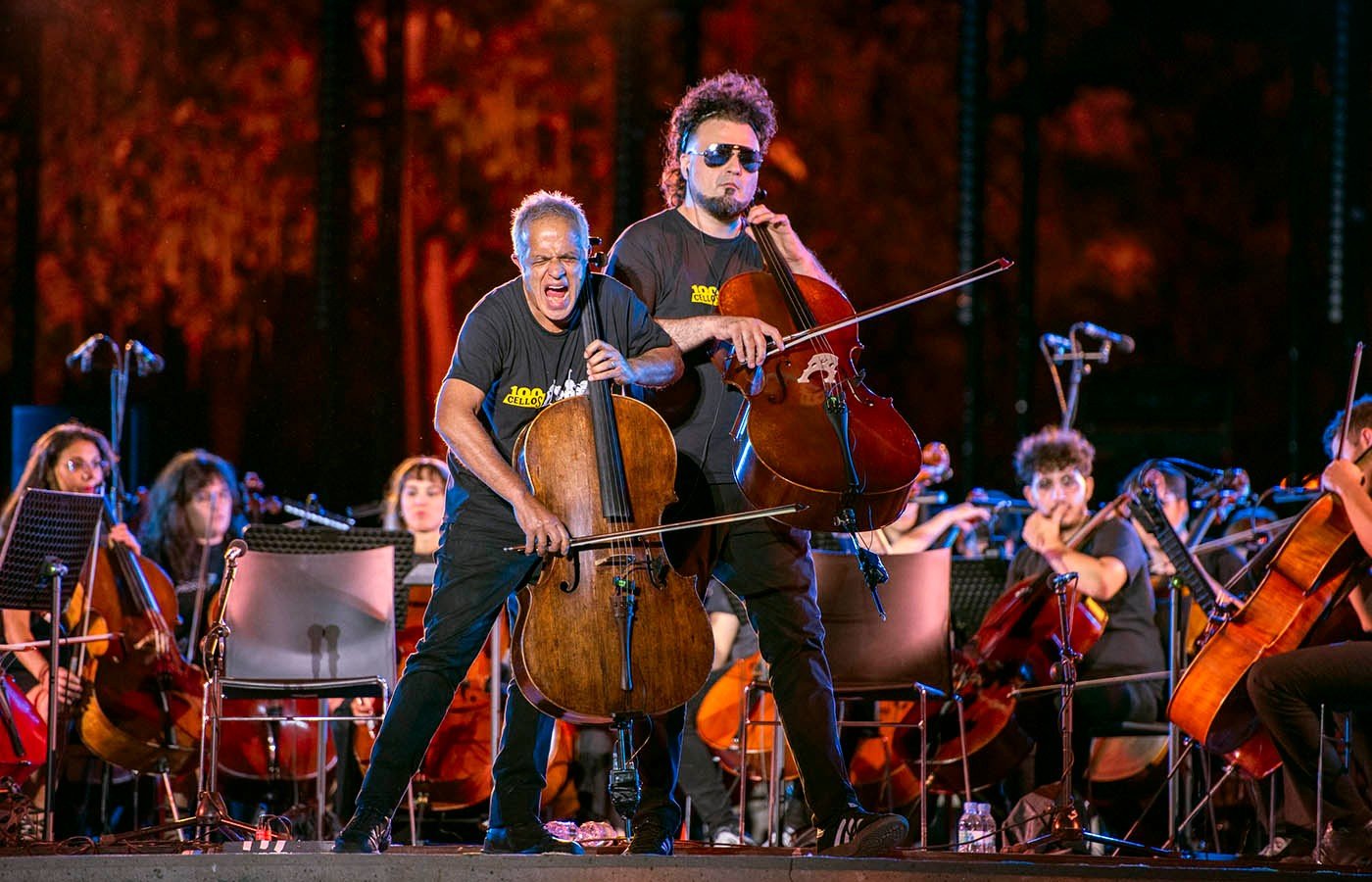 Immagine dalla pagina del concerto 100 Cellos Morning Session del Romaeuropa Festival
100 Cellos: practical file. The 100 Cellos of Giovanni Sollima and Enrico Melozzi return to Rome with a "100 Cellos Morning Session" on Sunday, November 15, 2026 at 11:30, in Sala Santa Cecilia at Auditorium Parco della Musica Ennio Morricone, Viale Pietro de Coubertin 30. The concert is part of Romaeuropa Festival 2026, on its closing day, and is produced in collaboration with the Accademia Nazionale di Santa Cecilia. Tickets cost from 20 to 30 euros, and the festival also offers passepartout options for several shows. The running time and the program of pieces are not published. Tickets are sold online through the channel indicated on the concert page on romaeuropa.net or through the festival box office, by phone at 06 4555 3050 or on WhatsApp at +39 334 348 8894, on Monday from 14:00 to 18:00 and Tuesday to Sunday from 10:00 to 13:00 and from 14:00 to 18:00. For those arriving by public transport, the Auditorium suggests metro line A to Flaminio and then tram 2, or buses 910, 53, 982 and 168, and the ATAC journey planner is useful for the route.
100 Cellos Morning Session: an orchestra of cellos on Sunday morning
About a hundred cellos on the same stage, on a Sunday morning, in the Auditorium's largest hall. The "Morning Session" format chosen by Romaeuropa Festival for the last day of its 2026 edition moves to an unusual time an ensemble that was born, and grew up, under the sign of the unexpected. The festival page doesn't give the program of pieces: there are no official details for this date, and the set list will remain a surprise.
The Romaeuropa presentation traces the project's path in a few lines: an outsized journey that went from the stage of the May Day Concertone in Piazza San Giovanni, in front of hundreds of thousands of people, to international tours in Dubai, Tokyo, Osaka, Budapest and Madrid, by way of iconic venues such as Teatro alla Scala, the Greek Theater of Taormina and Auditorium Parco della Musica itself. The festival speaks of an ensemble now recognized worldwide for its ability to redefine the language of the cello.
Why Sunday morning
November 15 is the closing day of Romaeuropa Festival, which this year runs from September 8 to November 15. The morning with the 100 Cellos opens an afternoon devoted to Philip Glass in Sala Petrassi and ends, in the evening, with Enrico Melozzi's Classical Rave Party in the same Sala Santa Cecilia. If you want to experience the festival's whole day, the Auditorium becomes a home for 12 hours.
An orchestra made of a single instrument
An ensemble of cellos only is a radical choice. Multiplying the same instrument by a hundred means getting a compact, enveloping sound, in which the differences between parts come from nuances and not from timbres. In a hall designed as a large sound box, like Santa Cecilia, the effect promises to be special.
Why hear them live
An ensemble like the 100 Cellos is hard to capture in a recording. The arrangement of the musicians on stage, the collective movement of the bows, the physical presence of a sound produced by dozens of identical instruments are as much a part of the experience as the music itself. It's one of those concerts worth leaving the house for on a Sunday morning.
Born at the occupied Teatro Valle
The 100 Cellos were born in 2012 at the Teatro Valle Occupato, from the meeting of Enrico Melozzi and Giovanni Sollima. The context matters. Teatro Valle, opened in 1727 and the venue of the world premiere of Pirandello's "Six Characters in Search of an Author" in 1921, had suspended activity on May 19, 2011 after the Ente Teatrale Italiano was abolished. On June 14, 2011 a group of performing arts workers, activists and citizens occupied it in protest, demanding that it remain public. The occupation lasted three years and ended peacefully on August 11, 2014 with the handover of the theater to Roma Capitale.
An idea born in a self-managed theater
In those years of self-management the Valle was a workshop of new ideas and practices on the management of cultural heritage. That a project like the 100 Cellos, based on bringing together dozens of musicians in a single open lineup, was born right there is no accident: the spirit of collective participation was the same. The orchestra organizes large gatherings of Italian and foreign cellists for concerts in Italy and abroad.
The Valle reopened
There's a calendar coincidence. After years of work, Teatro Valle reopened on October 16, 2026, with "La sera della prima. Sei personaggi in cerca d'autore" by Francesco Piccolo, as Artribune reports. A month later, the ensemble born within its occupied walls plays in the Auditorium's main hall.
Three centuries of history
The Valle was built at the wish of the nobleman Camillo Capranica to a design by Tommaso Morelli and opened on January 7, 1727, and it was originally made entirely of wood. Rebuilt in masonry between 1818 and 1822, first to a design by Giuseppe Valadier and then by Gaspare Salvi, it hosted the Rome premiere of Mozart's "Don Giovanni" in 1811 and the world premiere of Rossini's "La Cenerentola" in 1817. In 2021 it was named after Franca Valeri.
Giovanni Sollima, the cello without borders
Giovanni Sollima was born in Palermo on October 24, 1962. He graduated from his city's Vincenzo Bellini conservatory in cello, with Giovanni Perriera, and in composition, with his father Eliodoro Sollima. His career has led him to work with figures such as Claudio Abbado, Giuseppe Sinopoli, Martha Argerich, Riccardo Muti, Yo-Yo Ma, Giovanni Antonini, Patti Smith, Stefano Bollani and Paolo Fresu, and with orchestras such as the Chicago Symphony, the Royal Concertgebouw and the Budapest Festival Orchestra.
The compositions
His first major composition dates from 1993, when he wrote with other composers the "Requiem per le vittime della mafia", performed in Palermo Cathedral exactly one year after the Capaci bombing. In 2002 Teatro Massimo in Palermo staged "Ellis Island", a musical work on immigration with the singer-songwriter Elisa. The anthem of Expo 2015 is taken from his suite for cello and orchestra "Terra di Variazioni".
A cello from 1679 and one made of ice
Sollima plays a cello built in Cremona by Francesco Ruggieri in 1679. Among his most unusual projects is "N-Ice Cello", the story of a cello made of ice, from 2020. In 2013 and 2014 he was artistic director and maestro concertatore of the Notte della Taranta, and in 2025 he wrote the music for Sophocles' "Electra" at the Greek Theater of Syracuse.
Theater, dance and Piazzolla
Sollima has written a lot for the stage: "Casanova" from 2000 with choreography by Karole Armitage, "J. Beuys song" from 2001 for Carolyn Carlson, "Caravaggio" from 2004 commissioned by Balletto Teatro di Torino, the melodrama "Matteo Ricci" with Ruggero Raimondi. His discography also includes "Tracing Astor", the 2001 record on which Gidon Kremer plays Astor Piazzolla.
Enrico Melozzi, from the cello to the Sanremo podium
Enrico Melozzi was born in Teramo on June 22, 1977. He began studying piano at eight and taught himself composition. After graduating in cello and earning a degree in composition he became a Fellow of the London College of Music. He has composed operas, sacred music and scores for film and theater, and among the awards he has received as a film composer is a Nastro d'argento.
Måneskin's conductor
The general public knows him as an orchestra conductor at the Sanremo Festival, where he first took the podium in 2012 accompanying Noemi. Since then he has conducted, among others, Achille Lauro in 2019, Pinguini Tattici Nucleari in 2020 and Måneskin in 2021, the year of their win with "Zitti e buoni". He has returned to the Ariston up to the 2026 edition.
From La Scala to the Roman night
On June 4, 2025 Melozzi conducted the 100 Cellos at Teatro alla Scala in a benefit evening for the 25th anniversary of the Fondazione Francesca Rava, titled "Tucidide. Atene contro Melo", with Alessandro Baricco and Giovanni Sollima. On April 16, 2026 he returned to La Scala leading the Italian Army Band for the 80th anniversary of the Republic. In 2016 he founded the Orchestra Notturna Clandestina in Rome, the star of the clandestine classical music raves.
Television and La Notte dei Serpenti
Since 2023 Melozzi has conceived and conducted "La Notte dei Serpenti", a concert event devoted to the musical culture of Abruzzo held on the Pescara coast and broadcast by Rai. In 2021 he was maestro concertatore of the Notte della Taranta with the singer-songwriter Madame, and in 2022 he arranged the song Il Volo presented at the Eurovision Song Contest and worked with Niccolò Fabi on the album "Meno per meno", a symphonic reinterpretation of his songs. In 2025 he wrote the theme and music for the program "Report".
The records and milestones of the project
The 100 Cellos project has also left a recorded trace. In 2018 Decca released a live album by Sollima and Melozzi, "100Cellos, Live". The year before, in 2017, Sollima had released "A Clandestine Night in Rome", accompanied by the Orchestra Notturna Clandestina conducted by Melozzi: another sign of the close bond between the two musicians and between their Roman projects.
From Palermo to the world
The project has given concerts in Italy, Hungary and Japan, and the Romaeuropa page adds Dubai and Madrid. Its international reach was built in a few years, starting from an occupied Roman theater.
Romaeuropa's final day at the Auditorium
On Sunday, November 15 Romaeuropa Festival closes its 2026 edition with four events at Auditorium Parco della Musica, which together make up a consistent path. After the 100 Cellos morning, at 15:00 Sala Petrassi opens the "Philip Glass Afternoon Sessions" with the French pianist Vanessa Wagner, who performs the complete 20 Etudes for piano by Glass in about three hours, and tickets cost from 20 to 25 euros.
The Glass afternoon
At 18:00, again in Sala Petrassi, the Chicago quartet Third Coast Percussion presents Philip Glass's "Aguas da Amazonia", closing the afternoon devoted to the American composer, who will turn 90 in January 2027. Here too the price ranges from 20 to 25 euros.
The classical rave evening
At 20:00 Sala Santa Cecilia hosts "The Classical Rave Party" by Enrico Melozzi and the Orchestra Notturna Clandestina, with the announced participation of Niccolò Fabi, Giovanni Sollima, Alessandro Baricco and the Italian Army Band, and tickets range from 30 to 40 euros. Sollima and Melozzi are therefore back on the same stage a few hours after the Morning Session.
The Accademia Nazionale di Santa Cecilia, partner of the concert
The concert is produced in collaboration with the Accademia Nazionale di Santa Cecilia, one of the oldest musical institutions in the world. Born as a congregation of musicians, over the centuries it became an internationally known academy, with an academic body of 70 full and 30 honorary members, a symphony orchestra and chorus and a long teaching tradition of advanced courses. It has been a foundation since 1998.
From the bull of Sixtus V to the Auditorium
The institution was founded in 1585 with the bull "Ratione congruit" of Pope Sixtus V, under the protection of Saint Gregory the Great and Saint Cecilia. The first Congregazione de' musici di Roma was based at the Pantheon until 1622, then moved to several churches in the city, including Santa Cecilia in Trastevere from 1652 to 1661. In its first century its members included Giovanni Pierluigi da Palestrina, at the start of the 18th century Arcangelo Corelli and Alessandro and Domenico Scarlatti, and in 1716 Clement XI ruled that all musicians working in Rome had to be members.
The 19th century and the orchestra
In 1838 the congregation was proclaimed a Pontifical Academy, and its members at the time included Rossini, Donizetti, Paganini, Liszt, Mendelssohn and Berlioz. After Italian unification, from 1895, the Accademia began forming a permanent orchestra and chorus, and the orchestra was the first in Italy to devote itself exclusively to the symphonic repertoire and gave the first performances of masterpieces such as Respighi's "Fountains of Rome" and "Pines of Rome".
A home with a museum and library
At the Auditorium the Accademia also has the Bibliomediateca and the Museum of Musical Instruments, opened in its new home in February 2008 to a design by Renzo Piano. If you stay at the Auditorium after the concert you can take the chance to visit, checking the hours on the website.
Romaeuropa Festival 2026
Romaeuropa Festival was born in 1986 on the initiative of the Associazione degli Amici di Villa Medici, which became the Fondazione Romaeuropa in 1990. The 2026 edition, the 41st, runs from September 8 to November 15 in different places around the city, from Auditorium Conciliazione to Mattatoio, from Teatro Argentina to Teatro Valle, from Villa Medici to MAXXI. The foundation's director is given on the website as Fabrizio Grifasi.
The supporters
The concert, like the whole festival, is produced with the contribution of the Ministry of Culture, the Lazio Region, the City of Rome, the Rome Chamber of Commerce and Fondazione Roma, with the support of Dance Reflections by Van Cleef and Arpels, and the main media partner is Rai.
Practical information
Sala Santa Cecilia is the Auditorium's largest hall. The Auditorium FAQ explain that the audience can usually enter the hall from 30 minutes before the start until five minutes before, and that entry is not allowed once the concert has begun, and latecomers, if the organizer allows it, are seated by the staff in different seats.
Tickets and passepartout
The price ranges from 20 to 30 euros depending on the section. The concert page also mentions passepartout options for two or three shows: if you want to follow several events on the festival's final day it can be a convenient option, to be checked with the box office.
Getting there and parking
From Flaminio station on metro line A take tram 2 toward Piazza Mancini, or the Roma-Nord train to Piazza Euclide. Buses 910, 53, 982 and 168 stop in front of the entrance. The Auditorium has two paid parking lots, one outdoor lot in front of the complex and one covered multistory garage, accessible from Viale Pietro de Coubertin and Viale Maresciallo Pilsudski.
Bar, restaurant and bookstore
Inside the complex there are a bar, a café bar, a bar-restaurant also accessible from the street and a large bookstore. If you spend the whole day of November 15 at the Auditorium, they're convenient stops between one concert and the next, without having to leave the Parco della Musica. The hours of each food spot should be checked on the Auditorium website.
Accessibility
According to the FAQ, the venue is designed for full accessibility, and bookings for wheelchair users are made at 06 8024 1281, every day from 11:00 to 18:00.
After the concert, a Sunday in Flaminio
The concert ends in time for lunch. The neighborhood around the Auditorium offers several options: the park of Villa Glori, which borders the complex, is good for a walk, MAXXI is in the same part of the city, and our page on Flaminio collects other places in the area. If you stay for the Philip Glass afternoon you can have lunch at the Auditorium's food spots and go back into the hall at 15:00.
A curious fact about Sala Santa Cecilia
The ceiling of Sala Santa Cecilia is made up of 26 large shells in American cherry wood, each with an average surface of about 180 square meters. These shells work as acoustic mirrors and turn the whole hall into a sound box. The result is a reverberation time of 2.2 seconds, a value considered unique in Italy for a hall of this size. If you sit in the hall you have the feeling that the sound intensity drops only up to the 10th row and then stays constant.
A name for the patron saint of music
The hall is named after Saint Cecilia, patron saint of music, like the Accademia that is its main user. In Rome the saint is venerated in particular in the basilica of Santa Cecilia in Trastevere.
Something nobody tells you about Sala Santa Cecilia
Rome's great symphonic hall has no pipe organ. The controversy began in 2002, while work was still underway, with an appeal by the association Italia Nostra, and it got very wide press coverage: the music critic Paolo Isotta went as far as calling Sala Santa Cecilia "a living room without a sofa". Luciano Berio, then at the head of the Accademia, responded to the complaint. More than a million euros was set aside for the instrument and a committee of organists was appointed, then disbanded. Today, when needed, electronic organs with digital samples and speakers are used.
Rome without an organ
Leaving aside the small instruments of some academic halls, Rome would be the only European capital without a pipe organ in a concert hall. It's a detail few concertgoers know.
My tip for visiting Sala Santa Cecilia
My tip, for a concert like the 100 Cellos, is not to insist on the front rows. In a hall with such a long reverberation, the sound is best appreciated at some distance from the stage, where the voices of the cellos blend. The gallery around the stage, including the part behind the performers, also offers a rare perspective: you see the musicians from the front and understand how a hundred bows manage to play together.
Arrive early
On Sunday morning it's best to arrive 30 or 40 minutes early: the hall is large and the galleries are served by only two elevators. If you have mobility difficulties you'd do well to move in good time.
A stop among the ruins
On the way out, before leaving the complex, it's worth going up to the terrace that runs around the buildings: between Sala Santa Cecilia and Sala Sinopoli you can see the remains of the Roman villa discovered during construction, whose presence forced Renzo Piano to change the original project. The midday light is the best time to look at them, and the finds are displayed in a small museum built under the cavea, with wooden models of the villa's different phases.
Another well-known fact, yet rarely mentioned
It's well known that Santa Cecilia is the hall of the Accademia and of symphonic music. Less often remembered is that its opening came eight months after that of the rest of the complex: on December 21, 2002, with a concert by the Orchestra of the Accademia Nazionale di Santa Cecilia conducted by Chung Myung-whun. Since 2003 the Auditorium has been the permanent home of the Accademia's concert season, and the Accademia also houses its Bibliomediateca and the Museum of Musical Instruments there.
The first criticisms
In the hall's first months there was no shortage of problems. The conductor Wolfgang Sawallisch, right after the opening, said he was impressed by the new Auditorium but not convinced by the stage and the acoustics, and problems were also noticed during an Ivano Fossati concert. Work followed to optimize the acoustics of the halls.
The right photo to take at Sala Santa Cecilia
Inside, the photo to take is of the ceiling, before the lights go down: the cherry wood shells, seen from the orchestra seats or the gallery, draw a wavy surface that looks like the body of an instrument seen from inside. With a hundred cellos arranged on stage, the image is even more effective.
Outside
Outside, Santa Cecilia is the largest of the three volumes and the most visible from the parking lot. From the plaza in front of the entrance you can frame its curved, lead-clad profile, which the Fondazione Renzo Piano compares, together with the other two halls, to an upturned mandolin.
Some important events that happened here in history
Sala Santa Cecilia gave Rome back a large hall for classical music more than 60 years after the demolition of the Augusteo, the city's historic concert hall.
2002: the opening
On December 21, 2002 the hall was opened with the concert conducted by Chung Myung-whun, completing the opening of the Auditorium that began in April with Sala Sinopoli.
2003: the home of the Accademia
Since 2003 the Accademia Nazionale di Santa Cecilia has had the permanent home of its season at the Auditorium: a historic step for an institution with an academic body of 70 full and 30 honorary members.
2020: the name of Morricone
In 2020 the whole complex was named after Ennio Morricone, who had earned his composition diploma at the Conservatorio di Santa Cecilia with Goffredo Petrassi and was a full member of the Accademia.
Who has passed through Sala Santa Cecilia
The hall is the home of the Orchestra and Chorus of the Accademia Nazionale di Santa Cecilia, today led by music director Daniel Harding, and has welcomed the great conductors and soloists of the international scene in the Accademia's seasons. The program of Fondazione Musica per Roma has also brought rock, pop and jazz there. The 100 Cellos themselves, according to the Romaeuropa page, have already been guests at the Auditorium. For the current symphonic season there's our page on the Accademia di Santa Cecilia season.
The superintendent at the opening
In 2000 Luciano Berio had become president and superintendent of the Accademia, and it was under his leadership that the new Auditorium opened in 2002. The open-air cavea, the complex's fourth space, is named after him.
Frequently asked questions about the 100 Cellos Morning Session
When do the 100 Cellos play in Rome?
On Sunday, November 15, 2026 at 11:30, in Sala Santa Cecilia at Auditorium Parco della Musica Ennio Morricone, Viale Pietro de Coubertin 30. The concert is part of the closing day of Romaeuropa Festival 2026 and is produced in collaboration with the Accademia Nazionale di Santa Cecilia. It's a single date, at a morning time unusual for the ensemble.
How much is a ticket?
Prices range from 20 to 30 euros, depending on the section. The festival also offers passepartout options for several shows, useful if you want to follow other events on the same day. Tickets are sold online from the Romaeuropa website or through the festival box office, by phone at 06 4555 3050 or on WhatsApp at +39 334 348 8894.
Who are the 100 Cellos?
It's an ensemble born in 2012 at the Teatro Valle Occupato from the meeting of the cellists and composers Giovanni Sollima and Enrico Melozzi. It brings together about a hundred Italian and foreign cellists and has played at the May Day Concertone, at La Scala, at the Greek Theater of Taormina and on tour in Asia and Europe, as far as Dubai and Madrid.
What's the program?
The Romaeuropa page gives only the title, "100 Cellos Morning Session", with no list of pieces. The program is not published, so it's best to come without precise expectations. If you want an idea of the project's repertoire you can listen to the live album Sollima and Melozzi released in 2018 on the Decca label.
How long is the concert?
The running time is not published on the festival page. Given the 11:30 start and the fact that Vanessa Wagner's Philip Glass concert begins at 15:00 in Sala Petrassi, if you want to attend both events you'll still have time for lunch at the Auditorium or nearby.
Is it suitable for children?
The festival doesn't give age limits. The Sunday morning time and the visual and sonic impact of about a hundred cellos make the concert a good chance to introduce young people to live music too, but the running time, not published, should be considered for the youngest children.
How do you get to the Auditorium on Sunday?
By metro line A to Flaminio and then tram 2 toward Piazza Mancini, or the Roma-Nord train to Piazza Euclide. The Auditorium also lists buses 910, 53, 982 and 168, and line 168 is a weekday line, so on Sunday it's best to check it. If you arrive by car you can use the paid parking lots accessible from Viale Pietro de Coubertin.
What's the link with the evening's Classical Rave Party?
Enrico Melozzi is the founder both of the 100 Cellos, with Giovanni Sollima, and of the Orchestra Notturna Clandestina, the star of the 20:00 Classical Rave Party in the same Sala Santa Cecilia. Sollima is also among the announced guests of the evening. If you want to attend both events you can ask about the festival's passepartout options.
The final tip on the 100 Cellos Morning Session
The 100 Cellos are one of the most original projects born in Rome in the last 15 years: an orchestra founded in an occupied theater that made it to La Scala without losing its taste for collective gatherings. Hearing them on a Sunday morning, in the Auditorium's largest hall and on the day that closes Romaeuropa Festival, is a way to take part in a celebration of music more than in a traditional concert. My suggestion is to consider a passepartout and turn the morning into a full day, with Glass in the afternoon and Melozzi's Classical Rave Party in the evening. For the rest of the program there's our page on Auditorium Parco della Musica. And if you come with children or teenagers, the morning time and the visual impact of a hundred cellos make this the most accessible way into the festival's entire closing day.
Article written by the editorial team of Tour Leader Pro, contact them for Private/Corporate/V.I.P. Tours and Experiences.
Planning a trip to Rome? The English guides for visiting the city are on ItalyPlanner.com.