Titizé, A Venetian Dream at Teatro Olimpico in Rome, January 8 to 10, 2027
In short. Titizé, A Venetian Dream, the show by Daniele Finzi Pasca, is on stage at Teatro Olimpico in Rome, at Piazza Gentile da Fabriano 17, from Friday, January 8 to Sunday, January 10, 2027, for four performances: Friday at 20:30, Saturday at…
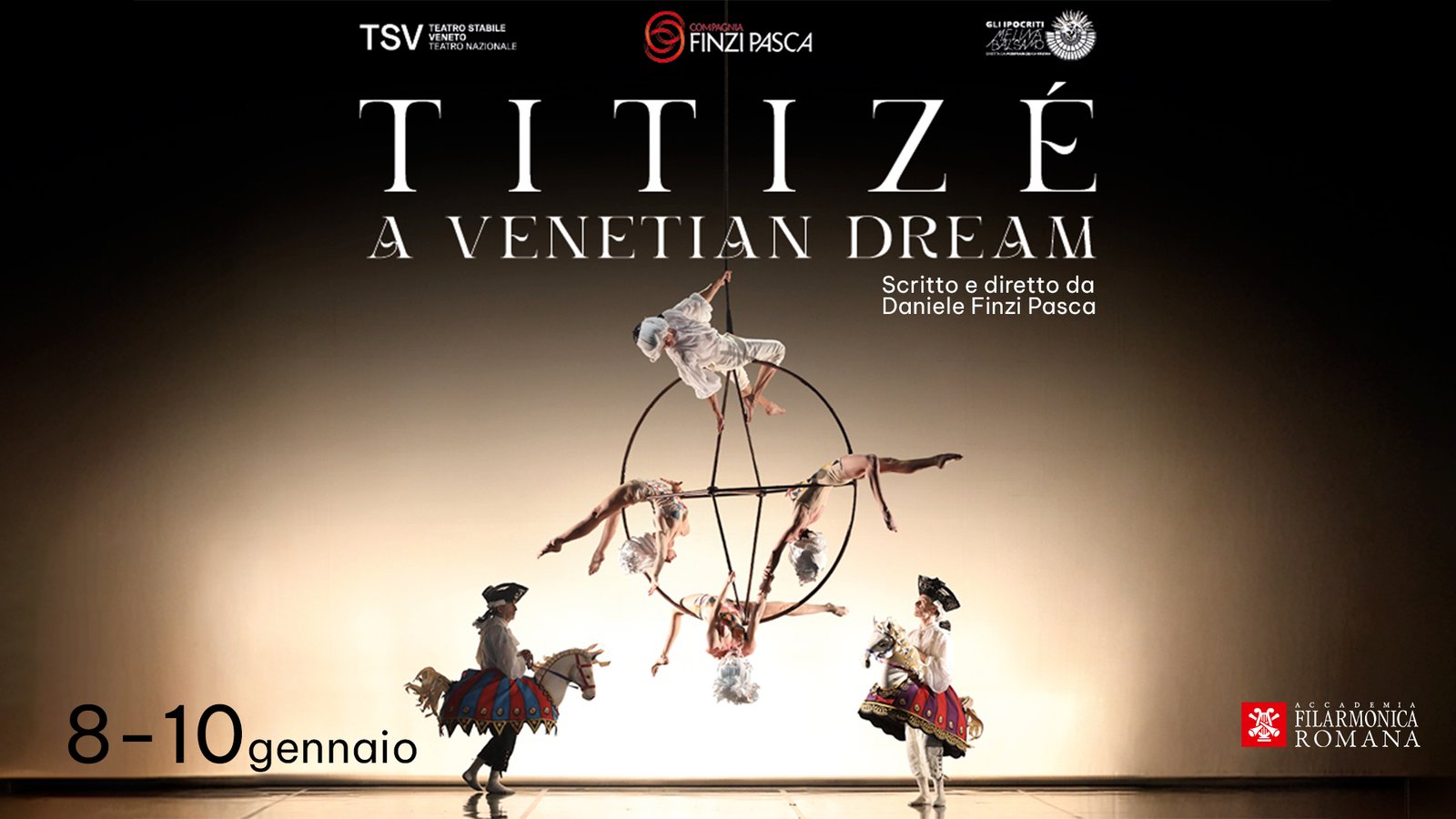
Titizé, A Venetian Dream, the show by Daniele Finzi Pasca, is on stage at Teatro Olimpico in Rome, at Piazza Gentile da Fabriano 17, from Friday, January 8 to Sunday, January 10, 2027, for four performances: Friday at 20:30, Saturday at 16:30 and 20:30, Sunday at 17:00. You get there by metro A to Flaminio and then tram 2 to the terminus at Piazza Mancini, from where you walk about 500 meters along Viale del Pinturicchio. Alternatively there is bus 910 from Termini to the Pannini stop, about 300 meters from the theater. The prices published by the theater range from 22 euros (side balcony with railing) to 42.70 euros (gold premium orchestra) plus the presale fee, with a reduced rate for children under 12 starting from 15.40 euros. Tickets are bought on the venue's official website, with an online fee of 1.50 euros per ticket, or at the theater's box office. The show lasts 80 minutes with no intermission and is recommended from age 6 up.
Language: opera sung in its original language; no English surtitles are announced, so check with the theater.
January at Flaminio, after the noise of the holidays, begins with a Venetian dream. Titizé is the creation with which Compagnia Finzi Pasca returned to the theater after years of big ceremonies and international circus: 10 performers among acrobatics, clowning, magic and stage machines, and a city, Venice, told without need of words. It arrives at Olimpico in collaboration with the Accademia Filarmonica Romana, that is, with the institution that has been this theater's soul for decades. Below you will find what you see, who signs it, how to choose the seat and the performance, and then the story of a hall born as a cinema in the 1930s and saved by a subscription of citizens.
Titizé: what kind of show it is
Titizé, A Venetian Dream is an acrobatic theater show co-produced by Compagnia Finzi Pasca and the Fondazione Teatro Stabile del Veneto, Teatro Nazionale, in partnership with Gli Ipocriti Melina Balsamo. It was born for the stage of Teatro Goldoni in Venice, where it debuted on July 18, 2024, and carries the title of official show of the City of Venice.
A journey between dream and reality
Teatro Olimpico presents it as a journey between dream and reality in which acrobatics, clowning, magic, music and stage machines give life to a theater of wonder. It is a promotional definition, but it describes the genre well: it is not circus in the sense of a ring and numbers in sequence, and it is not drama. It is theater made with bodies, light and objects, in which the story proceeds by images.
Venice without words
On stage, 10 artists lead the audience into Venice, among poetic images, lightness and astonishment. In notes written in February 2024, Finzi Pasca lists what there will be: reflections in the water, low clouds and blurs, the play of masks, the night with its madness, the clowns' buffoonery, levitating objects, acrobats in flight, a surreal rain, impossible balances, the characters of tradition multiplied, doubled and rebuilt. And, above all, the city with its atmospheres and its mysteries.
The Commedia dell'Arte as root
The director links the company's clowning to tradition and to echoes of the Commedia dell'Arte. It is the most interesting point for an Italian spectator: the Venetian masks are not here a tourist knickknack, they are the matrix of a stage language that the commedia performers exported all over Europe and that the Lugano company takes up with the tools of contemporary circus.
A show for every age
The theater defines it as visual and universal, able to speak to everyone through emotions. The length of 80 minutes with no intermission and the recommended age of 6 and up make it one of the most suitable offerings for families of the whole season. The verdict is clear: it is the right choice for taking a child to the theater for the first time without boring the adults.
Dates and times of Titizé at Teatro Olimpico
Titizé is at Teatro Olimpico for four performances in three days, from January 8 to 10, 2027. It is a short stay, and this changes the buying strategy.
Friday, January 8 at 20:30
The Roman opening is an evening performance, at 20:30. It falls right after Epiphany, when many families have just ended their holidays. The Friday-night audience tends to be more adult.
Saturday, January 9, two performances
On Saturday there are two shows, at 16:30 and 20:30. The afternoon one is the best suited to small children, who are home for dinner by the end. The evening one is the most requested by those coming from outside Rome.
Sunday, January 10 at 17:00
The last performance is Sunday at 17:00. You come out shortly after 18:20, and there is plenty of time to dine unhurried in the neighborhood or return to the city before evening.
Tickets and prices for Titizé
The prices of Titizé at Teatro Olimpico range from 22 to 42.70 euros plus the presale fee, with a dedicated rate for children under 12. The theater specifies that the presale fee is always required when the ticket is issued.
The sections and full prices
Gold premium orchestra 42.70 euros plus 6.30 presale fee. Side premium orchestra 38 euros plus 5.70. Orchestra and balcony 34 euros plus 5.10. Balcony with railing 31 euros plus 4.70. Side balcony 28 euros plus 4.20. Side balcony with railing 22 euros plus 3.30.
The under-12 rate
For children under 12 the prices drop: 29.90 euros plus 4.50 in gold premium orchestra, 26.60 plus 4 in side premium orchestra, 23.80 plus 3.60 in orchestra and balcony, 21.70 plus 3.30 in balcony with railing, 19.60 plus 2.90 in side balcony, 15:40 plus 2.30 in side balcony with railing. For a family of four the difference from the full price is significant.
Where to buy them
Tickets are bought on Teatro Olimpico's official website, with a fee of 1.50 euros per ticket, or at the box office on Piazza Gentile da Fabriano, which is the best way to choose your seat by talking to a person. With only four performances, the advice is to buy early, especially for Saturday.
Who Daniele Finzi Pasca is
Daniele Finzi Pasca is a Swiss director born in Lugano on January 10, 1964, author of two Cirque du Soleil shows, Corteo and Luzia, and of Olympic ceremonies seen around the world. Titizé debuts in Rome two days before his 63rd birthday.
Lugano, photography and gymnastics
His father's family worked in photography, with a studio inherited from his great-grandfather. Young Daniele began artistic gymnastics at six and from there came closer to the circus. Anyone who watches a company show recognizes both roots: the precision of the trained body and the almost obsessive attention to light, which Finzi Pasca personally signs in Titizé too.
Calcutta and Teatro Sunil
In 1983 he left for India as a volunteer and assisted terminally ill patients in Calcutta. Back in Switzerland, he founded with his brother Marco and Maria Bonzanigo the company Teatro Sunil, with which he developed a vision of clowning, dance and theater that he calls the Theater of the Caress. It is the key to all his later work: a theater that seeks tenderness before astonishment.
Icaro, the show for a single spectator
In 1991 he wrote and performed Icaro, a monologue designed for a single spectator, staged more than 800 times in six languages and still in the repertoire. For a director who now works for audiences of thousands, it is a starting point that says a lot.
The Sky Trilogy and the Cirque du Soleil
Between 2002 and 2007 he created the Sky Trilogy, with Nomade, Rain and Nebbia, in co-production with Cirque Éloize of Montréal. In 2005 he wrote and directed Corteo for the Cirque du Soleil, and in the same period directed the closing ceremony of the Turin 2006 Winter Olympics. In 2016 he returned to the Cirque du Soleil with Luzia.
Sochi, Montréal, Vevey
In 2014 he directed the closing ceremony of the Sochi Winter Olympics and the opening ceremony of the Paralympics. In 2017 he created Avudo, a multimedia event for Montréal's 375th anniversary, in the old port. In 2019 he directed the Fête des Vignerons in Vevey, an event inscribed by UNESCO on the intangible cultural heritage of humanity.
Opera
In recent years Finzi Pasca has worked a lot in opera: Einstein on the Beach at the Grand Théâtre de Genève in 2019, Offenbach's Les Contes d'Hoffmann in 2022, Astor Piazzolla's María de Buenos Aires again in Geneva in 2023, and in 2024 Zarqa Al Yamama, considered the first major opera in Arabic.
Prizes and drama
In 2012 he received the Hans Reinhart Ring from the Swiss Society for Theatre Studies. In 2020 the Swiss Society Fellowship Prize in New York. In 2021 the Marco Borradori prize. Among his dramatic works are Donka, a letter to Chekhov from 2010, La Verità from 2013, built around a backdrop by Salvador Dalí, and Azul from 2022 with Stefano Accorsi.
Compagnia Finzi Pasca and the Titizé team
Compagnia Finzi Pasca was founded in Lugano in 2011 by Daniele Finzi Pasca with Antonio Vergamini, Hugo Gargiulo, Julie Hamelin Finzi and Maria Bonzanigo. It is a group of artists who have worked together for decades, and in Titizé almost all of them are found again.
Maria Bonzanigo, music
Music, orchestrations and sound design are by Maria Bonzanigo, co-founder of Teatro Sunil and of the company. In the original version the music was performed by the Orchestra di Padova e del Veneto conducted by Pasquale Corrado, with the Città di Piazzola sul Brenta choir. Some pages come from the soundtrack of the film Oro verde by Mohammed Soudani.
Hugo Gargiulo, sets
Scenography and props are by Hugo Gargiulo, with Matteo Verlicchi as associate set designer. Gargiulo also signed, with Daniel Cyr, the acrobatic star, one of the apparatuses built for the show. Cyr made the Cyr wheel, the large wheel that carries his name, Jean Claude Blaser the flying system, Mariève Hémond the carré.
Giovanna Buzzi, costumes
The costumes are by Giovanna Buzzi, who gives body to the masks and characters of the Venetian tradition. In a show without words the costume is half the story, and it is worth looking at closely.
Antonio Vergamini and the others
The producer is Antonio Vergamini, also a co-founder. Melissa Vettore, actress and the director's wife, appears as authorial consultant. Viviana Cangialosi handles communication, photography and visual design, and the show's official photo is hers too.
The 10 artists on stage in Rome
Teatro Olimpico names on stage Gian Mattia Baldan, Andrea Cerrato, Francesco Lanciotti, Léa Kral, Luca Morrocchi, Gloria Ninamor, Caterina Pio, Rolando Tarquini, Micol Veglia and Leo Zappitelli: multidisciplinary performers, as the director calls them, who move from acrobatics to clowning in the same scene.
A curiosity about Titizé, A Venetian Dream at Teatro Olimpico in Rome, January 8 to 10, 2027
The first show written by Daniele Finzi Pasca that went around the world was designed for a single spectator at a time. Icaro, from 1991, is a monologue in which the actor performs for one person, chosen from the audience and brought on stage. He has repeated it more than 800 times, in six languages, and has never stopped.
In Rome the same author arrives with 10 performers, stage machines, flying systems and a theater of over 1,400 seats. The leap seems enormous, yet the logic is the same. The Theater of the Caress, as Finzi Pasca calls his idea of the stage since the days of Teatro Sunil, seeks an intimate relationship with those who watch even when the watchers are a crowd. The Olympic ceremonies of Turin and Sochi, seen by millions, were built on the same criterion: simple, recognizable images that reach each person as if designed for them.
There is also a curious calendar detail. Finzi Pasca was born on January 10, 1964, and the last Roman performance of Titizé is exactly Sunday, January 10, 2027. The director turns 63 on the day his Venetian dream closes its Olimpico stop. It is a coincidence, and like all coincidences it means nothing. But it is the kind of thing that makes a date easier to remember.
Teatro Olimpico: from the 1936 cinema to everyone's hall
Teatro Olimpico at Piazza Gentile da Fabriano has been active as Cine-Teatro Olimpico since 1936 and as Teatro Olimpico since 1981. It faces Lungotevere Flaminio, level with the Ponte della Musica, and is the home of most of the Accademia Filarmonica Romana's concerts, which collaborates on Titizé.
A 1930s block
The block was built in 1935 and 1936 by the firm Garbarino, Sciaccaluga e Mezzacane for the Società Generale Immobiliare, which had bought the area from the Banca Commerciale Italiana. These were the years of the new Flaminio and of the Foro Italico on the opposite bank, and Rome was growing northward along the Tiber.
Cinema and variety shows
Until the 1950s, war aside, the hall was above all a cinema, and during the intermissions variety artists performed. Hence its form: a large cinema hall equipped from the start with dressing rooms and theater services.
The Filarmonica and Adriana Panni
In the postwar period the Accademia Filarmonica Romana rented the theater for its season. Under the presidency of Adriana Panni it lived a period of great vitality, and until the end of the 1970s the hall alternated concerts and screenings. Then the owning company and the film body went bankrupt, and the Olimpico was put up for sale.
1980: a company of citizens
Panni promoted a subscription and brought together many citizens in the Teatro Olimpico spa, which in 1980 bought the property. She was its president until 1994. From 1981 the program opened to drama, dance, comedy and big international shows, alongside the Filarmonica's concerts.
What the hall of Teatro Olimpico is like
The hall of Teatro Olimpico has 1,410 seats, 966 in the stalls and 444 in the gallery, with the stalls laid out like an amphitheater. For an acrobatic show, in which much happens up high, it is a favorable layout.
The raked stalls
The stalls seats rise toward the back in rows at constant height: those behind see over the heads of those in front. In the premium orchestra and orchestra sections the view of the stage is full, even for a child.
The horseshoe gallery
The gallery, which at the box office corresponds to the balcony, is horseshoe-shaped with curved tiers. The central sections face the stage head on. The side ones see it at an angle, and for aerial apparatuses this can cut off part of the image.
The stage
The stage measures about 10 meters in depth by 12 in width, with a removable wooden floor and an orchestra pit. A space suited to stage machines, flights and acrobatic wheels like those of Titizé.
The building
The building is reinforced concrete, with a high travertine base and travertine frames around doors and windows. A recent restoration brought its late rationalist appearance back to light. Inside there are a rotunda foyer and wide corridors. The theater cites a judgment attributed to Orson Welles, according to which the Olimpico is the only place in Rome able to recall the atmosphere of Broadway.
Something nobody tells you about Titizé, A Venetian Dream at Teatro Olimpico in Rome, January 8 to 10, 2027
Titizé arrives at Olimpico in collaboration with the Accademia Filarmonica Romana, and in the theater's corridors are kept the sets that great 20th-century artists created for the Filarmonica itself. Nobody points it out to you, but the link between music, visual arts and image theater that Finzi Pasca brings on stage has a precise precedent in that hall.
There are the golden forms by Corrado Cagli for Stravinsky's Mass, performed at Olimpico from October 29 to 31, 1975. The backdrop that Giacomo Manzù painted for Stravinsky's Histoire du soldat, on stage from October 11 to 14, 1966. Mirko's sculpture for Chordination, from Niccolò Castiglioni's Tre misteri, in 1968. Alfred Silbermann's scenography for another Mass, in December 2001.
The Histoire du soldat, in particular, is a tale for music, words and movement designed for a small traveling company: a theater poor in means and rich in imagination, a close relative of what the Lugano company has practiced for 40 years. Arrive 20 minutes early and show the children Manzù's backdrop before going in. They will understand on their own that even a famous sculptor painted for the theater, and the show that follows will have a backstory.
Where to sit to see Titizé
For Titizé the best seats are in the central stalls and the central balcony, where the view of the aerial numbers is complete. In an acrobatic show distance matters less than in a comedy. The angle matters more.
Stalls: the choice for children
The premium orchestra and the orchestra let you see faces, costumes and the clowns' work up close. Thanks to the rake, even a small child seated in the central rows has a clear view.
Central balcony: the overall picture
The central balcony costs the same as the orchestra and offers a frontal view from above. It is the ideal position for appreciating the composition of the images, the lights and the stage machines. For an adult who wants to understand how the show is built it is the first choice.
Sides and railing
The side sections and those with a railing cost less but may cut off part of the aerial apparatuses. For a child, the railing in front of the eyes is a real obstacle: if the budget allows, avoid it.
The advice I give you for visiting Titizé, A Venetian Dream at Teatro Olimpico in Rome, January 8 to 10, 2027
The advice is to choose the afternoon performance on Saturday, January 9 at 16:30, buying seats in the central balcony or the orchestra and using the under-12 rate if you have children. It is the performance that brings together the right audience, the right time and the most reasonable price.
The reasons are practical. Titizé lasts 80 minutes with no intermission: at 16:30 you are out before 18:00, with the light of sunset still on the Lungotevere on the best January days. The children arrive rested, are not hungry midway through the show and are home for dinner. The adults have the evening free.
The second piece of advice concerns how to get there. On Saturday afternoon Flaminio is busy, and parking around Piazza Gentile da Fabriano is difficult on every show day. Metro A to Flaminio and tram 2 to Piazza Mancini are the calmest solution: the tram is part of the fun for a child, and the 500 meters on foot along Viale del Pinturicchio take five minutes.
Third piece of advice: prepare the children without telling them the show. Show them a photo of Venice, talk about Carnival masks, explain that there will be no dialogue to follow. Then let them watch. Finzi Pasca's theater works best when whoever watches does not know what is about to happen.
Another well-known fact, yet rarely mentioned
Teatro Olimpico does not belong to a public body. It belongs to a joint-stock company born in 1980 from a subscription of citizens promoted by Adriana Panni, then president of the Accademia Filarmonica Romana. Many people in Rome know it, but it is rarely remembered, and with Titizé the fact becomes relevant again, because the Filarmonica is a partner of the show.
At the end of the 1970s the theater risked disappearing. The owning company and the film body that ran it had gone bankrupt, the building was for sale, and a large neighborhood cinema could become something else. Panni raised capital among professionals, entrepreneurs, intellectuals and simple music lovers. The Teatro Olimpico spa was born, with a broad shareholder base, with the Academy also participating, which bought the building from the Società Generale Immobiliare and still owns it.
The consequence can be read in the program. A private hall that must support itself needs full houses, and since 1981 Olimpico has opened its doors to international dance, comedy, concerts, family shows, without ceasing to host the Filarmonica's music. Titizé, which brings together a historic musical institution and a visual theater company, is the perfect example of this formula. When you sit down, you are a guest of a hall saved by a group of citizens. It is not a detail.
How to get to Teatro Olimpico for Titizé
Teatro Olimpico is reached by metro A to Flaminio and then tram 2 to the terminus at Piazza Mancini, from where it is about 500 meters on foot. These are the directions given by the theater, and they hold from Termini too.
Metro A and tram 2
From Flaminio station, in Piazzale Flaminio, tram 2 takes you to the terminus at Piazza Mancini. From there you follow Viale del Pinturicchio to Piazza Gentile da Fabriano, in five minutes.
Buses
The lines the theater lists with a stop nearby are 220, 232, 233, 280, 301, 446, 48, 910 and 911, besides tram 2. Bus 910 leaves from Termini toward Piazza Mancini: get off at the Pannini stop, turn left onto Viale del Pinturicchio and walk about 300 meters. Buses 200, 201, 53 and the night bus n24 also reach Piazza Mancini.
Roma Viterbo railway
Those arriving by the Roma Nord line get off at Flaminio and continue with tram 2 to Piazza Mancini.
By car
From the center you follow Viale del Muro Torto toward Piazzale Flaminio, then Via Luisa di Savoia, Lungotevere Arnaldo da Brescia and Lungotevere delle Navi to Lungotevere Flaminio. From the north you follow Lungotevere Maresciallo Diaz to the Foro Italico, cross Ponte Duca d'Aosta and turn right. Parking, on show days, is the real problem: with children it is best to leave early.
The right photo to take at Titizé, A Venetian Dream at Teatro Olimpico in Rome, January 8 to 10, 2027
The right photo for those going to see Titizé is taken on the Ponte della Musica, opposite Piazza Gentile da Fabriano, with the Tiber below and the theater's facade in the background. It is the photo closest to water that you can take in Rome before a show dedicated to Venice.
The bridge links Flaminio to the Foro Italico, and in January, after 17:00, the light is already that of evening. From mid-bridge, turning toward Flaminio, you frame together the river, the lights of the Lungotevere and the rationalist facade of the theater with its travertine base. For those going to the Saturday afternoon show, the best moment is the exit, around 17:50, when the sky turns blue and the street lamps come on. Rome has no canals, but the reflection of the lights in the Tiber does its part.
The second photo is taken inside, before going into the hall: Manzù's backdrop or Cagli's golden forms in the foyer, with the children in front. It is a keepsake that has a story, and that no other show of the season will give you in the same way.
During the show, no phones. Titizé lives on light: Finzi Pasca personally signs the lighting design, and a lit screen in the stalls breaks the darkness on which every image is built. Viviana Cangialosi's official photo, published by the theater, tells the show better than any shot taken on the sly.
Some important events that took place here in history
On March 4, 1965 Pierre Boulez conducted at Teatro Olimpico a concert with the Italian premiere of Igor Stravinsky's Abraham and Isaac and the European premiere of his Elegy for J.F.K. It is the date that best tells the weight of the Accademia Filarmonica Romana, today a partner of Titizé, in the city's musical life.
In the following years Olimpico hosted stagings in which art and music met: Stravinsky's Histoire du soldat from October 11 to 14, 1966, with the backdrop by Giacomo Manzù. Niccolò Castiglioni's Tre misteri from October 2 to 4, 1968, with Mirko's sculpture. Stravinsky's Mass from October 29 to 31, 1975, with the forms by Corrado Cagli.
1980 is the turning-point year: the Teatro Olimpico spa was born and bought the building. From 1981 the hall changed name and vocation, and visual theater and dance entered the program for good. In April 1982 Moses Pendleton's Momix debuted at Olimpico with Dance Theatre, and would become regular guests. The Lindsay Kemp Company brought Sogno di una notte di mezza estate in February 1989 and Dream and the big parade in 1993.
In the 1990s came Mikhail Baryshnikov with the White Oak Dance Project, from October 10 to 15, 1995, and the Bolshoi Ballet, from September 23 to 26, 1996. In 2004 the Béjart Ballet Lausanne. It is in this line of theater made of bodies and images, more than in that of drama, that Titizé finds its natural place.
Who has passed through Titizé, A Venetian Dream at Teatro Olimpico in Rome, January 8 to 10, 2027
Through the stage of Teatro Olimpico have passed Mikhail Baryshnikov, Maurice Béjart, Lindsay Kemp, Antonio Gades, Joaquín Cortés, the Bolshoi and the Momix, and for music Arturo Benedetti Michelangeli, Jessye Norman, Zubin Mehta and Pierre Boulez. This is the company into which Finzi Pasca's acrobatic theater fits.
For the music tied to the Accademia Filarmonica Romana the theater's memory also keeps Giuseppe Sinopoli and Luigi Dallapiccola. For song, Marillion in February 1988, Lucio Dalla with Henna from April 5 to 7, 1994, the Pooh with Musica dentro in October 1994, Giorgio Gaber with Un'idiozia conquistata a fatica on January 28, 1998. Among the protagonists of its history the theater also remembers Dario Fo and Nicola Piovani.
Comedy brought here Gigi Proietti with A me gli occhi in May 1996, and then Enrico Brignano, Vincenzo Salemme, Aldo, Giovanni e Giacomo, Lillo e Greg, Max Giusti, Maurizio Battista.
The thread tying Titizé to this history is that of dance and image theater. Lindsay Kemp and the Momix, with shows made of bodies, objects and images, have accustomed Olimpico's audience to shows in which words are not needed. Finzi Pasca, who comes from circus and clowning, speaks the same language with a different accent: more poetic, more tied to the Italian tradition of masks. In January he adds his name to a list that welcomes him well.
Flaminio around Teatro Olimpico
Teatro Olimpico is in the Flaminio district, north of Piazza del Popolo, in an area that in the last 20 years has become one of Rome's cultural hubs. The theater itself cites Auditorium Parco della Musica, the MAXXI and the Ponte della Musica as the places that changed the district.
The Ponte della Musica and the Foro Italico
The Ponte della Musica leads to the other bank, where the Foro Italico opens, built in the same years as the theater. With an hour to spare you can take a walk among the sports architecture of the 1930s.
Auditorium and MAXXI
Toward the interior of the district are the Auditorium Parco della Musica and the MAXXI. An exhibition in the morning and Titizé in the afternoon make a full day for a family arriving from out of town.
Milvian Bridge
Going up the Tiber to the north you reach Milvian Bridge, with its square full of venues: the natural destination for those leaving the evening performance who want to stay out late.
Toward Villa Borghese
Along Via Flaminia, toward the center, you meet the National Etruscan Museum of Villa Giulia, on the edge of Villa Borghese, and then Piazza del Popolo, where tram 2 starts.
Where to eat before or after Titizé
Around Teatro Olimpico, between Piazza Mancini, Via Flaminia and Piazza Gentile da Fabriano, there are pizzerias, trattorias and bars frequented by the audience of the theater and the Auditorium. It is a neighborhood offering, with no tourist pretensions, that works well with children.
Before the afternoon show
For the 16:30 and 17:00 performances a normal lunch and an afternoon snack at a bar before going in are enough. 80 minutes with no intermission are manageable even at six, but on a full stomach.
After the evening show
After the 20:30 performances you come out around 21:50. For a post-theater dinner, Ponte Milvio, a few minutes by taxi, has venues open late. With children, better a pizza near the theater before the show.
With a group
For a party it is best to choose Sunday at 17:00 and book the table for 19:00. The district is residential, and on show nights the closest venues all fill up in the same half hour.
Titizé with children
Titizé is recommended from age 6, lasts 80 minutes with no intermission and has a dedicated rate for children under 12. Of the whole Olimpico season, it is one of the shows best suited to a first time at the theater.
Why it works
There is no dialogue to follow: the story passes through images, acrobatics, gags, music. A six-year-old does not have to understand a plot, they have to watch. And clowning, the oldest language of theater for young audiences, is the root of the whole company.
Under six
The theater recommends the show from age 6. With a younger child the risk is the prolonged darkness and the length with no break. If you bring them anyway, choose a seat near the exit and the afternoon performance.
For older kids
For a middle schooler Titizé is a good way to discover that contemporary circus and theater are close relatives, and to hear the Commedia dell'Arte named outside the school textbook. Tell them beforehand that the director signed two Cirque du Soleil shows: that is usually enough.
Accessibility at Teatro Olimpico
Those with reduced mobility who want to see Titizé at Teatro Olimpico should contact the box office before buying, at biglietti@teatroolimpico.it. It is the surest way to learn about suitable seats and access arrangements.
The stalls are laid out like an amphitheater, on a slope, and the gallery is on the upper floor: these are elements to consider in choosing the section. With a stroller or a wheelchair, the box office can indicate the most convenient access. A phone call or an email settles in a few minutes doubts that online remain unanswered.
January in Rome: after the holidays, the theater
Titizé falls on the second weekend of January, right after Epiphany, when Rome returns to normal rhythms. It is one of the best periods to visit the city: museums empty out, the days are cold but often clear, and hotel prices drop after the holiday peak.
For families it is also the last weekend before school resumes its full rhythm. A show like Titizé, which speaks of Venice and Carnival, anticipates by a few weeks the season of masks. In January, at Flaminio, evening comes early: bring a real coat, because the Lungotevere is windy, and count on leaving in the dark even from the Sunday afternoon performance.
Teatro Olimpico's 2027 season after Titizé
The 2026/2027 season of Teatro Olimpico counts over 50 shows, with 16 titles on subscription, and 2027 opens with a group of visual theater and dance offerings. Titizé is the front door.
Other shows without words
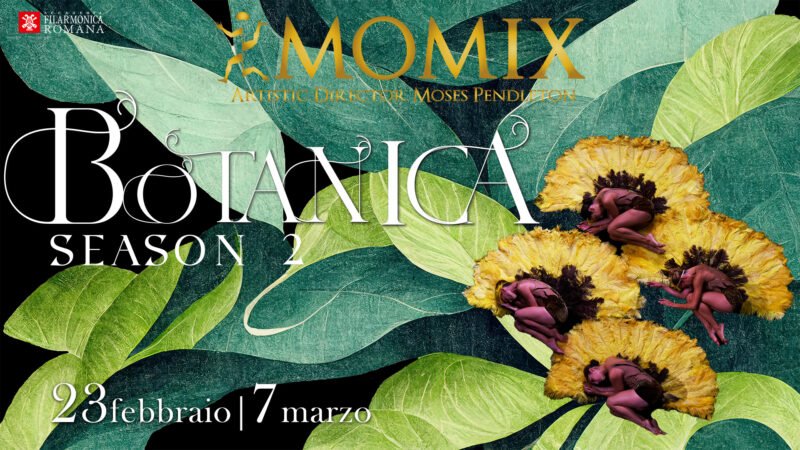
In the new year come Slava's Snowshow and the Momix with Botanica, longtime guests of the hall. Those who love Titizé have two good reasons to come back.
Comedy and storytelling
Among the other titles of 2027 are Angelo Pintus, Riccardo Rossi with Non ho l'età!, Federico Buffa with the story of Michael Jordan, Lillo e Greg with MOVIe ERCULeO and Angelo Duro. Before Titizé, on New Year's Eve, there is Maurizio Battista's special, who in November also brings to Olimpico Se non vinco... imparo.
Frequently asked questions about Titizé in Rome
When is Titizé at Teatro Olimpico in Rome?
Titizé, A Venetian Dream is at Teatro Olimpico in Rome from Friday, January 8 to Sunday, January 10, 2027, for four performances: Friday at 20:30, Saturday at 16:30 and 20:30, Sunday at 17:00. The theater is at Piazza Gentile da Fabriano 17, in the Flaminio district.
How much do Titizé tickets cost?
Titizé tickets at Teatro Olimpico range from 22 euros in the side balcony with railing to 42.70 euros in the gold premium orchestra, plus the presale fee. For children under 12 there is a reduced rate from 15:40 to 29.90 euros plus presale. The online fee is 1.50 euros.
How long is Titizé?
Titizé lasts 80 minutes with no intermission, according to Teatro Olimpico's information. The Saturday afternoon show, at 16:30, therefore ends shortly before 18:00, the Sunday performance at 17:00 around 18:20, the 20:30 evening ones around 21:50.
Is Titizé suitable for children?
Yes, Titizé is recommended from age 6 up and is built without dialogue, with acrobatics, clowning, magic and music. Teatro Olimpico provides reduced prices for children under 12, and the Saturday afternoon performance is the most convenient for families.
Who created Titizé?
Titizé is written, directed and lit by Daniele Finzi Pasca, a Swiss director, author of Corteo and Luzia for the Cirque du Soleil and of the Olympic ceremonies of Turin 2006 and Sochi 2014. Music by Maria Bonzanigo, sets by Hugo Gargiulo, costumes by Giovanna Buzzi.
How do you get to Teatro Olimpico by public transport?
Teatro Olimpico is reached by metro A to Flaminio and then tram 2 to Piazza Mancini, from where it is about 500 meters on foot along Viale del Pinturicchio. Alternatively, bus 910 from Termini stops at the Pannini stop, about 300 meters away.
Is there speaking in Titizé? Do you need to understand Italian?
Titizé is a visual show, built on acrobatics, clowning, music and stage machines. The theater defines it as universal, able to speak to everyone through emotions. For this reason it is suitable for foreign visitors too and for children who would not follow a spoken plot.
The advice is simple: if in Rome in January you have only one afternoon to devote to the theater with children, devote it to Titizé, Saturday at 16:30, in the central balcony. Arrive by tram, look at Manzù's backdrop in the foyer, and on the way out stop on the Ponte della Musica to see the lights in the Tiber. It is the Roman version of a Venetian dream, and it costs less than a ticket to Venice.
Article written by the editorial team of Tour Leader Pro, contact them for Private/Corporate/V.I.P. Tours and Experiences.
Planning a trip to Rome? The English-language guides to visiting the city are on ItalyPlanner.com.
Contact Information
Nearby
 Teatro Olimpico100 m
- Ponte della Musica – Armando Trovajoli200 m
- Flaminio400 m
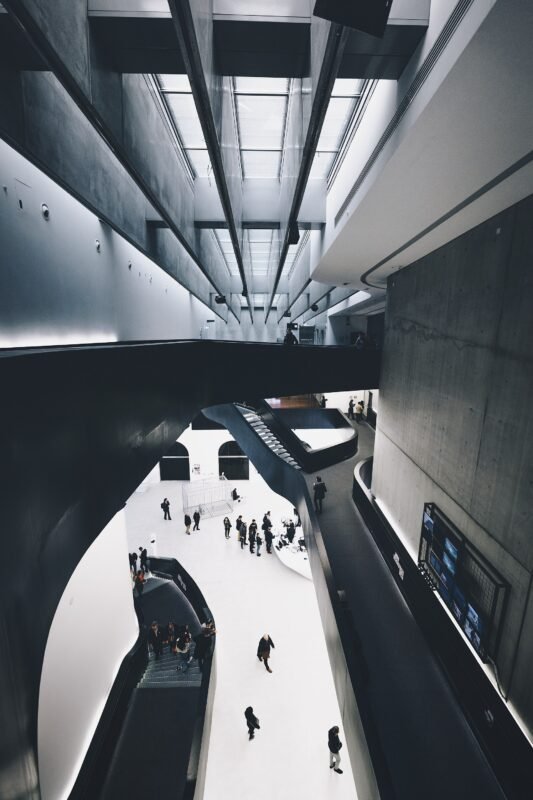
- MAXXI – National Museum of 21st Century Arts500 m
- Alberto Moravia House Museum700 m
- Villa Mazzanti700 m

Upcoming events nearby
- Maurizio Battista at Teatro Olimpico, Se non vinco… imparo, November 4 to 29, 2026100 m
- Angelo Pintus at Teatro Olimpico, Loro non sanno niente, January 14 to February 14, 2027100 m
- Slava’s SnowShow at Teatro Olimpico, January 27 to February 7, 2027100 m
- MOMIX Botanica at Teatro Olimpico, February 23 to March 7, 2027100 m



You might also like
- Belle e la Bestia, the Musical at Teatro Olimpico, December 26, 27 and 28, 2026
- La rivolta della gioia with Silvia Gallerano at the Auditorium Parco della Musica, December 18 to 20, 2026
- The Nutcracker by Balletto di Roma at the Teatro Olimpico, December 17 to 20, 2026
- Ghemon in La prima volta, l’ultima volta, l’unica volta at Auditorium Parco della Musica, April 19, 2027
- Alessandro Bergonzoni Arrivano i Dunque at Teatro Olimpico, February 20 and 21, 2027
- Back To Hawkins at Teatro Olimpico, February 17, 2027