I Colori dell’Antico. Marmi Santarelli at the Capitoline Museums, April 13, 2022 to April 30, 2032
In short. Marmi Santarelli is not one of those exhibitions that last three months and vanish: it is an installation set up inside a museum to stay there for a whole decade, until it becomes part of the museum itself.
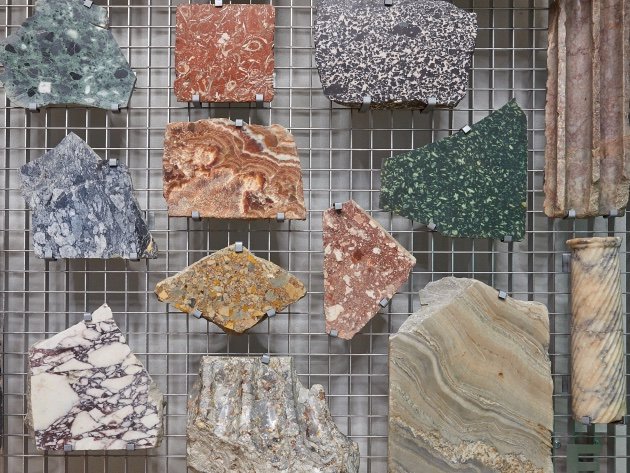
Marmi Santarelli is not one of those exhibitions that last three months and vanish: it is an installation set up inside a museum to stay there for a whole decade, until it becomes part of the museum itself. I Colori dell’Antico. Marmi Santarelli at the Capitoline Museums opened on April 13, 2022 and will stay open until April 30, 2032, which makes it one of the longest-running exhibitions in Rome. 10 years of being open means there’s no rush, no race to the last day, no line to book three weeks ahead. But it also means something else, less obvious: almost nobody sees it. Because when something is always available, we all tend to put it off.
The exhibition is spread across the rooms of Palazzo Clementino at the Capitoline Museums and presents a splendid selection of hundreds of polychrome marbles from the imperial age from the Capitoline collection and from the Dino and Ernesta Santarelli Foundation. They are two rooms, right beside the Medagliere, in a part of the Capitoline complex that a great many visitors rush through or ignore altogether, caught up in the schedule that takes them to the Capitoline Wolf, Marcus Aurelius and the Caravaggio in the Pinacoteca. Still, if I had to name a single section of the Capitoline Museums that can change forever the way you look at Roman architecture, I’d name these very two rooms full of colored stones.
The reason is simple and radical at once. We carry in our heads an idea of ancient Rome that is white: white columns, white statues, white temples. It’s an image built over the centuries, fed by Neoclassicism, reinforced by the plaster of nineteenth-century casts and the washed marble of black-and-white movies. The archaeological reality is the exact opposite. Imperial Rome was a city saturated with color, a catalog of yellow, red, green, violet and black stones veined with white, coming from half the known world. The marbles on display at Palazzo Clementino serve precisely this purpose: to give back the color intensity of a civilization that loved color and imported it at enormous cost from the four corners of the empire.
The installation came about thanks to a free 10-year loan for use agreed between the Santarelli Foundation and the Capitoline Superintendency: an arrangement that explains the unusual length of the exhibition and lets the public see together materials that would otherwise stay split between a private collection and the city storerooms. It is promoted by Roma Culture, Capitoline Superintendency for Cultural Heritage together with the Santarelli Foundation, curated by Vittoria Bonifati with scientific curatorship by Andrea G. De Marchi. The design of the installation is signed by the Cookies studio, made up of Alice Grégoire, Clément Périssé and Federico Martelli. Museum services are by Zètema Progetto Cultura and the catalog is published by Treccani, a volume of about 220 pages in Italian and English.
What you actually see in the two rooms of Palazzo Clementino
It’s worth being precise, because the wrong expectation ruins the visit. Anyone who walks in expecting whole statues, monumental sarcophagi and standing columns is thrown off. What you see is different and more interesting: a material archive, a collection of samples, a sort of enormous three-dimensional palette.

In the first room there are 82 polychrome fragments from the Santarelli Foundation. They are pieces of columns, slabs, fragments of basins, fountain feet, architectural elements: splinters of lost buildings, each one chosen to represent a specific stone quality. Their arrangement is not random, and here comes the smartest idea of the whole installation: the marbles are placed following the cardinal directions they came to Rome from. The great roads of the empire started from the center of the ancient city and radiated out toward the provinces, and the exhibition rebuilds that radiating pattern. You turn toward one wall and you’re looking at North Africa, you turn the other way and you’re looking at Asia Minor. The room works like a map made of stone.
In the second room the tone changes completely. Here there are two sample collections, that is, two systematic sets of small classified samples, of the kind that collectors and scholars put together between the eighteenth and nineteenth centuries. One belongs to the Santarelli Foundation and dates to the early nineteenth century: it includes 422 pieces. The other belongs to the Capitoline collection, was started in the second half of the nineteenth century by the Gui family and is made up of 288 tiles. The official presentations speak of “more than 660” marbles; the counts for the individual rooms, added up, give a higher total, so take the figure as an order of magnitude.
Also in the second room there is a piece that alone justifies the visit: a head of Dionysus mounted on an unrelated female bust, made up of eight different types of marble. It’s an object that tells two stories at once. The first is ancient and concerns the technique of assembled marble, which made it possible to get color effects impossible with a single block. The second is modern and concerns collecting: heads and busts were put back together, completed, joined with foreign parts to create objects that could be presented on the antiquarian market. Looking at that head means looking at the Roman workshop and the eighteenth- and nineteenth-century restoration shop at the same time.
A selection of marble-working tools from the Fiorentini workshop completes the picture. They are tools that look like they came out of a workshop of yesterday and instead belong to an unbroken technical tradition: pointed chisels, toothed chisels, flat chisels, points, shapes that in essence haven’t changed since the imperial building sites. Putting them next to the ancient fragments is a precise curatorial choice, because it shifts the attention from the result to the process, from the finished marble to the human work that produced it.
Finally, a documentary by Adriano Aymonino and Silvia Davoli plays on a loop, tracing the history of these materials in relation to the empire’s expansion policy. I recommend watching it before walking among the display cases, not after: it changes the way you read the fragments.
A curiosity about I Colori dell’Antico. Marmi Santarelli at the Capitoline Museums, April 13, 2022 to April 30, 2032
The curiosity I like best concerns the color you couldn’t afford. Red porphyry, that extremely hard stone of a violet red with white dots that you see in imperial sarcophagi and in the great basins, came from a single place in the world: the Mons Porphyrites, in the eastern desert of Egypt, between the Nile and the Red Sea. A single deposit, lost in the middle of nowhere, about 100 kilometers from the coast, reachable only along desert tracks guarded by water supply stations.
Ancient sources place the discovery of those quarries in the Tiberian age, at the beginning of the first century AD, and from that moment porphyry becomes a strictly imperial matter. It’s not a question of taste: it’s a question of monopoly. The quarry belongs to the emperor, extraction is run by the imperial administration, the material is distributed by political decision. In the following centuries red porphyry would become, to all effects, the color of power, so much so that in Byzantium the word porphyrogenitus was born, literally born in the purple, to indicate the children born to the reigning emperor in a palace room lined with that very stone.
Now keep the technical detail in mind: porphyry is one of the hardest stones that can be worked. You don’t cut it with a saw, or rather, you cut it at the cost of enormous effort and with abrasives. The ancients shaped it mostly by abrasion and percussion, spending a quantity of time and labor that today we struggle to imagine. When people tried to take up that craft again in the Renaissance, the technical problem seemed so difficult that it gave rise to a small legend, according to which the secret of the ancients had been lost along with a special temper of the tools. In reality the secret was much less romantic: it consisted of tens of thousands of hours of work paid for by an empire that could afford them.
On display, Egyptian red porphyry is present with a fragment of a basin. It’s a piece that looks modest, a scrap, and yet in front of you is the remnant of a logistics chain that started from a mountain in the Egyptian Arabian desert, came down along a track to the Nile, went up or down the river, reached Alexandria, crossed the Mediterranean on ships equipped for stone cargo and went up the Tiber to the Roman landing docks. All of this to get one red.
The geography of the empire written in stone
The conceptual heart of the exhibition is this: every colored marble is an address. Not a generic color, but a precise deposit, often unique, almost always very far away. Learning to recognize them means acquiring a skill that then goes with you all over Rome and all over Italy, because those materials are everywhere, reused in churches, floors, altars, Baroque chapels. I’ll try to line up the main ones, with the geography they carry with them.
Giallo antico, from Numidia
Giallo antico, which the ancients called marmor Numidicum, comes from the quarries of Simitthus, present-day Chemtou, in the northwest of today’s Tunisia, in a hilly area not far from the Algerian border. It’s a marbled limestone that runs from deep straw yellow to rich orange, often crossed by red veins and brecciated zones. The brightest and most mottled variety is called giallo antico focato, and it is with a fragment of a fluted column in giallo antico focato from Tunisia that the exhibition presents this quality.
Giallo antico has a fascinating political history. It enters Rome in the late Republican age, when Numidia is still an allied or rival kingdom, and its private use is denounced by moralists as a sign of unrestrained luxury. Then the quarries pass under imperial control and the yellow becomes one of the standard materials of public architecture, used like carpets in opus sectile floors, in columns, in wall cladding. If you walk into any Roman basilica and see large yellow fields cut into diamonds or squares, you’re most likely looking at Numidian stone that arrived here 2,000 years ago and was reused afterward.
Pavonazzetto, from Phrygia
Pavonazzetto, marmor Phrygium or Docimenum in the ancient sources, comes from Docimium, today Iscehisar, on the central Anatolian plateau. It’s white with patches and veins ranging from violet to wine red, and the Italian name comes from the comparison with a peacock’s tail. Together with giallo antico, pavonazzetto is the colored marble whose introduction in Rome historiography already places in the Republican age, while its real spread is tied to the age of Augustus.
Pavonazzetto has a precise function in imperial iconography: it’s the stone of the barbarians. The statues of Dacian prisoners, the so-called barbarians in pavonazzetto, used the violet veining to suggest sumptuous clothes and at the same time an exotic otherness compared with the whiteness reserved for the gods and for Romans. It’s a use of color that today we would call narrative, and it shows how far the choice of material was from merely decorative.
Cipollino, from Euboea
Green cipollino, marmor Carystium, comes from Karystos, on the Greek island of Euboea. It’s a white marble crossed by thin wavy green layers, which in cross section recall the overlapping leaves of an onion, hence the name. It’s perhaps the most immediately recognizable quality: those green bands that ripple, fold and draw waves are unmistakable.
Cipollino was imported in industrial quantities. Cipollino columns number in the hundreds in Roman monuments, and the reason is logistical before it is aesthetic: the Euboean quarries are relatively close to the sea, which cut the heaviest cost item of the whole chain, that is, overland transport. A monolithic column 10 meters long weighs tens of tons, and moving it over land required sledges, winches, oxen, reinforced roads. Moving it by sea cost a fraction.
Africano, from Teos
Africano, which despite its modern name doesn’t come from Africa at all, is the marmor Luculleum of the sources, quarried near Teos, on the coast of Asia Minor, not far from present-day Izmir. It’s a spectacular breccia: angular fragments of black, green, red and white set in a dark paste, an effect of petrified chaos. On display it is present with a column fragment from Turkey.
The ancient name points to Lucius Licinius Lucullus, the general and gourmet who in Roman tradition stands for the introduction of eastern luxury to Rome. Ancient tradition credits him, or blames him, with being the first to bring this stone to the city. Be the attribution historically accurate or legendary, the fact remains that the Roman imagination tied colored marbles inseparably to the idea of imported wealth, of corrupted customs, of yielding to Asian softness. Pliny the Elder, in the 36th book of his natural encyclopedia, devotes memorable pages to this polemic, listing with indignation the names of those who first lined their private homes with marble.
Troad granite and Egyptian granites
Granites deserve a separate discussion because they are not marbles in the geological sense, but in Roman practice they were treated as equivalent prized stone materials. Troad granite, quarried in the northwestern Anatolian region around ancient Troy, has a light gray or pinkish background dotted with dark, and is one of the most widespread materials for medium-sized Roman columns. If you walk around Rome and see slightly pinkish gray columns, in a church or a portico, most likely they come from there.
From Egypt, on the other hand, came the gray granite of Mons Claudianus, also quarried in the eastern desert, and the pink granite of Aswan, with its pinkish and black crystals. The monolithic columns of the Pantheon’s porch belong to this family of Egyptian materials, and looking at them after seeing the samples at Palazzo Clementino is an exercise I warmly recommend: suddenly those columns stop being anonymous architectural elements and become objects with an origin, a quarry, a story of transport.
Verde antico, serpentino, alabasters and the rest of the palette
Verde antico, marmor Thessalicum, comes from Greek Thessaly and is a dark green breccia with light fragments, a stone with an almost lush look, much loved in the late empire and then rediscovered with enthusiasm by the Roman Baroque. On display it appears with a fragmentary slab from Greece.
Serpentino, the green porphyry of modern sources, also comes from Greece, from the southern Peloponnese, and is a very dark green with light blade-shaped crystals. The exhibition documentation explicitly notes that the use of some colored marbles, including the hard green serpentino, dates back to periods before the classical world, to the Neolithic or the late Bronze Age: it means that some of these stones were already recognized as precious thousands of years before Rome existed. On display there is a fragment of a twisted small column in serpentino focato from Greece.
Alabasters are a chapter of their own. Translucent, warm, crossed by concentric circles and bands, they were worked into thin slabs also to let light through. Among the pieces on display are fragmentary slabs of alabastro a pecorella from Algeria and a slab of alabastro a pecorella minuto, also Algerian. They are materials of sedimentary origin, deposited by water, and precisely for this reason they tell a geology completely different from that of volcanic granites and metamorphic marbles.
The selection then includes qualities that widen the map further: Aleppo breccia, from Greece, present with a fragment of a fountain foot, bigio antico brecciato, Greek, with a fragmentary slab, a notable fragment of a strigilated labrum, that is, a large basin with a surface of curved fluting, in Greek bigio antico or in Tunisian nero antico, a slab of white and black of Aquitaine, which takes us to France, and even a fragment from a block of Indian astracan, which stretches the geographic field to the subcontinent.
This variety is the point. No single quarry, no single province could have supplied such a repertoire. It took a political system spread over three continents, a fleet, a road network, a bureaucracy able to manage warehouses, accounting and shipments. Colored marbles are, literally, the empire made visible.
Something nobody tells you about I Colori dell’Antico. Marmi Santarelli at the Capitoline Museums, April 13, 2022 to April 30, 2032
What nobody tells you is that this exhibition, beneath the decorative surface, tells of a gigantic operation of economic policy, and that the interpretation of that operation is still open today.
The exhibition’s presentation text is surprisingly honest on this point, much more than is usual in a museum panel. It says that extraction, working and transport required a great many workers, who had to be well trained and disciplined. It says that the overall costs were comparable to those of military campaigns. And then it adds a sentence you rarely read in a museum: the reason for all this is not entirely clear.
The hypotheses on the table are at least three and the exhibition lines them up without choosing. The first is the most obvious: desire for luxury, ostentation, a contest of magnificence among emperors. The second is fiscal: the imperial quarries produced revenue and the marble trade generated duties, contracts, movement of capital. The third is the one I find most fascinating: symbolic representation of imperial extension. Lining Rome with stones from Numidia, Phrygia, Egypt, Greece, Anatolia and Gaul means building a political discourse in which the capital physically contains the world it dominates. You walk in the Forum and you walk on a world map.
There is then a fourth hypothesis, suggested by the official text in an almost sideways way and extremely interesting: it is possible that Augustus and his successors deliberately wanted to finance these activities also to encourage ethnic and social blending within the enormous extent of the empire, involving the conquered peoples economically. Translated: the quarries as an instrument of integration. Giving structured, continuous and skilled work to peripheral communities was a way of tying them to the center. If this reading has a basis, the stones in the display cases are also the trace of a labor policy, not just of a policy of taste.
The second thing nobody tells you is chronological. The exhibition documentation lays out a precise sequence that is worth remembering, because it dismantles the idea of a Rome always identical to itself. In Egypt the pharaonic dynasties exploited different stone qualities, and the last of them, the Ptolemies, between 305 and 30 BC, widened the repertoire with porphyries and alabasters that would later be appreciated in Rome. In Rome, instead, the rejection of luxury prevailed for a long time, with a declared preference for ideas and materials drawn from tradition. The introduction of giallo antico and pavonazzetto goes back to the Republican age, their spread is to be linked to Augustus, while the greatest assortment of colored marbles is recorded under the Flavians, between AD 69 and 96. With the Antonines, finally, many quarries became imperial and the number of those outside Italy grew in particular.
Put another way, it took about two and a half centuries for Rome to go from considering colored marble a moral disgrace to considering it its own official architectural signature. It wasn’t a matter of taste: it was a change in collective mentality, accompanied step by step by the building of a state apparatus able to support it.
The marble trade, or how a column was moved
To fully appreciate what you see at Palazzo Clementino, you need to imagine the machine behind it. I’ll try to rebuild it in broad strokes, because it’s one of the most impressive logistical undertakings of antiquity and it’s talked about very little.
It all starts at the quarry. The imperial quarries were real settlements, with lodgings, kilns, cisterns, small forts, tool workshops, and in extreme cases like the eastern Egyptian desert also ramps and tracks built specially. The workforce included skilled technicians, quarrymen, stonecutters, cart drivers, administrative staff and, in some situations, forced labor. The block was detached with wedges set in grooves cut into the rock, then roughed out on the spot to reduce the weight to be carried: nobody moved useless material for hundreds of kilometers.
Blocks were marked with incised marks that recorded the year, the quarry, the crew, the responsible official, sometimes the order number. They are technical inscriptions, short, apparently insignificant, and yet they make up one of the most precious documentary corpora we have on the organization of ancient labor. From those marks scholars have rebuilt chronologies of quarrying activity, names of procurators, production cycles.
Then came transport. On land, sledges and carts pulled by dozens of animals, on roads prepared or reinforced for the occasion. By water, river boats and then specialized cargo ships, the so-called stone-carrying ships, designed to bear concentrated weights that would have stove in an ordinary hull. The wrecks of ships sunk with their cargo of columns and sarcophagi, found in several points of the Mediterranean, still give us today the picture of these voyages.
On arrival in Rome the materials were unloaded at the landing docks on the Tiber, in the area downstream of the Aventine where the great river warehouses stood, and stored in stone depots that must have been enormous. The Marmorata district, in the sector between the river and Testaccio, still carries in its name the memory of that function. From there the marble went to the workshops, where it was sawn into slabs, shaped into architectural elements or worked into sculptures.
This means that in Rome there was an imperial warehouse of prized stones, with stock that could sit for decades before being used. Some blocks bear extraction dates well before the construction of the buildings in which they were finally used. It means the State produced marble regardless of immediate demand: it kept the quarries active, built up reserves, and then distributed. An industrial policy, in every respect.
My advice for visiting I Colori dell’Antico. Marmi Santarelli at the Capitoline Museums, April 13, 2022 to April 30, 2032
The advice is counterintuitive: don’t visit it first, and above all don’t visit it as the last stop of a museum marathon.
The Capitoline Museums are vast and dense. If you reach Palazzo Clementino after two and a half hours of Palazzo dei Conservatori, Palazzo Nuovo, the Tabularium and the Pinacoteca, your brain is saturated and two rooms of stone fragments will seem to you, at best, a sequence of pretty colored stones. You need clarity to appreciate this exhibition, because its content is not emotional but cognitive: it asks for attention, comparison, reasoning.
The strategy that works best, for very different people, is this. Enter the museum as soon as it opens, at 09:30. Go straight to Palazzo Clementino, before anything else, when the rooms are still empty and your concentration is intact. Watch the whole documentary. Then spend 20 or 25 minutes on the fragments and the sample collections, without hurrying, trying to memorize at least five or six qualities: giallo antico, pavonazzetto, cipollino, africano, red porphyry, verde antico. They are the six names that change the city for you.
After that, do the rest of the museum. And here the magic happens: as you cross the rooms, you’ll start recognizing those materials everywhere. In statue bases, in the tops of ancient tables, in wall cladding, in the architectural fragments on display, in the floors. The museum, which before was a collection of works, becomes a catalog of materials. It’s a perceptual leap, and once you’ve made it you don’t go back.
Second piece of advice, a practical one: bring a decent light source, even just your phone’s flashlight used discreetly and without pointing it at the display cases in a way that bothers others. Many of these marbles change appearance radically depending on the angle at which the light hits them, and translucent alabasters in particular reveal internal structures that disappear completely in diffused light. Check the room rules first, of course, and follow the staff’s instructions.
Third piece of advice, the one about afterward. After seeing the exhibition, step out onto Capitoline Cordonata, walk down and go look at any Roman church from the seventeenth century. Roman Baroque is, among other things, a gigantic conscious reuse of ancient marbles, recovered from the ruins and set back into place in altars, chapels, floors. With the six names you’ve learned, you’ll start reading those surfaces like a text.
Fourth and last piece of advice: come back. The 10-year length of the installation is a gift that almost nobody takes advantage of. A second visit, months later, with a bit of reading in between, is worth infinitely more than the first. Few exhibitions in Rome allow this luxury.
Another well-known fact, yet rarely cited
The well-known fact is that ancient statues were painted. By now many people know it, it’s been talked about for years, color reconstructions of Greek and Roman sculptures have circulated and sparked quite a debate. What is almost never said is that sculptural polychromy was only a part, and not even the largest, of a much broader phenomenon.
The real ancient polychromy was architectural. It wasn’t only statues that were colored: it was floors, walls, columns, entablatures, thresholds, basins, tabletops. A luxury Roman interior was an environment in which every surface had its own color, and that color was obtained with stone, not with paint. The exhibition text also recalls that the hues were brightened with polishing, fats or waxes, and that they had to be coordinated with paintings and decorations that today are almost entirely lost.
This last observation is decisive and deserves to be repeated. When we look at an ancient opus sectile floor kept in a museum, we see an isolated fragment of a system that also included frescoes on the walls, painted stuccos on the ceilings, textiles, gilded bronzes, glass. The color composition was conceived as a whole. We have its most durable part, the stone one, and we mistake it for the whole. It’s a bit like judging a symphony when all you have is the double bass section.
And there’s a further level, the one the exhibition tackles in its most sophisticated part and which concerns the history of our gaze. The curatorial text points out a fact that it calls contradictory and overlooked: in the most organic revival of the ancient, that is, the Renaissance, the vivid hues of Rome were faded or reinvented. Artists who studied the ruins every day nonetheless gave back in their images an antiquity paler than the real one. A change comes with the maturity of Raphael, in the Vatican Rooms, starting from the Room of the Fire, made between 1514 and 1517, where several colored stones are painted in a consistent and recognizable way.
Then, in the mid-sixteenth century, marble inlay develops in Florence, which from 1588 will find its institution in the Opificio delle Pietre Dure and which seems to be reflected in the style of Bronzino, in those years paintings on slate also spread, and later on other stone qualities. Colored stone becomes an artistic material in its own right again.
But the commonplace resists, and the exhibition text unmasks it with remarkable clarity: the vivid colors of Rome soon triggered the idea that they were excessive, that they corrupted the measured Greek simplicity. It’s a prejudice that resurfaces periodically in art history, for example in judgments of Mannerism and Baroque as degenerations of Renaissance balance. And in the early Renaissance those colors must have been far more visible than today, given that the marbles had not yet suffered centuries of plundering or the action of air pollution.
Why then do so many images of the city show them faded, up to Neoclassicism and beyond? Here the curator puts forward a hypothesis that I find beautiful: it may be that this filter served to make images referring to the past credible, since something similar happens in the cinematic flashback, often shot in black and white or with altered colors. The fading would thus be a visual code to tell the viewer that what they see belongs to another time. These modifications may have helped to use the artistic image as a time machine.
Put differently: we took the color out of antiquity not because we didn’t see it, but because taking it out helped us perceive it as ancient. By giving the colors back, the exhibition also gives back the contemporaneity of that world.
From the Middle Ages to reuse: the second life of the stones
A passage worth following closely concerns what happened afterward. The progressive military, political, administrative and economic dissolution of the Roman West, which corresponds to the Early Middle Ages, saw the majority of the quarries close. There was no decision, there was a collapse of the system: without imperial administration, without fleets, without demand, without capital, the whole chain shut down.
At that point Rome and Italy found themselves in a singular condition: enormous quantities of prized marble were already here, embedded in buildings that were falling apart. Thus began the great season of reuse, which the exhibition text describes as a strong tendency to reuse ancient materials. The ruins became open-air quarries. Columns, slabs, thresholds were taken apart and set back in place elsewhere, often without any philological concern.
From this reuse came a new art, which would exploit colored marbles in an original way. Floors made with slabs reused whole or cut into pieces spread, forming geometric patterns: it’s the tradition that in Rome we know above all through the work of the medieval marmorari families, whose floors of discs, ribbons and braids can still be admired in dozens of the city’s churches. Those discs of red porphyry and green serpentino that you see set into Roman floors are, almost always, sections of ancient columns cut into slices.
The phenomenon went beyond Rome. The hues of some ancient marbles echoed in Romanesque and Gothic architecture, in Tuscany and other regions: facades and bell towers striped in white and red, or white and green, imitated porphyry and serpentino. And fourteenth-century painting did the same thing even more explicitly, reproducing with the brush the look of polychrome stones.
It’s a chapter I find instructive because it shows continuity beneath the break. The quarries close, the technique is lost, the empire disappears, and yet the desire for those colors survives and finds new paths: first material reuse, then pictorial imitation, then architectural simulation, finally, in the mature Renaissance and in the Baroque, the rediscovery and restarting of production in some quarries. The Roman palette never dies completely.
The right photo to take at I Colori dell’Antico. Marmi Santarelli at the Capitoline Museums, April 13, 2022 to April 30, 2032
The wrong photo, the one almost everybody takes, is the panorama of the room. It doesn’t work: the display cases reflect, the light is calibrated for conservation and not for photography, and the result is a dark space full of indistinct colored blotches. You throw the shot away and you’re left with nothing.
The right photo is the opposite: very tight. Get close to a single fragment and fill the frame with its surface. No context, no label, no display case frame. Just the stone. What you get is an abstract image, almost an informal painting, and paradoxically it’s the photograph that best gives back the sense of the exhibition, because it forces the eye to do exactly what the curators ask: look at the material as such.
The best subjects for this kind of shot are the brecciated marbles, that is, those made of angular fragments cemented together. Africano from Teos, with its black, green and red blocks in a dark paste, gives spectacular results. Giallo antico focato, with its red veins crossing the orange ground, works very well. Aleppo breccia produces compositions that look designed by a painter.
The second shot to try is the sample collections, and here the game changes completely. A collection with 422 pieces and one with 288 tiles offer regular grids of small colored squares: photographed head-on, with the lens parallel to the plane, they give images that look like color charts or conceptual mosaics. It’s the photograph that best conveys quantity and variety, and it also works very well when shared, because whoever sees it doesn’t immediately understand what they’re looking at and this generates curiosity.
The third subject, for those with patience, is the head of Dionysus made of eight types of marble. Don’t photograph it from the front as you would a portrait: look for the angle that highlights the material transitions, the joins, the changes of tone. It’s an object that tells its own construction, and the right photograph is the one that makes the assembly visible.
Technical note, because it matters: avoid the flash, which besides being generally forbidden completely flattens how stone surfaces read, wiping out exactly those variations in translucency and gloss that make a quality recognizable. Better to rest your phone or camera against the display case, so as to steady it and eliminate reflections, and let the light of the installation do the work. And always check what the current rules are for photography in the museum, which can change over time and from room to room.
Capitoline Hill, and why this exhibition is right here
It’s no accident that a collection of ancient marbles found a home on Capitoline Hill. In fact, it’s perhaps the most coherent location you could have imagined in all of Rome, and it’s worth explaining why.
The Capitoline hill is the symbolic point of origin of the city. Here stood the temple of Jupiter Optimus Maximus, the central sanctuary of the Roman State, where triumphs ended and where the fundamental documents of the res publica were kept. Here, on the slopes, stood the Tabularium, the State archive, whose monumental substructures can today be walked through inside the museum route and give one of the most beautiful views over the Roman Forum. Capitoline Hill is the hinge between political Rome and sacred Rome, between administration and founding myth.
The square you walk across today to reach the museum is instead a Renaissance invention: the design is by Michelangelo, begun in the 1530s and 1540s and completed only a long time after his death. It’s the square with the oval pattern in the paving, the palaces arranged in a trapezoid, the sloping staircase rising from below. At the center is the base of the equestrian statue of Marcus Aurelius, whose bronze original is kept inside the museums, sheltered, while outdoors you see a copy.
And here we get to the decisive point for understanding the exhibition’s context. The Capitoline Museums are universally considered the oldest public museum in the world. The conventional birth date is 1471, when Pope Sixtus IV donated to the Roman people a group of very valuable ancient bronzes, including the Capitoline Wolf, the Spinario and the colossal remains of an imperial statue. He didn’t put them in a private palace, he didn’t keep them for himself: he gave them back to the city, placing them on the hill that was the city’s symbol. That gesture, five and a half centuries ago, invents an idea that today seems obvious to us and then was not at all: that an artistic heritage can belong to a community.
In the following centuries the collection grew enormously. Ancient sculptures, portraits, inscriptions were added, the Pinacoteca with its paintings, the Medagliere with coins and medals. The complex took shape in Palazzo dei Conservatori, in Palazzo Nuovo, in Palazzo Senatorio and then in the structures of Palazzo Caffarelli and Palazzo Clementino, connected to the rest of the route. It is in this second group of buildings, with its terraces looking over the city, that the marble exhibition is found today.
There is a deep coherence in all this. A museum born from a donation to the people hosts a collection that arrived on free loan from a private foundation. Materials that in antiquity were the exclusive preserve of the emperor and a very few privileged private individuals become objects of free public viewing for anyone who holds a city museum card. Capitoline Hill, which 2,000 years ago was the place where power showed itself, remains the place where that power is told and made available to anyone who climbs the staircase.
Some important events that happened here in history
Capitoline hill is probably the patch of land with the greatest density of historical events in all of Europe. I’ll try to point out the ones I find most useful to keep in mind while climbing up.
The dedication of the temple of Jupiter Capitolinus. Tradition places it in the very first years of the Republic, at the end of the sixth century BC. The temple was the hub of Roman State religion for more than a thousand years, destroyed and rebuilt several times after fires. Its foundations in tufa blocks are still partly visible inside the museum area, in the Exedra of Marcus Aurelius and in the archaeological sectors of Palazzo Caffarelli: walking beside those blocks means touching the oldest level of the monumental city.
The conclusion of triumphs. The triumphal procession that crossed Rome after a military victory had the Capitoline itself as its final destination, where the victorious general climbed to sacrifice. The riches and spoils displayed along the route included, among other things, prized materials from the conquered territories. The link between conquest and precious stone that the exhibition tells finds here its most direct ceremonial representation.
The poetic coronation of Francesco Petrarch, in 1341. Petrarch was crowned poet laureate on the Capitoline, consciously reviving a rite that was imagined to be ancient. It’s a foundational episode for the very idea of Renaissance: the hill becomes again the symbolic stage of a cultural rebirth, no longer military but literary.
The donation of Sixtus IV, in 1471. As I was saying, it’s the birth certificate of the public museum. The pope hands to the Roman people a core of ancient bronzes that were kept at the Lateran. The placement on the Capitoline, seat of the civic administration, clearly expresses the meaning of the operation.
Michelangelo’s design for the square. Begun around the 1530s and 1540s on papal initiative, it reorganizes the whole hill and gives it the look we know. The choice to orient the square toward the modern city, turning its back on the Forum, is an urban planning statement of enormous scope.
The opening of Palazzo Nuovo to the public, in 1734. Under Pope Clement XII the Capitoline collection is arranged and opened in forms that closely resemble the modern museum. It is in this eighteenth- and nineteenth-century context, moreover, that the collecting of the marble sample collections on display also matured: one of the two, the Foundation’s, dates to the early nineteenth century, while the Capitoline one was started in the second half of the century by the Gui family.
The signing of the Treaties of Rome, on March 25, 1957. In the Hall of the Horatii and Curiatii, inside Palazzo dei Conservatori, the treaties establishing the European Economic Community and Euratom were signed. That hall is part of the visit route: you can enter the exact place where one of the founding charters of contemporary Europe was signed. I find the coincidence with the exhibition’s theme almost poetic, because both tell, 2,000 years apart, the attempt to hold different territories together through something that circulates.
The opening of the marble installation, on April 13, 2022. In the very long chronology of the hill it is a tiny event, and yet for those who frequent the museum it marked a real change: two rooms previously little valued became one of the most original sections of the whole complex.
Who has passed through I Colori dell’Antico. Marmi Santarelli at the Capitoline Museums, April 13, 2022 to April 30, 2032
Since it opened, the exhibition has attracted a curiously varied public, and the list of categories that visit it says a lot about what it is.
There are archaeologists and archaeology students, for whom a collection of this kind is a working tool before it is an aesthetic experience. Recognizing stone qualities is a technical skill acquired only with the eye, by comparing real samples, and a collection of hundreds of pieces freely accessible for 10 years is a teaching resource that’s hard to overstate.
There are restorers and marble workers, a category that visits these rooms with very particular attention. For those who work stone, being able to observe up close the grain, the fracture, the behavior of an ancient quality means understanding how to intervene on a historical artifact. The presence of the tools from the Fiorentini workshop, in this sense, is a direct bridge to the living trade.
There are architects and designers, who come for practical reasons and leave with something more. The color fields of the sample collections work as a reference palette, and it’s not rare to see professionals systematically photographing the tiles.
There are collectors and stone enthusiasts, a secluded and passionate world that has a centuries-old tradition in marble collecting. The historic sample collections on display are exactly the kind of object around which that world was built.
There are photographers, drawn by the abstract surfaces, and contemporary artists, who find in this collection a sort of archive of natural textures that no digital library can match.
There are Romans, who often come up as a couple or with friends visiting, taking advantage of the free entry guaranteed by the city museum card, and who are perhaps the most loyal public, the one that comes back.
And then there are curious travelers, the ones who aren’t satisfied with the obligatory route and look in cities for what others don’t look at. They are the ones who leave Palazzo Clementino talking animatedly, because they have just discovered a different way of seeing the rest of the whole trip.
As for historical figures, the Capitoline as a whole has seen practically everyone who has mattered in the history of Rome pass through: pontiffs, emperors, ambassadors, artists, Grand Tour travelers. For the two exhibition rooms, opened in 2022, the matter is obviously different and more modest, and I prefer not to attribute illustrious visits that I can’t document.
Practical information for organizing your visit
Here is what you need to know, with the general warning to always check the notices on the museum’s official website before leaving, because hours and access conditions can change for technical reasons or special events.
Where. Capitoline Museums, Palazzo Clementino, Piazza del Campidoglio 1. The museum complex also has an entrance at Via delle Tre Pile 1. You get there by climbing Michelangelo’s Cordonata from Piazza d’Aracoeli, or by the vehicle road that goes around the hill.
When. The exhibition is open from April 13, 2022 to April 30, 2032. The hours listed by the museum call for opening every day from 09:30 to 19:30, with last admission one hour before closing. On December 24 and 31 the hours are shortened, from 09:30 to 14:00. The closing days are May 1 and December 25.
Tickets. Access to the exhibition is included in the admission ticket to the Capitoline Museums, at current rates: you don't need a separate ticket. For holders of the civic museum card, admission is free. It's best to check the updated rates and any discounts directly on the official channels, because the pricing policy of Rome's civic museums is reviewed periodically.
Phone information. The reference number for the city's cultural system is 060608, active every day during daytime hours.
How long. For the two exhibition rooms alone, allow 30 to 45 minutes, including watching the documentary. For the whole Capitoline Museums complex you need at least two and a half hours, and anyone who wants to see the Pinacoteca and the Tabularium without rushing would do well to plan for three and a half or four.
Accessibility. The Capitoline complex has accessible routes and elevators connecting the different levels, but the morphology of the hill and the layering of the buildings make it useful to contact the museum in advance to check the best route for specific needs.
With kids. It works better than you'd expect, as long as you set up the visit as a recognition game. Give each child three colors to find and let them look for them in the display cases. The color density of the rooms and the almost natural-history-collection format of the sample sets catch the attention of the little ones far more than a gallery of statues.
Which season to choose. Since it's an entirely indoor route, the exhibition is perfect in the months when Rome is too hot or too rainy to stay outside. In summer the museum rooms offer a welcome climate refuge in the middle of the day, in winter they are a destination that doesn't depend on the weather. On weekends and on discounted-admission days the complex gets quite crowded, so early on a weekday morning remains the best choice.
What to see nearby, to build a day
Leaving the museum, you find yourself at the point of greatest monumental concentration in the city, so it's worth planning a little.
The most natural combination is with the Colosseum and the central archaeological area, which you reach by walking down toward Via dei Fori Imperiali. After seeing the marbles, looking at the ruins with fresh eyes is an instructive exercise: you'll start looking for the lost cladding, the traces of the sockets for the slabs, the fragments of colored columns left in the archaeological lawns.
A less obvious pairing, and a very coherent one thematically, is with Trajan's Markets, where the Museum of the Imperial Forums keeps and presents architectural elements and stone materials from the forum complexes. It's the place where the lesson of the sample sets finds application on a monumental scale.
For those with an extra day who want a strong contrast, I recommend Centrale Montemartini, the branch of the Capitoline Museums set up inside a decommissioned thermoelectric power plant: ancient statues among turbines and diesel engines. After thinking about the color of stone, seeing those snow-white sculptures against the black of the industrial machines produces a visual short circuit that is worth the trip.
Why go back, and why I recommend it
In Rome's exhibition landscape, dominated by big names and poster-style retrospectives, a display made of stone fragments seems destined for a niche of specialists. I think it's exactly the opposite.
This exhibition does something almost no exhibition does: it hands you a tool. It doesn't tell you a story that you listen to and forget, it teaches you to recognize something. And that something is scattered all over Rome, all over Italy, across half of Europe. After seeing it, you walk into a church and see the columns differently. You walk through an archaeological site and notice the sockets for the cladding slabs. You look at a Baroque floor and recognize the yellow of Numidia next to the green of Thessaly. It's a permanent skill, acquired in 40 minutes, available for free to anyone with the civic museum card.
And then there's the pure pleasure of color. After so many years spent imagining antiquity as a world of white statues in white rooms, seeing those display cases lit up with orange, violet, bottle green, purple red, brecciated black has the effect of an awakening. Antiquity becomes again what it was: a world inhabited by people who loved looking at beautiful, colorful things, and who were willing to spend fortunes to have them.
You have until 2032, which means you have no excuses but also, if I know you, that you risk never going. Put it in your calendar now, the next time you climb up to the Capitoline Hill.
Frequently asked questions about I Colori dell'Antico. Santarelli Marbles at the Capitoline Museums April 13, 2022 to April 30, 2032 Capitoline Museums
Where is the I Colori dell'Antico exhibition and until when is it open?
The I Colori dell'Antico exhibition, with the Santarelli Marbles, is at the Capitoline Museums, in Palazzo Clementino, at Piazza del Campidoglio 1, with an entrance also from Via delle Tre Pile 1. It is open from April 13, 2022 to April 30, 2032.
What can you see in the I Colori dell'Antico exhibition?
In the I Colori dell'Antico exhibition you won't find whole statues or monumental sarcophagi, but a material archive, a collection of samples of colored marbles: the first room displays 82 polychrome fragments from the Santarelli collection.
Why was red porphyry so precious in antiquity?
The red porphyry displayed in the I Colori dell'Antico exhibition was precious because it came from a single place in the world, Mons Porphyrites, in the eastern desert of Egypt between the Nile and the Red Sea: a single deposit, remote and very far from Rome.
Is it better to visit I Colori dell'Antico at the beginning or at the end of a visit to the Capitoline Museums?
It's best to visit it neither first nor as the final stop of a museum marathon. If you arrive at Palazzo Clementino after hours of visiting Palazzo dei Conservatori, Palazzo Nuovo, the Tabularium and the Pinacoteca, the risk is that the stone fragments will look like just a sequence of rocks, without the mental time to appreciate them.
Why is the I Colori dell'Antico exhibition on the Capitoline Hill?
The location on the Capitoline Hill, where the I Colori dell'Antico exhibition is, fits the history of the hill, the symbolic point of origin of the city and the site of the temple of Jupiter Optimus Maximus, the central sanctuary of the Roman state.
How do you get to Palazzo Clementino, where I Colori dell'Antico is?
You get there by climbing Michelangelo's Cordonata to Piazza del Campidoglio, where the main entrance of the Capitoline Museums is, or by entering from Via delle Tre Pile 1. It's still best to always check the notices on the museum's official website before leaving, because hours and access conditions can change.
What to see near the Capitoline Museums after the I Colori dell'Antico exhibition?
After the I Colori dell'Antico exhibition, the most natural combination is to walk down toward the Colosseum and the central archaeological area along Via dei Fori Imperiali, to look at the ruins with fresh eyes and look for the lost marble cladding described in the exhibition.
To keep organizing your trip
When a visit like this becomes the starting point of a broader itinerary, across the Capitoline Hill, the Forums, the civic museums and maybe a few days outside Rome, it's best to rely on someone who builds tailor-made itineraries. For guided visits and accompaniment with licensed guides, a solid reference point is Tour Leader Pro, which works with professionals able to turn two rooms of marbles into a memorable story.
If instead the problem is putting together the pieces of a longer Italian trip, with transfers, timing and choices to make among different cities, I find the work of Italy Planner very useful, designed precisely for people who want an itinerary built with criteria instead of a generic list of attractions. Between the two, everything you need is well covered: the depth of the story on site and the overall structure of the trip.
Contact Information
Nearby
 Capitoline Museums100 m
- Palace of the Conservators on Capitoline Hill100 m
- Capitoline Hill100 m
- Capitoline Cordonata100 m
- Insula of the Ara Coeli100 m
- Basilica of Santa Maria in Aracoeli100 m


Upcoming events nearby
- Diego Rivera at the Capitoline Museums: the Big Exhibition on 20th-Century Mexican Art100 m
- Il non finito at the Capitoline Museums, the Unfinished Paintings of the Pinacoteca100 m
- I Colori dell’Antico. Marmi Santarelli at Musei Capitolini, on view through April 30, 2032100 m
- The Colossus of Constantine, the Reconstruction at the Capitoline Museums100 m



You might also like
- Ordinare il mondo: The Nanda Lanfranco Archive at MAXXI, November 13, 2026 to January 31, 2027
- Andy Warhol Forever Love at the Vaccheria, until March 28, 2027
- Marinella Senatore at the Galleria Nazionale d’Arte Moderna: Artist at GNAMC until December 31, 2026
- 11 plus Rooms at MAXXI, November 27, 2026 to February 7, 2027
- Et in Arcadia ego at Casa di Goethe, December 2, 2026 to April 4, 2027
- Marina Abramović at Galleria Nazionale d’Arte Moderna, November 18, 2026 to April 4, 2027