Eurospin RomaOstia Half Marathon 2027 from EUR to Ostia, February 28, 2027
In short. The Eurospin RomaOstia Half Marathon 2027 takes place on Sunday, February 28, 2027: meeting at 7:30, wave starts from 9:00 on Via Cristoforo Colombo, in front of Palazzo dello Sport in EUR (metro B, stops EUR Palasport and EUR Fermi),…
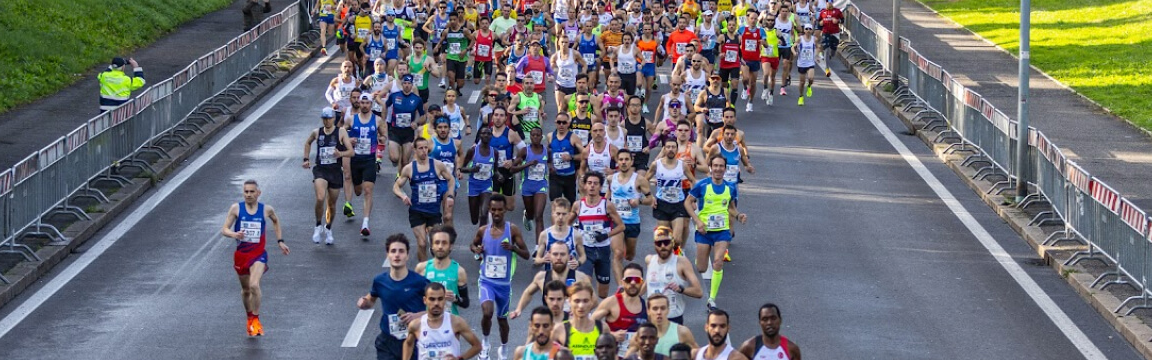
The Eurospin RomaOstia Half Marathon 2027 takes place on Sunday, February 28, 2027: meeting at 7:30, wave starts from 9:00 on Via Cristoforo Colombo, in front of Palazzo dello Sport in EUR (metro B, stops EUR Palasport and EUR Fermi), with the finish in Ostia at Piazzale Cristoforo Colombo, the Rotonda on the seafront, after 21.097 kilometers. For the return from the finish there is the Cristoforo Colombo station of the Roma Lido railway, about 200 meters from the finish line. Registration is online from the race's official website, which publishes fees, deadlines and rules. Bib pickup takes place at the Casa RomaOstia village.
It's the best-attended half marathon in Italy and one of the longest-running road races in the country: born in 1974, in 2027 it reaches its 52nd edition according to the official rules. From EUR to the Tyrrhenian, along the Colombo, with a climb that every Roman who runs knows by name. In our view, for runners it's one of the few races in which you literally cross Rome from the city to the sea, and it's worth the trip even from out of town.
The RomaOstia Half Marathon 2027: date, times, distance
The RomaOstia Half Marathon 2027 is held on Sunday, February 28, 2027, with the meeting at 7:30 and wave starts from 9:00, over a distance of 21.097 kilometers. It is included in the World Athletics international calendar and in the national FIDAL calendar.
Who organizes it
The race is called and organized by the Gruppo Sportivo Bancari Romani, under the aegis of World Athletics and FIDAL, with the patronage of Roma Capitale and the Lazio Region. Since 2018, from the 44th edition, RCS Sport has been an organizational partner of the historic organizers, with communication, marketing and sponsorship expertise. Eurospin is the sponsor that gives the edition its name.
Registration until February 15
The rules of the 2027 edition set the closing of online registration at February 15, 2027, two weeks before the race. Anyone planning to run from outside Rome would do well to register early, also because fees rise as the date approaches.
The time limit
The maximum race time is 3 hours and 30 minutes, with two time gates: anyone who doesn't pass the 10th kilometer within 1 hour and 40 minutes is stopped, and a second check is planned at the 15th. It's a generous limit for a half marathon, which allows even those who run at an easy pace to take part.
The RomaOstia course: from EUR to the sea
The RomaOstia course starts on Via Cristoforo Colombo, against the direction of traffic, in front of Palazzo dello Sport at the level of Viale dell'Umanesimo, makes a loop of about four kilometers inside EUR and then goes down the Colombo to the Ostia seafront. The organization states that the route is the same as in recent editions.
The start, kilometer zero
Until the 2010 edition the start was in the direction of the sea. Today the first kilometers are run instead inside the EUR district, which the organization describes as flat, with wide streets and smooth asphalt. It's a start designed to spread out the pack before the long straight.
Kilometers 0 to 4: the EUR loop
You cross the bridge over Laghetto dell'EUR, after less than a kilometer you turn left onto Viale Europa, at 1,500 meters you cross Viale Tupini. Then Largo Kemal Atatürk, Viale dell'Umanesimo again, Via del Ciclismo, Via della Tecnica, Largo Atatürk again, Via dei Primati Sportivi and the long Viale dell'Oceano Pacifico, until you cross the Colombo again past the fourth kilometer. The curves are wide and don't break the rhythm.
From 4 to 10: the Colombo toward the sea
From here you run toward Ostia on Via Cristoforo Colombo. A slight slope accompanies the runners toward the junction for Via Pontina and then under the bridge of the Grande Raccordo Anulare. For the rest the road flows fast.
From 10 to 14: the Camping climb
It's the stretch everyone fears. The first part, about a kilometer and a half, is the hardest, with a grade that doesn't exceed three degrees. For another 1,400 meters the climb softens until the Acilia junction, where it ends. Anyone who managed the first 10 kilometers well gets over it unscathed, anyone who started too fast pays for it here.
From 14 to 17: the descent
Past the climb begins the fastest stretch of the race: a descent of about two and a half kilometers that gives back the breath spent. If the legs respond, here you gain time.
From 17 to the finish
The descent becomes gentler, with very slight changes in grade. You begin to smell the sea, and you can push until the finish at Piazzale Cristoforo Colombo, facing the Tyrrhenian.
Wave start, grids and timing
The RomaOstia start is organized in waves, and each wave is divided into grids according to the time declared at registration, which the organization checks. Access to the grids of the second and third wave is allowed only after the start of the previous wave, at the time indicated on the information sheet.
Real time
The final ranking is drawn up on real time, the actual time taken from the start line to the finish line, except for elite athletes. Starting at the back of the grid, therefore, doesn't penalize your personal result.
Intermediate splits
Partial timing is planned at the 5th, 10th and 15th kilometer. They are useful for those following a runner from home and for those who, after the race, want to understand where they lost or gained.
The best declared time
Entering or changing your best time, which determines the grid, can be done until 23:59 on February 15, 2027, by writing to the address indicated in the rules. After that date the grid is the one assigned.
RomaOstia 2027 registration: requirements and rules
Italian and foreign athletes who are registered members or hold a Runcard can sign up for the RomaOstia Half Marathon 2027, with the requirements set by the official rules. Registration is open on the race website, under Iscrizioni 2027.
FIDAL members
Athletes registered for 2027 with FIDAL-affiliated clubs in the Juniores, Promesse, Seniores and Master categories, men and women, can take part. The organization also offers participants a FIDAL membership at €35.
FIDAL and EPS Runcard
Athletes holding a FIDAL Runcard or EPS Runcard born on or after January 1, 2007 can take part. In this case a medical certificate of competitive fitness specific to track and field, issued by a doctor in Italy and valid on February 28, 2027, is always required.
Paralympic athletes
The rules admit athletes registered for 2027 with clubs affiliated to the Paralympic federations recognized by the Italian Paralympic Committee, including FISPES and FISDIR, with the conditions indicated in the rules themselves.
Fees and payment
Registration fees are published on the official website and rise as the race approaches. The rules specify that the fee in force at the time of payment applies, not that of pre-registration, and that a pre-registration must be paid within 48 hours, otherwise it lapses.
The race pack
Those who have paid the fee are entitled to the participant kit, made up of the race shirt, gymbag and bag-drop sack, plus any other materials.
The Casa RomaOstia village and bib pickup
Pickup of bibs and race packs for RomaOstia takes place at the Casa RomaOstia village, in the days before the race. Hours and address for the 2027 edition are communicated by the organization in the weeks before the race.
Who needs to sort things out
FIDAL members with an irregular status must fix it on the federation portal before pickup. Runcard holders must upload the medical certificate to the organizers' portal or bring the original to pickup.
Pickup for clubs
Clubs that want to pick up bibs for more than five athletes follow a dedicated procedure, described in the rules. For a sports group coming from outside Rome it's best to organize ahead.
A curiosity about Eurospin RomaOstia Half Marathon 2027 from EUR to Ostia, February 28, 2027
Two of the fastest times ever run by Italian women over the half marathon were run at RomaOstia, and neither counts as a record. In 2012 Anna Incerti, European marathon champion in Barcelona in 2010, finished fifth in 1h08'18", a time better than the Italian record of the time. In the same race Valeria Straneo, later world marathon silver medalist in Moscow in 2013, finished fourth in 1h07'46".
The reason is technical. RomaOstia is a point-to-point race: it starts in one place and finishes in another, without turning back. For races of this type the rules on ratifying records are restrictive, and so those times, though better than the Italian record of the time, never entered the official lists.
The course, though not flat, is considered very fast. Many amateurs here have run their personal best. And the times of the elite remain impressive: in 2022 the Kenyan Sabastian Sawe won in 58'02", the second-fastest time in the world that year, and in 2026 Michael Kiplangat Temoi lowered the race record to 58'00".
The history of RomaOstia since 1974
RomaOstia was born on March 31, 1974, over a distance of 28 kilometers, with 313 athletes classified overall and 212 bank employees. For the first five editions it was the Italian interbank half-marathon championship, and that is why a sports group of bank employees still organizes it today.
From 28 kilometers to the half marathon
The first editions were run over distances different from the current one, with winning times around an hour and a half. From 1987 the times steadily fall to around an hour and two minutes: it's the sign of the shift to the classic half marathon distance, 21.0975 kilometers.
The skipped editions
The race wasn't held in 1982, 1999 and 2020, the last time because of the Covid pandemic. For the rest it has been run every year, usually between late February and March.
The president and the book
Luciano Duchi, president of RomaOstia since the very first edition, told 30 years of the race in the book Una corsa una vita: results, records, figures of Roman track and field, seen by the person who invented that race.
One thing nobody tells you about Eurospin RomaOstia Half Marathon 2027 from EUR to Ostia, February 28, 2027
The real last kilometer of RomaOstia isn't the one that leads to the finish: it's the train ride back. The organization itself presents it as the final experience of the race. About 200 meters from the finish is the Cristoforo Colombo station of the Roma Lido railway, with trains every 15 minutes, and thousands of runners with the medal around their neck and the windbreaker from the refreshment area fill the cars toward Rome.
The practical advice almost nobody gives is to choose your stop carefully. Anyone who left the car or hotel near the start doesn't have to ride to the end of the line: the organization suggests getting off at Magliana and taking metro B there, which goes directly to EUR.
The second thing few people mention concerns the bag drop. The trucks are located shortly after the refreshment area, and the truck number and bag color are printed on the bib. Look at them before the start, not after 21 kilometers, when even reading a number becomes tiring. It seems a detail. At 11:00 in the morning, with 10,000 people around, it isn't.
Third: the alternative to the train is staying in Ostia for lunch. The organization itself suggests a seafood lunch by the sea. After a half marathon it's a reward that makes sense.
The advice I give you for visiting Eurospin RomaOstia Half Marathon 2027 from EUR to Ostia, February 28, 2027
For runners, the advice is to respect the Camping climb. Between the 10th and 14th kilometer the Colombo climbs for almost three kilometers, and the first part, a kilometer and a half, is the most severe. Anyone who gets there after following the enthusiasm of the start, with the gentle descent toward the Raccordo inviting you to speed up, loses in the climb everything they gained before. Start steady, pass the Acilia junction with energy left and use the descent between the 14th and 17th kilometer to recover.
Second point: plan the morning backward. Meeting at 7:30, wave starts from 9:00, with access to later grids only after the previous wave has started. If you're in one of the last waves you'll start later, but you'll still have to drop off your bag and reach the grid on time. Check the Sunday opening time of metro B before counting on it.
Third, for those accompanying a runner: don't chase them along the course. The Colombo is a wide, fast road, with few crossing points. Say goodbye at the start, then take the Roma Lido railway toward Ostia and wait at the finish. You'll arrive before them, and you'll have time to find a good spot facing the Tyrrhenian.
Last: February by the sea can be cold and windy. Keep a dry garment in the bag-drop sack. After the finish the body cools in a few minutes.
The start in EUR, in front of Palazzo dello Sport
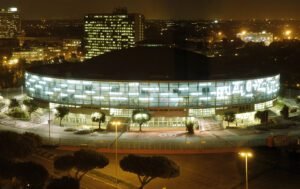
RomaOstia starts from Via Cristoforo Colombo in front of Palazzo dello Sport, the great dome designed by Pier Luigi Nervi with Marcello Piacentini for the 1960 Rome Olympics, which many Romans still call PalaEUR.
The EUR district
EUR was born for the Universal Exposition planned for 1942, which never took place. What remains are the great axes, the monumental squares, the travertine buildings like Palazzo della Civiltà Italiana, and an urban plan of wide avenues that today turns out to be perfect for a mass start. For a visit of the district there is our guide to EUR, what to see.
How to get to the start
Metro B stops at EUR Palasport, the station closest to the start, and at EUR Fermi. From Termini, line B arrives without changes. On Sunday morning, with streets closed for the race, the metro is the only real choice.
The lake
The first kilometer crosses the bridge over Laghetto dell'EUR, the artificial body of water between Palazzo dello Sport and the rest of the district. It's the most photogenic point of the start, and the first where the pack stretches out.
The finish in Ostia, at Piazzale Cristoforo Colombo
The RomaOstia finish is at Piazzale Cristoforo Colombo, on the Ostia seafront, facing the sea. After the finish line you walk toward the seafront to receive your medal. Farther on are the photo panel for souvenir pictures and the refreshment area, where you receive a bag with the windbreaker.
Ostia, the city by the sea
Ostia Lido was born from the land reclamation of the late 19th century, when laborers from Ravenna came to drain the marshes at the mouth of the Tiber. The railway arrived in 1924, Via del Mare in 1927. The Pontile dates from 1940. The official name of Lido di Ostia dates to 1949. The race retraces, deep down, the 20th-century dream of a Rome that reached all the way to the sea.
After the race
Anyone who stays in Ostia has a day at the seaside out of season ahead. South of the finish begins Pineta di Castel Fusano, farther on the dunes of Capocotta beach. A few kilometers inland, the excavations of Ostia Antica, the port of imperial Rome.
Another well-known fact, and yet rarely mentioned
Every Roman runner knows that RomaOstia is a heavily attended race. Less often cited is the precise figure: in 2015 the race exceeded 12,000 registrants and 11,000 finishers, a record that makes it the most attended race of all by Italian athletes, marathons included.
The second fact, known to enthusiasts and ignored by the general public, concerns Italians. Since 2001, when Giuliano Battocletti won, no Italian man has won RomaOstia again. Since 2011, after Anna Incerti's second win, no Italian woman. For 20 years the podium has belonged to Kenyans and Ethiopians, with a few illustrious exceptions like the American Galen Rupp in 2018. The race has become international, and times have dropped accordingly: under the hour, for men, almost every year since 2011.
The third concerns the origin. RomaOstia was born from a sports group of bank employees, and for the first five editions it was the interbank championship. The fact that one of the biggest races in Europe is still organized by that group, with a professional partner at its side, tells well how grassroots sport works in Italy: associations of enthusiasts who, over time, build something enormous.
The right photo to take at Eurospin RomaOstia Half Marathon 2027 from EUR to Ostia, February 28, 2027
For runners, the right photo is the one you can't take by yourself: the finish with the sea behind you. After the finish line, on the seafront, the organization sets up a panel for souvenir photos, but the best shot is another one. Have yourself photographed by whoever is with you, with the medal around your neck and the Tyrrhenian behind, at Piazzale Cristoforo Colombo. It's the only half marathon in Italy that ends like this, and the image says it without needing a caption.
For those accompanying, the photo of the start is in EUR. From the side of the lake, with the dome of Palazzo dello Sport in the background and the tide of runners turning onto the Colombo, you get the image that conveys the size of the race. With thousands of people in motion you need a fast shutter speed and an elevated position: the steps around Palazzo dello Sport are the ideal spot, if accessible.
Anyone who wants an artistic photo can wait along the Colombo in the stretch of the Camping climb, between the 10th and 14th kilometer. There the faces say it all: it's the moment when the race is decided, and runners no longer feel like smiling at the lens. A real photo, not a souvenir photo.
A tip for runners: don't stop to take photos during the race. RomaOstia is a fast, crowded race, and anyone who slows suddenly in the middle of the pack creates problems for the people behind.
A few important events that happened here in history
On March 31, 1974 the first RomaOstia was run, over 28 kilometers. Umberto Risi won in 1h28'54", among the women Manuela Mausoli. Risi won again in 1978, and the following year the reign of Marco Marchei began, winner in 1979 and 1980. Those were the years when road running became a mass sport, and the Colombo lent itself perfectly: a wide, straight road leading from Rome to the sea.
In 1985 Steve Jones won, the first foreign winner, then the world marathon record holder. In 1997 Stefano Baldini won in 1h00'56", then an Italian record, and returned to the podium in 2003 and 2004, third. Six months after the 2004 edition he won the Olympic marathon in Athens. In 2002 the Kenyan Robert Kipkoech Cheruiyot won, four-time winner of the Boston marathon.
In 2005 Rosaria Console won in 1h09'34", a time that for many months was the best in the world over the half marathon. In 2011 the first men's time under the hour, Tujuba Beyu Mergesa in 59'58". In 2015 the participation record. In 2020 the race was skipped because of the pandemic.
On March 6, 2022 Sabastian Sawe won in 58'02", and the Kenyan Irene Kimais set the women's race record in 1h06'03". In 2026, at the 51st edition, Michael Kiplangat Temoi took the men's record to 58'00". Every record change, at RomaOstia, also tells how world athletics has changed in half a century.
Who has passed through Eurospin RomaOstia Half Marathon 2027 from EUR to Ostia, February 28, 2027
Along the Colombo have passed Olympic champions, world record holders and winners of the great marathons. The most famous of the Italians is Stefano Baldini, winner in 1997 and Olympic marathon gold in Athens 2004. Among the foreigners, Steve Jones in 1985, then the world marathon record holder, and the American Galen Rupp, winner in 2018. Robert Kipkoech Cheruiyot, winner in 2002, won the Boston marathon four times. Paul Kirui, first in 2004, later became half marathon world champion in New Delhi.
The women's history of the race is full of Italian names. Gloria Marconi won in 2002 and 2003, with 1h09'25". Rosaria Console, of the Fiamme Gialle, has a unique record: first in 2005, second in 2003, 2006 and 2010, third in 2004, fourth in 2009. Anna Incerti, European marathon champion in 2010, won in 2009 and 2011. Valeria Straneo, world marathon silver medalist in 2013, ran here one of the fastest times ever achieved by an Italian woman. Nadia Ejjafini won in 2006, when she was still competing for Bahrain, before becoming Italian.
In recent years the race has become the terrain of Kenyans and Ethiopians: Guye Adola, winner in 2017 and 2019, Florence Kiplagat in 2012, Gladys Cherono in 2017, Sabastian Sawe in 2022. But RomaOstia, as the organizers say, lives above all on amateurs. They, by the thousands, are the real list of who passed through here: office workers, retirees, students who on a late-winter Sunday ran from Rome to the sea. On February 28, 2027 the new ones will join them.
RomaOstia for those who don't run: where to watch it
For those accompanying a runner or who simply want to see the race, the best spots at RomaOstia are three: the start in EUR, the Camping climb on the Colombo and the finish on the Ostia seafront.
In EUR
The start is the biggest spectacle: thousands of people in the grid, the waves leaving one after the other. With metro B you reach EUR Palasport. Then, after the start, you take the metro to Magliana and from there the Roma Lido railway toward Ostia.
At the finish
The finish at Piazzale Cristoforo Colombo is reached by the Roma Lido railway, Cristoforo Colombo station. The seafront offers space to wait and a bar to warm up.
The closed streets
On the Sunday morning of the race the Colombo and the streets of the course are closed to traffic. Anyone who isn't running and has to move around the southern quadrant of Rome would do well to use the metro and train or to check the traffic measures published by Roma Capitale in the preceding days.
Where to sleep and eat for RomaOstia
For those coming from out of town, the most convenient solution for RomaOstia is to sleep in EUR or along metro B, so you can reach the start on foot or in a few stops. The organization lists packages agreed with accommodations in the district on the official website.
The night before
In EUR there are restaurants, pizzerias and neighborhood trattorias, especially around Viale Europa and the main squares. The dinner the night before is the time for a simple plate of pasta: no experimenting, no fried food, no late dinners.
After the race
In Ostia a seafood lunch on the seafront is the natural reward. Along the coast there are plenty of restaurants and beach clubs open in winter too. On race Sunday it's best to book, because thousands of runners and companions will have the same idea.
Late February in Rome: running in winter
Late February is a good time to run in Rome: morning temperatures are low but rarely harsh, and by the sea the air is milder than in the city. Wind on the coast, though, can change the race.
A season of races
RomaOstia opens the spring of the big Roman races. Two weeks later, on Sunday, March 14, 2027, there is the Rome Marathon. In the fall the Rome Half Marathon offers a half marathon in the historic center. Anyone preparing for the marathon often uses RomaOstia as a test over the distance.
The weekend in the city
The day before the race, Saturday, February 27, the Neri per Caso sing at Auditorium Parco della Musica, on the first date of their new tour. For those accompanying a runner it's an idea for the evening, for runners it's maybe better to go to bed early.
Frequently asked questions about RomaOstia 2027
When is RomaOstia 2027 run?
The Eurospin RomaOstia Half Marathon 2027 is run on Sunday, February 28, 2027. The official rules indicate the meeting at 7:30 and wave starts from 9:00, on Via Cristoforo Colombo in front of Palazzo dello Sport in EUR.
Where does RomaOstia start and finish?
RomaOstia starts in EUR, on Via Cristoforo Colombo in front of Palazzo dello Sport, at the level of Viale dell'Umanesimo, and finishes in Ostia at Piazzale Cristoforo Colombo, the Rotonda on the seafront. The distance is that of the half marathon, 21.097 kilometers.
How do you register for the RomaOstia Half Marathon?
You register for the RomaOstia Half Marathon online from the race's official website, under Iscrizioni 2027. You need FIDAL membership for 2027 or a FIDAL or EPS Runcard with a medical certificate for competitive track and field valid on race day.
How much does RomaOstia 2027 registration cost?
The RomaOstia 2027 registration fees are published on the official website and increase as the race approaches. The rules specify that the fee in force at the time of payment applies, and that pre-registrations must be paid within 48 hours.
What is the RomaOstia time limit?
The RomaOstia Half Marathon time limit is 3 hours and 30 minutes. The ranking is drawn up on real time, that is, net time from the start line to the finish line, except for elite athletes.
How do you get back to Rome after the finish in Ostia?
After the RomaOstia finish you return to Rome by the Roma Lido railway: Cristoforo Colombo station is about 200 meters from the finish line, with trains every 15 minutes. To get back to EUR it's best to get off at Magliana and take metro B.
Where do you pick up the RomaOstia bibs?
RomaOstia bibs and race packs are picked up at the Casa RomaOstia village in the days before the race. Hours and address are communicated by the organization. Runcard holders must present the medical certificate if they haven't uploaded it online.
What is the RomaOstia record?
The men's RomaOstia record is 58'00", set in 2026 by the Kenyan Michael Kiplangat Temoi. The women's record is 1h06'03", by the Kenyan Irene Kimais in 2022. Because of the rule on point-to-point races, these times don't count as official records over the distance.
Final advice on RomaOstia
The advice remains one: run your race, not that of the person running next to you. The Colombo downhill toward the Raccordo invites you to start fast, the Camping climb presents the bill, the final descent rewards those who are patient. And at the end there is the sea, which no other Italian half marathon can offer. Keep a dry sweatshirt in the bag, take the train with the others and treat yourself to lunch on the seafront: it's as much a part of the race as the clock.
Article written by the editorial team of Tour Leader Pro, contact them for Private/Corporate/V.I.P. Tours and Experiences.
Planning a trip to Rome? The English guides to visiting the city are on ItalyPlanner.com.
Contact Information
Nearby
 Palazzo dello Sport100 m
- Laghetto dell’Eur300 m
- EUR – Esposizione Universale Roma600 m
- Historical Museum of Communication600 m
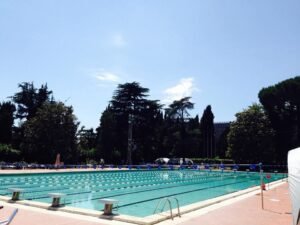
- Piscina delle Rose700 m
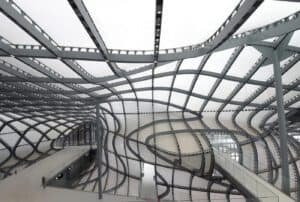
- Fuksas Cloud – New Convention Center800 m
Upcoming events nearby
- Il Volo at Palazzo dello Sport in Rome, December 17, 2026100 m
- Notre Dame de Paris at Palazzo dello Sport in Rome, December 26, 2026 to January 10, 2027100 m
- Sfera Ebbasta at Palazzo dello Sport in Rome, February 2 and 3, March 5, 2027100 m
- Antonello Venditti at Palazzo dello Sport in Rome, March 8, 2027100 m



You might also like
- Più libri più liberi 2026 at Nuvola in EUR, December 4 to 8, 2026
- Zero Assoluto at Palazzo dello Sport in Rome, May 21, 2027
- Tedua at Palazzo dello Sport in Rome, January 28, 2027
- MadMan, MM Anthology Live Tour at Atlantico, January 27, 2027
- Roma Arte in Nuvola 2026 at the Nuvola in EUR, November 20 to 22, 2026
- Elodie at Palazzo dello Sport in Rome, April 29 and 30, 2027