Published on · updated on
On February 23 the Romans celebrated the Terminalia, the festival of the god Terminus, protector of boundaries. It was the last ritual day of the year in the oldest calendar, and the moment when neighboring landowners gathered at the boundary stone for a shared sacrifice.
- Date: February 23
- Deity: Terminus, god of the termini (boundary stones)
- Symbolic place: the Capitoline Hill, in the Temple of Jupiter Optimus Maximus
- Main source: Ovid, Fasti II, lines 639-684
Who Terminus Was
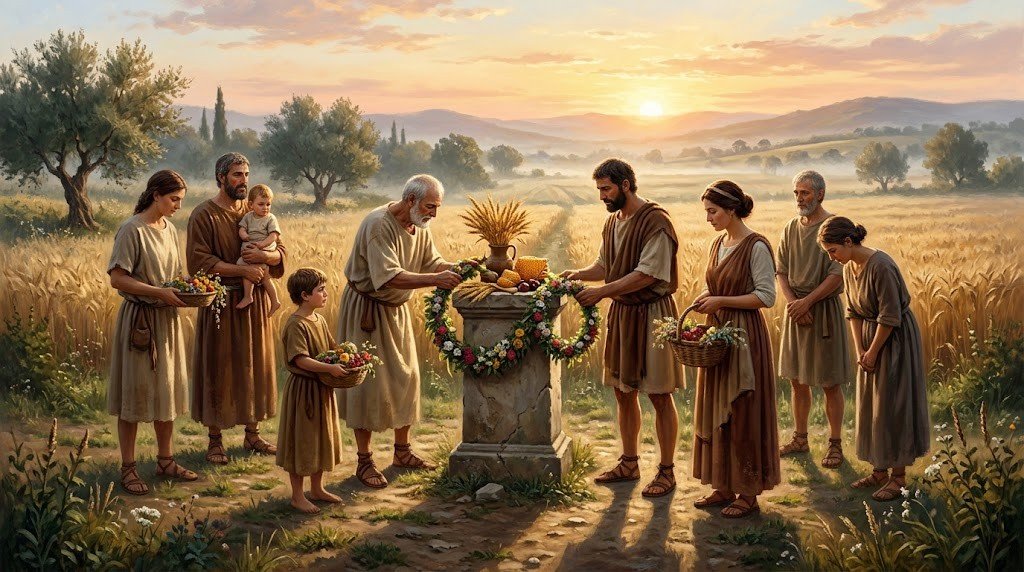
Terminus was the god of the stone that separates one field from another. For the Romans a boundary was not just a legal line: it was a sacred object, and moving it was sacrilege. A tradition attributed to King Numa, reported by Dionysius of Halicarnassus, says that anyone who removed a boundary marker could be consecrated to the gods and killed with impunity. Read it as tradition, not as documented law.
The Neighbors’ Rite
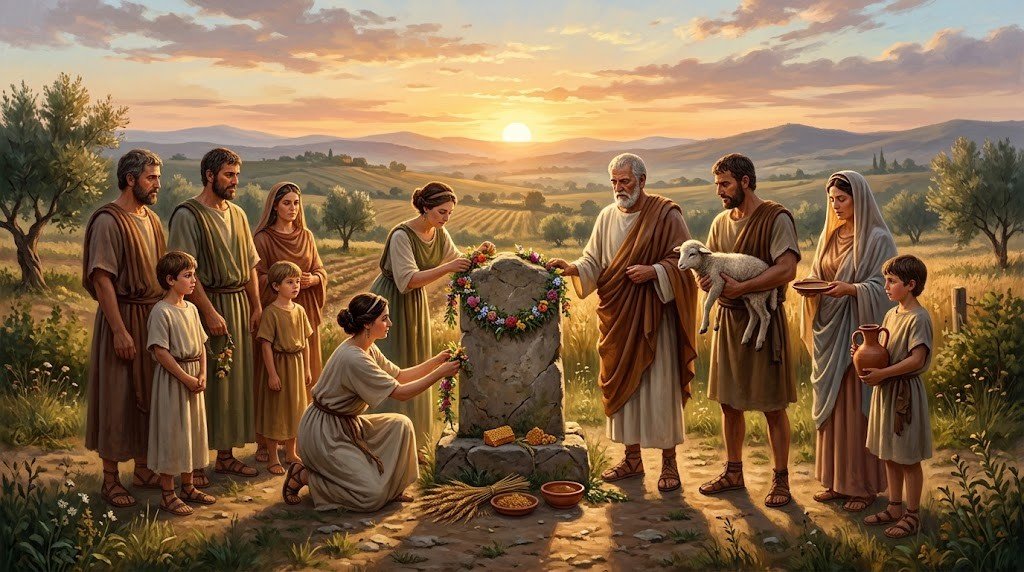
Ovid describes a simple, popular ceremony: each family crowned its own boundary stone with garlands, built an altar, burned grain, honeycombs and wine on it, and sacrificed a lamb or a piglet. The two neighboring landowners sacrificed together on the same stone, each from his own side, and then feasted. It was a rite that also helped people remember where the line ran.
The Stone on the Capitoline
Livy tells us that when the Temple of Jupiter on the Capitoline was being prepared, all the altars of the lesser gods were removed with the consent of the auspices, except the one of Terminus, which would not be moved. For this reason, according to tradition, a sacred stone remained in the cella of the temple beneath an opening in the roof: Terminus had to be worshipped under the open sky. The Romans took it as an omen of stability for their rule. On the hill you can find our page on the Capitoline Hill.
A Public Sacrifice on Via Laurentina
Ovid also recalls a public sacrifice at the sixth milestone of Via Laurentina, where in his account the ancient boundary of Roman territory ran: a moment when the festival of private boundaries merged with that of the boundary of the State.
Why February 23
In the ancient calendar February was the last month, and the Terminalia closed its cycle. For this reason Varro and other authors link the festival to the end of the year. In years when an extra month was intercalated, tradition says it was inserted after February 23 or 24.
Frequently Asked Questions
When was the Terminalia celebrated?
On February 23, in honor of the god Terminus, protector of boundaries.
What was offered to Terminus?
Grain, honeycombs and wine burned on an altar, then a lamb or a piglet, according to Ovid’s description.
Why did the Temple of Jupiter have an opening in the roof?
According to Livy’s tradition, the stone of Terminus could not be covered: the god had to be worshipped under the open sky.
This festival is part of the calendar of ancient Roman festivals and the mos maiorum, where you can find all the other observances.
Sources
- Ovid, Fasti II 639-684
- Livy, Ab Urbe condita I 55
- Dionysius of Halicarnassus, Roman Antiquities II 74
- Varro, De lingua latina VI 13
The illustrations are generated with artificial intelligence for evocative purposes.