Published on · updated on
On December 11, the Romans celebrated the Septimontium, the festival of the “seven mountains.” It does not match the classical seven hills. It is a remnant of the oldest Rome, when the city was a federation of villages scattered across the heights.
- Date: December 11
- Who celebrated it: the montani, the people of the heights
- Meaning: a memory of the Rome of villages, before the Servian Walls
- Sources: Varro (De lingua latina VI 24), Festus, Plutarch (Roman Questions 69)
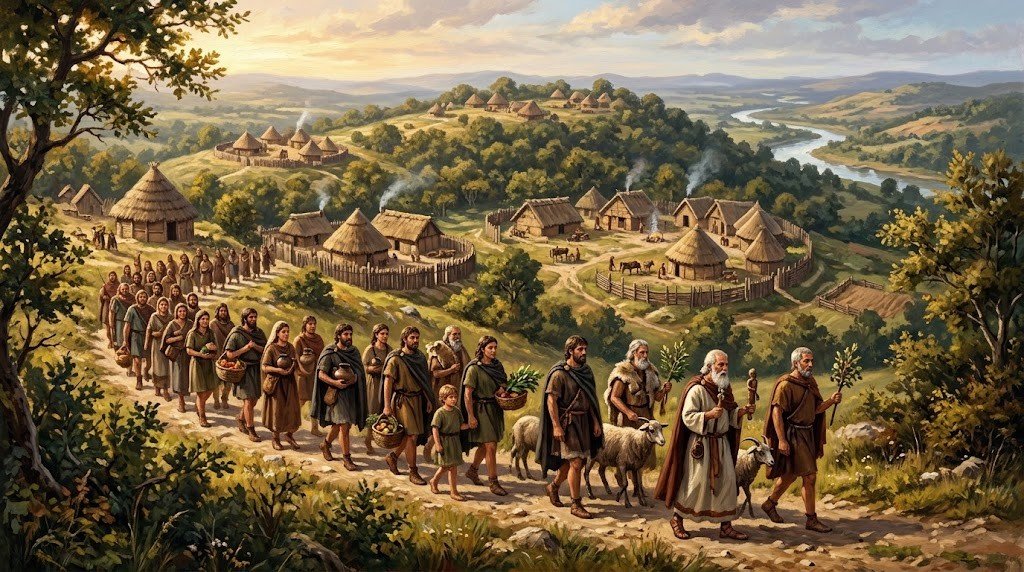
Seven Mountains, Not the Seven Hills
The canonical seven hills are the Palatine, Capitoline, Quirinal, Viminal, Esquiline, Caelian and Aventine. The Septimontium refers to a different list. Festus cites names such as Palatium, Velia, Fagutal, Cermalus, Oppius, Caelius and Cispius, but the ancient authors do not agree on every detail, and the exact list remains an open problem among scholars.
A Festival of Villages
Varro distinguishes the montani, the people of the mountains, from the pagani, the people of the villages on the plain. The Septimontium was the festival of the former, and it preserved the memory of an organization that came before the unified city. We have no accounts of the rite in its earliest days.

How It Was Celebrated
The sources are fragmentary. Plutarch notes that on that day the use of vehicles was avoided. Suetonius also records that the emperor Domitian gave senators and equestrians a banquet for the Septimontium.
The Palatine
The Palatine was the core of the oldest settlement. To learn more, visit our page on the Palatine.
Frequently Asked Questions
What is the Septimontium?
A Roman festival on December 11 that recalled the ancient “seven mountains” of the archaic city.
Are they the seven hills of Rome?
Not exactly: the ancient list of the montes differs from that of the classical seven hills.
Who took part?
The montani, meaning the people of the heights, according to Varro.
This festival is part of the calendar of ancient Roman festivals and the mos maiorum, where you can find all the other observances.
Sources
- Varro, De lingua latina VI 24
- Festus, De verborum significatu, entry “Septimontium”
- Plutarch, Roman Questions 69
- Suetonius, Life of Domitian 4
The illustrations are generated with artificial intelligence for evocative purposes.