Published on · updated on
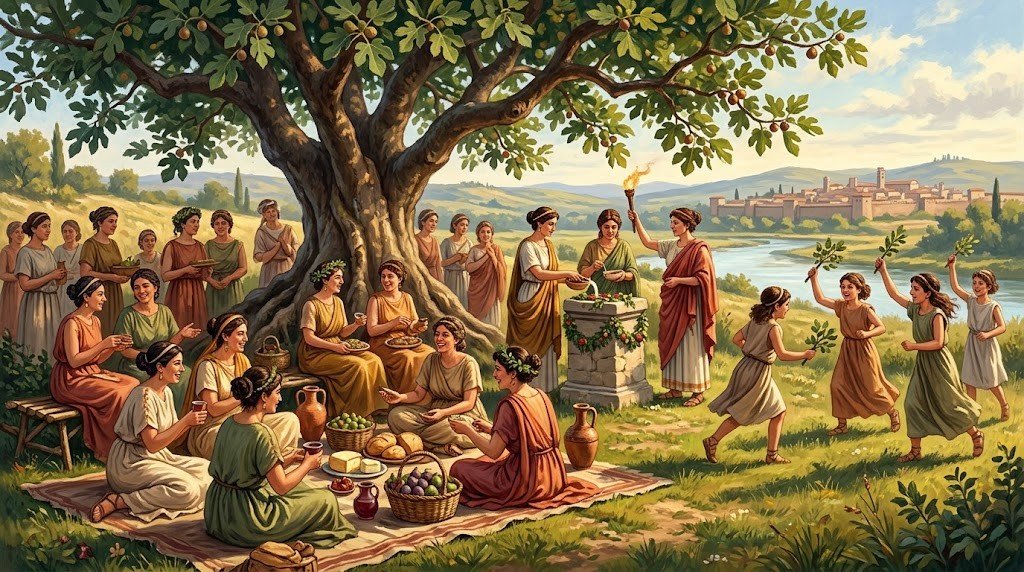
On July 7, the Nones, Roman women celebrated the Nonae Caprotinae, a festival of Juno Caprotina in which the maidservants played the leading part. The rite took place under a caprificus, the wild fig, and the sources tie it to two different legends.
- Date: July 7, on the Nones
- Deity: Juno Caprotina
- Symbol: the caprificus, the wild fig
- Sources: Plutarch, Romulus 29 and Camillus 33. Macrobius, Saturnalia I 11. Varro, De lingua latina VI 18
A rite for free women and maidservants
The matrons sacrificed to Juno Caprotina under a wild fig, and the maidservants joined the festival dressed as free women, staging a mock battle with stones and sticks. Macrobius is the main source on this point.
The legend of the siege
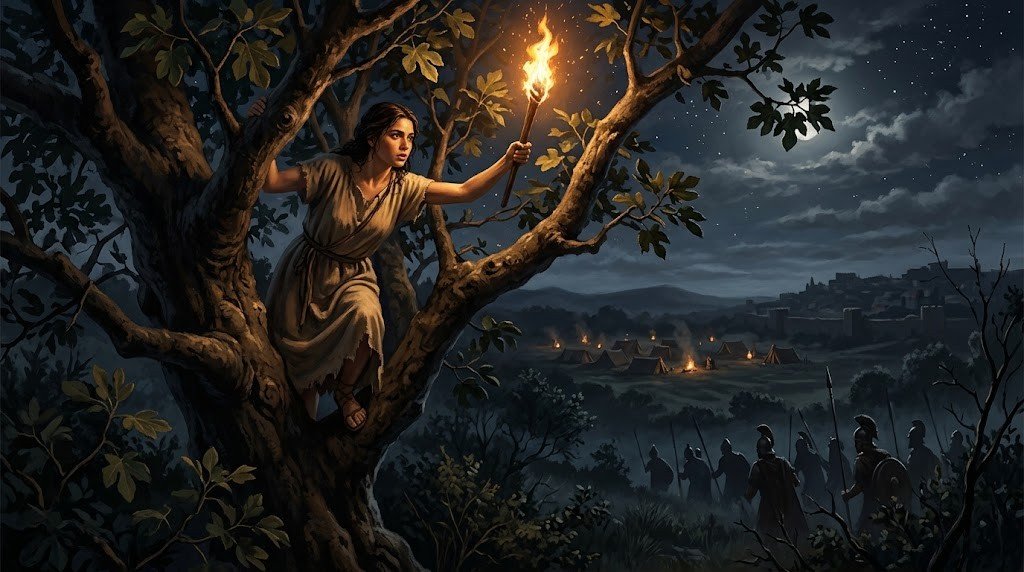
According to one tradition, after the siege by the Gauls the Latins demanded Roman wives and daughters. A maidservant named Tutula (or Philotis, depending on the author) led a group of enslaved women to the enemy camp, posing as a free woman, and at night she signaled to the Romans from the wild fig with a torch. As a reward the maidservants won their freedom and this festival.
The legend of Romulus
Plutarch gives a second version: the festival commemorates the disappearance of Romulus, which according to myth happened at the Goat Marsh, in the Campus Martius, during a thunderstorm. The name “Caprotina” would be tied to this very place. The fact that the sources give different explanations shows how uncertain the origin was even for the ancients.
The Campus Martius
The Goat Marsh lay in the Campus Martius, where the Pantheon stands today. To get your bearings, see the Pantheon page.
Frequently asked questions
What are the Nonae Caprotinae?
A July 7 festival dedicated to Juno Caprotina, with a special role for the maidservants.
Why the wild fig?
The tree appears in both legends: as the maidservant’s signal point and as the place where Romulus vanished.
Who was Tutula?
According to one tradition, the maidservant who led the Roman enslaved women into the Latin camp. The name varies across the sources.
This festival is part of the calendar of ancient Roman festivals and the mos maiorum, where you will find all the other observances.
Sources
- Plutarch, Life of Romulus 29
- Plutarch, Life of Camillus 33
- Macrobius, Saturnalia I 11
- Varro, De lingua latina VI 18
The illustrations are generated with artificial intelligence for evocative purposes.