Published on · updated on
On December 21, around the winter solstice, the Romans celebrated the Angeronalia, the festival of the goddess Angerona. It is one of the most mysterious observances in the calendar: the goddess was shown with her mouth closed, and the ancients linked her to the secret name of the city.
- Date: December 21 (Divalia, Angeronalia)
- Deity: Angerona, goddess of silence, alongside Volupia
- Rite: sacrifice by the pontiffs in the shrine of Volupia
- Sources: Varro, De lingua latina VI 23. Macrobius, Saturnalia I 10. Pliny, Naturalis historia III 65
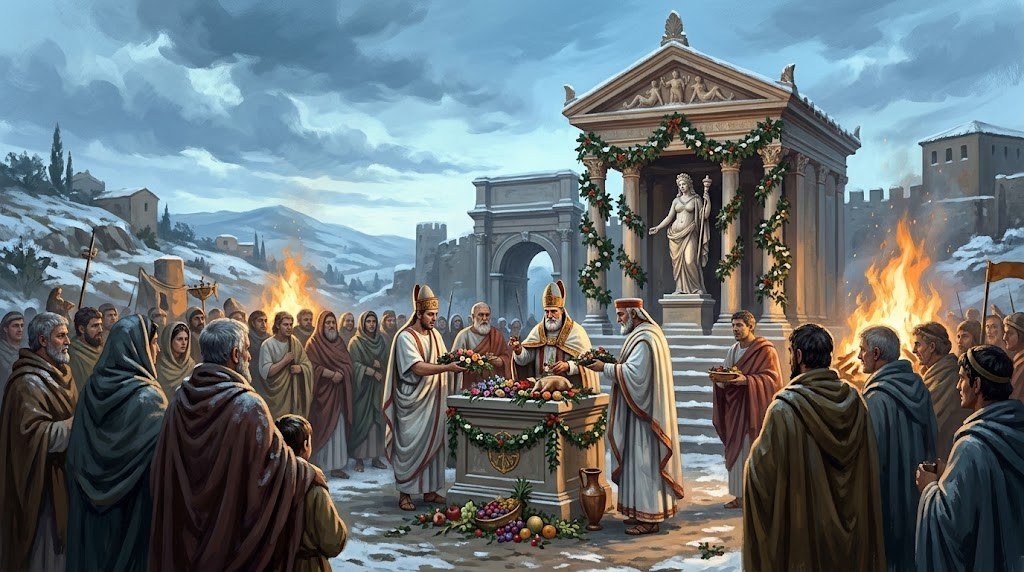
The Pontiffs’ Sacrifice
Varro and Macrobius record that on December 21 the pontiffs sacrificed in the shrine of Volupia, the goddess of pleasure. The sources disagree on the location: Macrobius places the shrine of Volupia near the Porta Romanula, an inner gate on the northern side of the Palatine, while Varro speaks of a sacrifice in the curia Acculeia. The exact location remains uncertain.
The Statue with the Sealed Mouth
Macrobius describes the statue of Angerona with her mouth bound and sealed, as if to enforce silence. Its meaning is still debated: the ancients tied it to a secret, while modern scholars propose a link to anguish (angor) or to the solstice.
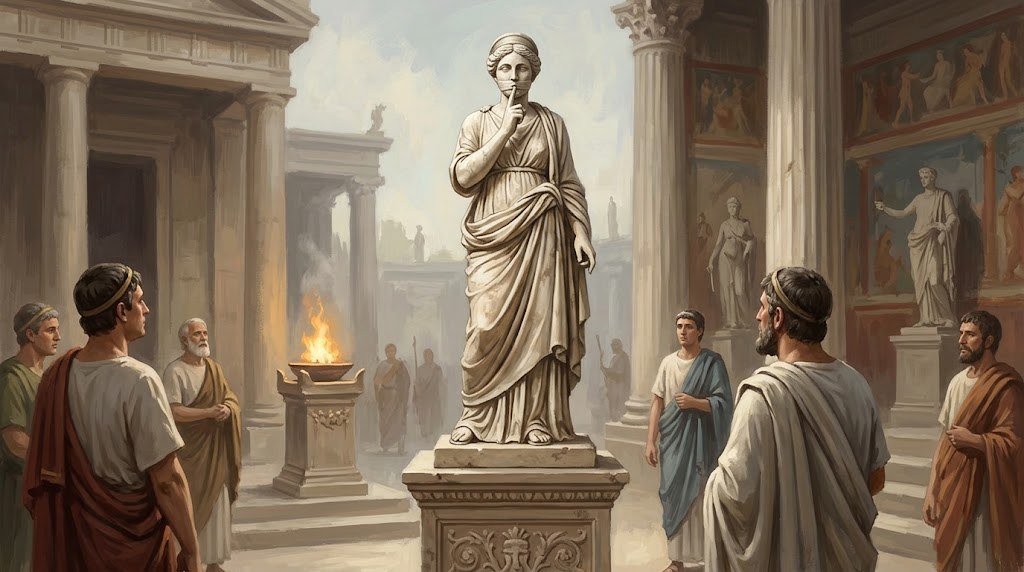
The Secret Name of Rome
Pliny the Elder reports that the secret name of Rome, tied to its protective deity, was never to be revealed, and that a certain Valerius Soranus supposedly died for doing so. The explicit link with Angerona comes from later authors such as Macrobius and Solinus. A late source, John Lydus, suggests the name was “Amor,” that is, Roma read backward. It is an ancient theory, not a fact.
The Palatine
To explore the area, see the Palatine page.
Frequently Asked Questions
Who was Angerona?
A Roman goddess of silence, shown with her mouth closed.
When were the Angeronalia celebrated?
On December 21, around the winter solstice.
What was the secret name of Rome?
We don’t know: the ancient sources only say that it was forbidden to speak it.
This festival is part of the calendar of ancient Roman festivals and the mos maiorum, where you can find all the other observances.
Sources
- Varro, De lingua latina VI 23
- Macrobius, Saturnalia I 10
- Pliny the Elder, Naturalis historia III 65
The illustrations are AI-generated for evocative purposes.